
Siem Reap on a Plate
“Are you running the marathon tomorrow?”
Risa, the kind young woman at the front desk of our Siem Reap hotel, is not being ironic.
Bama and I want to laugh. Our near-instantaneous answer, a polite “no,” dispels any notion that we will be needing a 3 a.m. wake-up call. By pure coincidence, the two of us have arrived the day before the Angkor Wat International Half-Marathon, and the French guests booked into the room next door are taking part. Depending on where we travel, itineraries sometimes involve hiking excursions, snorkeling, or even a bit of ocean kayaking. But running? The point of this holiday in Siem Reap was to explore the area’s incredible trove of ancient temples and to eat.
We discover a cosmopolitan mix of eateries within easy walking distance of our nine-room bolt-hole in the hip Wat Bo neighborhood: there are Japanese and Korean restaurants, a hole-in-the-wall serving up steaming bowls of Lao noodles, and a bona-fide French bakery whose decadent, béchamel-drenched ham-and-cheese croissants are the best I’ve ever had in Southeast Asia. One night, we try khinkali dumplings and cheese-filled khachapuri bread from Georgia (the Caucasus country, not the US state) at a place Bama finds entirely by accident on Google Maps.
But what we are most interested in is Khmer cuisine. Compared to neighboring Thailand and Vietnam, Cambodia’s culinary richness has received scant attention abroad. And that’s a shame. Luckily, Bama and I don’t have to look very far – right around the corner, in fact – to find authentic local fare. Pou Restaurant occupies the front garden of a B&B, where talented chef-owner Mengly Mork turns traditional home-cooked recipes into artfully plated dishes without toning down their original flavors. As for the name of the venue? It means “Uncle” in Khmer, even though Mengly looks far too young to be anyone’s uncle. Pou quickly becomes a go-to spot to fuel up on something hearty before our temple-hopping excursions: we frequent the place almost every day while in Siem Reap.
Early on the morning of the half-marathon, we step into a shaded dining area at Pou and settle down for breakfast. Bama orders num banh chok – described on the menu as lightly fermented rice noodles with “smashed fish curry”, cooked taro stem, and edible Sesbania grandiflora flowers. I choose white rice and braised duck breast in a sweet-spicy sauce, served with a teacup-sized bowl of clear broth. On one side of the table, several sauces and condiments come arranged in a boxy wooden tray; one jar contains fermented soybean paste, while another holds rust-red chili paste akin to Indonesian sambal. We spoon dollops of the latter onto our plates. It turns out to be addictive and devilishly spicy, even for a chili-lover like Bama.
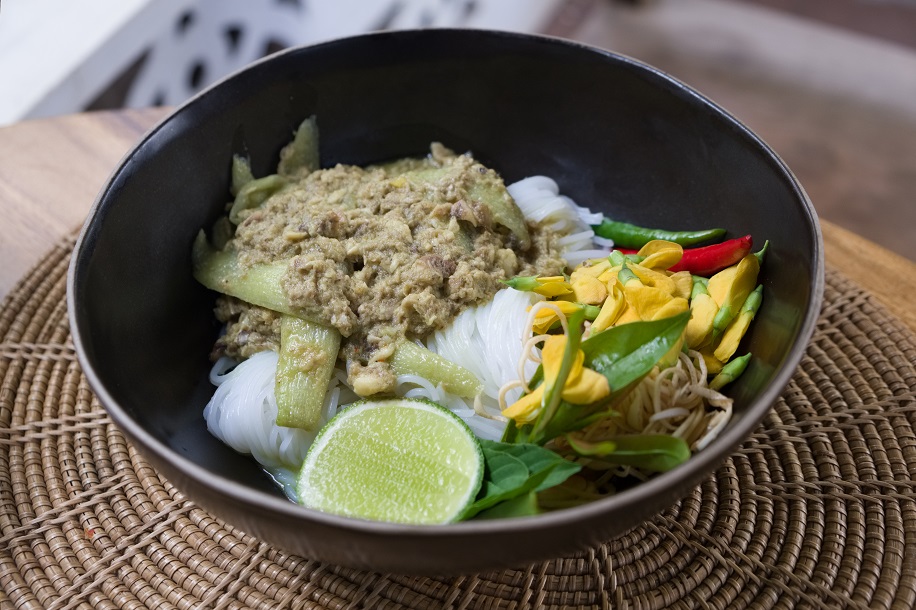
Num banh chok noodles with “smashed fish curry” at Pou Restaurant in the Wat Bo area
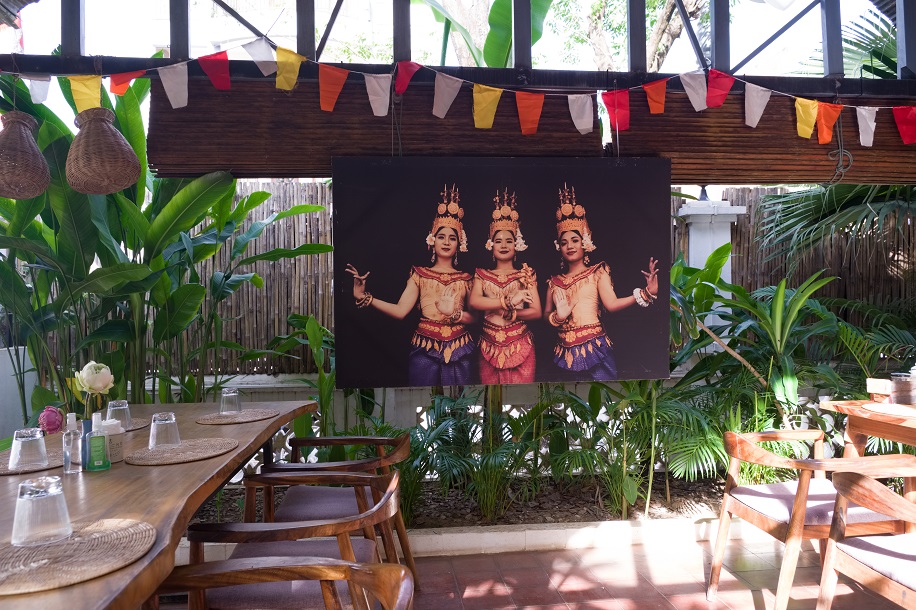
A photograph of Cambodian apsara dancers in a breezy seating area, also at Pou
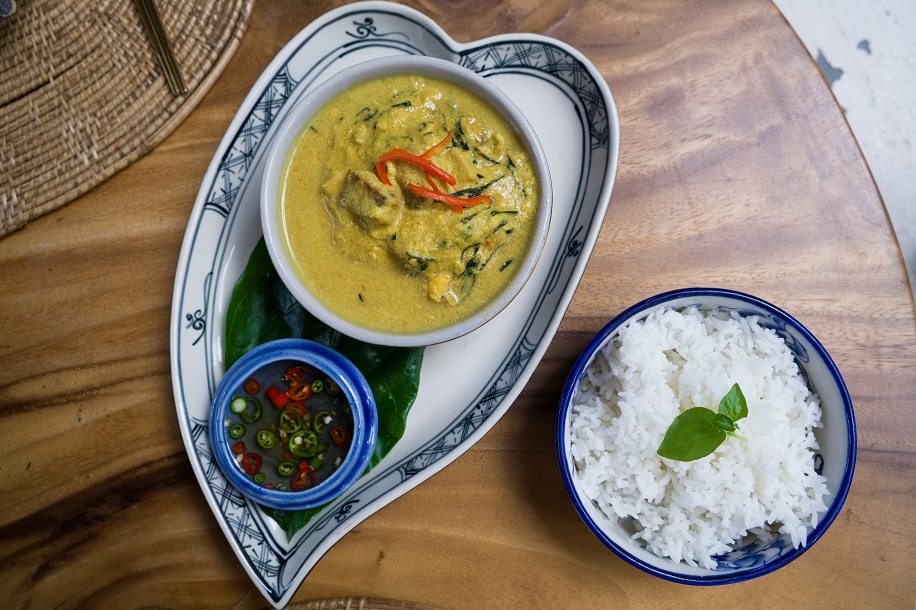
Chef Mengly Mork’s delicious fish amok, perhaps the most well-known Khmer dish abroad
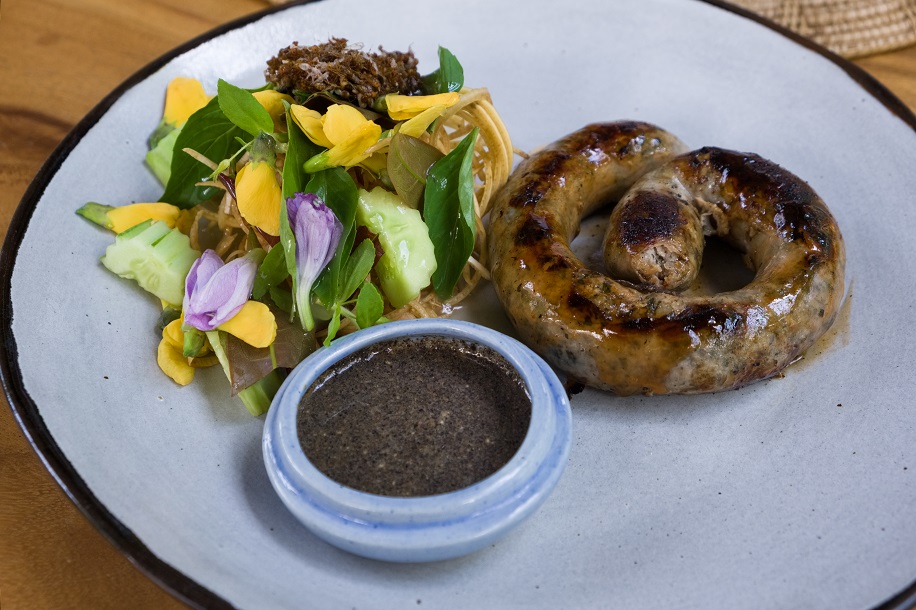
Homemade Kulen Mountain pork sausage with Kampot pepper sauce at Pou
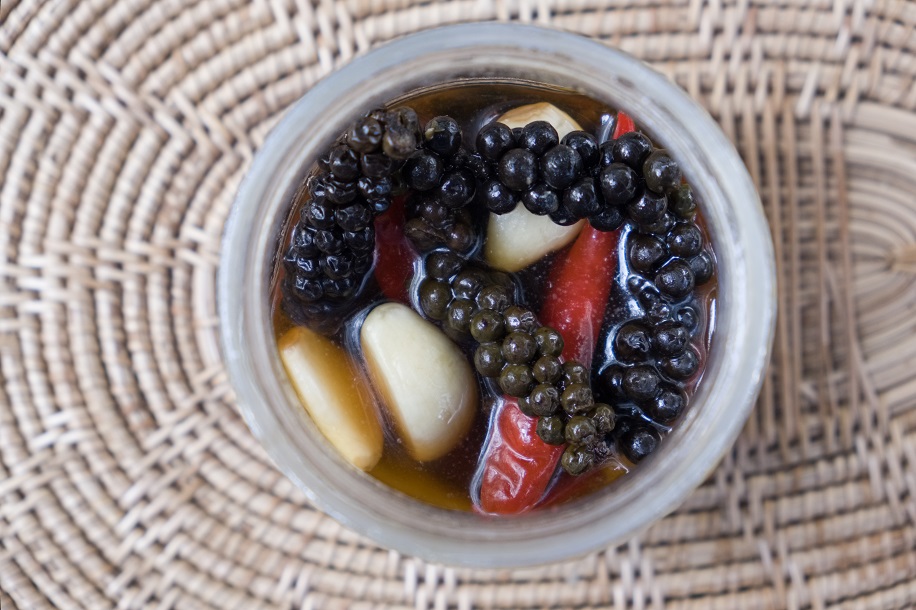
Cambodian pepper, garlic, and chili pickled in vinegar
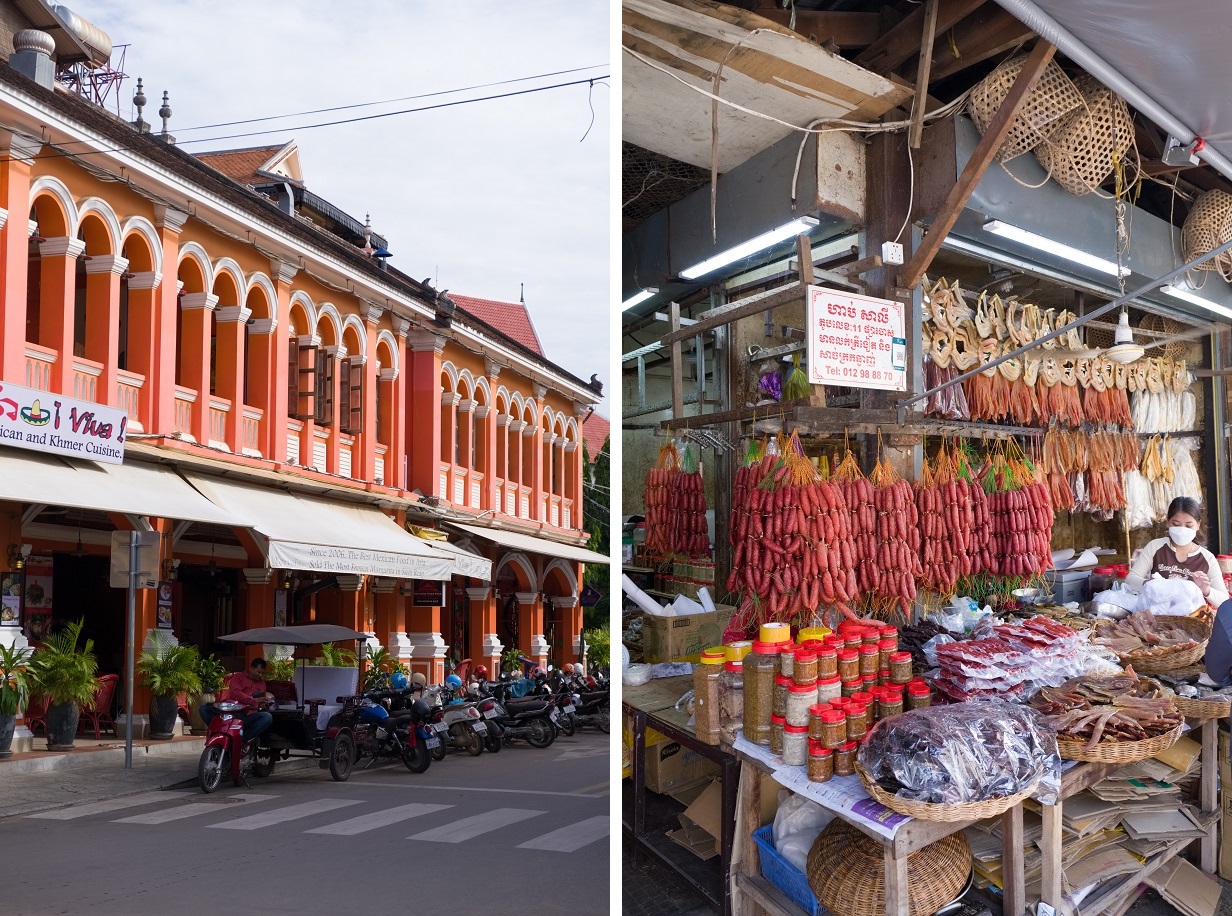
Pastel-hued shophouses in the heart of Siem Reap; sausages for sale at the Old Market
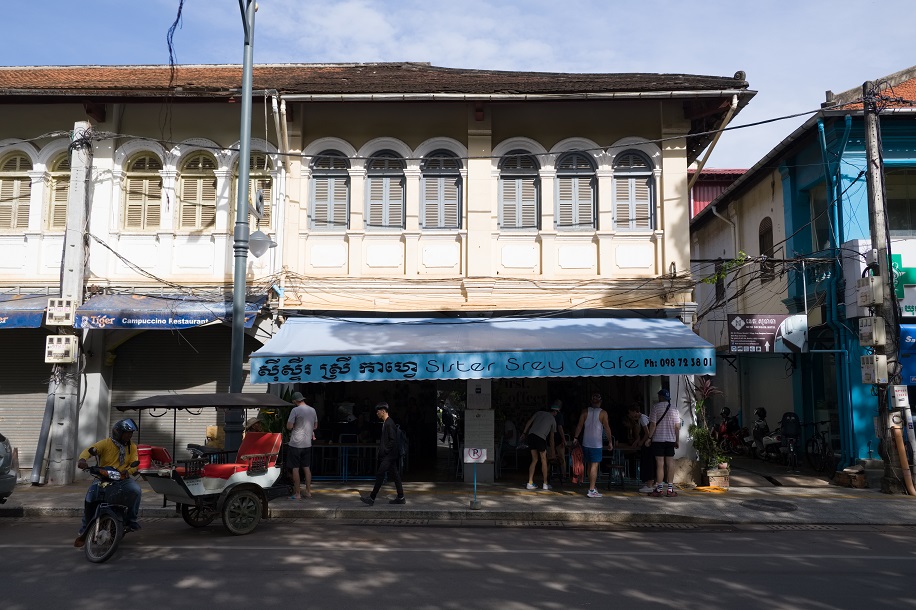
The façade of a downtown café popular with backpackers
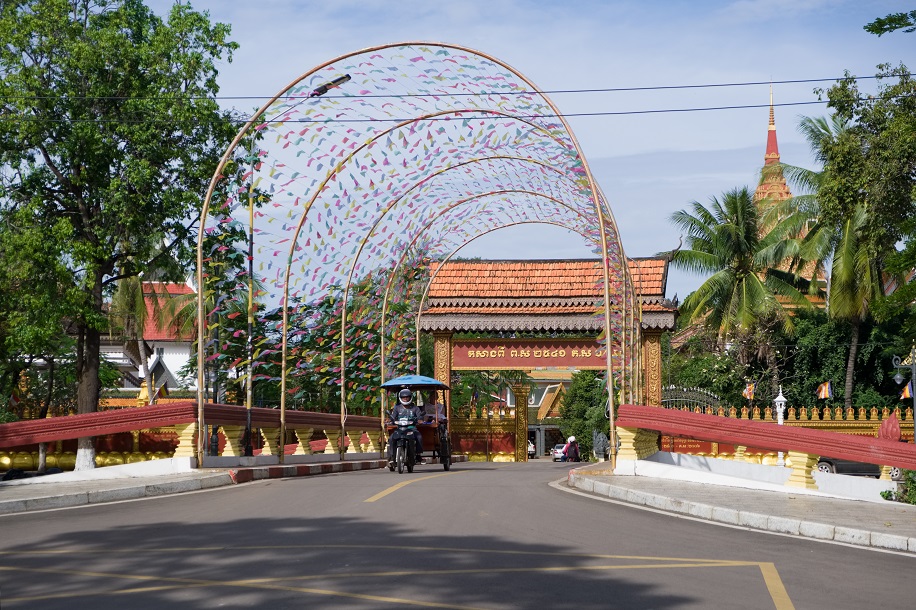
A remork crosses the bridge near the Buddhist temple Wat Preah Prom Rath
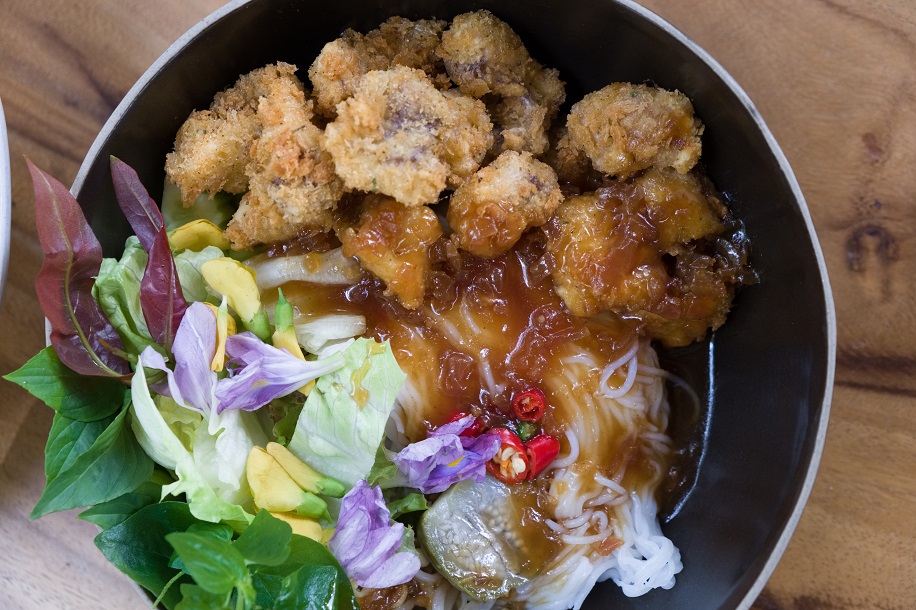
Fried redtail catfish pieces with num banh chok in tamarind sauce at Pou
On Risa’s advice, we steer clear of the ancient sites on the running circuit and spend the day entirely in Siem Reap. A post-breakfast stroll reveals just how much there is to discover: fragrant blossoms of orange jasmine fleck the bushes on the banks of the caramel-brown Siem Reap River, and we cross a narrow bridge festooned with rainbow pennants flapping in the breeze. On the other side, saffron-robed monks saunter past the gates of a Buddhist temple whose spires and ornate rooflines punctuate the tropical blue sky. Pastel-hued shophouses from the French colonial era huddle over streets around the old market; there are dried fish and pork sausages strung up for sale beside souvenir stalls filled to the brim with woven straw bags, hats, and the usual elephant-print harem pants. The tree-lined riverfront promenade is quiet at this hour, but comes alive after dark, when festive lights draping the bridges burn brightly and denizens fill the plastic chairs set up beside a procession of food carts.
Bama, who briefly stayed in Siem Reap during a 2011 backpacking trip from Bangkok to Saigon, is amazed at the dramatic transformation that has swept through what was then an unremarkable country town. “Now, it feels like a cross between Ubud and Luang Prabang,” he says. I can see why. While the easygoing charm reminds us of the former Laotian royal capital, we come across more than a few artsy stores that wouldn’t look out of place in Bali, including one selling magazine-worthy furniture and home accessories just a few doors down from our budget lodgings. The chic boutique hotel right across the street channels the tropical modernist style of the 1950s and 60s; its fleet of vintage cars, including a Rolls-Royce and several Mercedes-Benzes, are parked in a whitewashed garage or displayed at the entrance.
It’s not just swanky shops and design-forward lodgings that signal Siem Reap’s rise – the place has also undergone another physical makeover in the past few years. As Covid-induced border restrictions kept foreign tourists out, the Cambodian government made good on an ambitious plan to tear up more than 106 kilometers (65 miles) of urban streets, installing proper sidewalks, bike lanes, and drainage systems. The results are truly impressive: today’s Siem Reap may well be the second-most walkable city in Southeast Asia after Singapore. Coming from Jakarta, where infrastructure for pedestrians is woefully inadequate, Bama and I relished being able to walk around freely without having to dodge gaping holes over storm drains; navigate an obstacle course of uneven surfaces and roped-off zebra crossings; or worry about getting hit by cars and motorbikes running a red light.
At lunchtime, it takes us less than 15 minutes on foot to cover the distance from the hotel to another restaurant on my Siem Reap wish list. Tucked inside a converted two-story house in the Wat Damnak area, Jomno – Modern Khmer Kitchen does local specialties with a contemporary twist. Stepping through the celadon-green French doors into the venue, we manage to snag a window-side table with views of the front yard. And not a moment too soon – the airy dining room fills up shortly after our arrival. Bama and I share a delicious larb (minced salad) of river prawn, pork, and diced green beans in lime vinaigrette, then some smoky grilled chicken in an elevated korko stew featuring mixed vegetables and moringa leaves. Up next is a plate of homemade Battambang-style pork and beef sausage, served with pounded split peas, salad greens dressed in eggplant salsa, and thinly sliced rings of banana blossom. All three dishes taste as beautiful as they look.
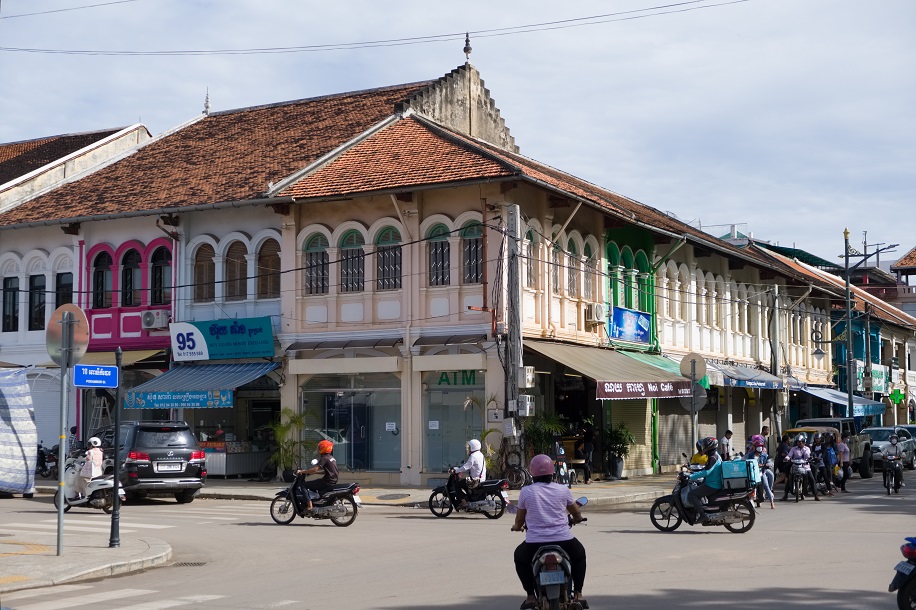
French-colonial shophouses across the street from Psah Chas, Siem Reap’s Old Market
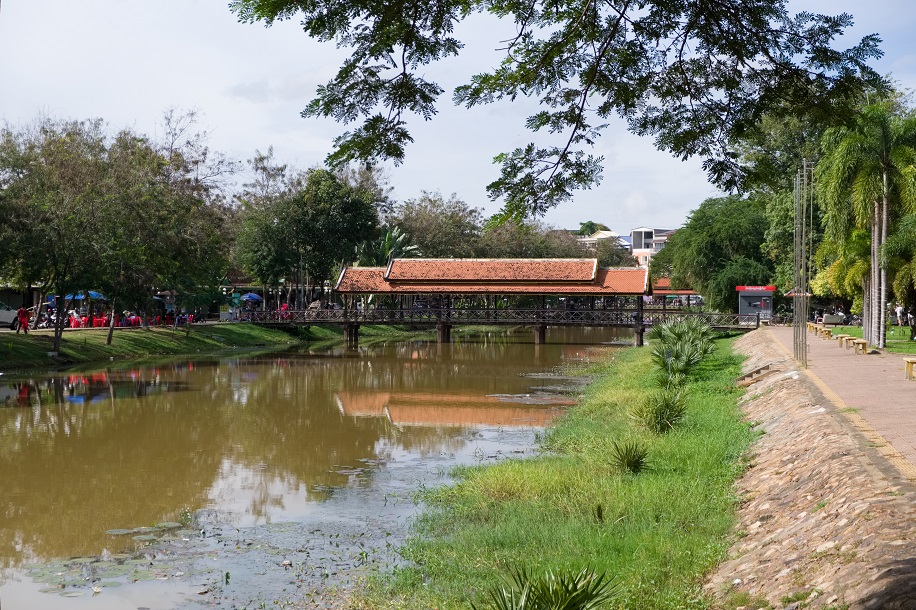
A wooden pedestrian bridge over the slow-moving Siem Reap River
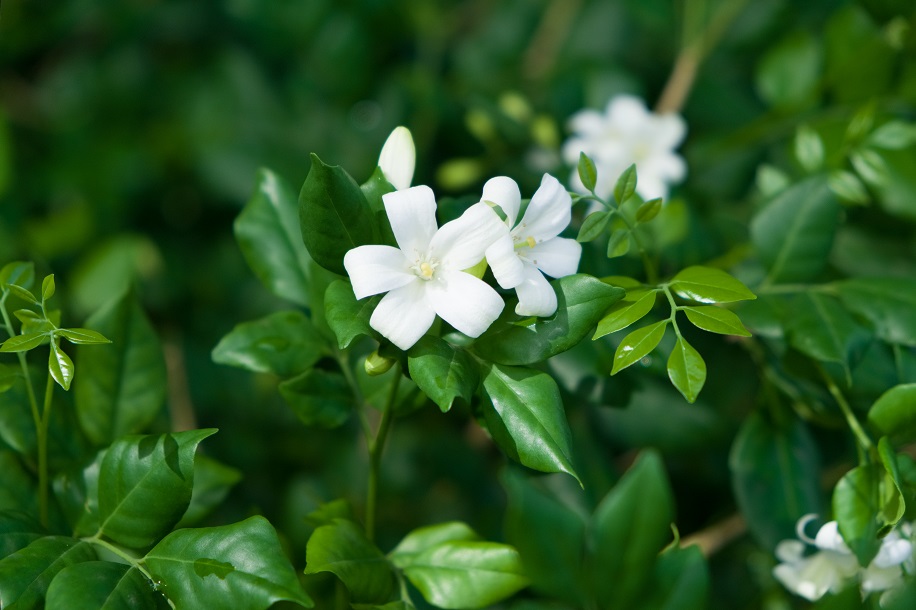
Orange jasmine blossoms on the riverbank
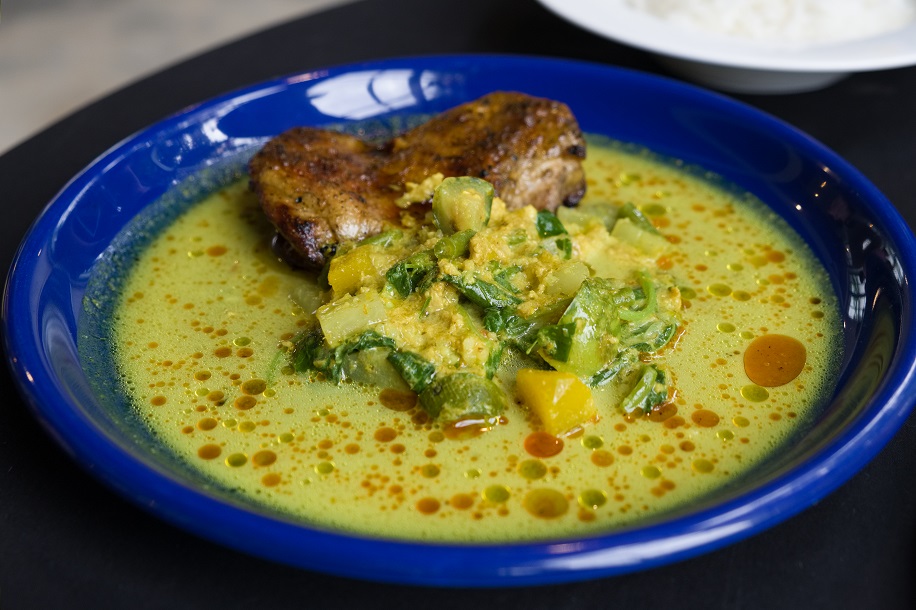
Jomno – Modern Khmer Kitchen’s take on hearty korko stew, featuring grilled chicken
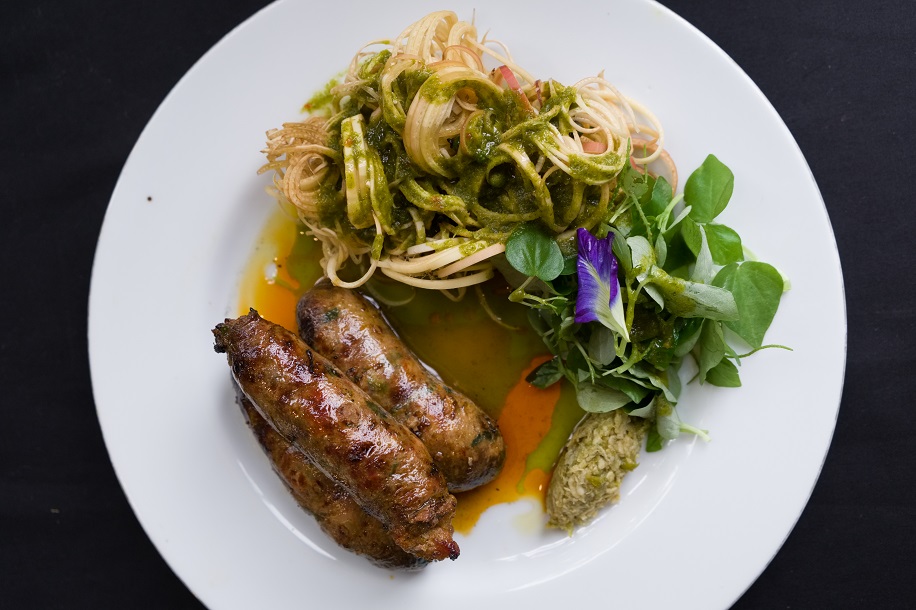
Battambang-style sausage and banana blossom salad with fresh greens at Jomno
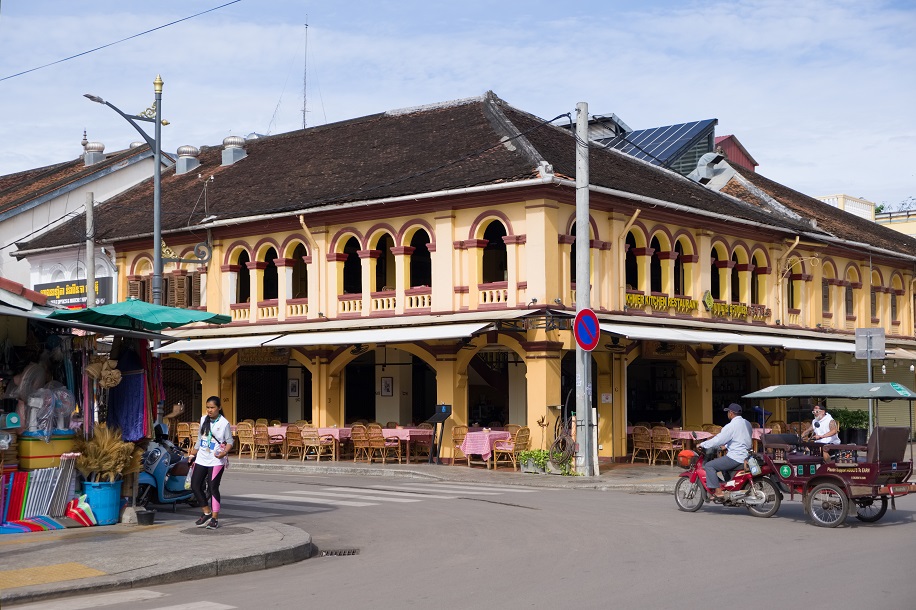
More renovated shophouses (now home to a Khmer restaurant) and a remork
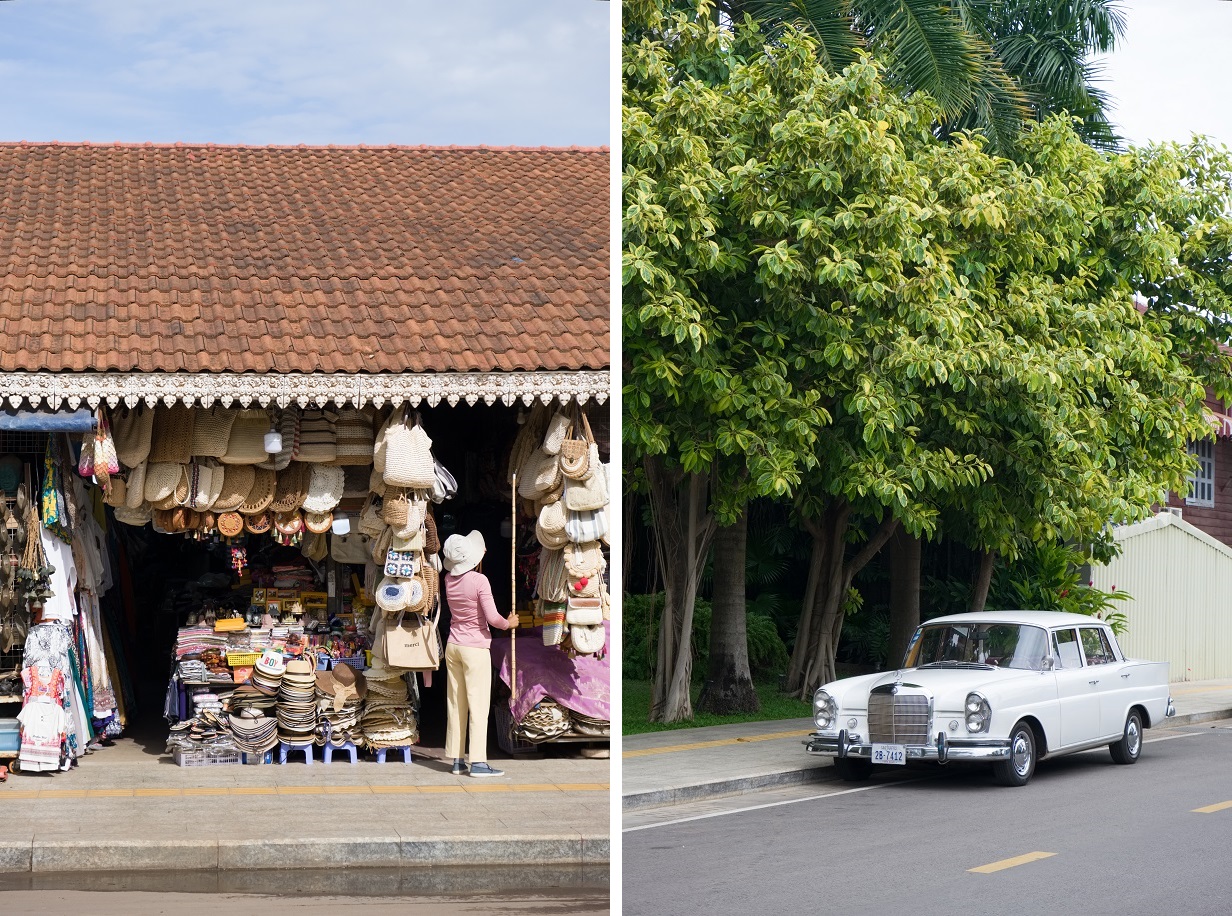
A souvenir stall at Psah Chas; one of the vintage Mercedes-Benzes owned by a chic hotel
The first time I heard about Khmer cuisine was at least a decade ago, from an old friend in Hong Kong who had just returned from the first of several volunteering trips to the southern Cambodian city of Kampot. A civil engineer by training, he’d gone to help design and build an eco-friendly elementary school, and he raved about a dish called fish amok. There were (and still are) no Khmer restaurants in my hometown, and nothing of the sort exists anywhere in Jakarta. So, I was thrilled to finally sample it myself in Siem Reap. Bama felt the same way – it was something he missed out on during his short sojourn back in 2011. “I went to KFC,” he sheepishly admitted. “The only local food I tried was beef lok lak in Phnom Penh, and I wasn’t impressed.”
Fish amok is often considered a national dish of Cambodia, though some Khmers might disagree because of a purported Thai influence – understandable given the uneasy relationship their country has had with its larger and wealthier neighbor over the centuries. (Cross-pollination is likely to have happened in the other direction, for when the ascendant Thais sacked Angkor in 1431, they carted off a great number of artisans, entertainers, and palace cooks to their capital of Sukhothai.) But regardless of the specialty’s origins, I can see why it flies the Cambodian flag. Fish amok is pretty as a picture, being a golden, turmeric-tinted hue, and traditionally steamed and served in a banana-leaf cup. It’s also easier to accept for foreigners unaccustomed to the pungent, sour, and salty properties more dominant in some other Khmer favorites.
Even the surprisingly surly waitstaff at a Lonely Planet–recommended spot couldn’t dampen our excitement at eating this celebrated dish the night of our arrival. Several days later, after a long morning spent hopping between the temples, Bama and I order the fish amok at Pou, whose menu explains it as “Amok paste marinated Tonle Sap fish with coconut cream, palm sugar, and egg.” Tonle Sap, of course, refers to the massive lake directly to the south of Siem Reap, a major source for foodstuffs like freshwater fish, herbs, aquatic vegetables, and the like since pre-Angkorian times.
Pou’s version swaps out the banana-leaf container for a large porcelain ramekin with a separate dipping bowl of chopped bird’s-eye chilies in fish sauce. On its own, the fish amok has noticeably more depth and complexity than the one we ate on that first night. Bama can’t help noticing how the flavor profile echoes that of the cuisine found in his home province, a region where even the savory dishes have a penchant for sweetness. “This tastes very Central Javanese,” he says.
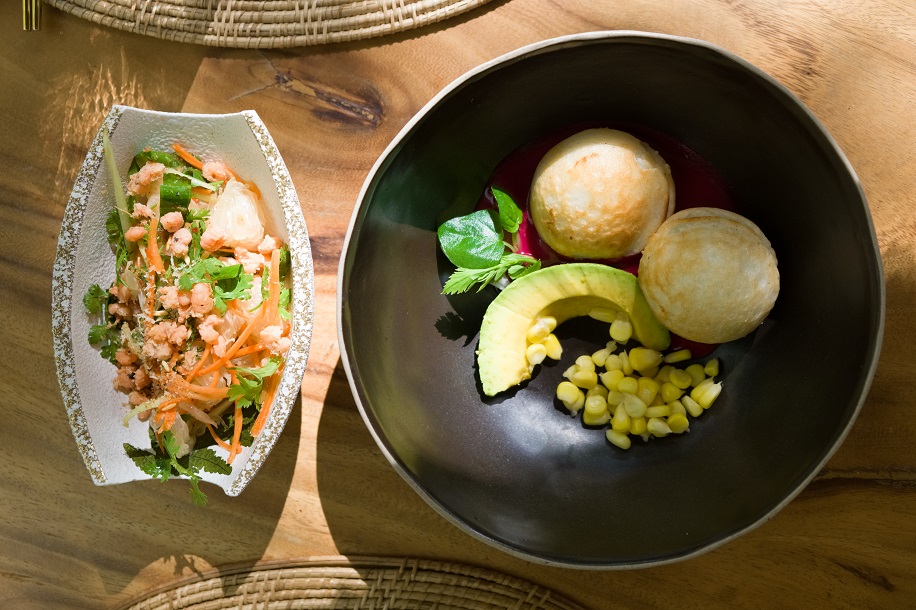
Over the next few days, we order nearly all the items on the menu, including num kruk, or round coconut-and-rice flour pancakes cooked in a cast-iron grill pan. At Pou, the Cambodian street-food favorite is jazzed up with a beetroot-and-galangal sauce in vibrant magenta, as well as avocado and sweetcorn. It’s served alongside pomelo salad featuring freshwater shrimp from Tonle Sap and a dressing of pounded garlic, coriander, and fish sauce. We also try num banh chok noodles served two different ways: topped with juicy, deep-fried pieces of catfish in a sweet-and-sour tamarind sauce, and tucked under thick slices of tender duck breast in a lip-smacking green curry.
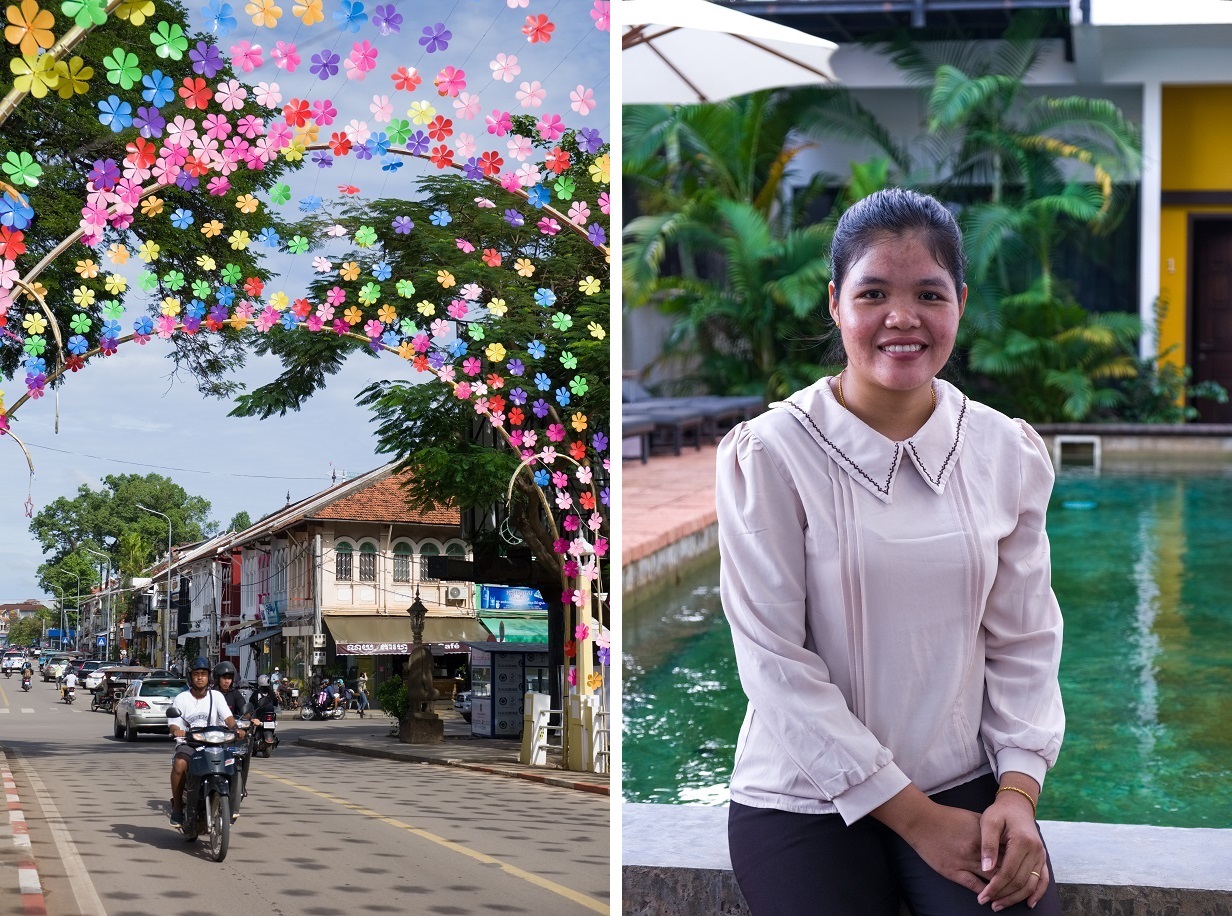
Entering the historic heart of Siem Reap; Risa, the kind receptionist at our hotel
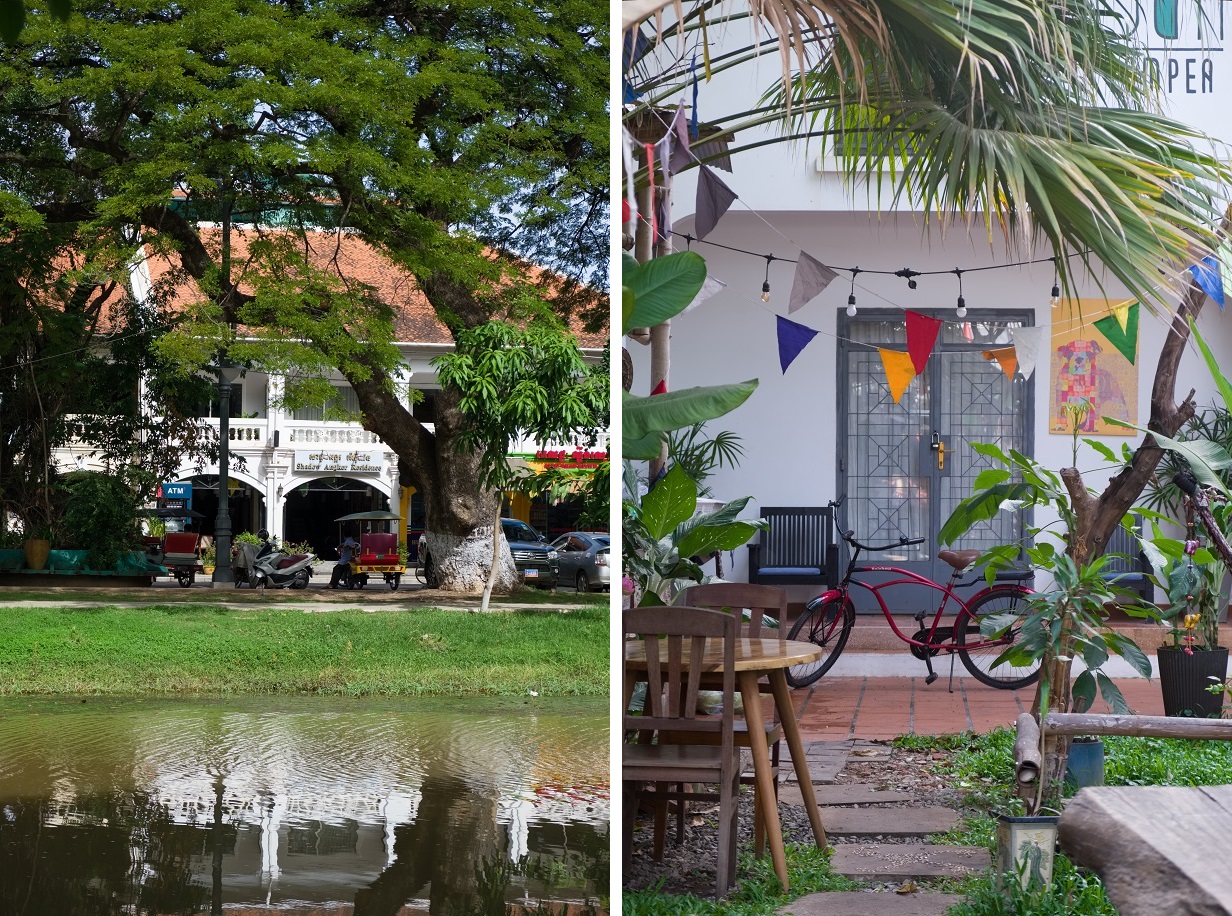
Shophouses and trees reflected in the river; a scene from Pou and the terrace of a B&B
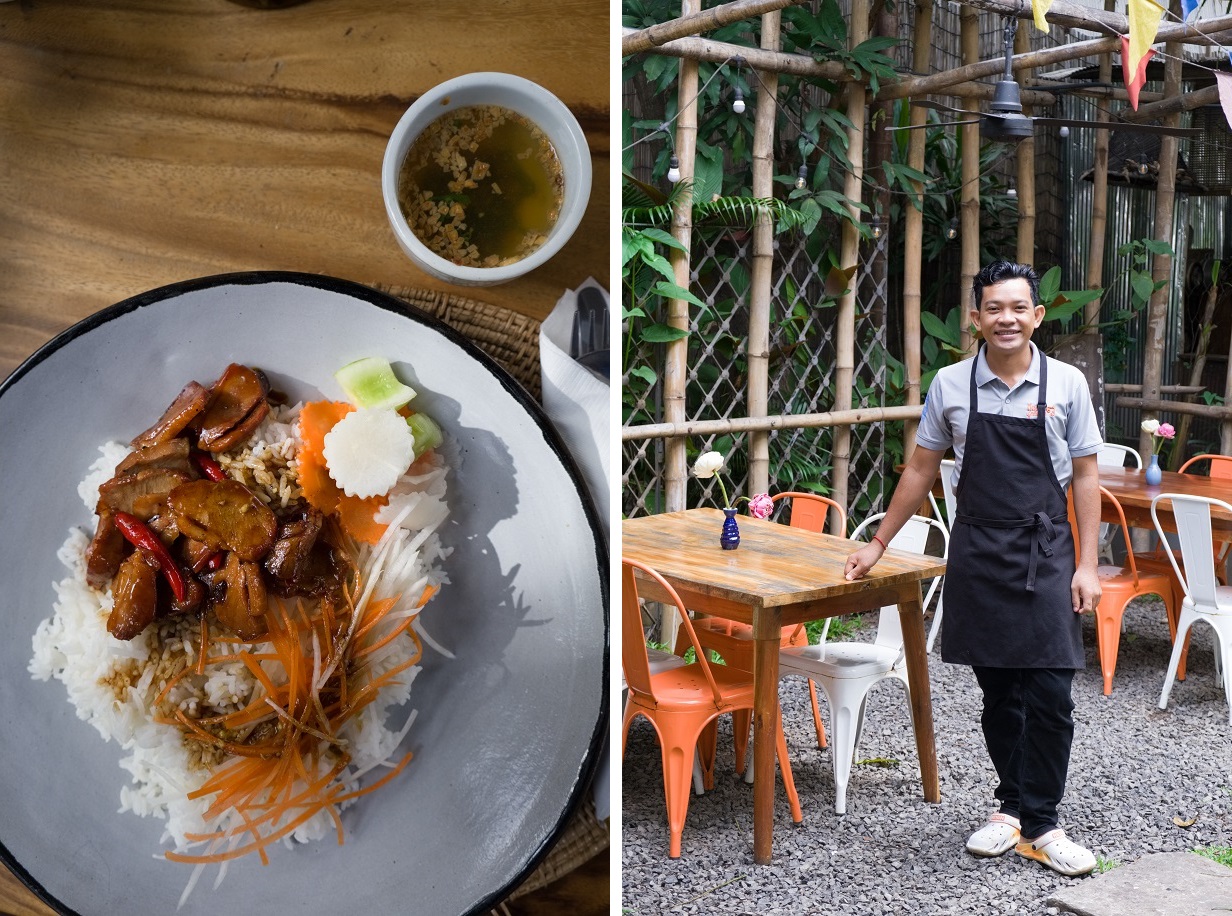
A breakfast of sweet-spicy duck breast over rice at Pou; the young chef-owner Mengly Mork
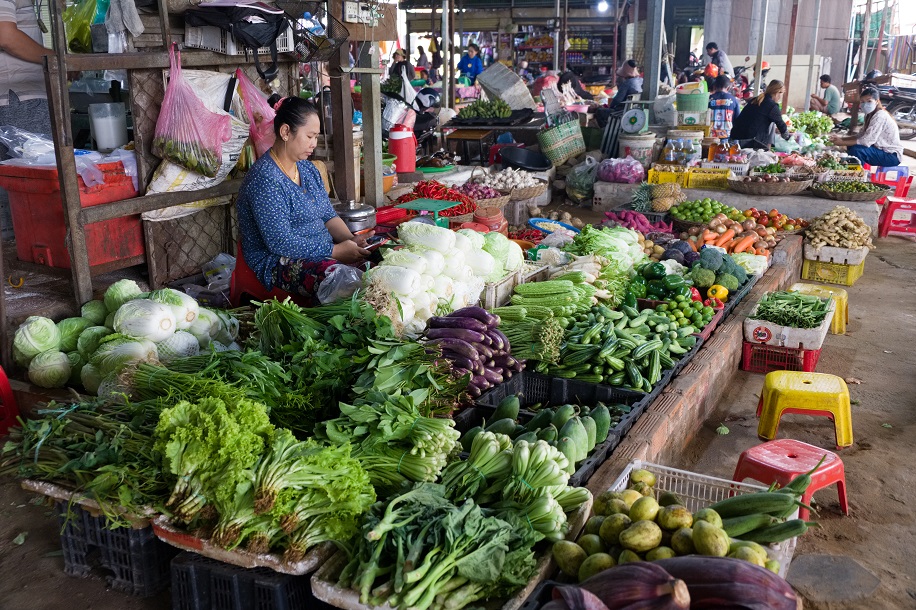
A riot of fresh vegetables on display at Psah Kraom market
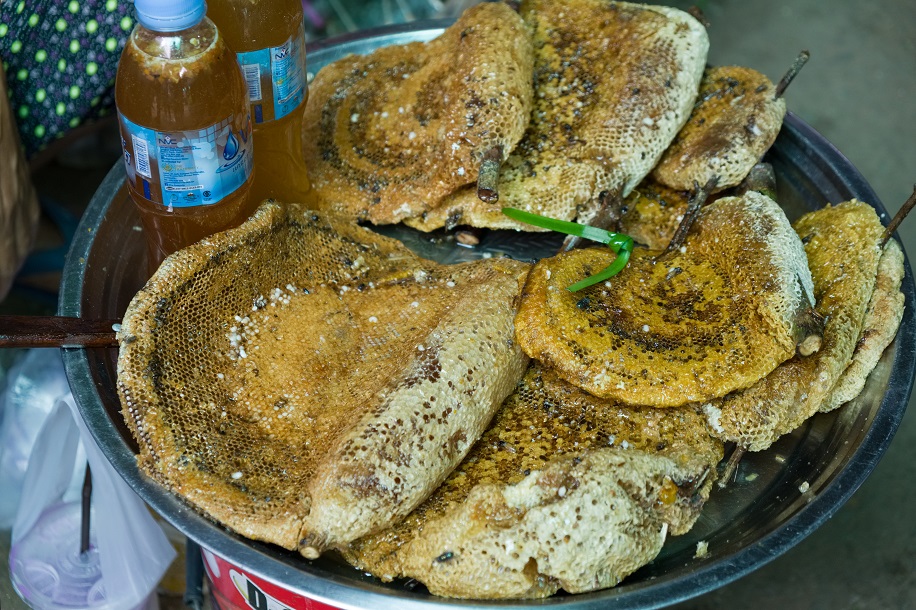
Whole raw honeycombs for sale
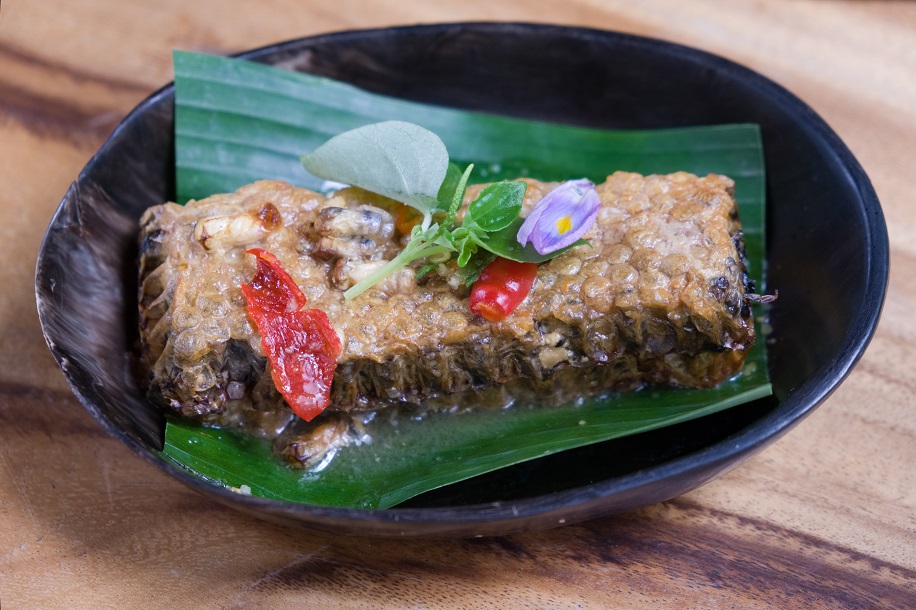
Pou’s marinated bee larvae grilled in banana leaf
One of our favorite dishes at Pou is the Kulen Mountain sausage made of spiced pork mixed with mung bean and peanut. There are also greens, red tree ant dressing, and Kampot pepper sauce on the side. Cambodia, incidentally, produces what many gourmands consider to be the world’s finest pepper cultivar. Prized since French colonial times, the spice has attained an EU-recognized protected geographic indication, which means the label “Kampot pepper” can only be used for those grown in a specific area around its namesake city.
We also try a traditional delicacy of garlic-and-chili marinated honeycomb grilled in banana leaf. Rather than being sweet, it bursts with a predominantly savory and somewhat nutty flavor. The “jungle sour beef” is just as intriguing: thin slices of meat are served in a broth infused with the flesh and small edible seeds of the krorsang fruit (a.k.a. wood lemon), which has a thick, dense rind. Red tree ants have been liberally used to add a crunchy texture and a bit more tartness, while Kampot pepper, grilled spices, and the salted and fermented fish paste known as prahok complete the soup. The latter is an essential ingredient that gives so many Cambodian dishes their punchy umami notes.
To get a better sense of the fundamentals of Khmer cuisine, we join a market tour and cooking class led by chef Mengly himself. German-Iranian couple Michael and Azadeh are our companions for the half-day experience. The four of us squeeze into the back of a remork – the breezier Cambodian version of a tuk-tuk – to visit Psah Kraom on the other side of the river. Mounds of tropical fruits like guava, jackfruit, and rambutan enliven makeshift tented stalls leading down from the road to a permanent structure roofed in corrugated iron, where we’re surrounded by vegetables and herbs in seemingly infinite varieties.
Azadeh stares in wide-eyed wonder at the dizzying array of unfamiliar ingredients, piled high in woven baskets, Styrofoam boxes, and plastic trays at every turn. “I love markets!” she declares with a huge grin. Michael is intrigued but rather less enthusiastic; he later admits being a little sickened at the sight of all that freshly butchered meat and fish left out in the open. (Psah Kraom probably wouldn’t live up to Germany’s strict hygiene regulations.) Bama and I marvel at the size of the redtail catfish that Pou uses in its kitchen: the pinkish-orange steaks are so large and meaty one might almost mistake them for salmon at first glance. They’re nothing like the regular catfish consumed in homes and informal street-side eateries across Indonesia.
Nearby, we see repurposed paint buckets filled with prahok, whose unappetizing appearance and pungent, funky aroma will be off-putting to more squeamish visitors, and a jovial vendor in flowery pajamas selling impressive amounts of kroeung, the catch-all term for a spice paste and another building block of Khmer cooking. Mengly pauses by a platter of whole honeycomb in its raw, natural form. “The part we use at the restaurant is the center – it’s the larvae.” The surprising taste of the dish suddenly makes sense, and Bama and I realize the innocuous description on Pou’s menu, “grilled beehive”, doesn’t tell the whole story.
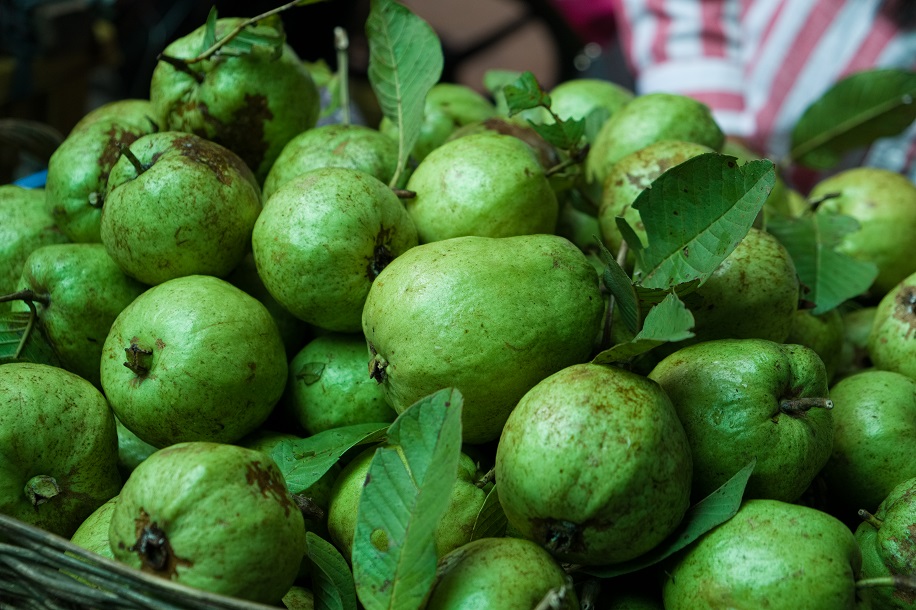
Freshly picked guavas in a large basket at Psah Kraom
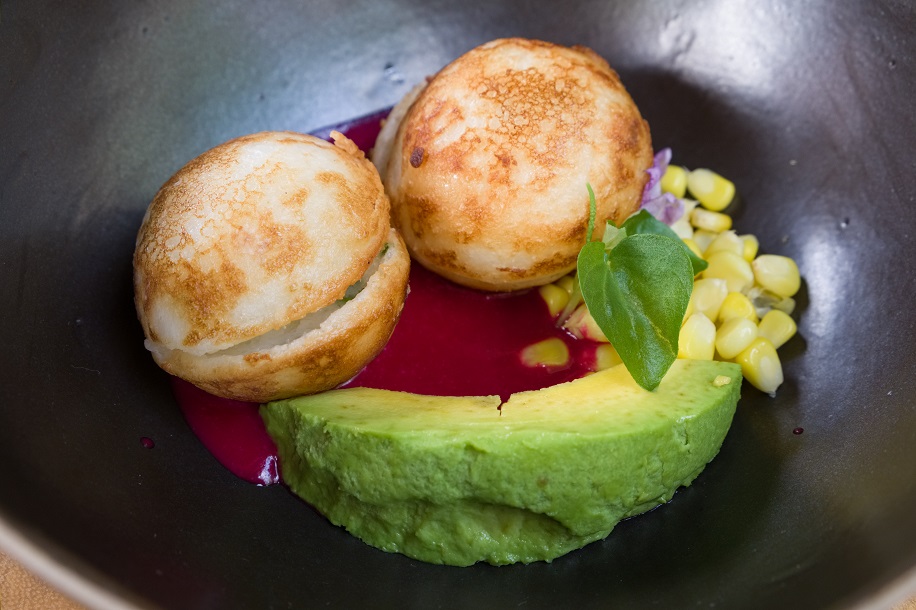
Chef Mengly’s modern take on num kruk pancakes, a Cambodian street-food favorite
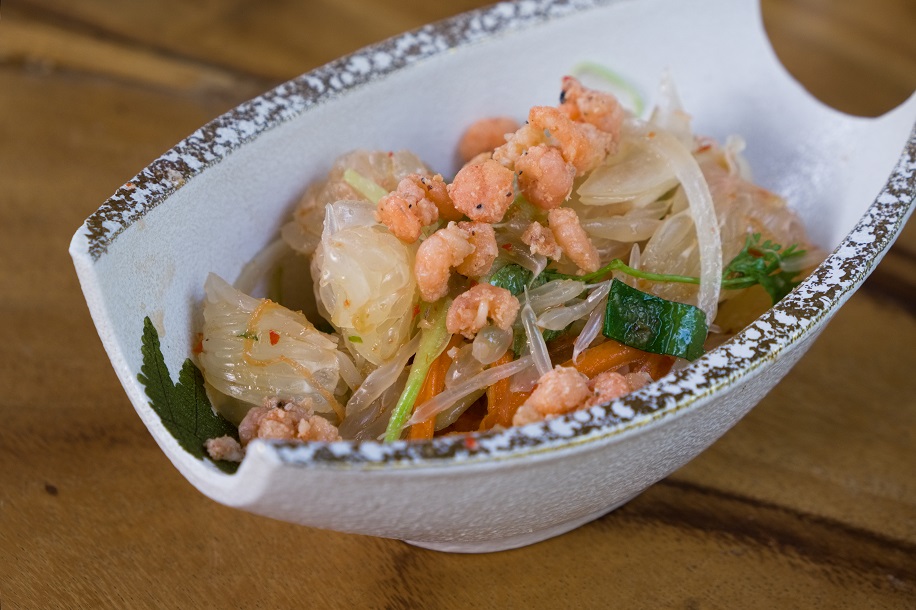
The num kruk come with a separate serving of zesty pomelo and shrimp salad
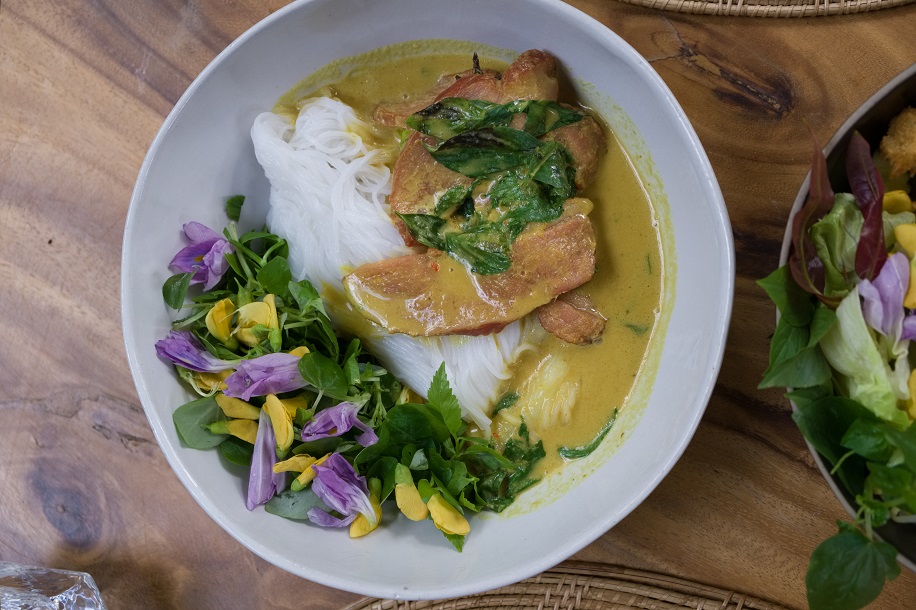
Num banh chok and roasted duck breast in green curry at Pou
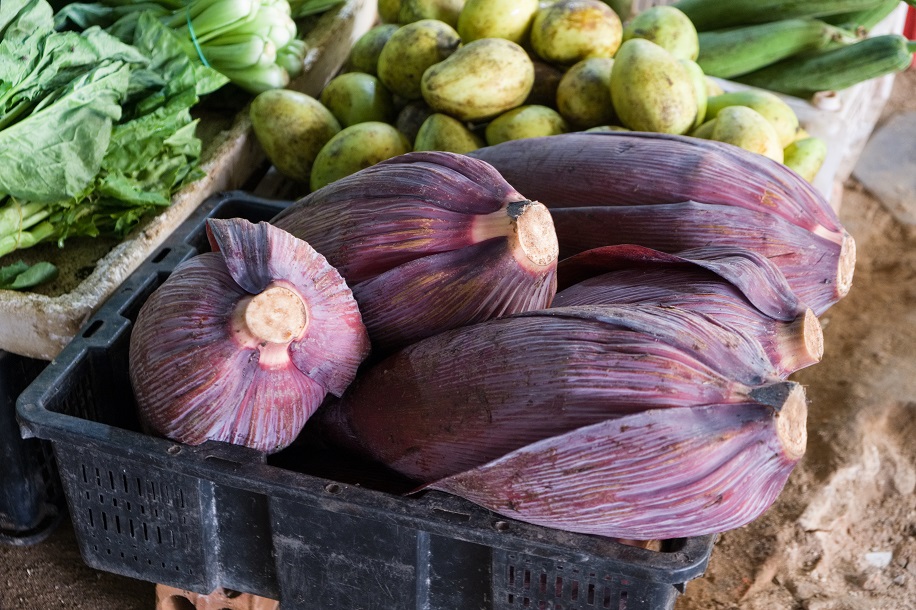
A tray of banana blossoms seen at Psah Kraom
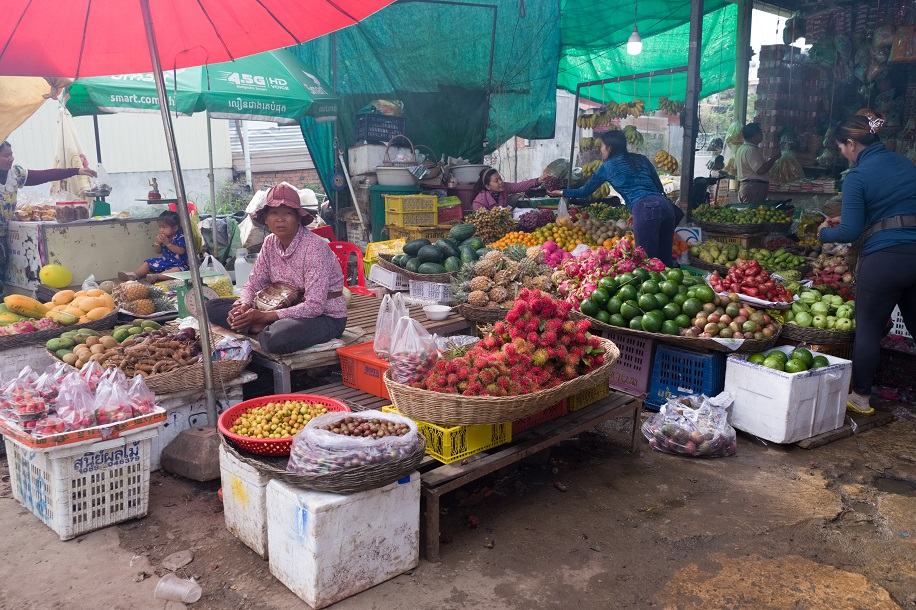
Vendors selling rambutan, pineapple, and more tropical fruits at the same market
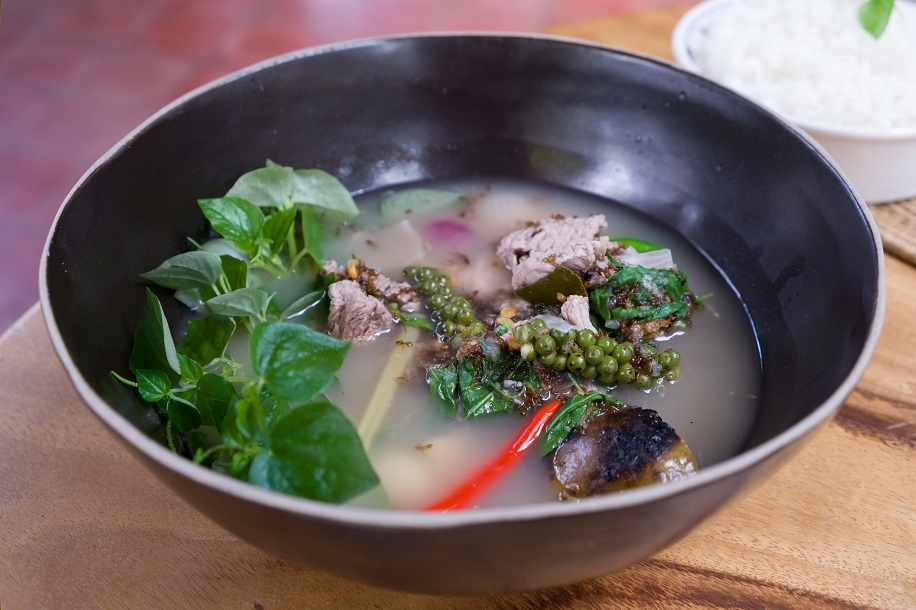
Pou’s “jungle sour beef” soup with red tree ant and sour krorsang fruit
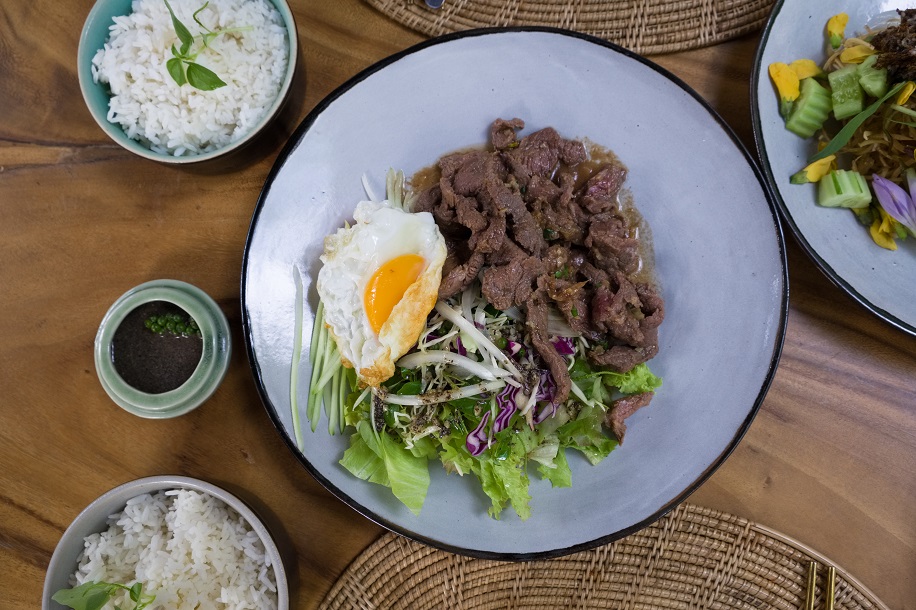
Beef lok lak, a dish Cambodia shares with neighboring Vietnam
Back at Pou, Mengly momentarily disappears into the kitchen with his bags of groceries as the rest of us gather around a communal table fashioned out of rough-hewn timber. Laid out on top is a neat arrangement of small bowls, spatulas, knives, cutting boards, and saucepans on portable stoves. Mengly proves a forgiving and patient teacher – nothing feels intimidating or rushed as we get to work preparing a three-course meal for lunch, starting out in reverse order. First comes dessert: a ginger-infused milk pudding featuring tapioca pearls that are sweetened with condensed milk and gooey palm sugar, which we slowly melt into the simmering liquid while stirring constantly on low heat. When Pou’s young chef gives the all clear, each of us pours our sweet creations into cylindrical ceramic bowls to cool down and set in a fridge.
What follows is an appetizer of Khmer-style prawn and pomelo salad with slices of juicy pork belly (several weeks later I manage to replicate the dish, minus the pork, for Bama’s mother to try). Azadeh is clearly in her element. She appears relaxed, almost nonchalant, as she sautees the prawns to perfection. Bama hands me the responsibility of pan-frying the pork for everyone to use. “I think you should do it,” he says. “You’re the expert.” We adjust the heat while the meat cooks in its own fat, crisping up the edges but keeping the pieces moist. Coriander stalks are tossed into a hefty wooden mortar and pestle, along with lime juice, spoonfuls of fish sauce, and roughly chopped garlic, shallot, and red chilies that we take turns pounding by hand. Mengly looks concerned when Azadeh drops an extra handful of unseeded chilies into the dressing. “Oh, it’s fine – we both like it spicy,” Michael explains with a grin.
For mains, we learn to whip up a classic fish amok. Bama and I quickly realize why it tastes so familiar – the kroeung uses ingredients commonly found in Indonesian kitchens: lemongrass, garlic, shallot, chili, fingerroot, turmeric, galangal. Intriguingly, the recipe also calls for waxy noni leaves. Mengly instructs us to fold them in half, cut out most of the midribs, and slice the rest into thin strips to scatter in our individual bowls, combining them with the blended spice paste, fish sauce, coconut cream and palm sugar, chunky pieces of redtail catfish, and a whisked egg. Once all the items have been well mixed, we carefully slide the contents into prepared banana-leaf cups inside a large steamer. The exquisite flavor of the end result is matched by a genuine sense of accomplishment.
Despite all the meals we’ve enjoyed at Pou and a few other local spots, one traditional Khmer dish has eluded us so far – prahok ktis. It’s a popular dip consisting of prahok, minced pork, and roasted pea eggplants braised in a coconut gravy, and usually comes paired with crunchy vegetable crudités. Bama and I turn to Risa for recommendations on our last day in Siem Reap. “Oh! The best one I’ve had is in a place a bit far from here,” she tells us excitedly. This turns out to be none other than Mahob Khmer Cuisine, a nouvelle Cambodian restaurant we hadn’t visited even though it was on our wish list. Risa immediately calls Mahob to secure a table for two – she worries the place might be fully booked on a Friday evening. We’re heartened to know that it isn’t out of the reach of ordinary Cambodians working in the hospitality industry. “Even for me as a local, I can afford to go and eat there,” Risa adds. “Apart from prahok ktis, I love the eggplant with chicken and the hot stone beef.”
We arrive well before daylight fades and are shown to a table in the quiet front garden. A gaggle of uniformed Singaporeans on a company outing file into the main dining room as the skies begin to darken; we eventually devour plates of green mango salad with river prawns, chargrilled eggplant featuring minced chicken and fresh sprigs of fish mint, and wok-fried snakehead fish fillet in a sweet-sour soy and tamarind sauce. But the undisputed star of the show is the creamy prahok ktis. The dip has a reddish-orange color and a deep complexity that makes us savor every mouthful eaten with cucumber, carrots, and sliced eggplant or semi-sticky rice. One thing’s for sure – Bama and I will sorely miss these Khmer flavors after we leave in the morning. ◊

Mahob Khmer Cuisine’s prahok ktis – one of our favorite dishes in Cambodia
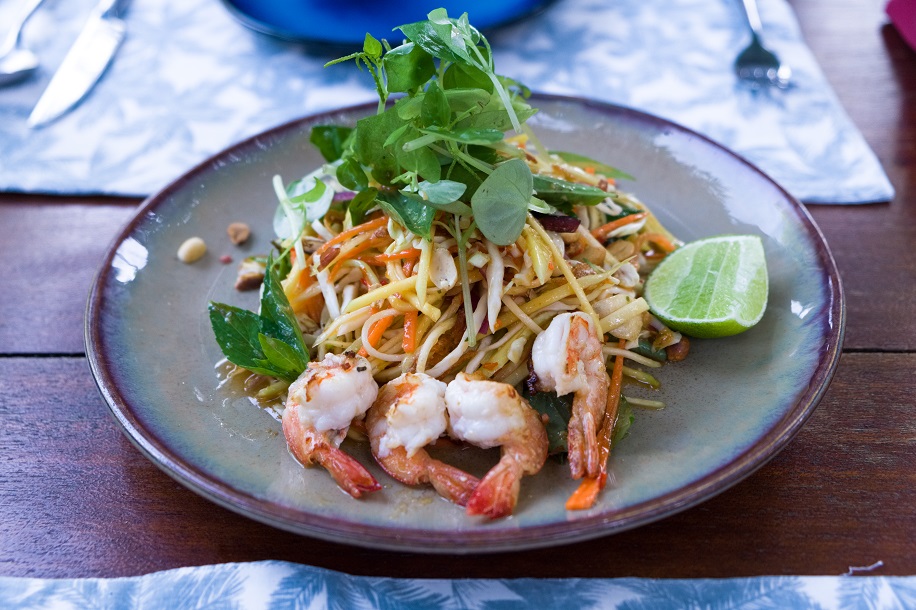
A zingy, sweet-sour salad of green mango and river prawn, also enjoyed at Mahob
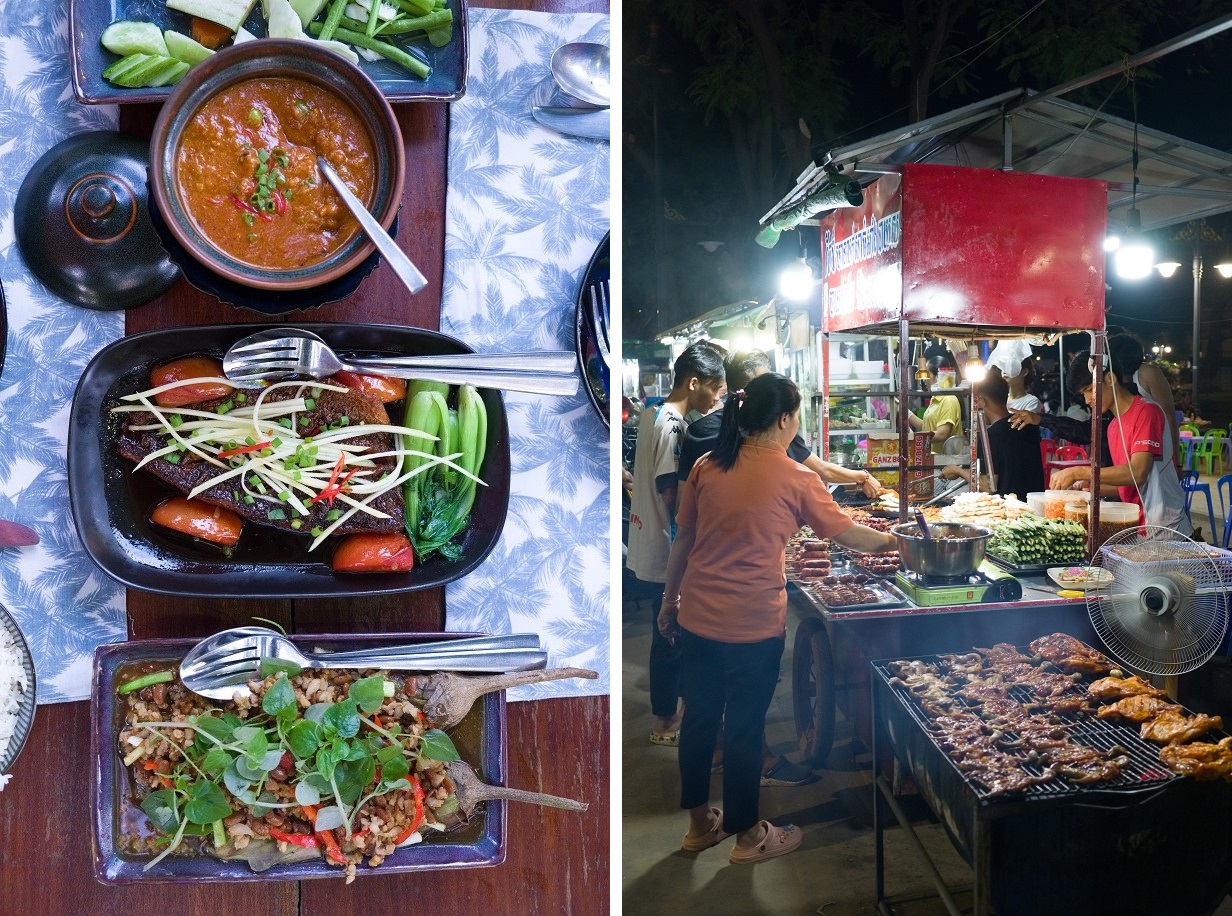
Main courses for our last dinner in Siem Reap; a riverside barbecue stall
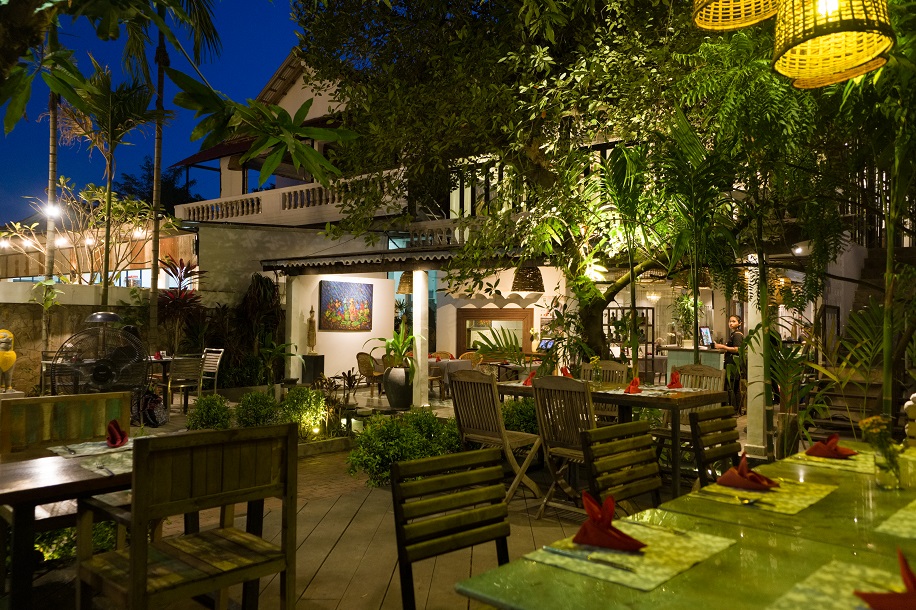
Mahob’s outdoor dining area after dark
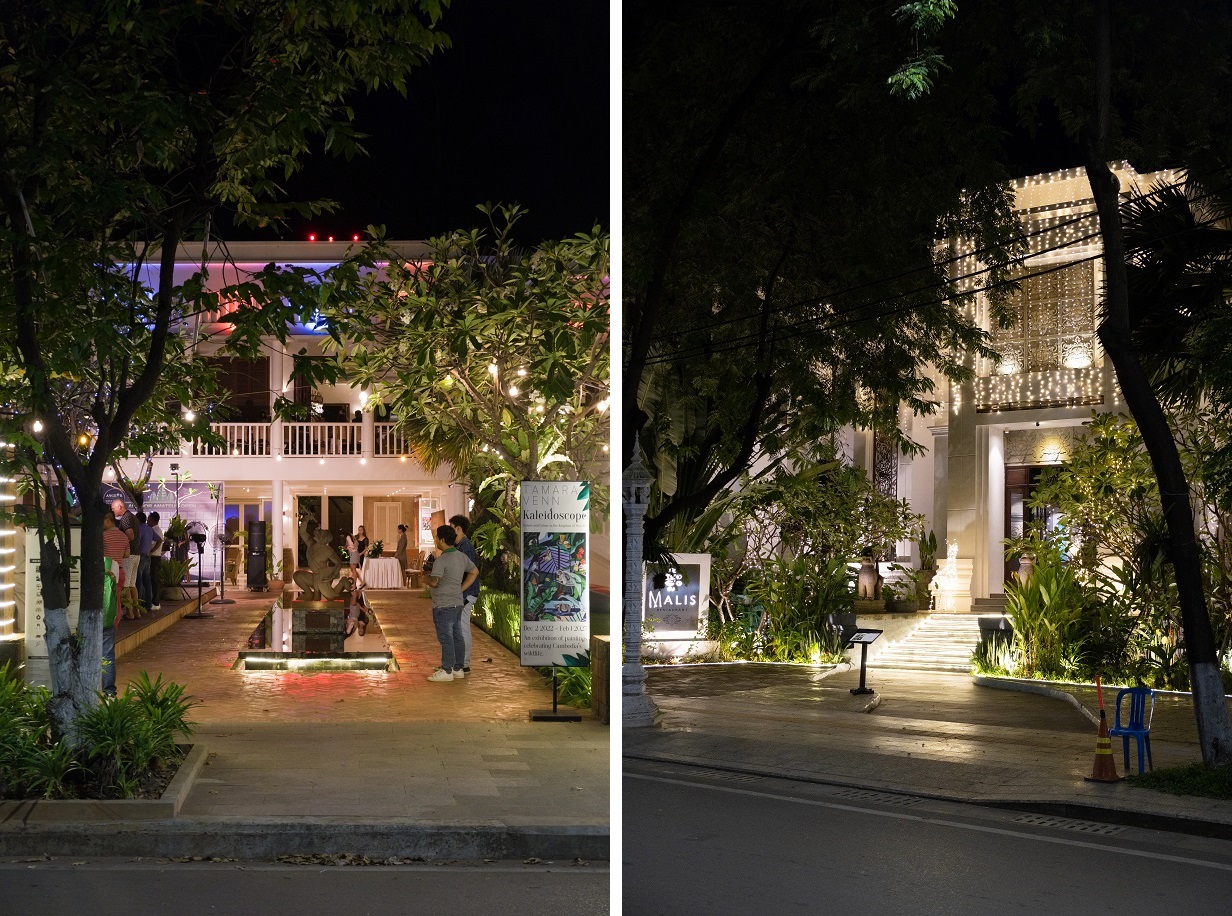
An alfresco event being held at a five-star hotel; the entrance of an upscale Khmer restaurant
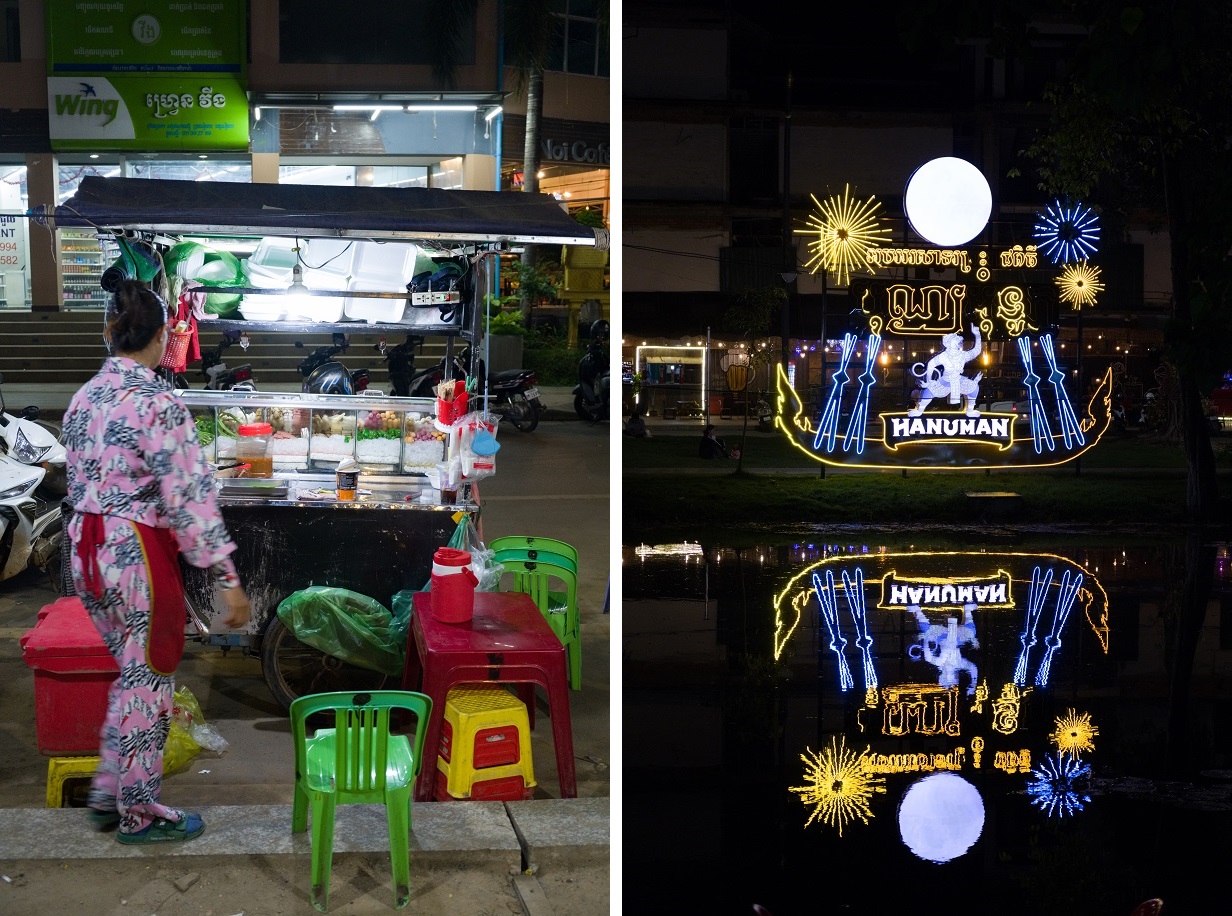
One of the mobile street-food carts along the river; festive decorations by a local beer brand
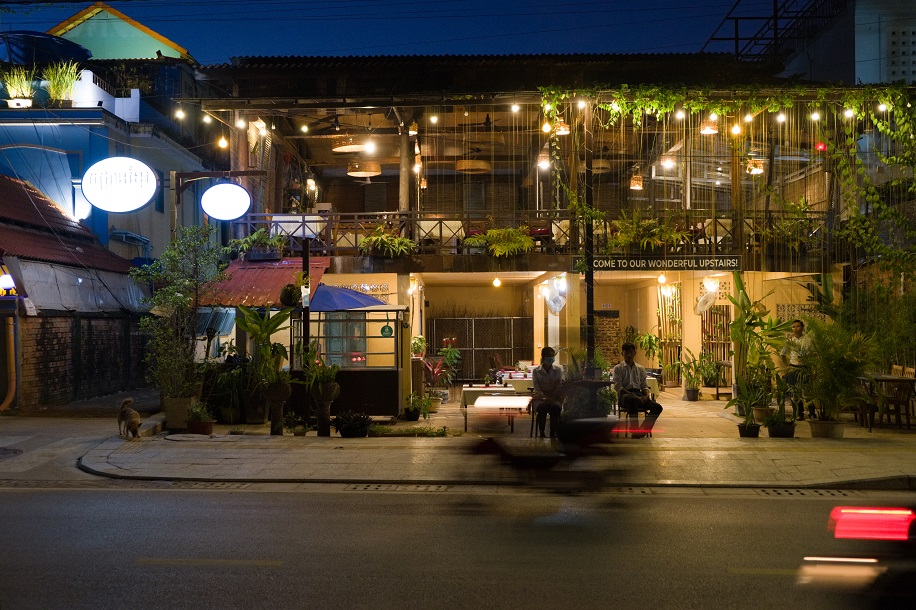
Servers at a casual river-facing restaurant wait for customers on a Friday night




 Plus Ultra
Yum! Regardless of what there is to see in Cambodia, eating seems like half the fun.
I agree! Khmer food is such a treat, and it was wonderful to see passionate local chefs doing their utmost to turn the spotlight on Cambodia’s traditional flavors, sometimes in bold new ways.
I can’t believe how much I missed by resorting to an American fast food chain as opposed to trying as many local dishes as possible when I went to Cambodia for the first time. But I was a different person back then, and Siem Reap very much a different city. I don’t think Pou, Mahob, and all those places we went to had existed in 2011. It was very inspiring to see how young chefs like Mengly reinterpret traditional Khmer cuisine and bring it to people’s attention today. That certainly is one good way of preserving an aspect of a local culture.
We were so spoiled to have Pou just around the corner from our hotel. If only we had one more day in Siem Reap, I’d have loved to dine at Mahob again and maybe try another Khmer restaurant. Who knows what we’ll find there the next time we go!
You guys are such an adventurous eaters! I very much enjoyed the cuisine in Siem Reap, but I stuck to the fish amok and a few other dishes. No bee larvae for me! While I marveled at what you ate, I also relished all these photos of Siem Reap itself. Because I was part of a group (not my usual travel style), I had less time for wandering and didn’t see as much of the town as you did. One morning I did slip away for 3-4 hours by myself, walking the mile or two from my hotel into the downtown and just ambling around for a while before heading back for our next outing. It was nearly 100 degrees outside which forced me to stroll in a leisurely way, and that was great for really getting to see the town that anchors all the temples visits. Still, you saw so much and ate so much, and that was really fun for me to see and revisit!
A few of the restaurants had an intriguing raw freshwater fish dish on the menu, but in the end we decided against ordering that just to be on the safe side. Despite all our wanderings in Siem Reap, Bama and I never managed to set foot in any of the temples downtown. So we stayed in the Wat Bo area without actually seeing the landmark it was named after! If it weren’t for the half-marathon, we would probably have gone straight to Angkor and missed seeing the shophouse-lined streets around the Old Market.
One day I’d like to travel with you guys for the food! (Except for the chilis of course). I have such a love-hate relationship with food when I’m travelling, but this all sounds so amazing. As does your description of the Siem Reap of today. We were there in early 2012 and obviously it was nothing like it is now. It was a pretty sleepy town then with just the one main tourist street (is it called Pub Street?) I can’t remember what I ate except that the American man (who owned with his Vietnamese wife the guest house we stayed in) took us to a very down home place across the road for some kind of really good rice dish for breakfast.
Alison
Yes Alison, Pub Street is still around! But it didn’t really entice Bama and I since neither of us are big beer drinkers, and we were much more interested in the riverside. I guess you can say that Siem Reap has really blossomed and “grown up” in the past decade. From work I learned about two Australian travel writers based there who say it is hands down the culinary capital of Cambodia. Apparently the food scene in Phnom Penh is nowhere near as interesting.
We were certainly not enticed by Pub Street either – exactly the kind of place we pretty much stay away from, but I have no memory of where we did eat except that one breakfast. We were staying in a very down-home guest house about a 20 minute walk down dusty local roads, and the owners were so lovely.
A.
I’ve never tried any of these foods before. They sound intriguing and interesting. But I also know I’m nervous trying new foods. But the prahok ktis wll likely be the first thing I would try.
Hi Matt, Khmer food might be a little different from what you typically eat in Toronto, but I think you kind of have a head start already. Especially in terms of being familiar with fermented Asian ingredients like shrimp paste and black bean paste. In any case, I hope you get the chance to visit Cambodia someday!
Last time I was in Siam Reap was like 17 years ago, I was very poor and mainly ate Banh Mi type sandwiches for less than a dollar. I was missing out! I’ll have to check out the culinary scene when I got back. Those sausages made of mung beans and peanut sound interesting.
Seventeen years ago Siam Reap seemed quite dismal. It sounds like it has really improved if it can be compared at all to Ubud or Luang Prabang.
There was nothing I didn’t like about any of the Khmer dishes I had in Siem Reap. Even at the nicer restaurants, things were pretty affordable, so Bama and I never needed to splurge to have a great meal. Fingers crossed, you and Kristi will get the chance to go back soon!
Love how you guys explore the gastronomic offerings of a destination as well as its cultural landmarks! We are never half as adventurous with our tastings but we did enjoy Khmer and Lao food very much and do rate both higher than Thai. It would be wonderful indeed to get to travel with you two for the food someday 🙂
That sounds like something we can look at if/when you and Ravi come to Indonesia in the future! 🙂 Khmer cuisine was such a delight for both of us, and the hands-on cooking class (with the chef-led market tour) made things even more fun.