
On the Food Trail in Bali

There was a time my knowledge of tropical food-bearing flora was so limited, I recognized nothing other than banana trees. Some of that ignorance can be attributed to my upbringing in Hong Kong’s hyper-dense concrete jungle. While holidaying in my hometown in early 2014, Bama laughed when he realized I had no idea a relatively common plant grown in the soil of the city’s outlying islands—and sometimes on urban rooftops—was in fact the papaya tree.
Happily, living in Indonesia has opened my eyes on that front, and much of the education has taken place during work or leisure trips to Bali. At the end of January, I returned to the island for just under a week to research the exciting culinary scene in Ubud. The subject was a handful of restaurants where chefs are doing remarkable things with local ingredients. Most have embraced the infinite possibilities of the Indonesian larder, and chosen not to rely on the ludicrously expensive imported foodstuffs (foie gras, truffle, beluga caviar et al.) that have become a tired cliché in so many fine-dining venues across Asia.
The afternoon I arrived, an enthusiastic staff member called Felicia took me on a tour of the flourishing gardens at Room4Dessert. She pointed out the tightly planted sorghum and rosella and amaranth, and I soon spotted ripening mango and cacao, before being offered juicy, mildly sour bilimbi fruit Felicia plucked right off the tree. Sadly, I couldn’t stay long enough for the dessert-focused dinner experience. I did, however, get to try a specialty named “The Sugar Refinery” from the 10th anniversary menu. Felicia said the dish had evolved continually from Room4Dessert’s early days, when chef-founder Will Goldfarb (he of Netflix series Chef’s Table fame) invented a completely new technique for making meringue.
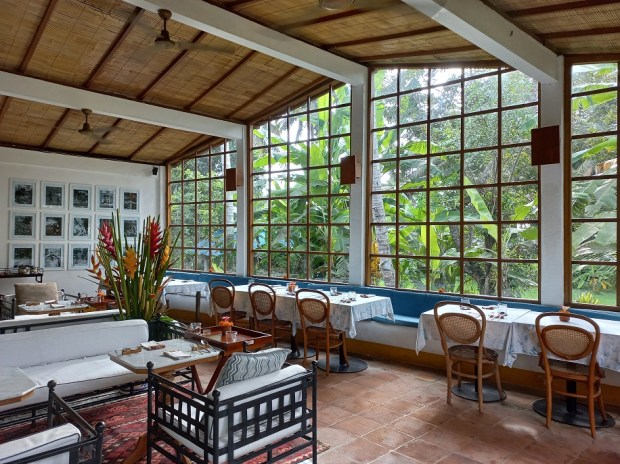
L’hort, the beautiful main dining area at Room4Dessert in Ubud
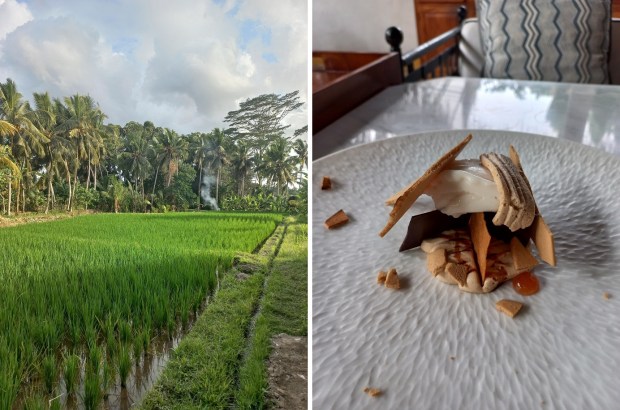
A paddy field behind Room4Dessert; The Sugar Refinery is one of R4D’s signature dishes
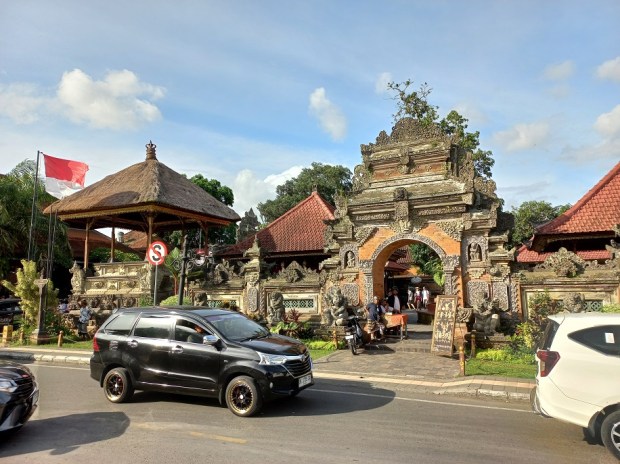
One of the gateways to Ubud’s royal palace
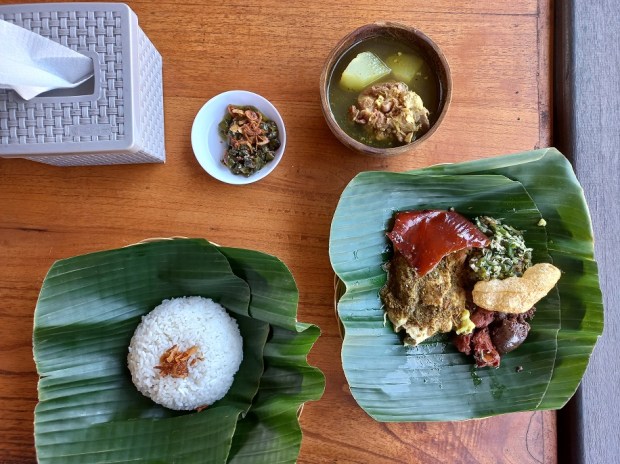
A pork-tastic Balinese lunch at Babi Guling Gung Cung
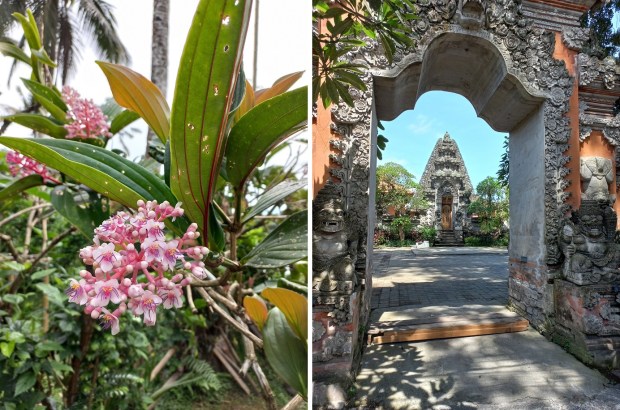
Edible trijata flowers; the front yard of the former offices of Ubud’s raja (king)
With some free time on my hands during the second day, I went in search of a good babi guling, or Balinese spit-roasted pig. An early lunch beckoned on the shaded rooftop terrace at the unassuming Babi Guling Gung Cung in central Ubud. Not only did my white rice come with fork-tender meat and crispy skin—there were also sides of lawar (chopped boiled long beans and toasted coconut shreds); a crispy pork-rind cracker; battered spiced meat; and oret (liver sausage). As if that weren’t enough, the meal included a bowl of pork-bone broth and chayote, alongside moreish green chili sambal topped with fried shallot. Later, while walking along Ubud’s main strip, I noticed the traffic slowing to make way for a religious procession. Tourists on both sides of the street stood transfixed as cymbals announced the arrival of a stream of young men kitted out in patterned sarongs, white button-up shirts and headdresses, and women who carefully balanced offerings on their heads. I stopped for a moment to watch the devotees turn down an alleyway toward a temple gate, grateful for this serendipitous encounter with the magic of everyday Bali.
One morning, I rode pillion on a scooter for nearly an hour along winding rural roads that dipped down steep river valleys before rising again on the other side. My guide was an affable sous chef nicknamed “Boss” for his Gordon Ramsay–esque outbursts in his younger days at Ubud’s boundary-pushing Locavore restaurant. Our destination? A traditional food forest owned by local farmer Pak Agung and his family. The excursion proved even more eye-opening than a foraging experience I joined two years ago in the jungles of Bali’s highlands. As Pak Agung and Boss led the way, they took turns handing me ripe tamarillo, mulberry, chayote flower, mangosteen, and the creamiest, freshest avocado that has ever passed my lips. “You’ll never get avocados this good in the supermarket!” Boss beamed. I also sampled a spoonful of slightly sour stingless trigona bee honey taken straight from the hive, then sipped the sweet and freshly harvested sap of an arenga palm tree—usually fermented for a few days to make the alcoholic drink tuak.
There were plenty of other things I’d never seen or tasted before. I did not decline Boss’s offer to try sago grub two ways: live (creamy) and barbecued over an open flame (still creamy, but with a smoky flavor reminiscent of bacon). Less extreme than insect larvae was the coconut apple, a spongy, dense mass that develops inside the coconut after it has sprouted. Wani, or white mango, just so happened to be in season at the time of my visit, and I was excited to try the elusive fruit six years after I’d heard about it from a Balinese hotel manager on the island of Bintan.
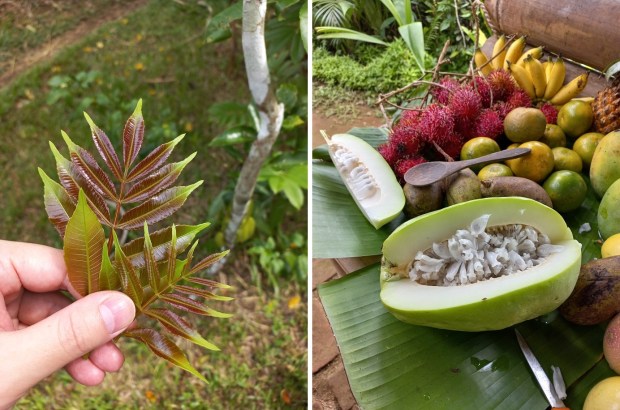
Medicinal cemcem leaves; the melon-like lisah is a relative of the passion fruit
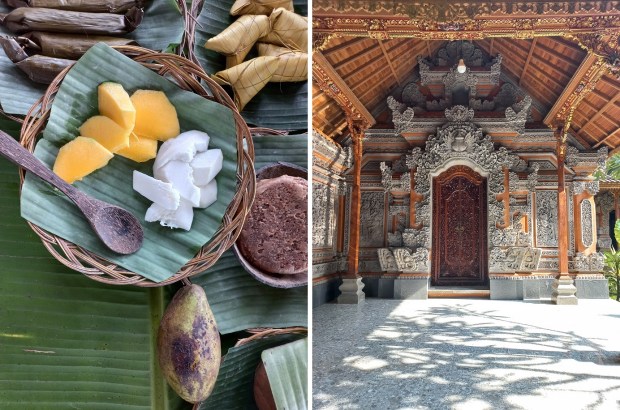
Enjoying two kinds of local mango; an exquisite façade in a Balinese family compound
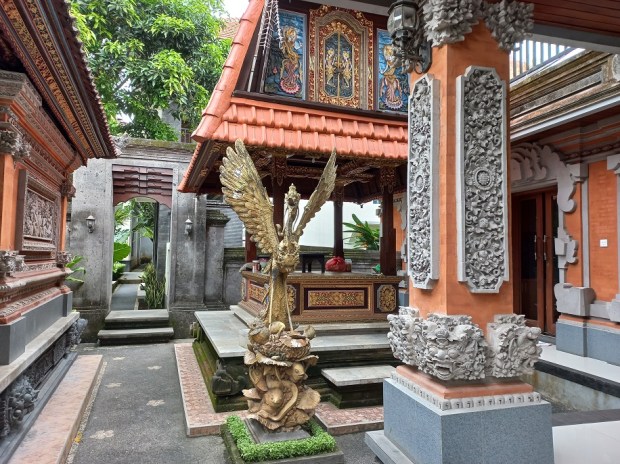
This particular compound in Ubud led to a guesthouse run by the same family
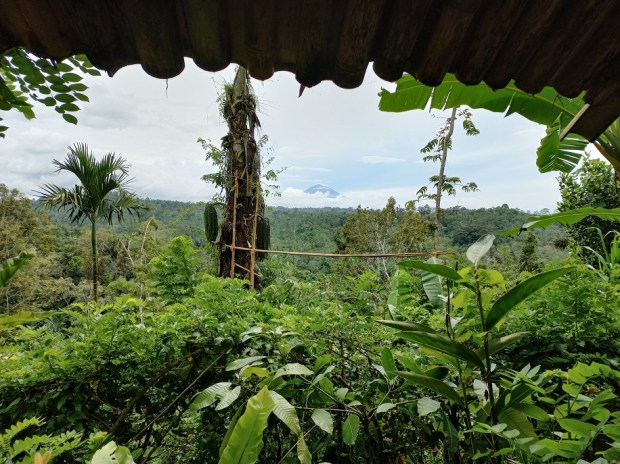
A view of the sacred volcano Mount Agung from Pak Agung’s food forest north of Ubud
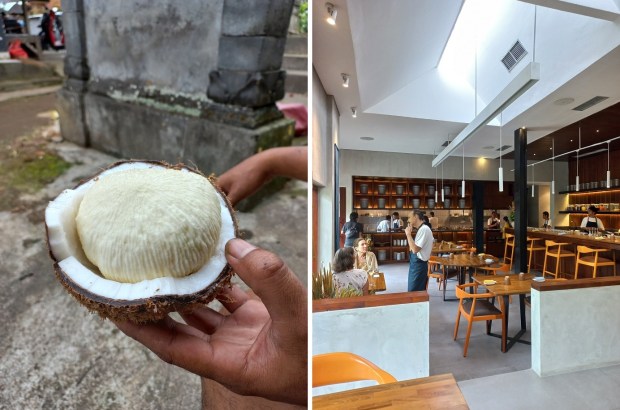
A whole coconut apple; Herbivore is a plant-based sister restaurant of Locavore NXT
Another highlight was the just-opened Locavore NXT, whose impressive new digs on Ubud’s outskirts have replaced a much smaller spot in the center of town. With rooftop permaculture gardens, a lounge and bar hosting occasional workshops, a basement mushroom-growing chamber, and a koji fermentation room, Locavore NXT is far more than a place to eat. The quirky tropical Brutalist design matched the astonishing 20-course seasonal menu: just about every dish proved imaginative and fun. (Just the other week, a well-traveled journalist based out of Singapore emailed me to say Locavore NXT was easily the best restaurant he’d been to in years.) Before dinner, chef-owners Ray Adriansyah and Eelke Plasmeijer very kindly sat down for an hour-long interview at the restaurant’s quiet coffee bar even as service was about to begin. What transpired was a thought-provoking discussion that touched on their close working relationship, the challenges of using only Indonesian ingredients, and the genesis of NXT. Eelke told me the place had grown to a scale beyond their wildest dreams—it now employs close to 100 people. “Things got a little out of hand,” he chuckled.
Joining me at NXT (and tagging along for the rest of the trip) was seasoned British photographer Martin Westlake, who first arrived in Indonesia in 1988 as an offshore surveyor in the oil industry and never left. His towering height and serious demeanor might seem intimidating at first, but I found him warm and quick to crack a joke, sometimes to the bemusement of restaurant servers. For this specific project I stepped in as his producer, setting the schedule, arranging transport (mostly through the ride-hailing app Gojek), and organizing photo shoots at each of the locations.
Since this wasn’t a hotel-centric story, I spent most nights between two cheap and cheerful guesthouses in the center of Ubud. These no-frills stays bookended a brief sojourn at NXT, where Eelke and Ray put the two of us up in their brand-new cabins. Known as The Wood Rooms, they were downright luxurious: each one had a plush bed to sink into, padded armchairs, a minibar stocked with handpicked goodies, and a spacious bathroom as well-designed as that of a stylish boutique hotel. Sliding glass doors opened out to a porch with a picnic table overlooking the restaurant’s vegetable plots and the neighboring rice paddies. Completing the bucolic scene was a forest backdrop and Mount Batukaru—Bali’s second-highest summit—peeking out above the swaying coconut palms.
The next morning, after a stroll through the roof gardens, I wandered down to the staff canteen for a hearty Western breakfast cooked up by Boss and another chef. Martin and I had our fill of sourdough, fried eggs, bacon and homemade pork sausages, omelet-sized hash browns, and a delicious kale and pumpkin salad. Much to my delight, slices of the luscious white mangoes I’d enjoyed so much at Pak Agung’s food forest soon materialized on a separate plate. I dug in and quickly polished them off, but not before snapping a photo for memory’s sake. ◊
* * *
Postscript: The full online version of the story I wrote for DestinAsian magazine can be found here—The Best Restaurants in Ubud to Visit Now.

Tropical Brutalism at Locavore NXT; a spread of local snacks at Pak Agung’s food forest.
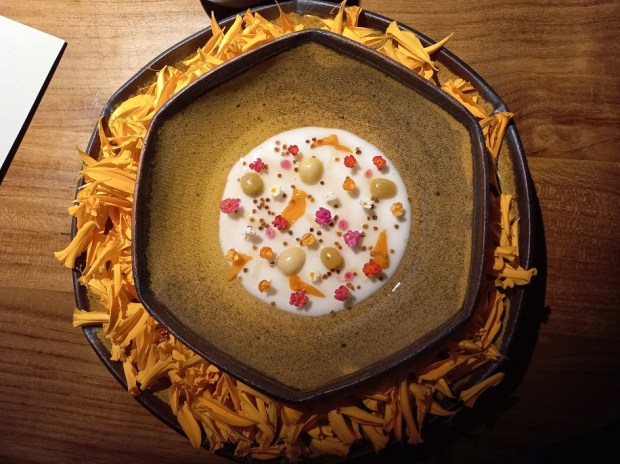
A dish of rice koji, pink guava, bee pollen, and gooseberries at NXT
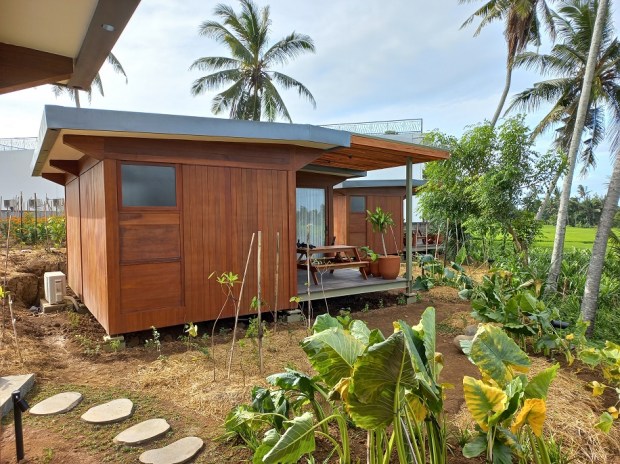
Guests visiting Locavore NXT can stay overnight in three on-site cabins
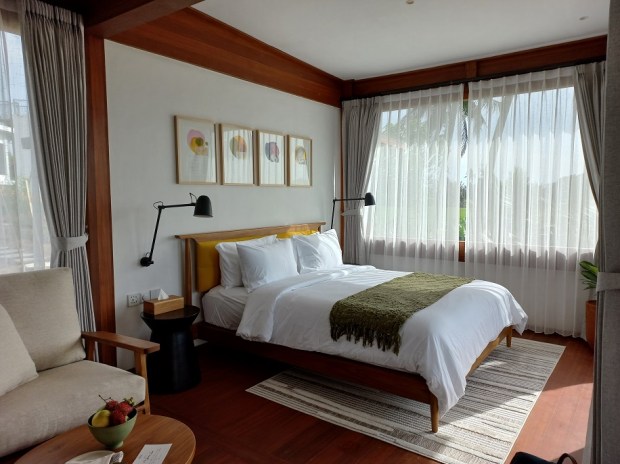
Inside one of the cozy new cabins known as The Wood Rooms
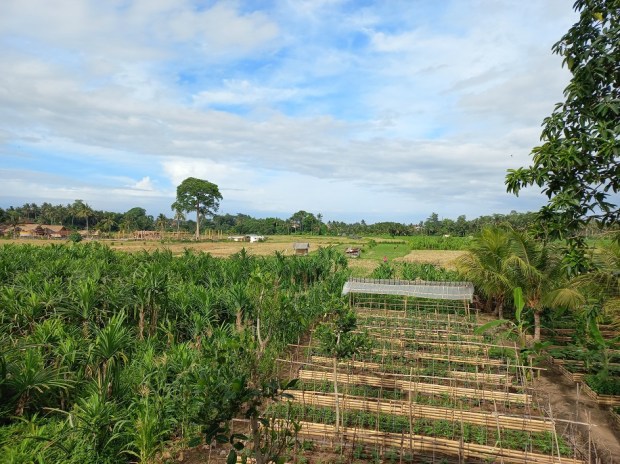
Looking out over vegetable plots and rice paddies from my cabin’s front porch
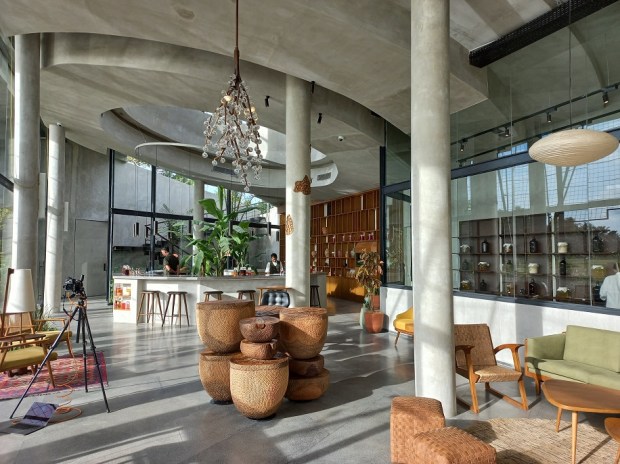
Preparing for a photo shoot inside Locavore NXT’s bar and lounge
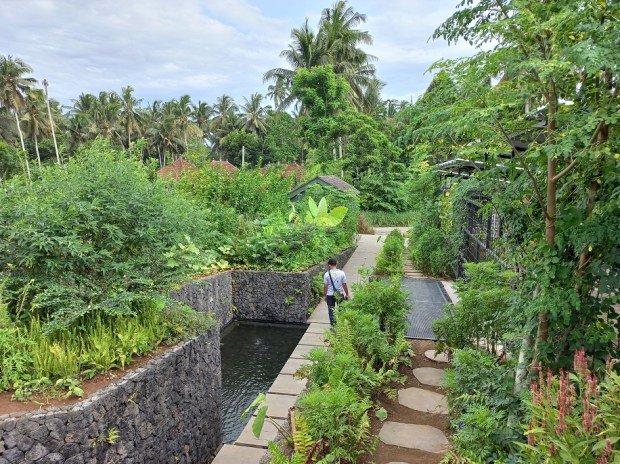
The view down a ramp from the rooftop permaculture garden at NXT
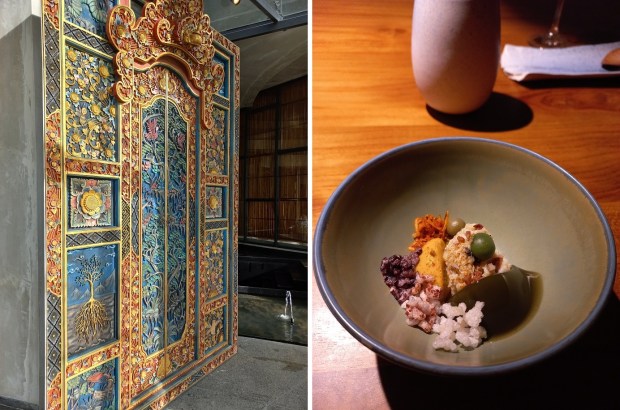
A handcarved pivot swing door at NXT; this dish features local heritage rice and mud crab




 Plus Ultra
The foods that you try on all your travels are so colorful and scrumptious looking! New tastes to try are one of the most fun parts of traveling to different places. We live in southern Mexico most of the year, and it’s quite amazing how many variations a taco can have throughout the country! I enjoy ALL of your blogs, both the information and photos, though I may not leave comments. Keep traveling!
Thank you for the lovely comment, Marilyn! A Canadian uncle of mine recently spent about 10 days in Oaxaca and shared some pictures of what he ate in the family WhatsApp group – including enmoladas and some very creative-looking modern dishes. Mexico happens to be at the very top of my travel wish list, partially because of its diverse cuisine. If only it weren’t so far away and hard to get to from where I live!
Such an interesting article James, it looks like the Bali food scene is flourishing! I think I am the only Australian to never have been to Bali yet – only because it’s full of Australians and I’d rather go somewhere where I’m not surrounded by my fellow countrymen/women! lol. But I should change that, it looks like it has so much to offer if you find the right spots!!
You should, Anna! I used to have a similar mindset about Bali until Bama convinced me to travel there for the first time in December 2013. I haven’t looked back since—it is such a special island with incredible natural beauty, rich craft traditions, and a deeply spiritual culture that could teach the wider world so much. If/when you go, my advice would be to steer clear of the busier resort areas in the south.
Yes when I do go I won’t be going anywhere near a resort! I would definitely seek out the quieter places!
I remember how hard it was to convince you to go to Bali. But now it looks like you’ve fully embraced the island’s charms. You know it much better than I do now, which is unsurprising since my last trip there for a holiday was nine years ago! The royal palace of Ubud and those intricate decorations at the guesthouse really make me miss Bali even more. How cool it is that you got to try some fruits and leaves which I believe a lot of Indonesians are unfamiliar with. I’m particularly intrigued by the coconut apple and wani. Given the latter’s classification in the same genus as mango and kemang, I can only guess how it tastes.
Considering my reluctance not so long ago, it is funny that I seem to go quite often these days for work! I’ve been counting the number of times I’ve visited Bali and the latest trip was actually my 11th. Fingers crossed you’ll get to try both coconut apple and wani during a Bali holiday in the not-so-distant future!
Best job in the world, eat and travel on company money.
Indeed—I’m a very lucky fellow!
Wait… all these years I’ve been reading a writer? Wow. No wonder you write so well.
You know I chuckled at you not knowing what a papaya tree looks like then I realized I had no idea either. I had to quickly Google it which I had to do again with the Sago grub. You’re an adventurous eater. But I do like creamy pudding type foods too. Hmm…
Now I’m going to read up on those other fruits and your article.
Matt, you’re too kind… writing has been my profession since 2012, but I’m still learning from those who have been doing it for longer.
Actually, the sago grub wasn’t the most extreme thing I tried in Bali. Right after that, I was presented with a live cricket to be barbecued and eaten with the head and limbs removed. It’s not something I will likely have again—the sago grub tasted much, much better!
This is all so wonderful. I mean it’s Bali! Of course it’s wonderful! Your post made me long to return, and to sample some of these places. Lovely.
Alison
Alison, I really hope you and Don make it back to Bali sometime. It may seem beyond reach the way things are now, but you never know!
What a job you have! And so richly deserve, as you have every skill needed for it – innate curiosity, intelligence, open-mindedness, bravery (I’m such a wimpy eater), and of course an incredible command of language which brings all of your talents together and allows all of us to benefit. I read both articles and enjoyed them greatly. (I had to look up the phrase “rode pillion,” and now I hope to get to utter it someday!
Thank you so much for the high praise, Lex—those words mean a lot to me! I’ve learned (and am still learning) from fellow bloggers like yourself and the excellent writers I’ve read or encountered while on the job. Hope the novel has been progressing well and life in North Carolina has been treating you better since your last post!