
A Fresh Perspective on Penang
You never know who you might meet on your travels. Back in February, on the first night of a weeklong assignment on the Malaysian island of Penang, I found myself sampling cocktails at a speakeasy called Backdoor Bodega. Though I was tempted to call it an early night, I couldn’t help striking up a conversation with the friendly American couple seated next to me at the counter. They told me they lived in South Carolina and were visiting on their honeymoon. Out of respect for their privacy, I’ll refer to them as Bruce and Shayla instead of using their real names. “We thought of New Zealand, but we wanted to go somewhere completely different,” Shayla told me. “A place with a different culture, and where people don’t look the same as us. We wanted to be pushed a little out of our comfort zone.”
The newlyweds had arrived earlier from Singapore, and we quickly bonded over a shared love of food and a willingness to discuss serious topics. I was astonished by the depth of the conversation that unfolded over the next two hours — it touched on everything from Southeast Asian history and race relations to international politics and American food culture. Before retiring for the night, Shayla and I exchanged WhatsApp numbers with the hope that we’d meet again in the next few days.
A great deal has changed in the 11 years since Bama and I last set foot in Penang during our six-month Spice Odyssey. I barely recognized the place from all the newer high-rise buildings on the drive from the airport into George Town, the island’s capital. It was only when I saw Komtar Tower, a 12-sided cylindrical skyscraper I remembered from a childhood visit, that I realized I was in familiar territory. This 249-meter (816-foot) structure, the defining landmark of George Town’s skyline, was once the tallest building in Southeast Asia. Over the first few days of the trip, when I stayed at a cheap hotel one block away, I used its illuminated glass crown as a navigational tool to find my way back each night.
Most of my week was spent exploring and interviewing creative folks who had established small businesses of their own. It became clear that the scale of their projects was deeply influenced by the urban fabric of George Town’s UNESCO-listed historic core, dominated as it is by heritage shophouses with a narrow street frontage and deep footprint, engendering a certain level of intimacy.
Dinners were almost always preceded by conversations with talented local chefs, some from mainland Peninsular Malaysia, others born-and-bred Penangites who had returned from Singapore to make their own contributions to their home island’s dining scene. At Curios-City, a former warehouse turned industrial-cool restaurant, twentysomething head chef Adrian Tan excitedly spoke of blending Malaysian flavors and European techniques, using Penang-sourced ingredients like flower crab and sea snail, stingless Trigona bee honey, and coconut flower nectar.
I also spent a few hours at the studio of ceramicist Belle Yeoh, who left the corporate world after Covid and pivoted to her true passion in pursuit of a slower, more intentional lifestyle. Fashion designer Kang Pei Shern had a similar story to tell: she trained as a doctor and worked in pharma companies before starting her brand Betterthanblouses, which turns heritage batik fabrics into casual-chic everyday wear with edgier silhouettes. I soon discovered that many of my interviewees knew each other personally; that tells you something about the sense of community in Penang’s creative circles.
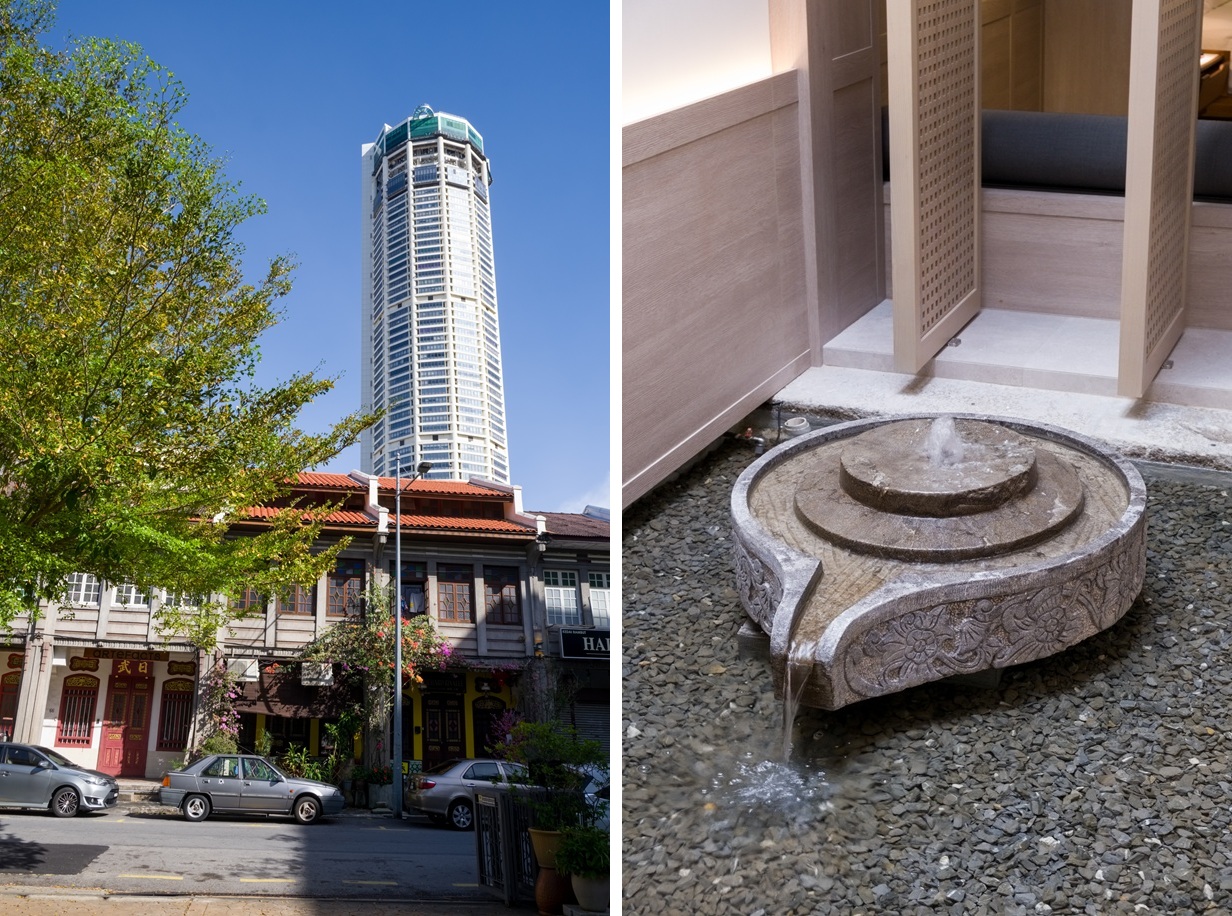
Komtar Tower looming above a row of shophouses; a rice-grinder fountain in a suite at Soori Penang
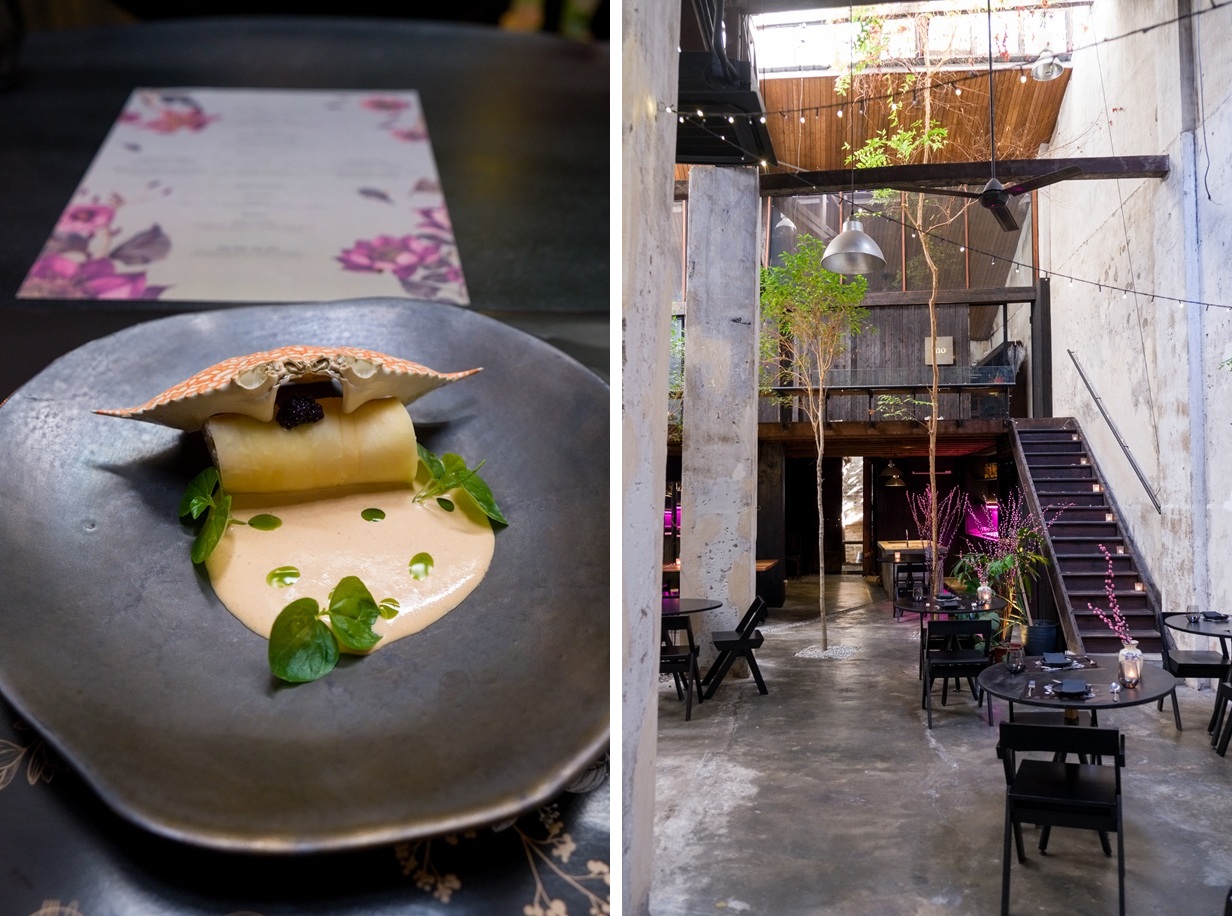
A papaya roll stuffed with flower crab and mud crab at Curios-City; the restaurant’s interior
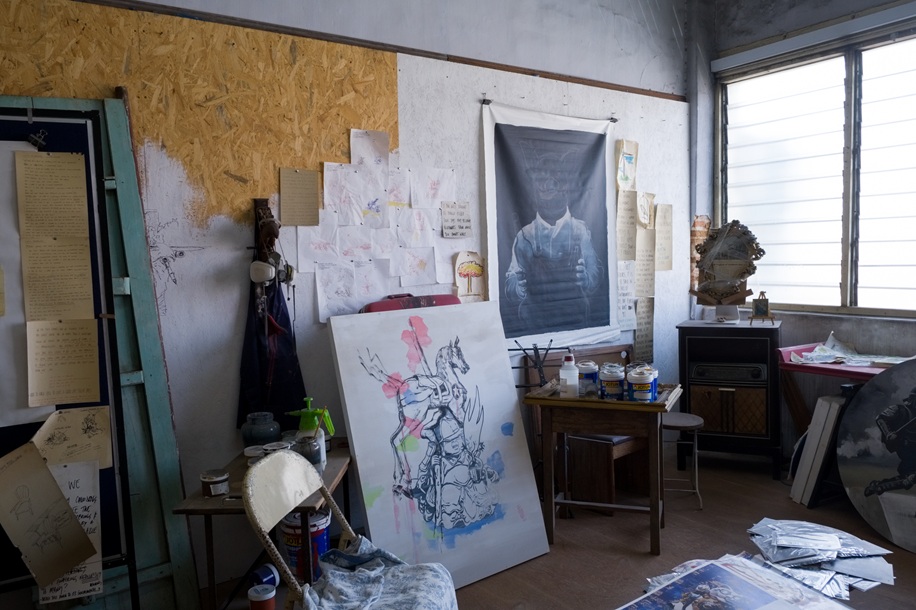
The Betterthanblouses boutique has a studio for its designer’s artist husband, Thomas Powell
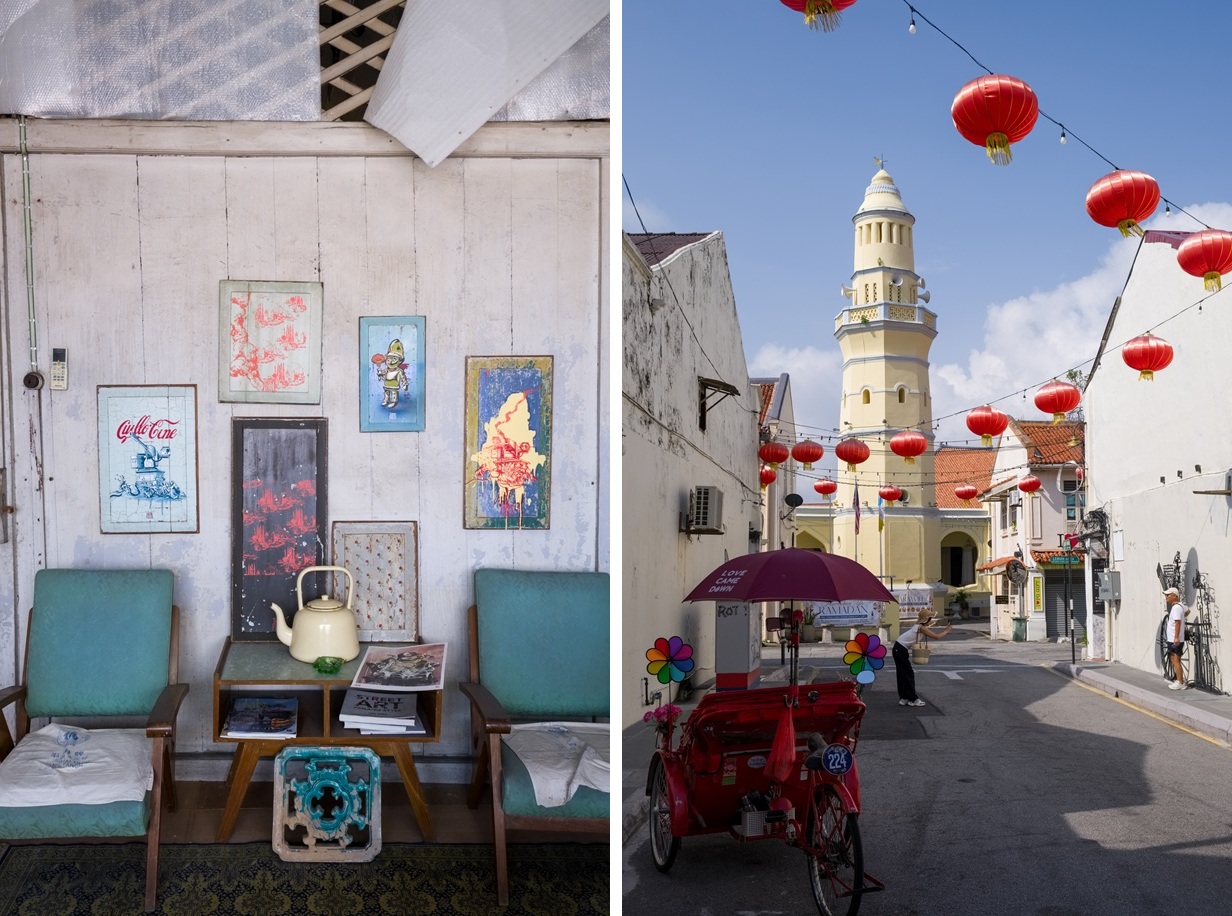
Antique furniture and art at Betterthanblouses; the minaret of Acheen Street Mosque
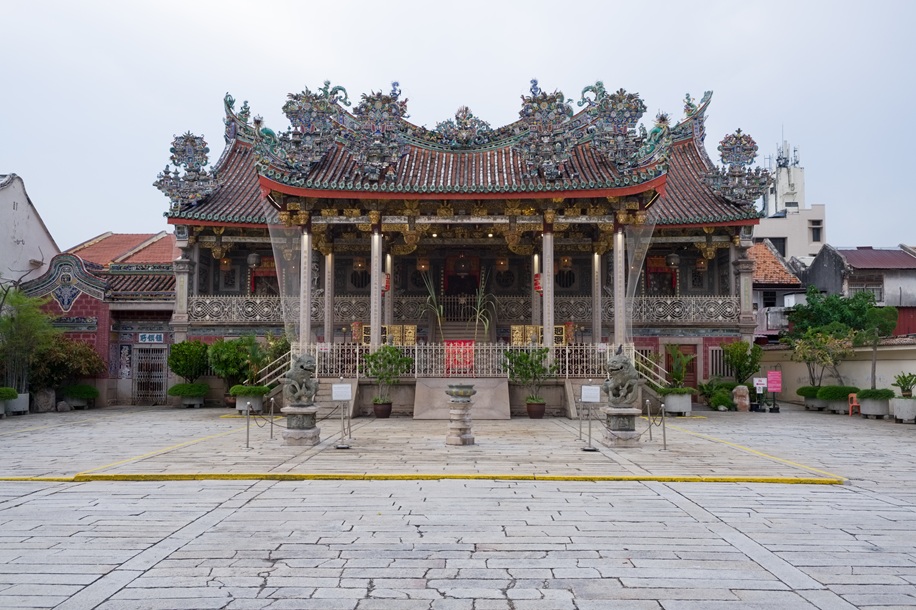
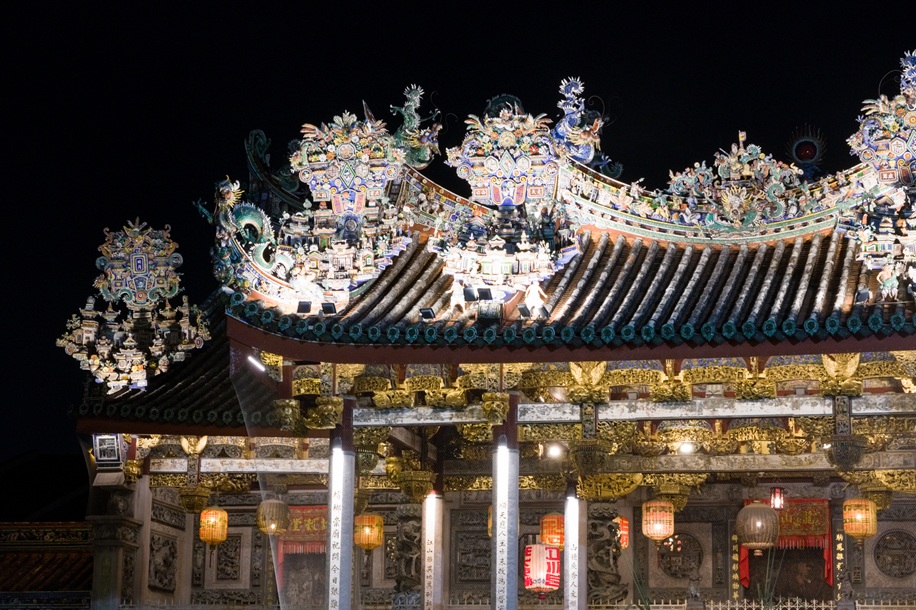
Leong San Tong Khoo Kongsi, Malaysia’s most opulent Chinese clan house and temple
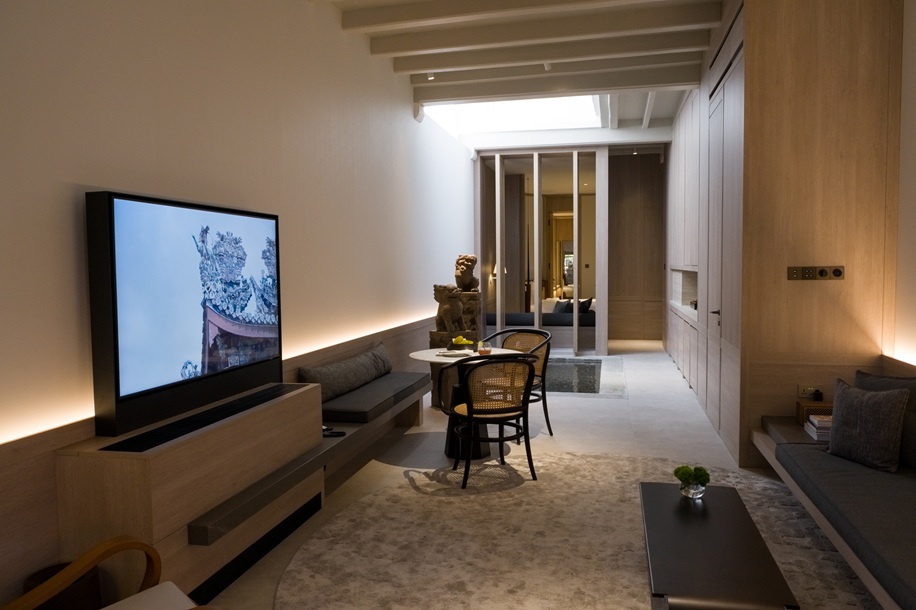
The living room of a shophouse-size suite at Soori Penang
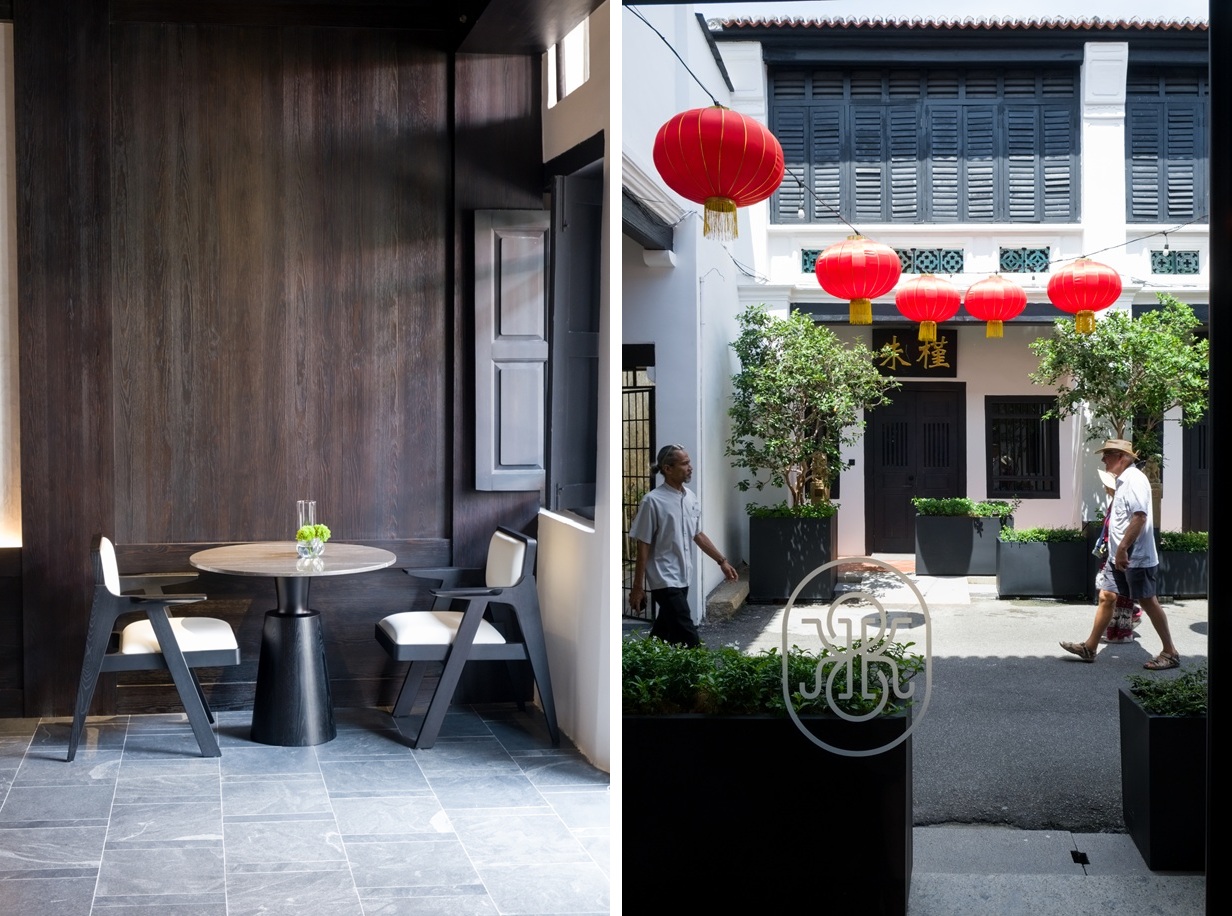
Seating in the hotel’s lounge and wine bar; looking out at the facade of a shophouse suite
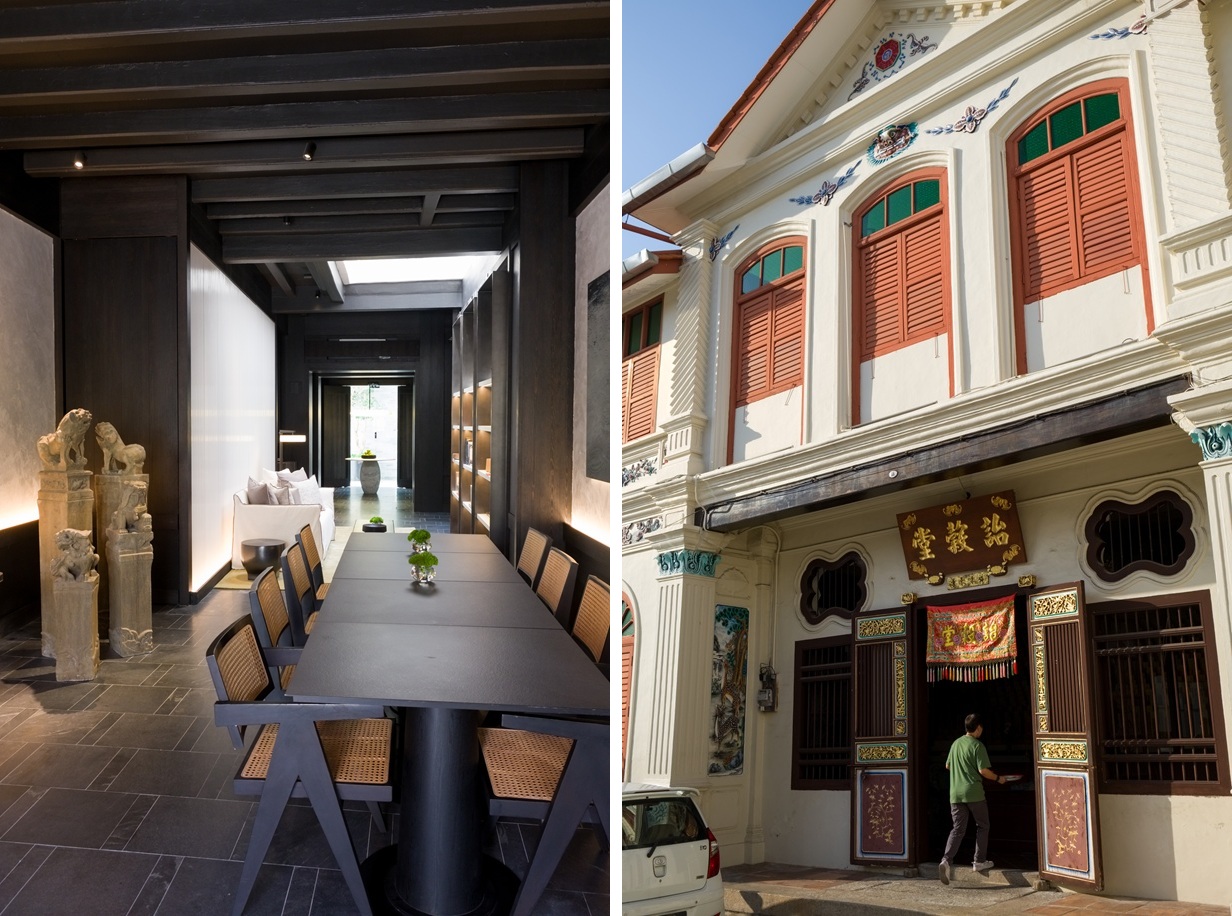
Soori Penang’s communal lounge; early morning at the Khoo Kongsi compound
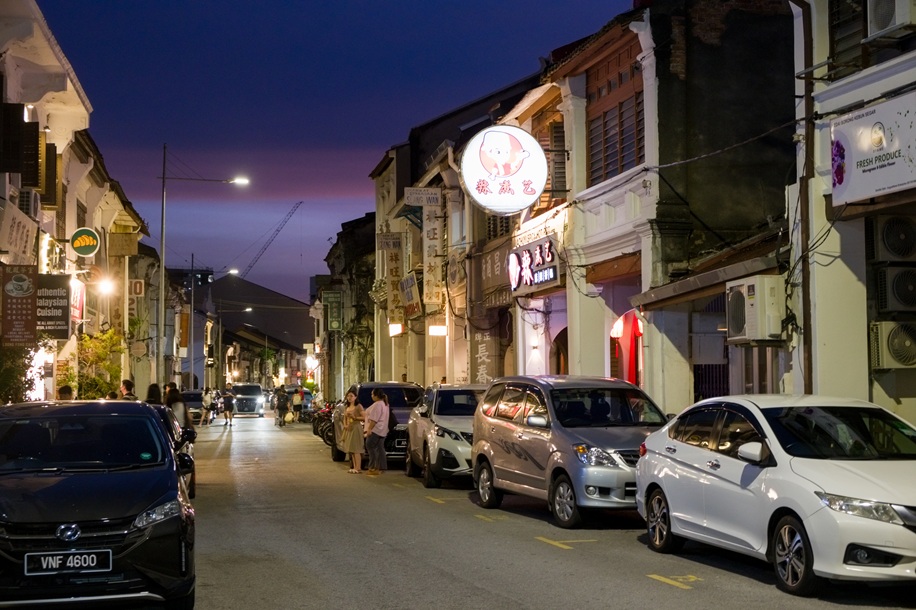
Dusk falls over the heritage shophouses along Beach Street
George Town’s boutique lodgings were also an integral part of the story. Something I wasn’t quite prepared for was the transition from a windowless ground-floor room at that budget hotel near Komtar Tower to Soori Penang, a new ultra-luxe retreat contained inside two rows of 19th-century shophouses, each converted into a suite with a skylighted pool and fountain. Not everyone will appreciate a minimalist bolt-hole with little in the way of natural light. But as someone who prefers to sleep in total darkness, the windowless bedroom at Soori Penang suited me just fine.
I had some free time the afternoon I checked in to the Soori, so Bruce and Shayla agreed to meet at a café-restaurant a short walk away. Over iced coffee and smoothies, they raved about the plates of smoky char kway teow they had enjoyed for breakfast at Swee Kong Coffee Shop — it was so good they ordered seconds. The couple then drew an intriguing parallel with one of their favorite places in the American South. “George Town reminds us a lot of New Orleans. What we’ve noticed is there’s one very touristy strip like Bourbon Street, but once you come off that, you see all these artsy places with an eclectic, creative vibe,” Bruce told me. “And the food scene there is amazing, too!” Shayla grinned.
I didn’t get to eat char kway teow while in Penang, but I managed to track down one of my favorite local specialties on a guided tour the Soori organized for myself and two fellow Asian journalists. We stopped for lunch at a hawker center called New World Park Food City, where I ordered a large bowl of tangy asam laksa: rice noodles and flaked mackerel in a rich fish soup cooked with tamarind, spices, herbs, and shrimp paste.
The meal capped off our visit to the Pinang Peranakan Mansion — a house-museum popular with Chinese holidaymakers — and a pair of Buddhist temples in the not-so-touristed Pulau Tikus neighborhood. The first was Wat Chayamangkalaram, which has served the local Thai community since the mid-19th century. Colorful statues of mythical guardians and gleaming glass-mosaic naga serpents guarded its main building; inside, we admired a 33-meter-long (108-foot) reclining Buddha built in the 1950s. But the other journalists and I preferred the quieter Dhammikarama Burmese Temple right across the street, where visiting devotees kneeled in prayer before an enormous standing Buddha robed in gold leaf. The faintly smiling statue was surrounded by ornate, highly refined teakwood carvings; the ceilings and most decorative panels had been left unpainted, allowing the material to speak for itself.
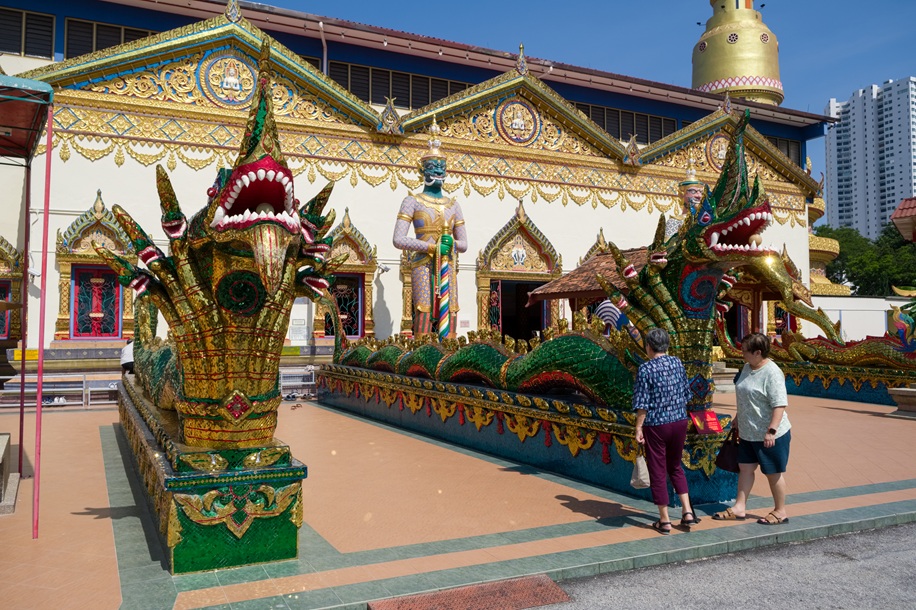
Statues of mythical “naga” serpents outside the Thai temple of Wat Chayamangkalaram
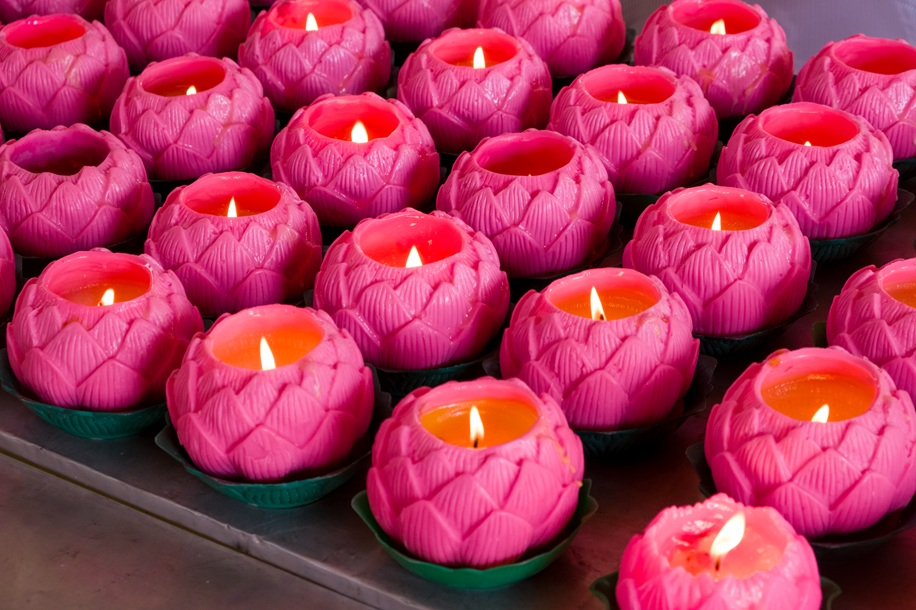
Lotus-shaped votive candles inside the temple
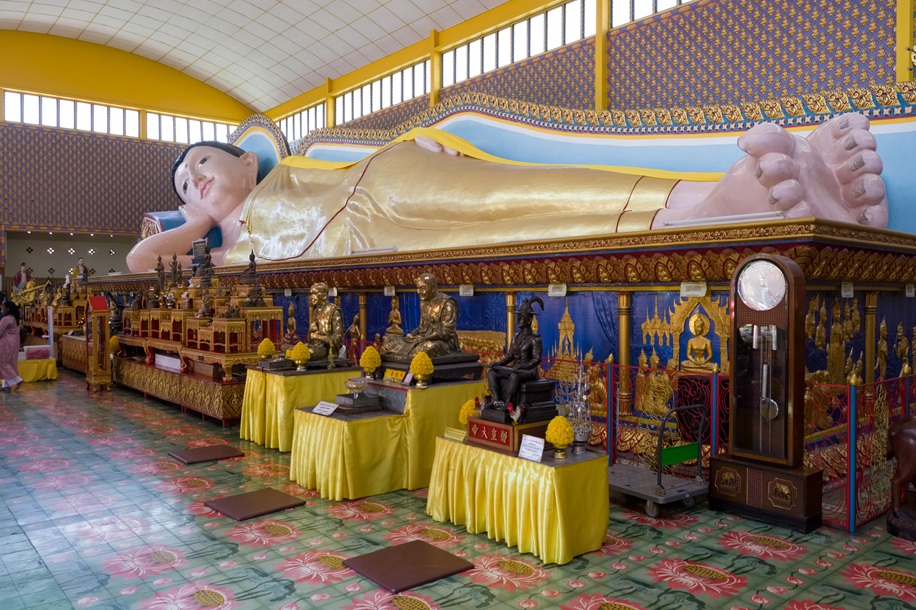
Wat Chayamangkalaram’s 33-meter (108-foot) reclining Buddha
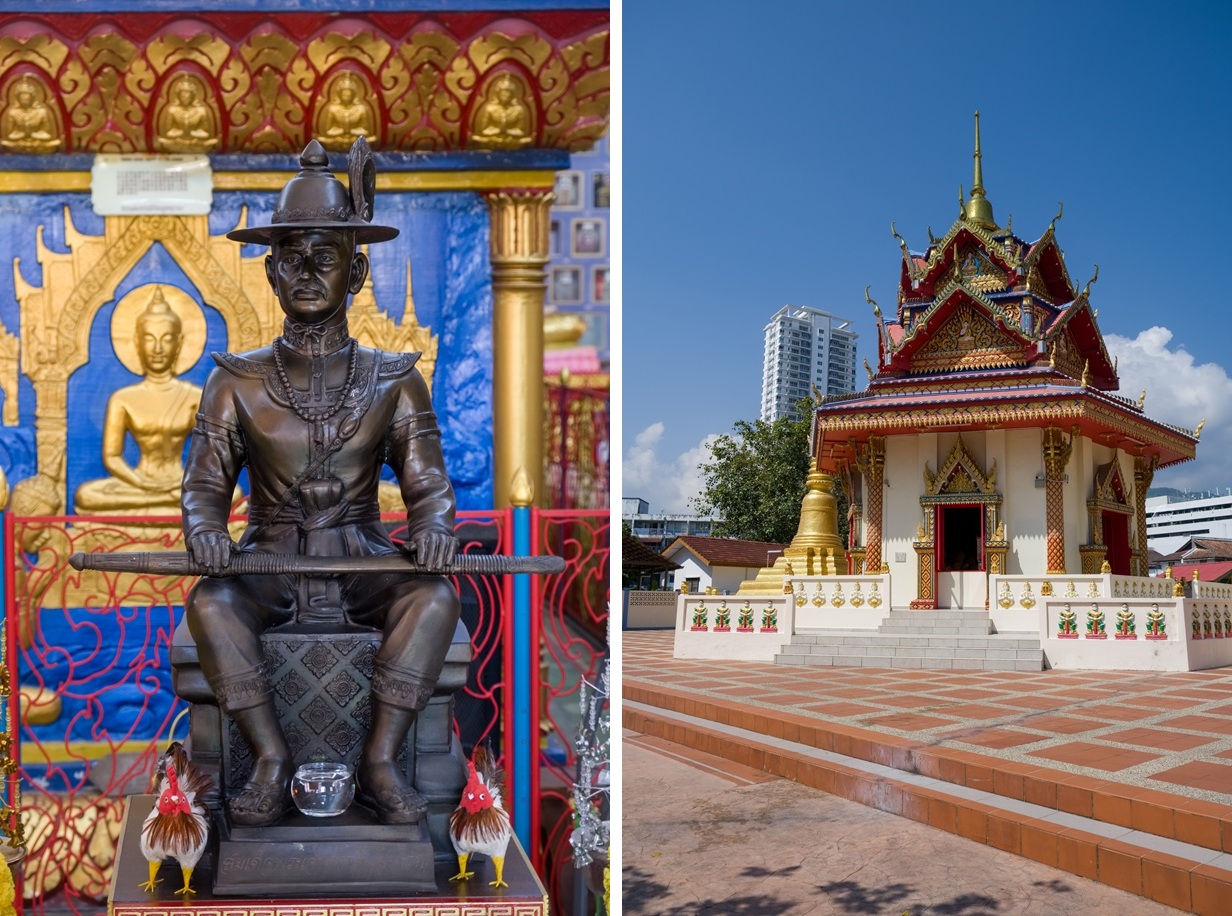
A statue of a Thai king holding a royal sword; the hexagonal pavilion on the temple grounds
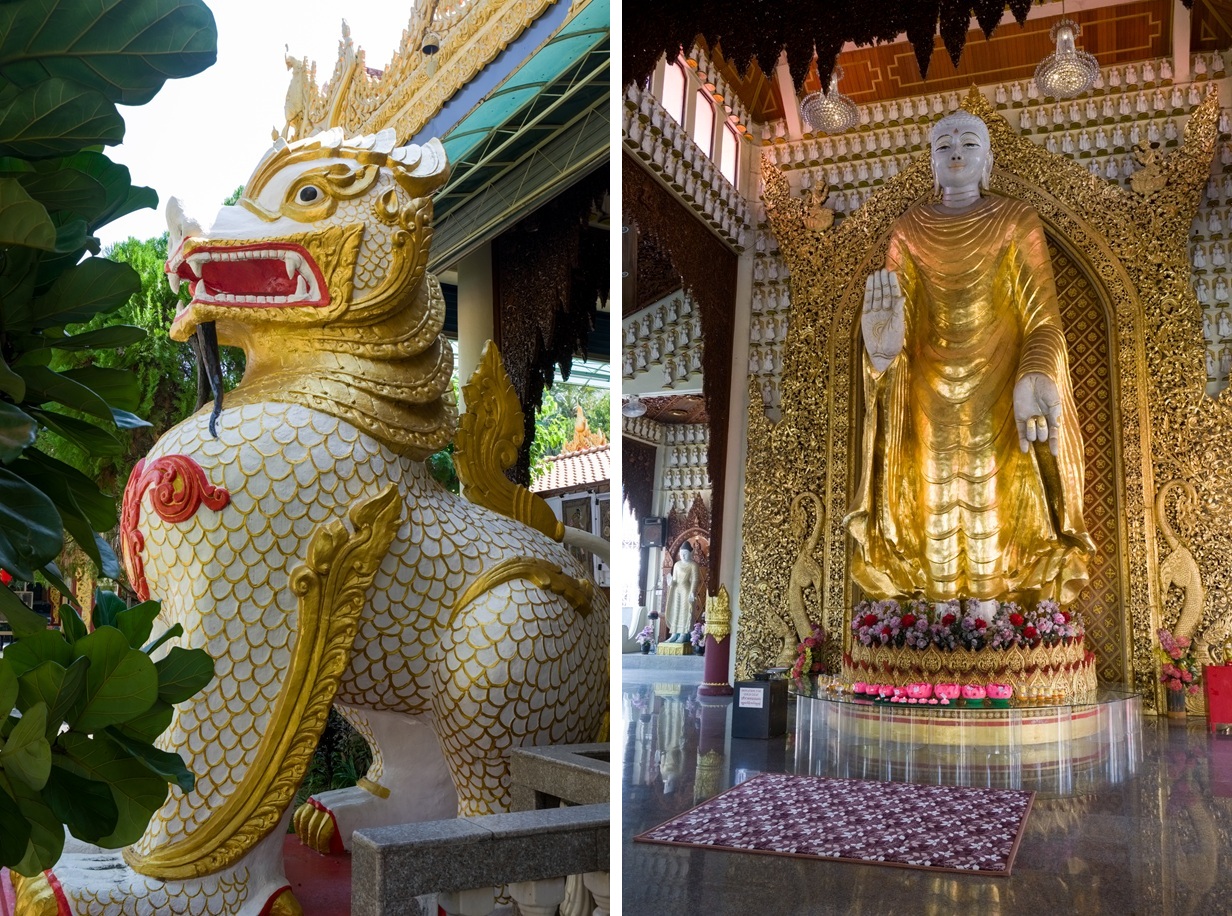
A “chinthe” guardian lion at Dhammikarama Burmese Temple; the standing Buddha inside
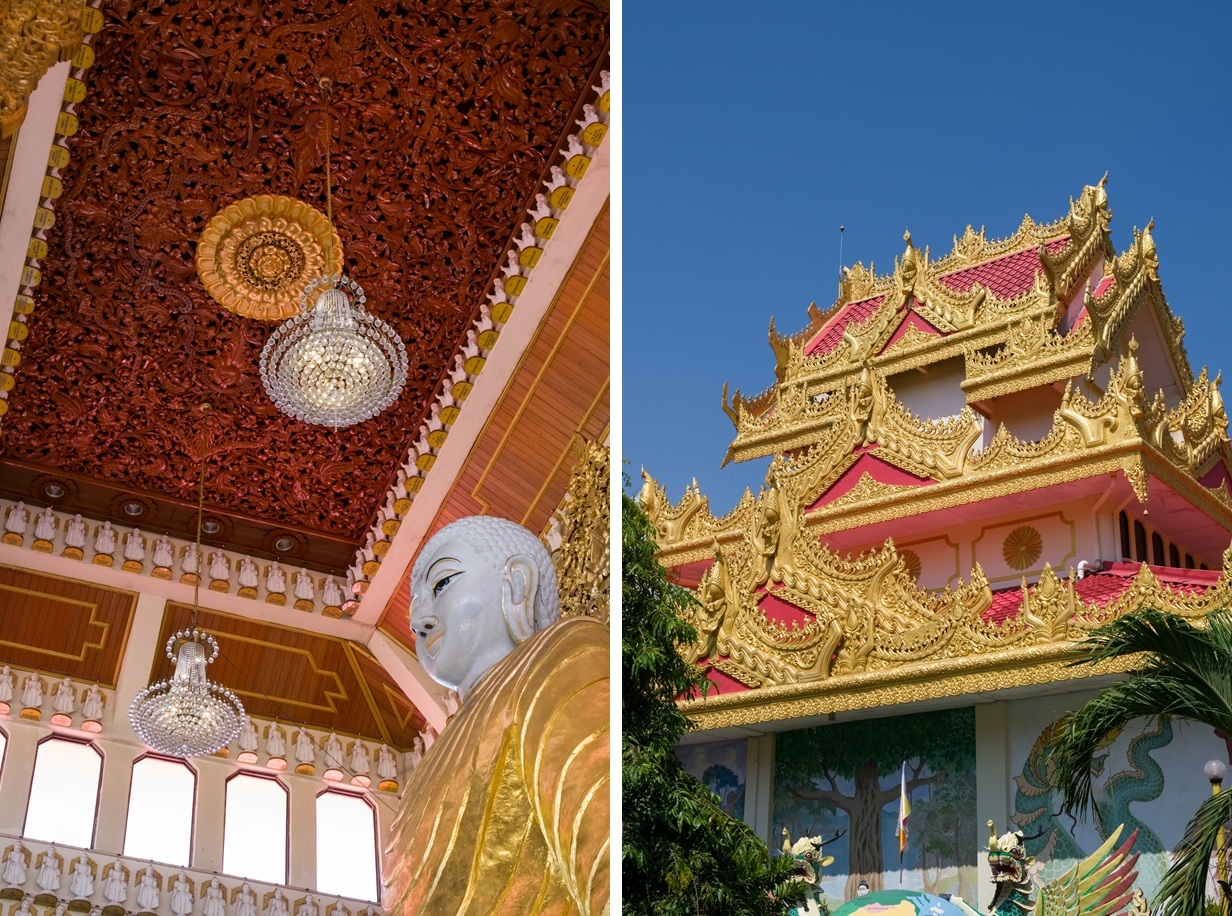
Richly carved teakwood ceiling panels above the Buddha; Burmese-style temple roofs
Being in Penang at the tail end of Lunar New Year meant lingering holiday crowds but a festive atmosphere, with streetscapes decked out in Chinese red lanterns and the distinctive pow-pow-pow of firecrackers going off at random times. The clamor came to a dramatic crescendo on the eve of the Jade Emperor’s Birthday, when fireworks were launched into the night sky from all across George Town. I had a partial view of the pyrotechnics from the historic Khoo Kongsi clan compound where the Soori is located.
Eleven years ago, I visited Khoo Kongsi with Bama without knowing much about the clan who built it. The Khoos have been in Penang for nine generations, having left the shores of southern China’s Fujian province to seek better opportunities abroad. They first arrived on the island in the late 18th century, soon after the founding of George Town by Captain Francis Light of the British East India Company. Over the ensuing decades, they became one of the wealthiest and most influential Chinese clans in Malaysia, and the Khoos eventually embarked on a building project worthy of their prestige. Named Leong San Tong (literally “Dragon Mountain Hall”) Khoo Kongsi, it would serve double duty as their clan house and ancestral temple.
The first iteration on this site took eight years to construct, but soon after it was finished in 1901, the structure mysteriously burned down following a lightning strike on the eve of the Lunar New Year. Penangites believe the original clan temple was so grand and ostentatious it angered the gods. My fellow journalists and I were told the current building, finished in 1906, is actually a scaled-down version of its predecessor. That revelation left us slack-jawed. Our first glimpse of Leong San Tong Khoo Kongsi lit up after dark elicited gasps of delight; the sight is so magnificent it would stop anyone in their tracks.
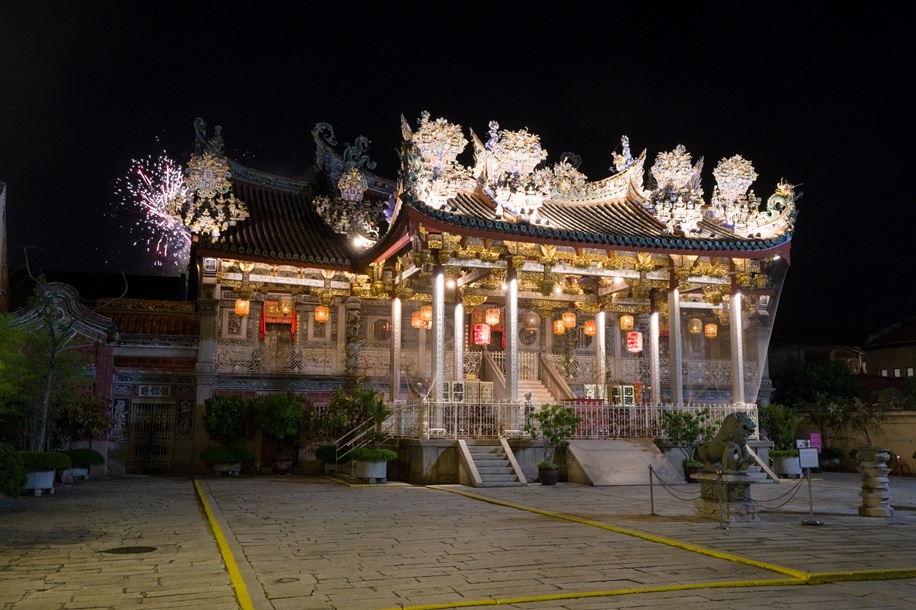
Fireworks going off behind the illuminated clan temple of Leong San Tong Khoo Kongsi
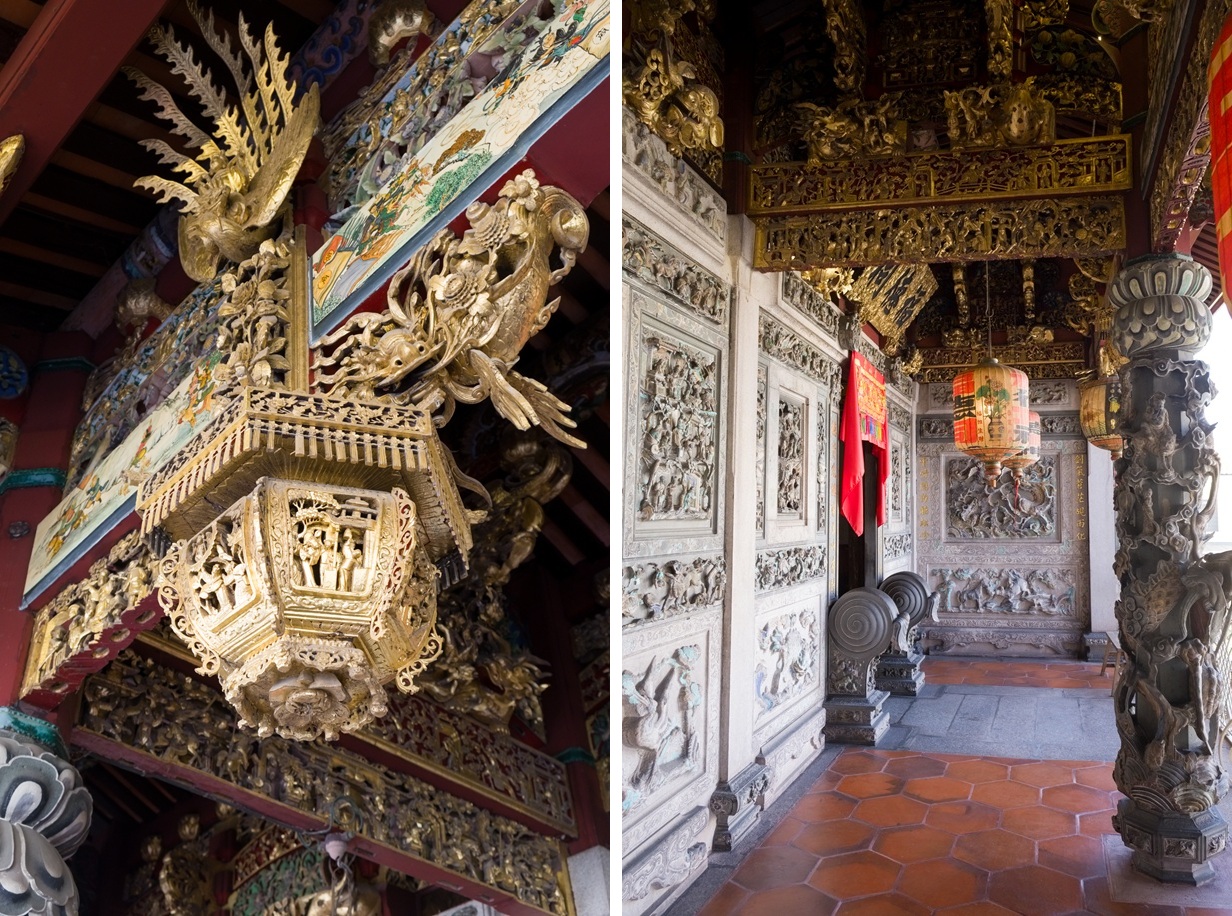
No expense was spared with the temple’s richly carved woodwork and stone panels
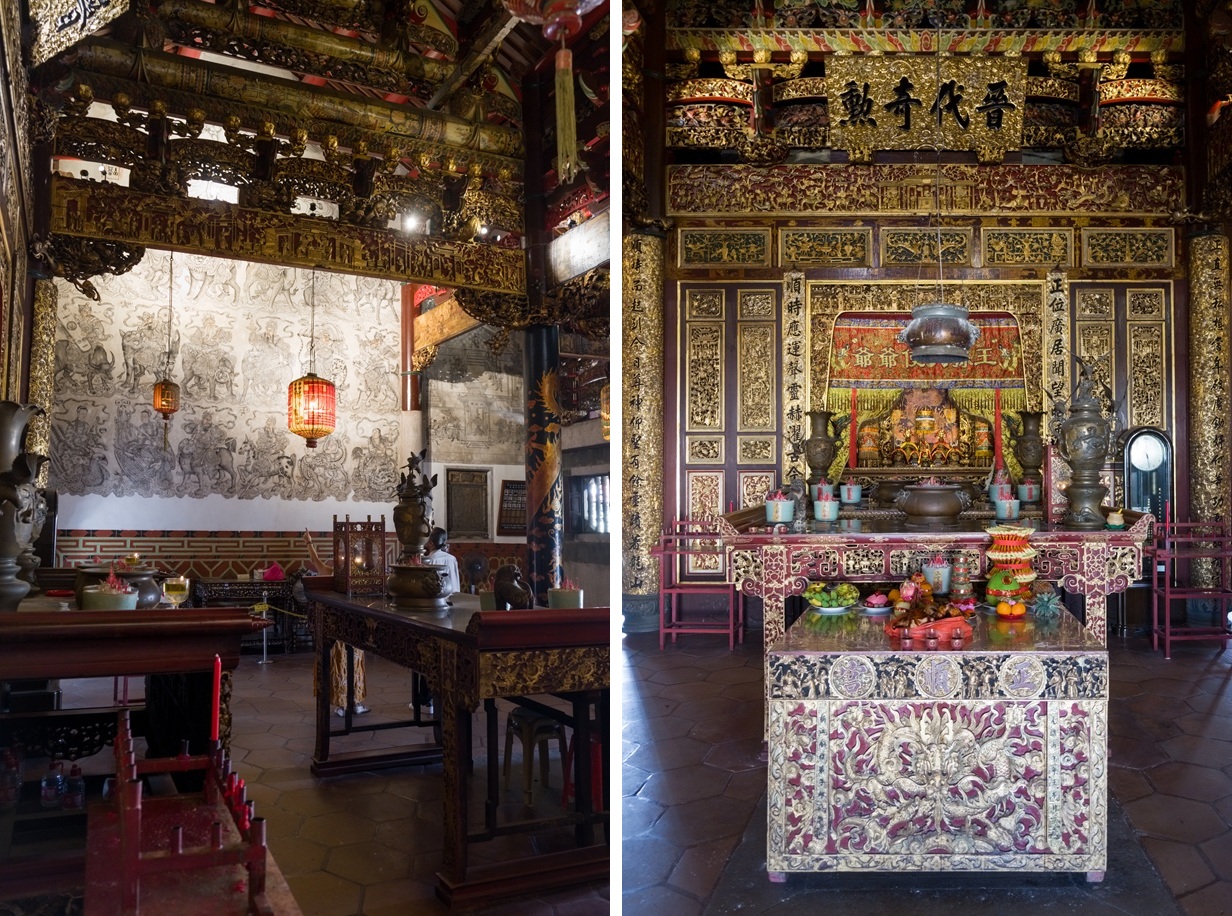
The elaborate prayer hall inside attests to the Khoos’ wealth and influence
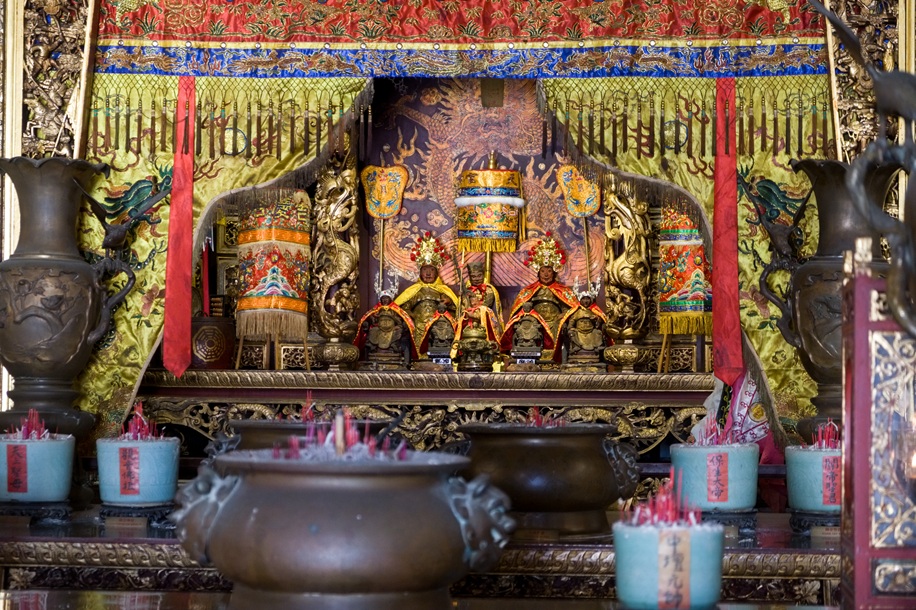
Enshrined deities at Leong San Tong Khoo Kongsi
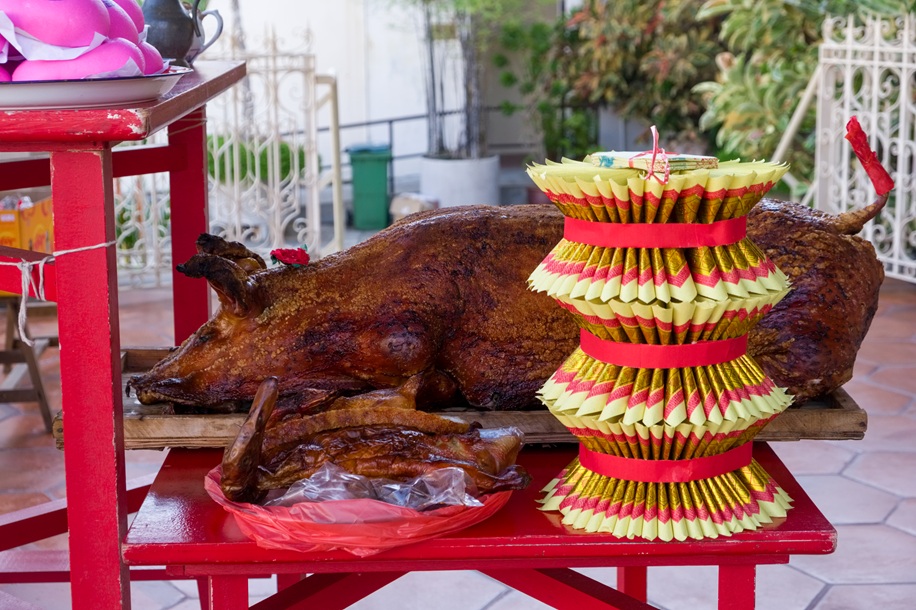
A roasted sacrificial pig and duck at the temple’s open-air prayer pavilion
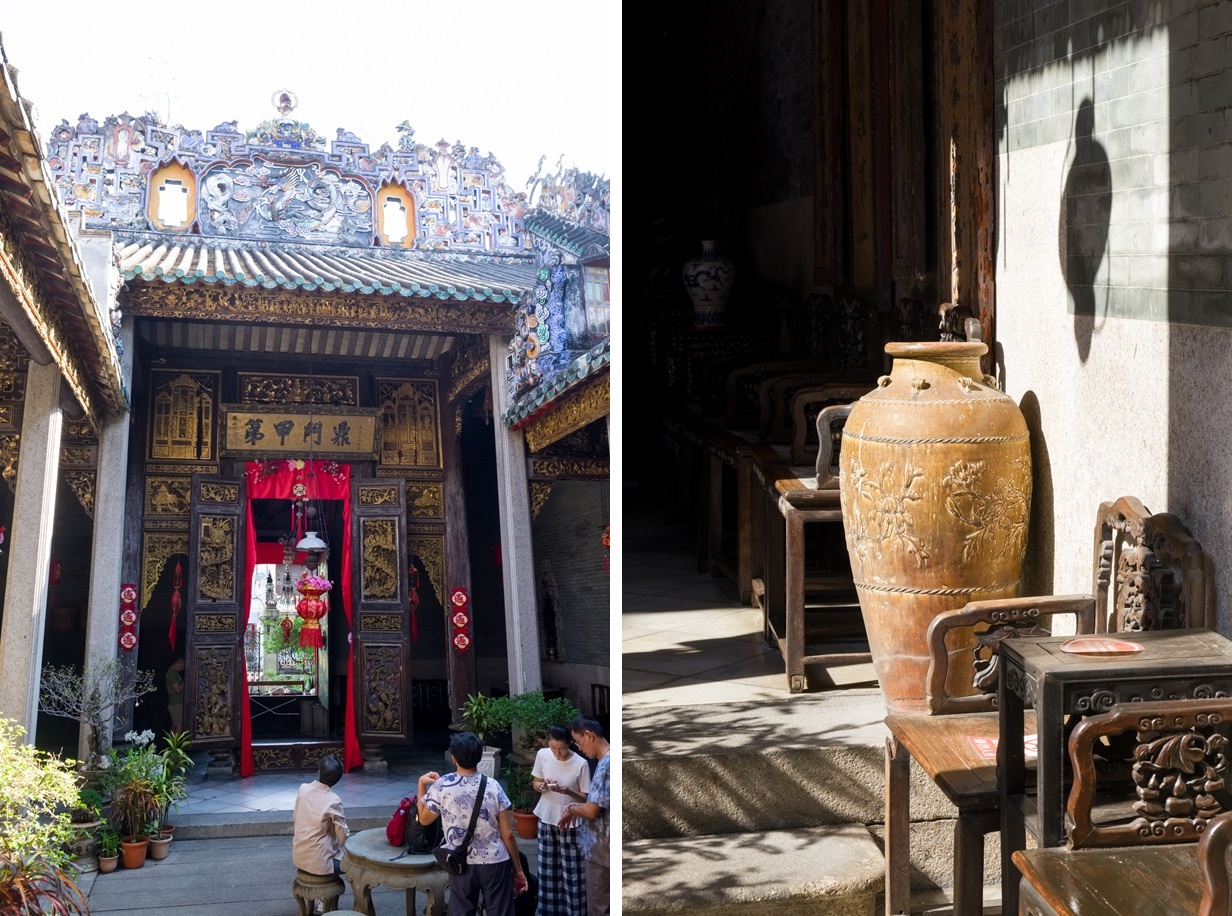
The Cantonese-style Chung Keng Kwee Temple next to the Pinang Peranakan Mansion
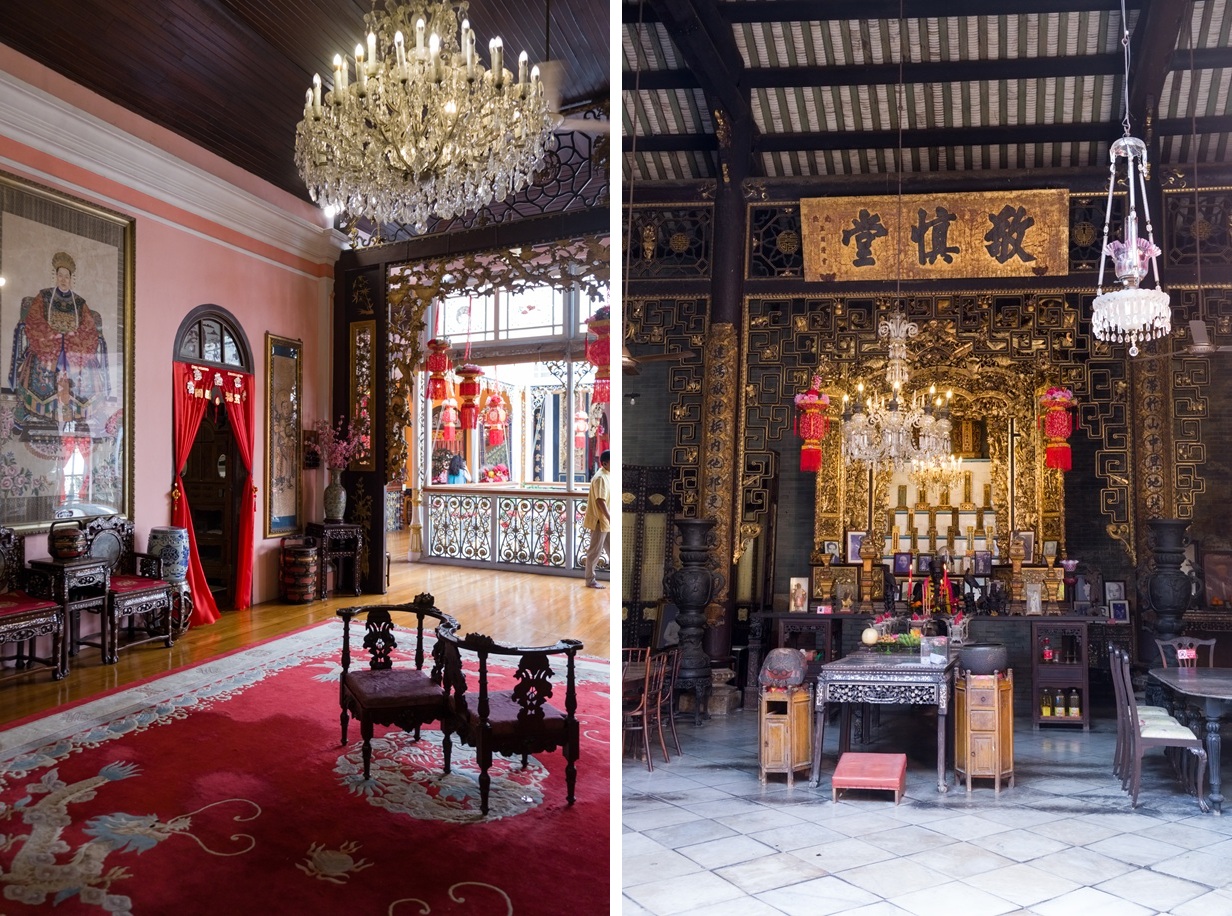
The mansion and its adjacent clan temple were both completed in 1899
After two nights at the Soori, I moved out of George Town’s UNESCO-listed core area to Cheong Fatt Tze – The Qing Suites, the newly renovated annex of the famous Blue Mansion built by Chinese industrialist Cheong Fatt Tze. That indigo-washed landmark has starred in plenty of movies; it served as the backdrop of the climactic mahjong scene in the 2018 hit rom-com Crazy Rich Asians. I’d explored the heritage hotel with Bama on a guided tour 11 years ago, but this visit was different. Flashing my key card from The Qing Suites gave me access not only to the mansion’s main courtyard and its upstairs exhibits, but also the guests-only sections on either side. There, I enjoyed roaming the empty corridors and carpeted staircases, but never figured out the way to the swimming pool in the back garden.
The Qing Suites occupies what was once the servants’ quarters directly opposite the mansion. I found it cozy, homey, and blissfully quiet; my ground-floor suite had its own walled garden, and the room opened onto a central courtyard with a bar at one end and small round tables for satisfying breakfasts and afternoon tea. What surprised me most of all was that the price point wasn’t out of reach; guests here pay less than 30 percent of the nightly rate at the Soori.
Though I’m not much of a wellness person, the hotel was keen for me to try out their spa focused on traditional Chinese medicine (TCM). Growing up in Hong Kong meant having exposure to TCM from a young age. On our mother’s urging, my siblings and I drank bitter herbal concoctions from time to time, and in my early teens it became a last resort for treating a pervasive skin rash that no Western medicine could seem to get rid of. These days, TCM is not something I can wholeheartedly condone nor reject; while it is often brushed off as a pseudoscience outside Asia, the ideas of balance and harmony that underpin it are worth a closer look.
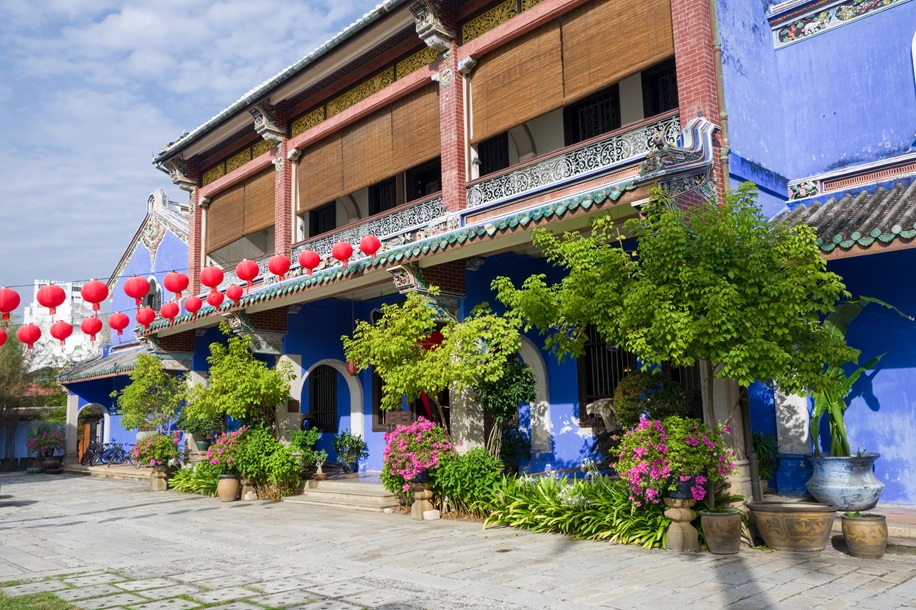
Cheong Fatt Tze’s famous Blue Mansion is an 18-room heritage hotel
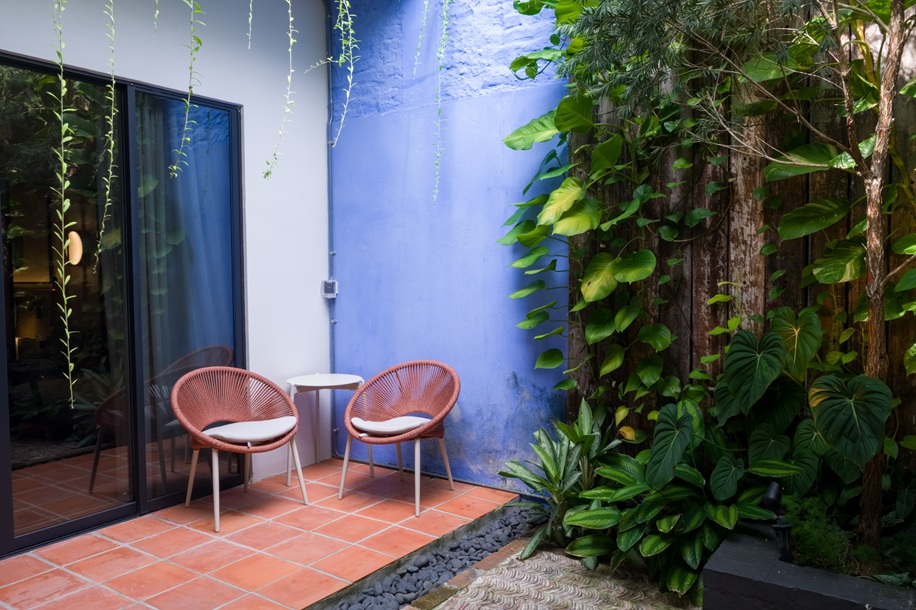
One of the private walled gardens at Cheong Fatt Tze – The Qing Suites
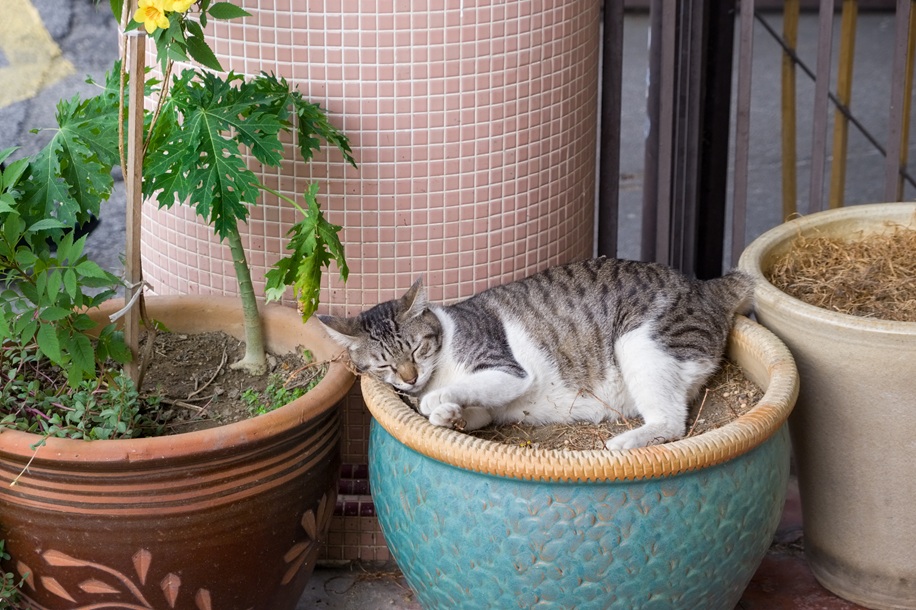
A George Town resident taking a catnap
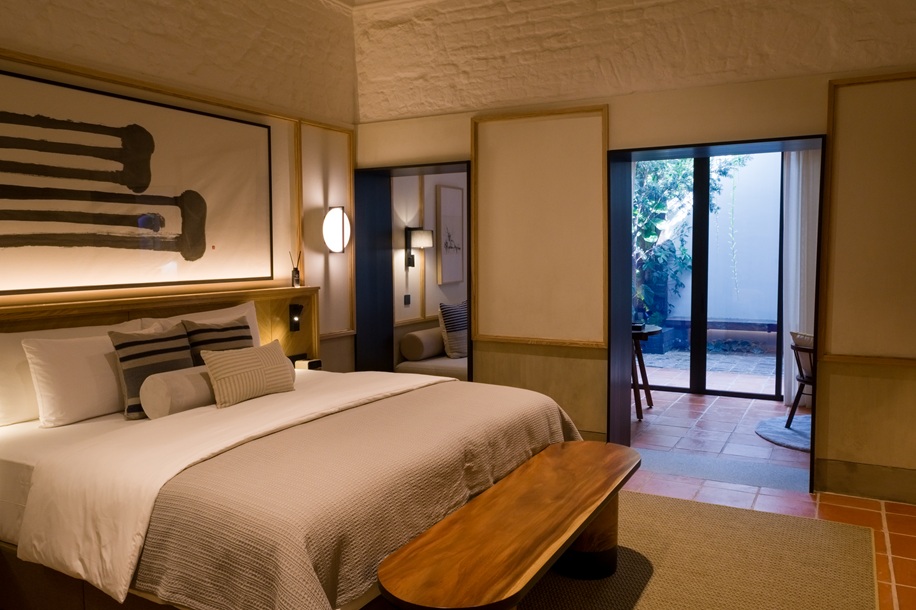
My cozy ground-floor room at The Qing Suites
My spa session at The Qing Suites began with a private consultation. A young practitioner who introduced herself as Thian took my pulse and asked me to stick out my tongue so she could examine it and take a photo. Thian’s diagnosis caught me by surprise: “Your tongue is a V shape when it should be a U. This means you are tense.” Showing me the shot of my tongue, she pointed out that its edges were swollen. “So, your liver qi is blocked,” Thian said matter-of-factly with a touch of concern. She surmised that it was related to stress and a lack of sleep, both of which had plagued me during my time in Penang. Mainly because I was running between interviews, feeling the pressure of getting a high-caliber story out of the trip, and sleeping well past my usual bedtime as dinner appointments often ended late.
Thian’s suggested treatment involved some soothing gua sha, using a smooth-edged tool to gently scrap the skin with massage oil, and acupuncture. The ultra-fine needles pricking my hands, legs, and feet did not hurt one bit. What did hurt though was the cupping therapy that followed: Thian filled bulbous glass jars with heated air and kept them in place like suction cups for seven minutes. The treatment left large circular bruises on my back for weeks and weeks afterwards. It looked as though I’d been beaten up by thugs in a George Town back alley.
The next evening, I found myself walking down a deserted alleyway from a main street to reach Lucky Hole, a warehouse-turned-restaurant where iconoclastic local chef Waymann Cheong and his kitchen team prepared one of the best meals I’ve had so far this year. Lucky Hole’s sharing plates were inventive and thought-provoking without resorting to foams and molecular gastronomy: I ordered snapper carpaccio with the flavor of a Sichuan hotpot; orecchiette with grilled unagi (Japanese eel), mushrooms, fresh egg yolk, and marmite; a fabulous eggplant schnitzel; and brined chicken breast that tasted just like ham.
I truly believe that the enjoyment of food should be a social occasion, and having good company matters at mealtimes. So I was more than thrilled to have Bruce and Shayla crash what was meant to be a solo dinner. Their presence made the experience richer and more memorable than if I’d gone and eaten alone. And, as it happens, it was the night before they were leaving for Kuala Lumpur. Five months later, Shayla and I continue to exchange regular updates about our daily lives and travels by WhatsApp and email. I knew that I’d be meeting local creatives, chefs, and artisans while in Penang, but I could not have imagined coming across two new lifelong friends. ◊
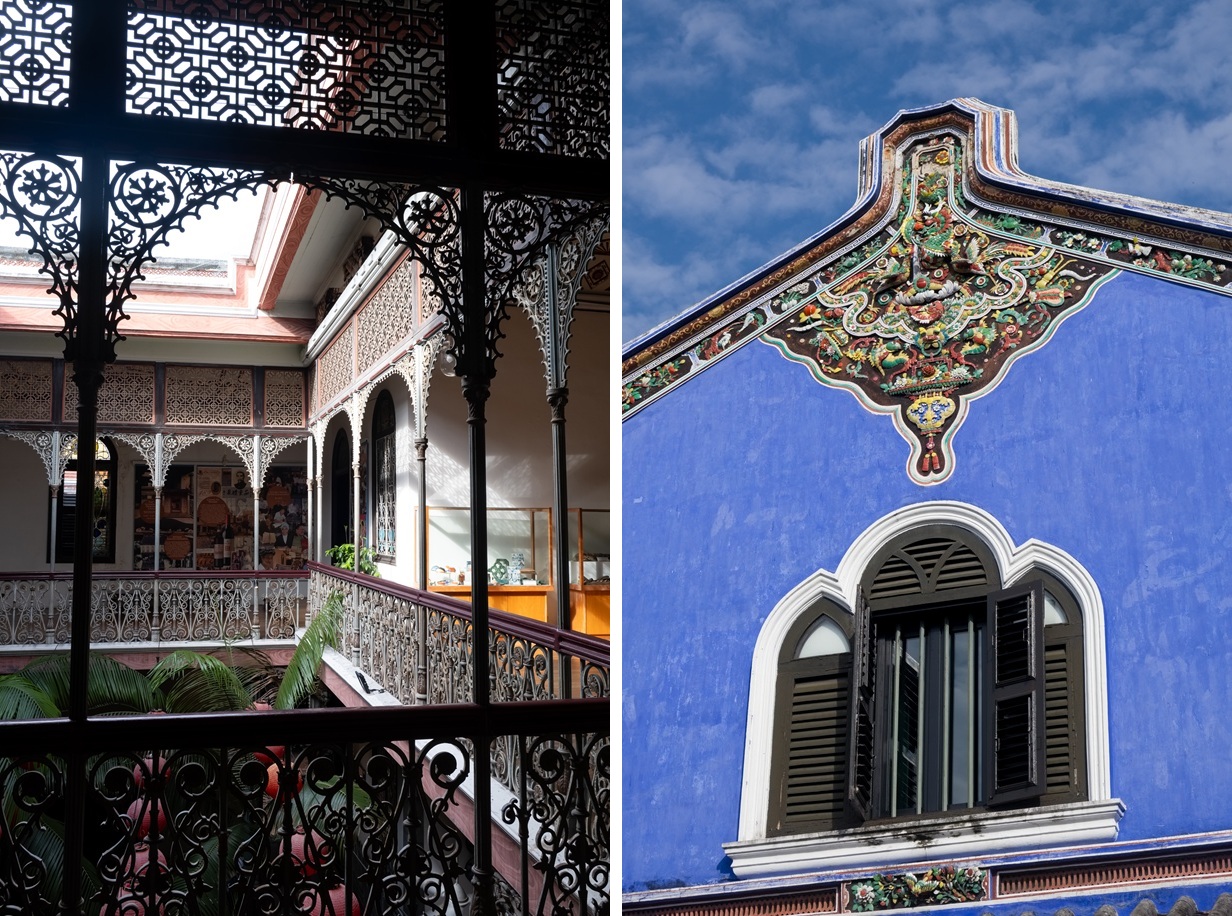
Revisiting the Blue Mansion, 11 years later
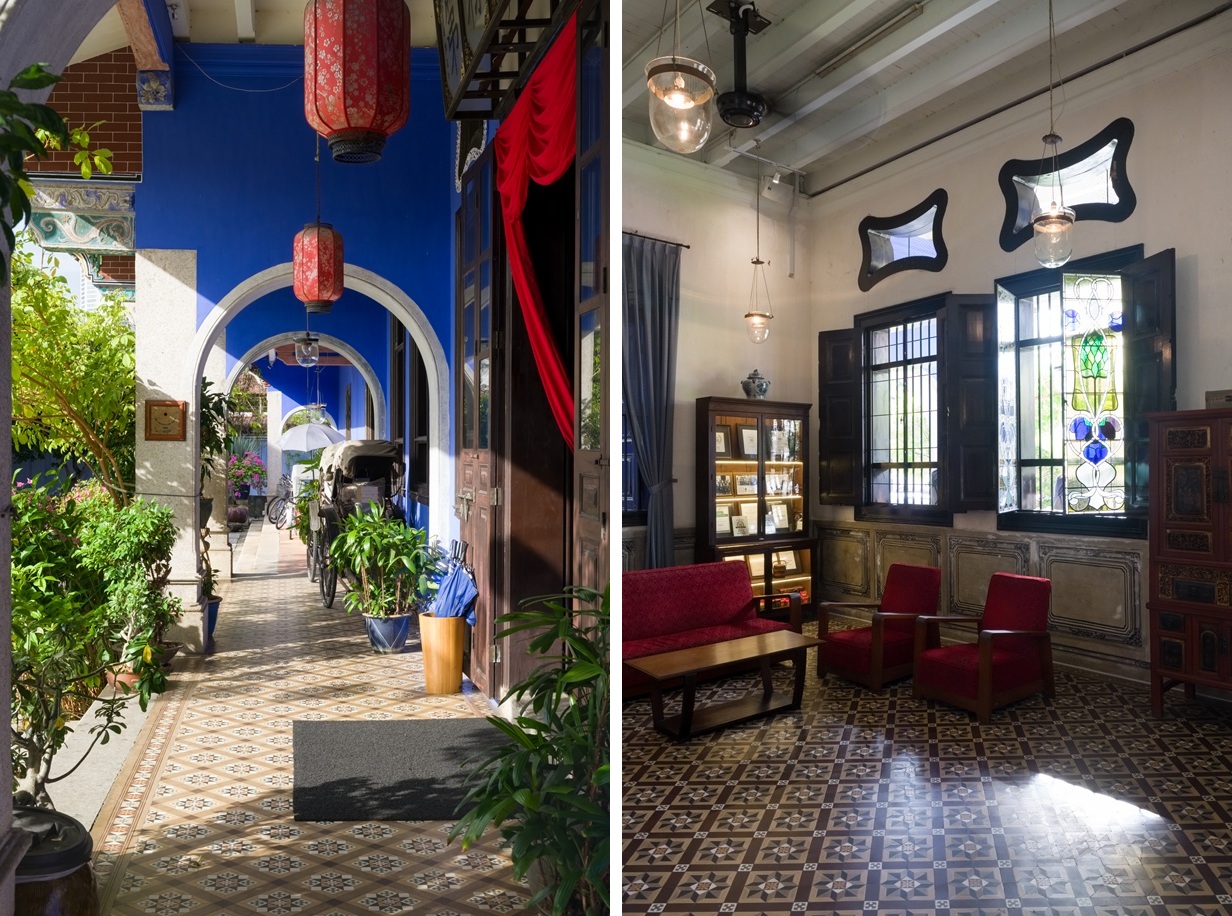
The much-photographed front porch of the mansion; inside the reception area
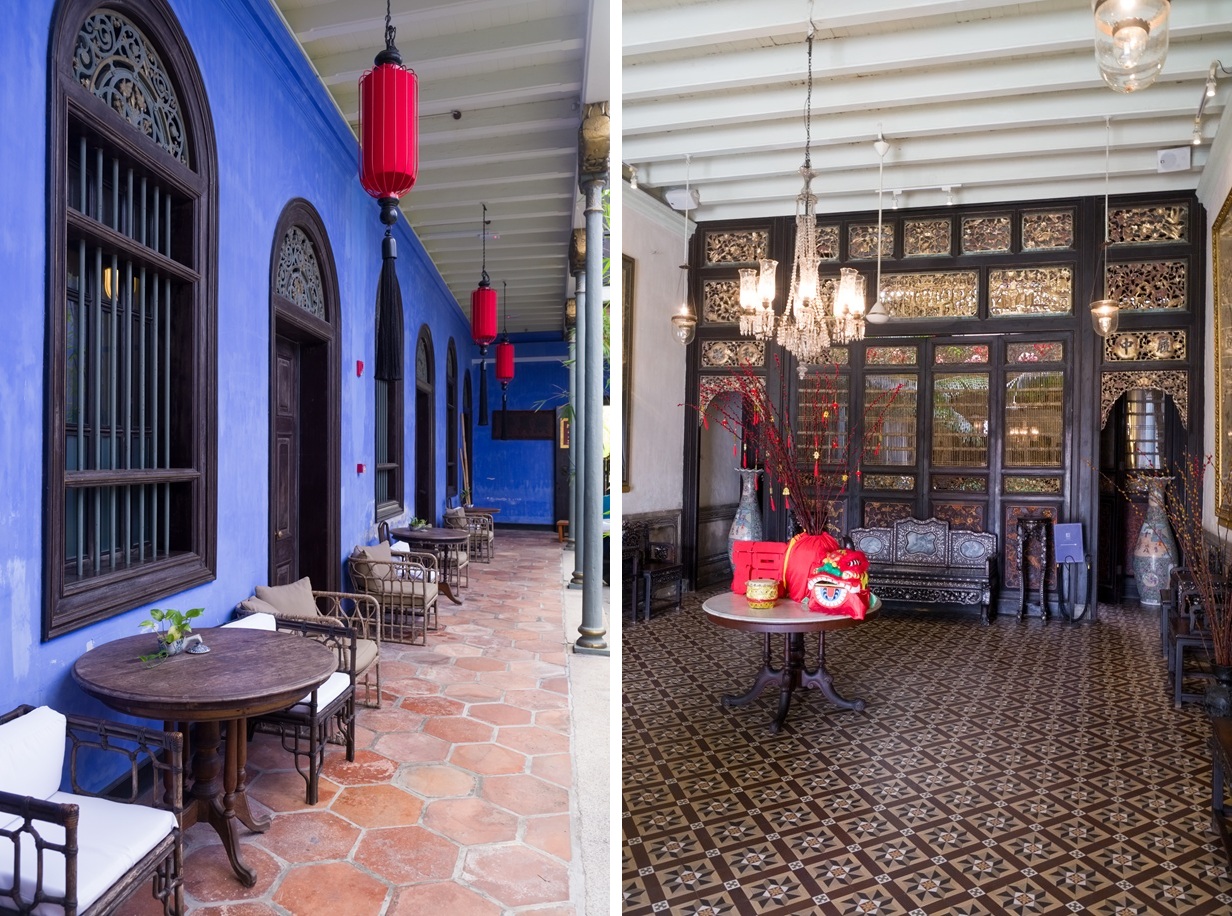
One of the mansion’s guests-only courtyards; the gilded, intricately carved screen in the entry hall
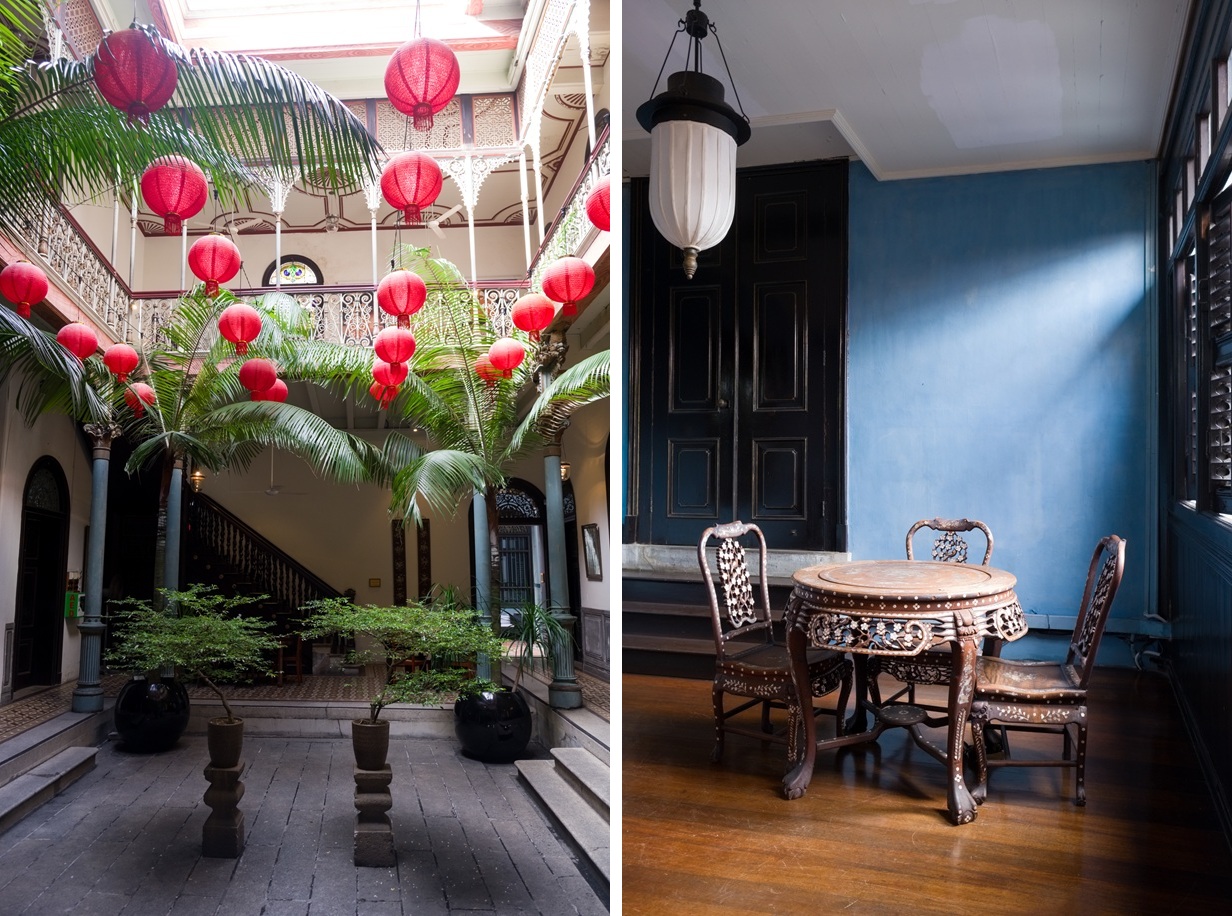
Lunar New Year lanterns in the mansion’s main courtyard; antique furniture upstairs
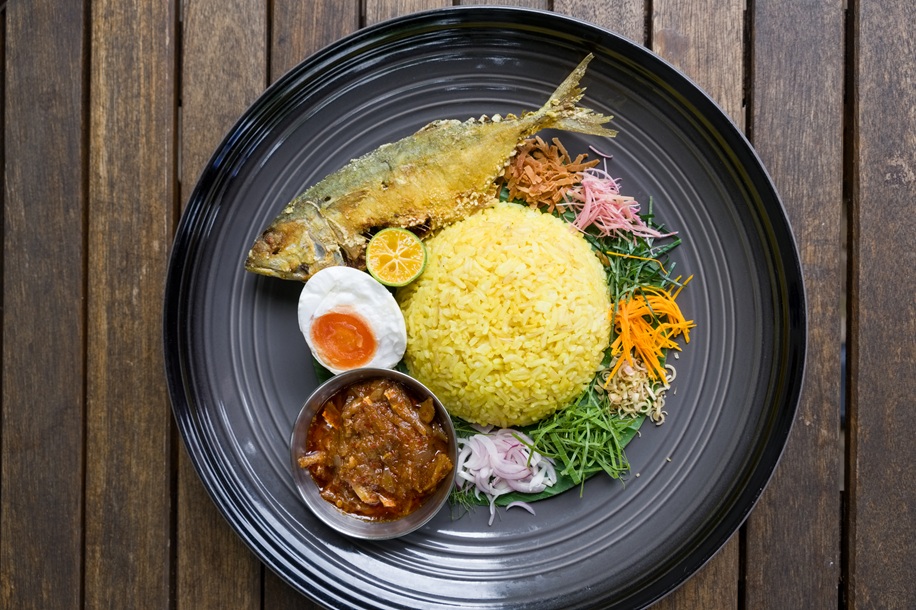
A Malaysian lunch of “nasi ulam” (herbed rice salad) with fried mackerel and spicy-sweet sambal
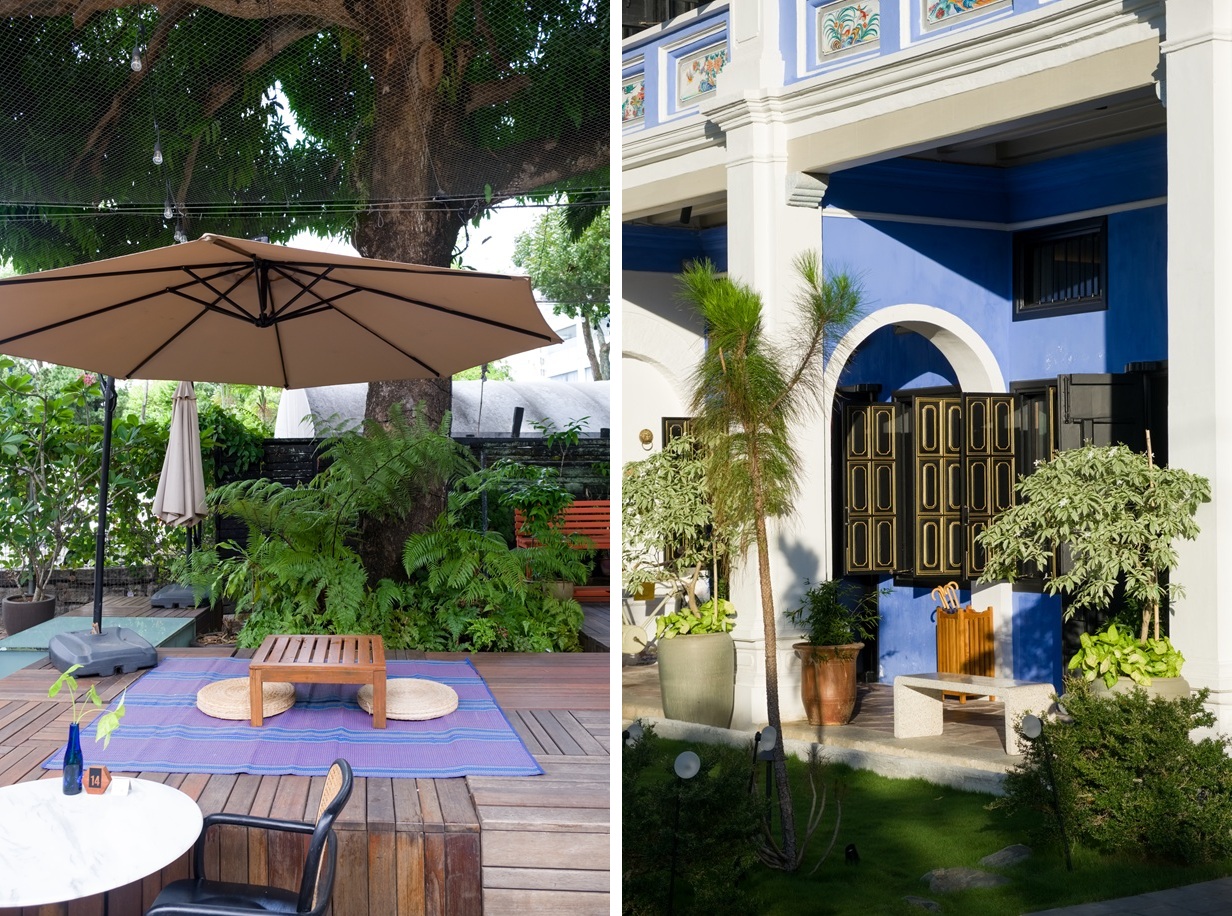
Outdoor seating below a mango tree at the mansion’s Cafe Mangga; an arcade at The Qing Suites
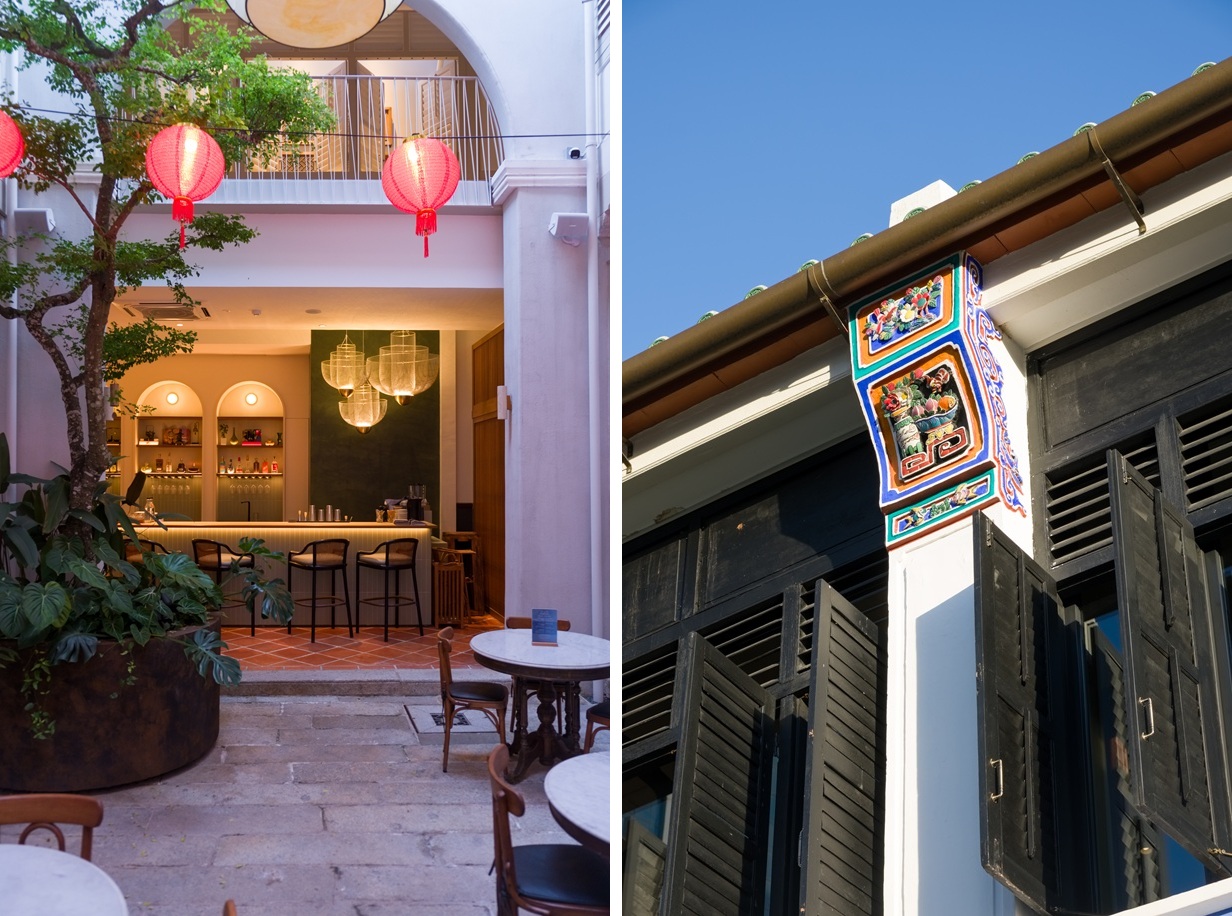
The bar at The Qing Suites’ private courtyard; colorful porcelain detailing on the facade
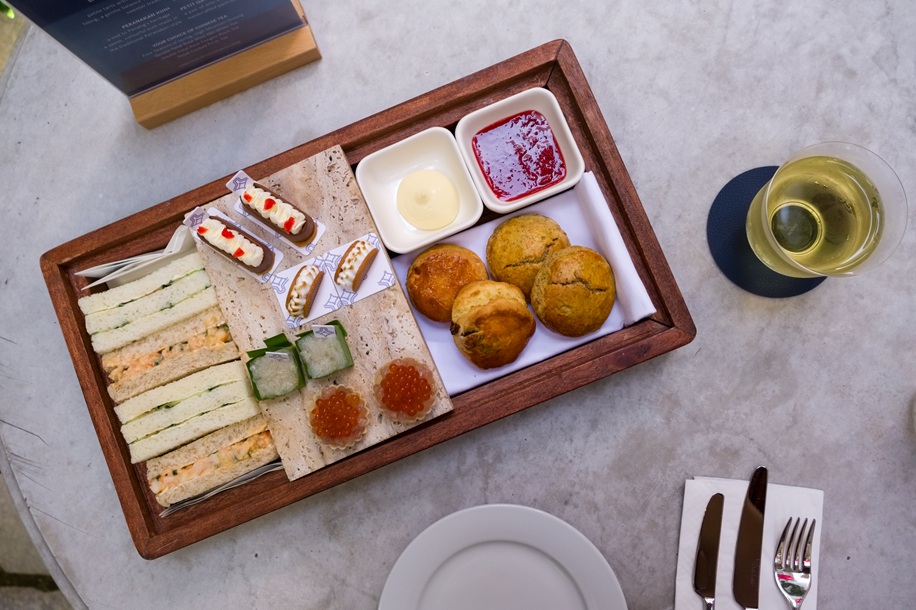
Scones, finger sandwiches, and mini-pastries for afternoon tea at The Qing Suites
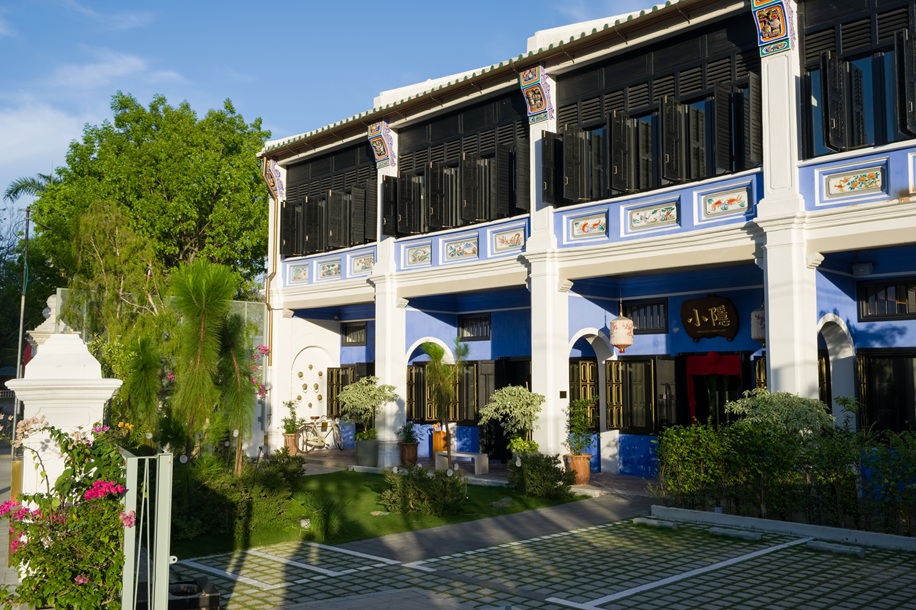
The restored facade of The Qing Suites aglow in the evening sun





I enjoyed the middle section best. It was like wonderland seeing those temples xx
Absolutely, Jo — the temples I visited on this trip to Penang were incredibly beautiful. I loved how each one had their own distinct character and a unique architectural style. The care and craftsmanship that went into building them was clear for all to see.
Thanks for this very thorough virtual visit. It looks all so beautiful. Another corner of the world to add to our list…(Suzanne)
My pleasure, Suzanne. Penang is simply fabulous — I think it is my favorite place in Malaysia for so many reasons. The well-preserved (and colorful) heritage architecture, the exceptional street food and interesting restaurants, and the undercurrent of creativity are just a few I can think of. I would love to go back again soon!
Beautiful post! Penang is a gorgeous place, and a true foodie destination; looks like you ate very well during your time there! It’s also great meeting and befriending people on your travels, to stay in touch over the next few months, years, even decades! Thanks for sharing your time in Penang with us, James; it brought me back to my own stay there a couple of years ago!
Thank you, Rebecca! It’s great to hear that you got to experience the charms of Penang a few years back — I don’t know why I waited so long after my last visit to return, especially since it’s just a three-hour flight from Jakarta!
The style of the buildings is glorious (as well as the food). It’s been years since I was in Malaysia and even longer in Penang so I’m sure I wouldn’t recognize anything! Your post is enticing me back.
I have a feeling you might still recognize George Town. They’ve done such a good job keeping so many of those beautiful heritage buildings intact, and since it became a UNESCO World Heritage site in 2008, the rules about renovating shophouses have become very stringent (in a good way)!
That’s good to know because the style of the old buildings is majestic.
Having just returned from Taiwan, you can imagine my surprise seeing pictures of a temple that looked so similar to the ones we just spent so much time admiring. Thanks for the great tour.
stay safe
Steve
Hi Steve, thank you for the wishes of safety!
I can see what you mean about the striking similarities between Leong San Tong Khoo Kongsi and the Taiwanese temples you saw on your most recent trip. There’s a very good reason for that — the Khoos are culturally Hokkien, having emigrated from the coast of China’s Fujian province, and many Taiwanese trace their ancestry to the same region just across the Taiwan Strait.
I, too, am awed that what you show is a “scaled back” version of the original temple. Well done capturing the gorgeous architecture lit up at night, with fireworks exploding behind. I enjoyed your opening story of finding great conversation with strangers, but I think what touched me the most in this post was learning about the close community in Penang among creators. It must feel so good to be one of them.
The creative people I met in Penang were all so inspiring — each one was making a difference and giving the place even more color in their own unique ways. It is heartening to know they have found a niche in such a supportive environment with such a strong sense of community.
Wow – you stayed at the Blue Mansion! My bf and I travelled to Malaysia late last year. It was our first time. I really enjoyed it. I would go back in a heartbeat. I think it’s wonderful that you’re able to make friends when you travel. I also looked back at your other post you referenced. I was in that area too enjoying the chendol from a cart (first time having it).
Sort of — not the actual mansion but the quieter annex across the street! I’m glad to hear you were in Penang last year with your partner, and that you tried some of the classic street food like chendol. It must have been quite the journey flying all the way from Toronto to Malaysia. I’m guessing you must have gone via Hong Kong or Taipei.
We went from Toronto to KL via Shanghai. It was a long flight! I also visited Hong Kong on the way back and spent some time in China (Chaozhou).
I remember how good the food in Penang was. The curry mee particularly stood out, for it wasn’t our first choice but it ended up being a great find. If only we could track where the vendor is now. It’s funny that you had a TCM session in George Town because for Indonesians the city is more well-known for its good quality and relatively affordable healthcare facilities. Someone from work told me that in the past her father went to a hospital in Penang regularly to treat his cancer. And now he’s free of it. I love that shot of the cat!
Hopefully we will have the chance to return to Penang on a vacation in the not-too-distant future. How nice to hear that your coworker’s father is now cancer-free after being treated there. I too wish I’d known where the curry mee vendor has relocated her little stall and eatery. None of the bowls of curry mee we’ve had since then has matched hers in either taste or complexity!