
Bali’s Lake District and Beyond
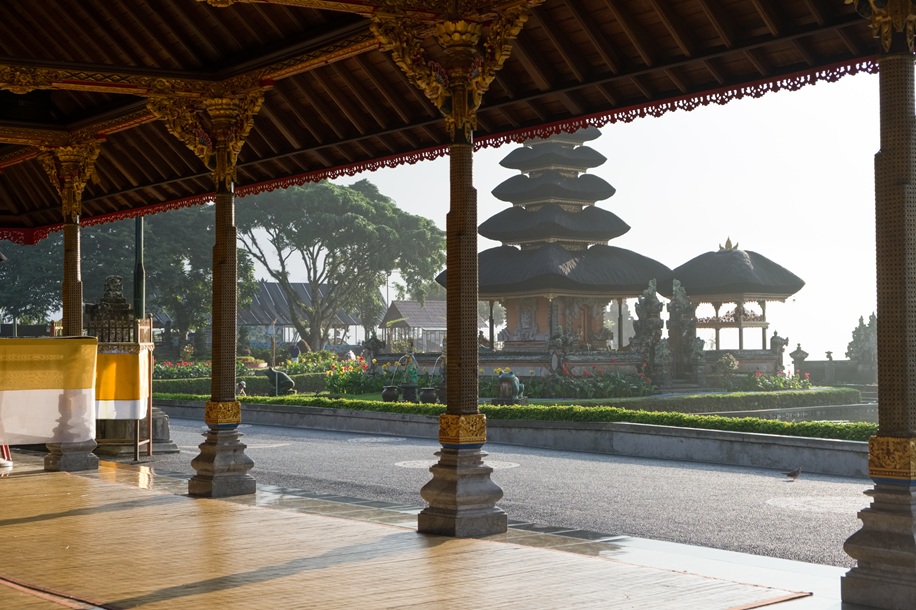
It took Bama three trips to get the shot he wanted of the pagoda-like meru at Bali’s most iconic Hindu temple, Pura Ulun Danu Beratan. Persistent rain, not unusual given the fickle weather in the island’s north-central highlands, had dampened his first two visits years ago. Now, he stood transfixed at the postcard-perfect scene before us: bright blue skies with scattered wisps of cloud over Lake Beratan, the temple’s famed meru appearing to float on its calm, mirror-like surface. The dark palm-fiber roofs of both towers had been recently rethatched, and beneath their eaves, lustrous gold-painted wooden carvings shimmered in the early morning light. All was quiet.
Historical records say that a Hindu sanctuary dedicated to Dewi Danu — the Balinese goddess of water, lakes, and rivers — has existed on this site since the early 17th century. These days, Pura Ulun Danu Beratan is a well-known photo spot for the millions of domestic and foreign tourists who flock to Bali each year, but we’d arrived so early the crowds were nowhere to be seen. Bama and I had come shortly after opening time at 7 a.m., and we encountered only a few other visitors wandering the temple’s manicured lakeside grounds, including two serious photographers with their tripods. The parking gates were still raised and ticket machines offline when we left about an hour later.
Yana, a reliable twentysomething driver from Ubud, had picked us up at the airport the previous afternoon. But the fine weather that met us in the sunny lowlands soon gave way to a thick blanket of cloud, and raindrops began pattering the windshield as we neared our family-run lodgings a 10-minute drive from Lake Beratan. With just four simple cottages, The Green Ponci Bedugul was just the place we needed to unwind from the stress of daily life in Jakarta. Our timber-walled cottage and its shaded deck looked out to terraced vegetable fields and a dense forest on the far side of the valley. The scent of the fresh mountain air somehow took me back to childhood summers in Canada, and each morning we’d be greeted by a symphony of crowing roosters, birdsong, and chirping insects. Coming from a noisy, traffic-choked megalopolis of 11 million people, these soothing sights and sounds could just as well be from another world.
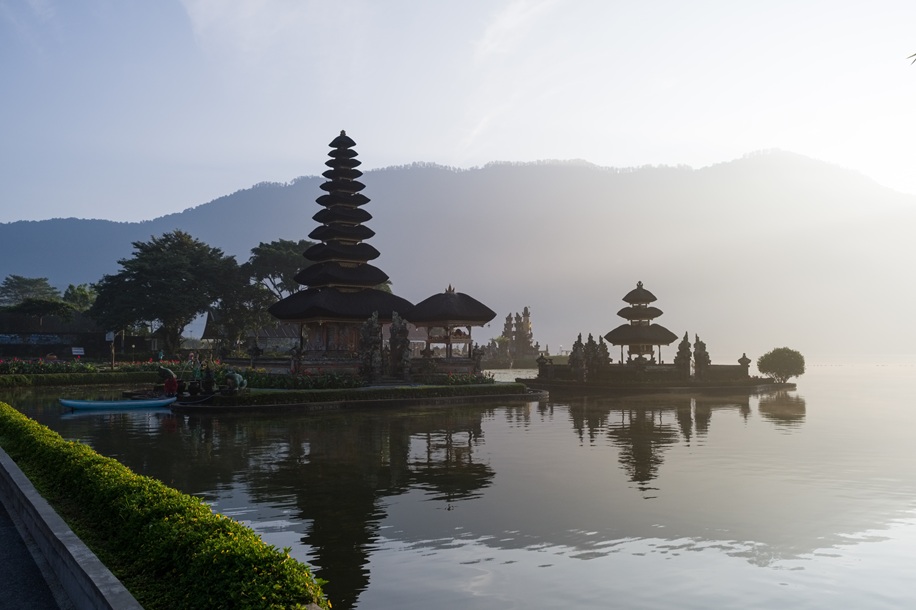
The iconic multi-tiered “meru” towers of Pura Ulun Danu Beratan
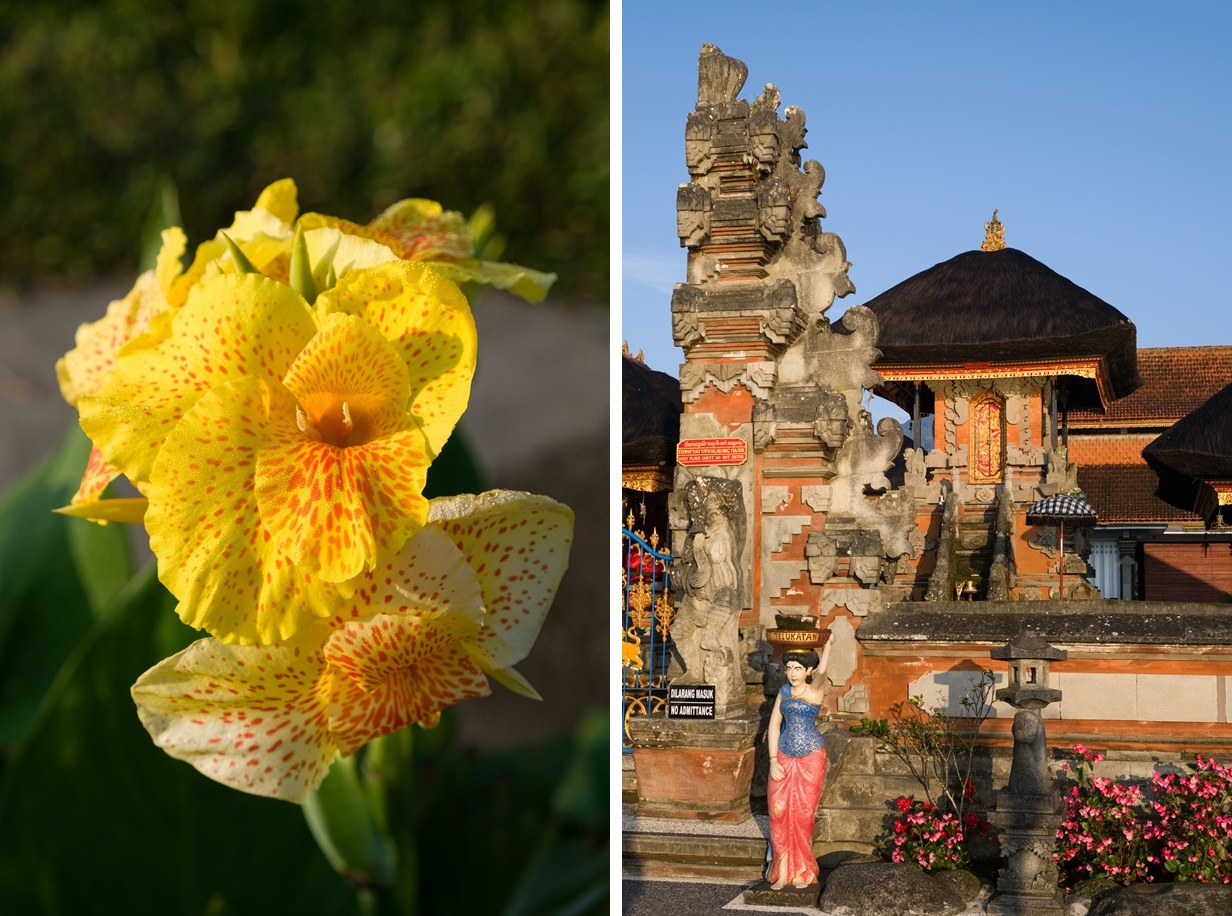
Canna lilies by the lake; a temple shrine in the early morning light
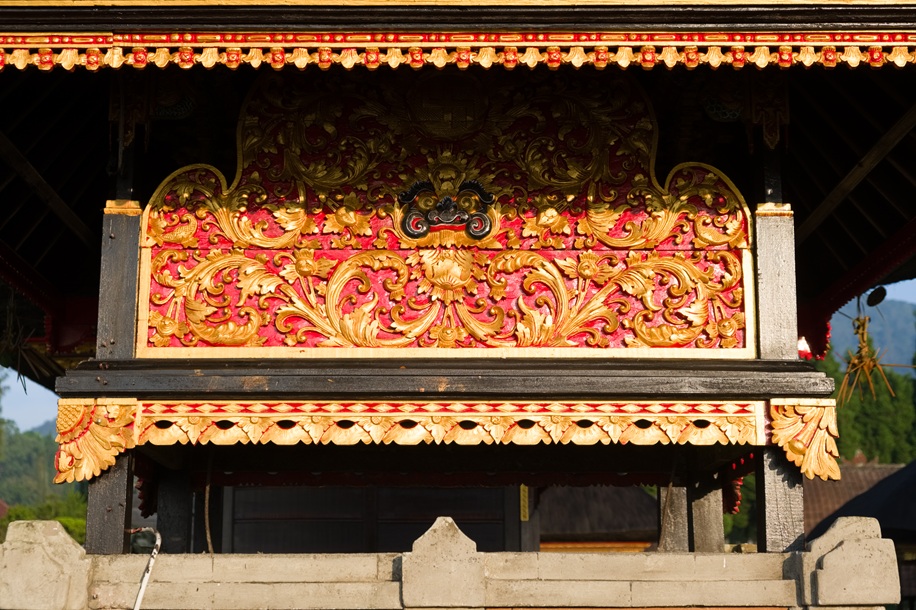
Exquisitely carved and painted details at Pura Ulun Danu Beratan
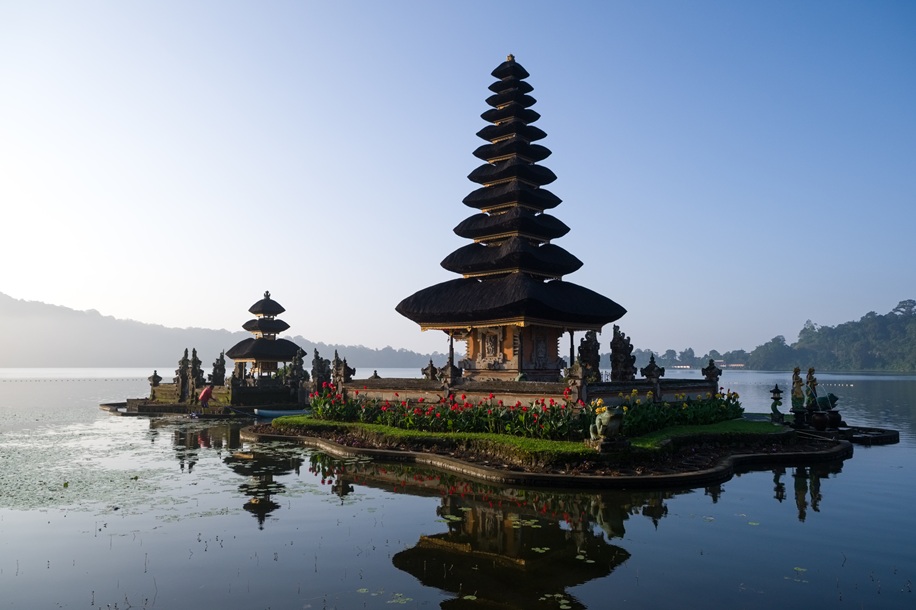
An idyllic morning in Bali’s lake district
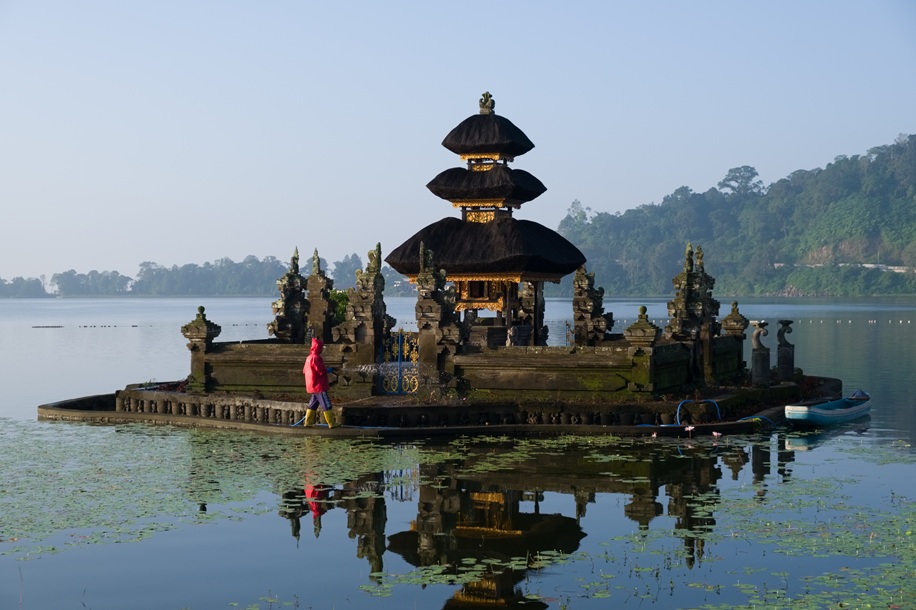
Hosing down the outer walls of the “meru”
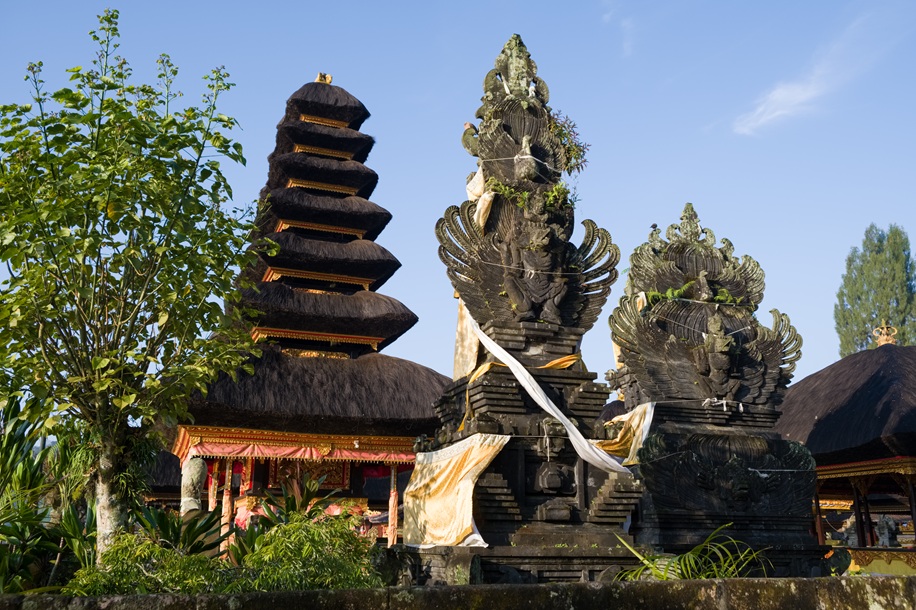
Sacred structures in a walled-off enclosure

Ornamental details atop a pillar; a sparrow and golden finials on the roof
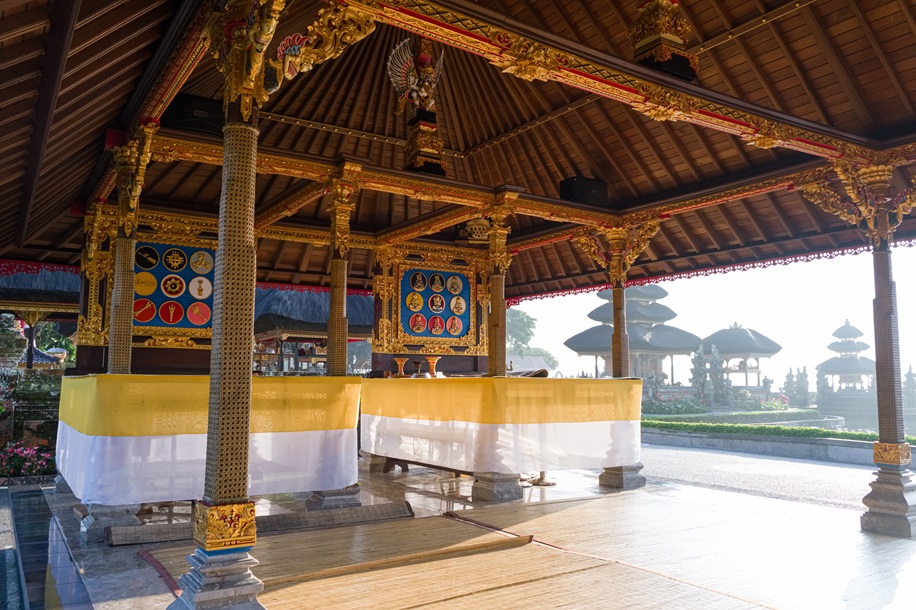
A raised open-air pavilion steps from the lake
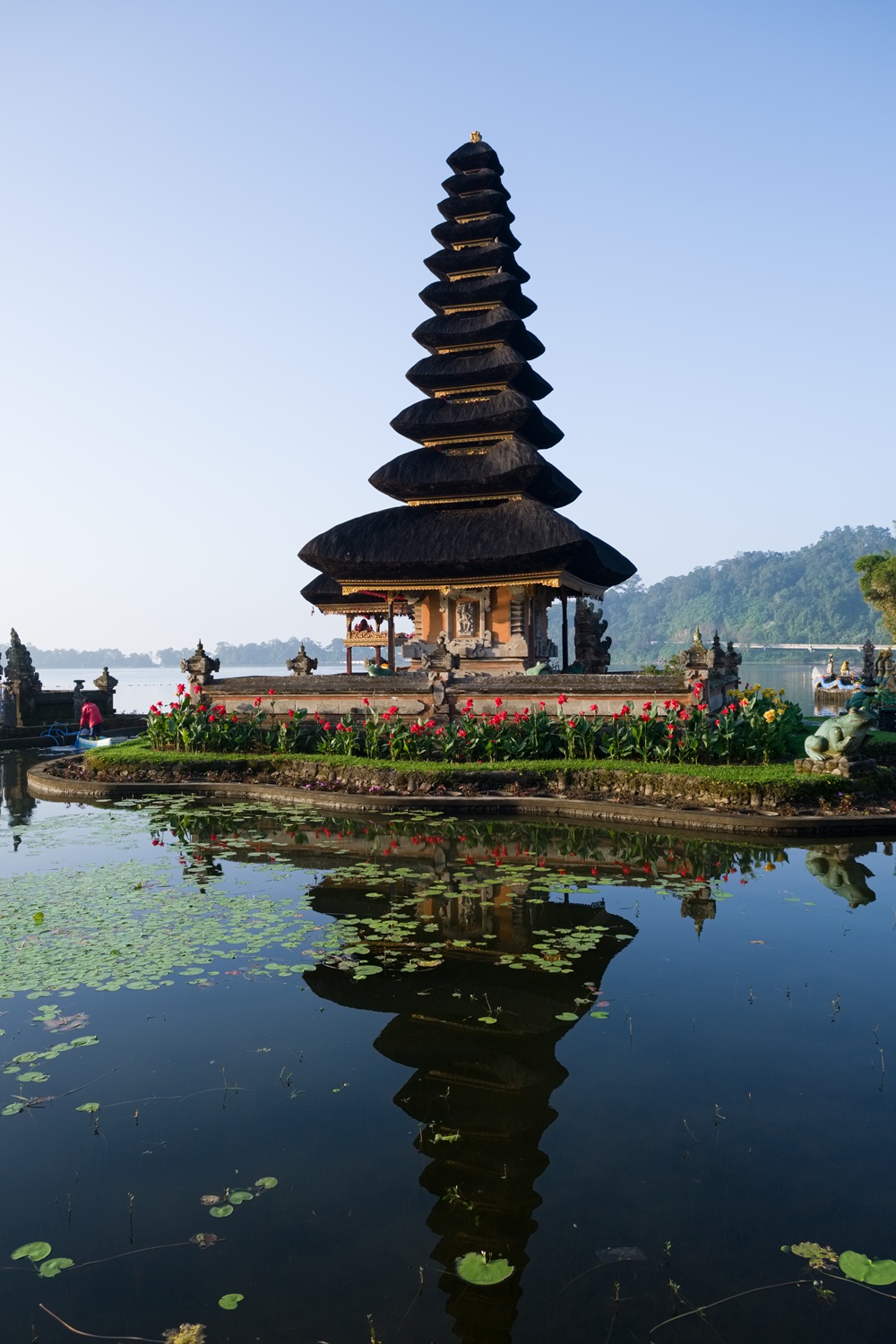
The “meru” at Pura Ulun Danu Beratan have been recently rethatched
It’s the middle of June, well into dry season and a good month for snorkeling or lounging on a beach. But Bama and I have chosen to spend the entirety of our trip away from Bali’s fabled coastline, giving the busy resort areas a wide berth. The only time we see the ocean is when we’re at Ngurah Rai International Airport — landing, taxiing, or waiting in the domestic terminal for our flight out.
With Yana at the wheel, the plan is to spend three full days exploring inland Bali. On our wish list are all four of the island’s crater lakes, a bit of temple-hopping, and some real-deal local cuisine. After visiting Lake Beratan and a breakfast of babi guling (roast suckling pig) at a roadside eatery about a half-hour’s drive downhill, we head east via Ubud to Penglipuran. This is one of only four Indonesian entries in the United Nations World Tourism Organization’s global network of Best Tourism Villages. Each place has been selected for showing how responsible tourism can have a positive effect on the local community, be it in preserving culture and traditions, creating economic opportunities, or safeguarding biodiversity.
Penglipuran might be heaving with massive tour groups of middle- and high-school students at the time of our late morning visit, but Bama and I can imagine how peaceful it must be once the crowds are bussed elsewhere. Here at Penglipuran, it’s possible to experience a slice of local life by booking a homestay and touring the surroundings with a village guide. We immediately notice how the well-kept main street and the alleyways peeling off it are spotlessly clean: a rare sight for Indonesia (more on that later). While wandering in and out of the many residential courtyards that are open to the public, Bama spots a makeshift store selling cold bottles of loloh cemcem, a Penglipuran specialty. The all-natural drink is refreshing, sweet, and herbaceous — nourishing the body with the medicinal properties of the cemcem leaf.
Ten minutes down the road, the hillside sanctuary of Pura Kehen is almost deserted at midday. The only other visitors we encounter in its terraced enclosures are an older Dutch couple and two French friends accompanied by their Balinese guides. Before Dutch colonial rule it likely served as the royal temple of Bangli, one of nine minor kingdoms on the island. The place has been around since at least the 13th century; an even older copper inscription from the early 11th century mentions it under a slightly different name. On the tranquil grounds we marvel at a majestic banyan tree with a shrine high up in its branches, along with the ornate carvings of botanical motifs and mythical beasts adorning the temple structures.
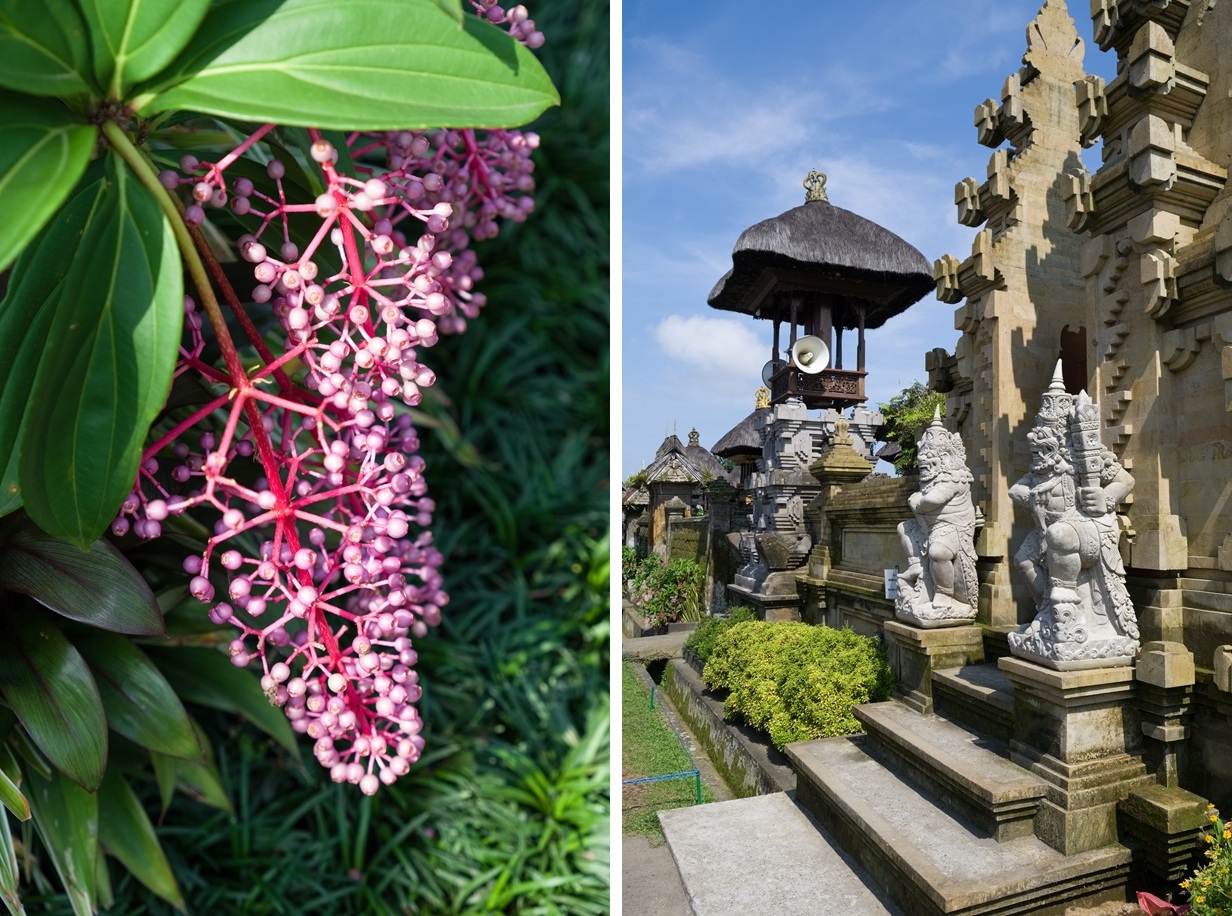
Medinilla flowers; statues and a “kulkul” drum tower at Penglipuran village

Looking down the busy main street of Penglipuran
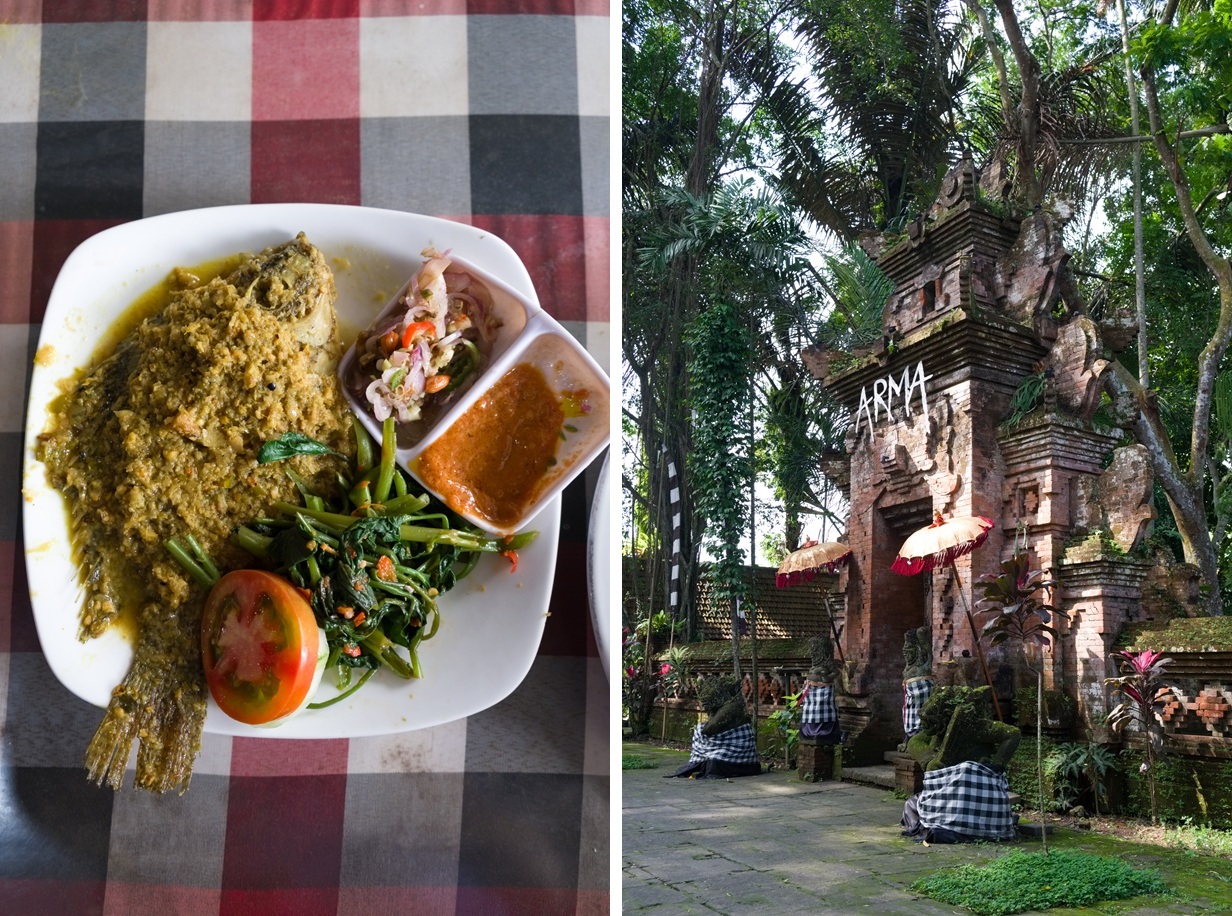
“Nyat-Nyat” tilapia in Bangli; the stage at Ubud’s Agung Rai Museum of Art
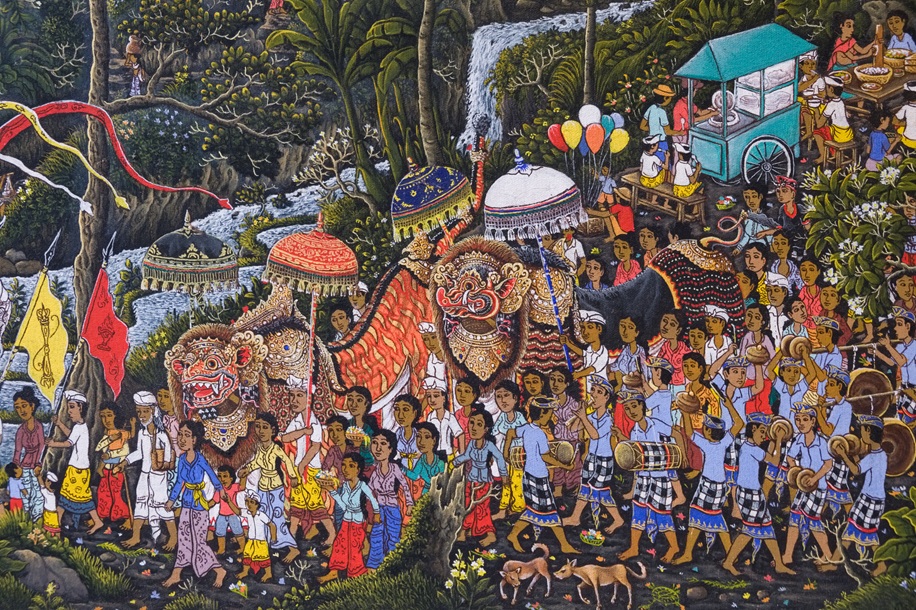
A detail from Wali “Ekadasa Rudra” (2015), an oil painting by I Wayan Mardiana
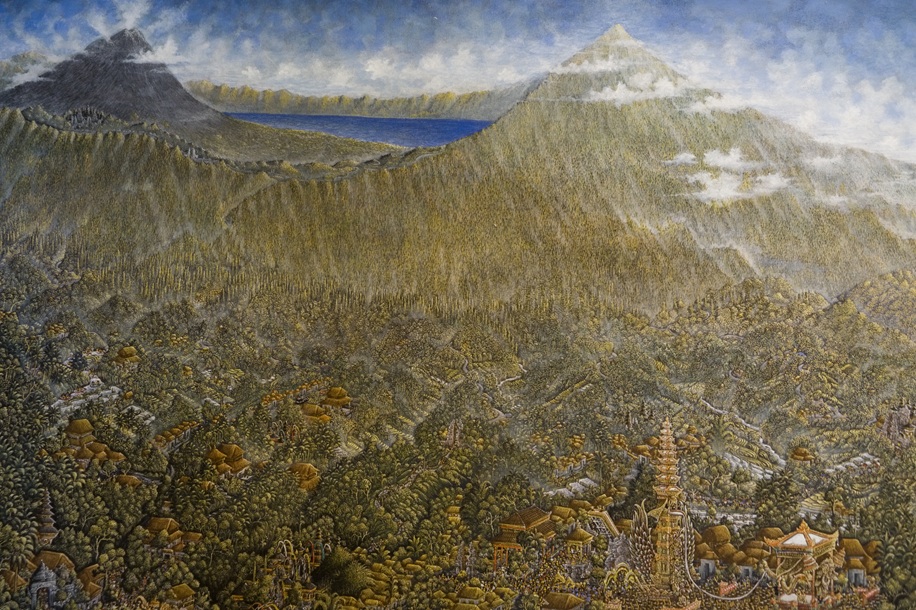
One section of Mardiana’s more recent acrylic on canvas, titled Living Tradition (2024)
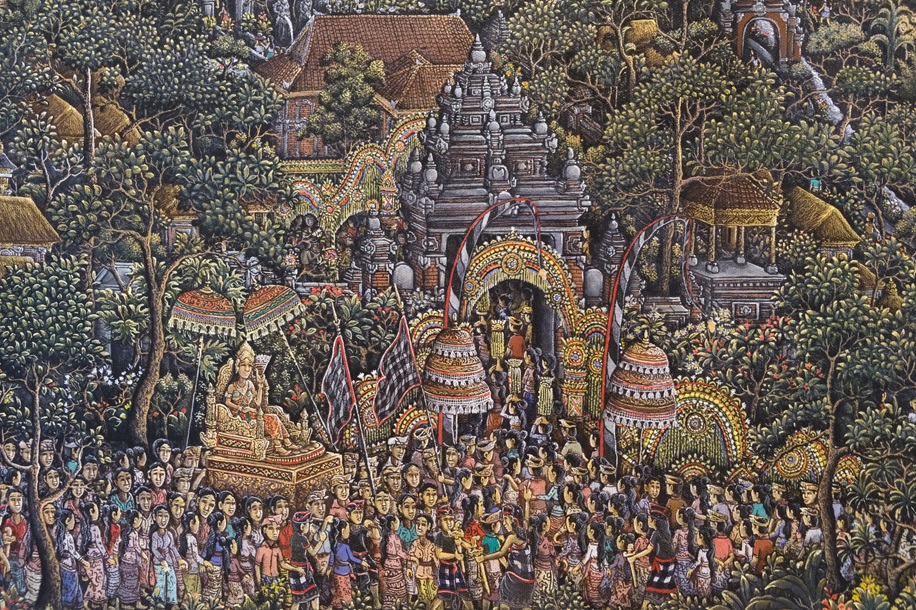
A royal procession in Ubud at the bottom of the same painting
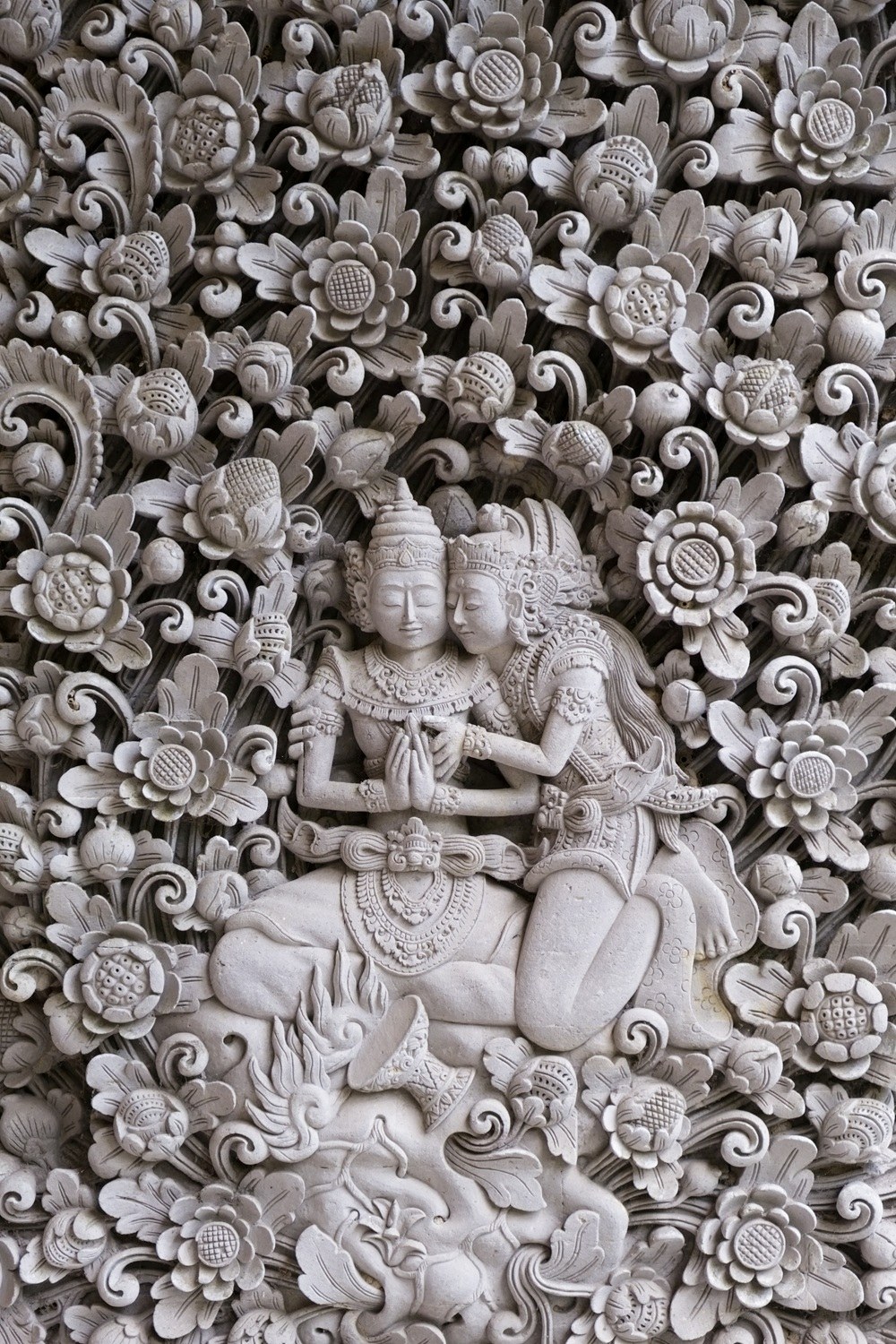
The Balinese are exceptional wood and stone carvers
Pura Kehen overlooks Bangli’s modern-day town, where we settle in for lunch at a no-frills eatery named Mujair Nyat-Nyat Pak Bagong. The specialty dish here is fried whole tilapia smothered in a rich and complex spice paste; the name nyat-nyat describes the process of cooking the flavorful sauce or broth into a thick reduction. Ours come served with stir-fried water spinach, rice, and a hopelessly addictive tomato and chili sambal. Also present is the quintessentially Balinese condiment sambal matah, which features finely sliced shallot and lemongrass in coconut oil.
While passing through Ubud on the way back to our highland cottage, Bama and I explore the galleries at the Agung Rai Museum of Art (a.k.a. ARMA). Local art dealer Anak Agung Gde Rai opened this museum in 1996 after expanding the gallery he and his wife established during the late seventies; as an avid collector and ambassador of Balinese culture, he has amassed an impressive permanent collection over the decades, including works by Walter Spies — the German artist who brought the island to the attention of the Western art world in the 1930s. Indonesian talent is represented by way of prominent figures such as Affandi and Hendra Gunawan, not to mention Raden Saleh, a 19th-century master revered as the first “modern” Indonesian painter trained in the Western tradition.
ARMA’s galleries take up two separate buildings ensconced in leafy Balinese gardens. Inside the larger hall, we admire exuberant paintings by Ubud-based artist I Wayan Mardiana, whose recently finished acrylic on canvas Living Tradition presents an idealized bird’s-eye view of Ubud and its surroundings, complete with scenes of festive processions and rural life, as well as sites like the cave temple of Goa Gajah and the ancient rock-cut shrines at Candi Gunung Kawi. Hanging in the same room is his 2015 oil painting Wali “Ekadasa Rudra”, a colorful depiction of the area around Pura Besakih — the “mother temple” on the slopes of sacred Mount Agung — with local architecture, traditional costumes, and religious celebrations rendered in exquisite detail.
The exteriors of the museum buildings are decorated too. Beside a side entrance, an intricately chiseled relief portrays a couple amid a host of stylized flowers. Then, in a corner of one gallery, we get an absolute surprise. Bama stumbles across a painting by a distant relative whom his late mother spoke about during his childhood. Bagong Kussudiardja was a choreographer, dancer, and artist who ran a traditional Javanese dance school in the city of Yogyakarta — the sister institution to the one overseen by Bama’s own grandfather in Semarang.
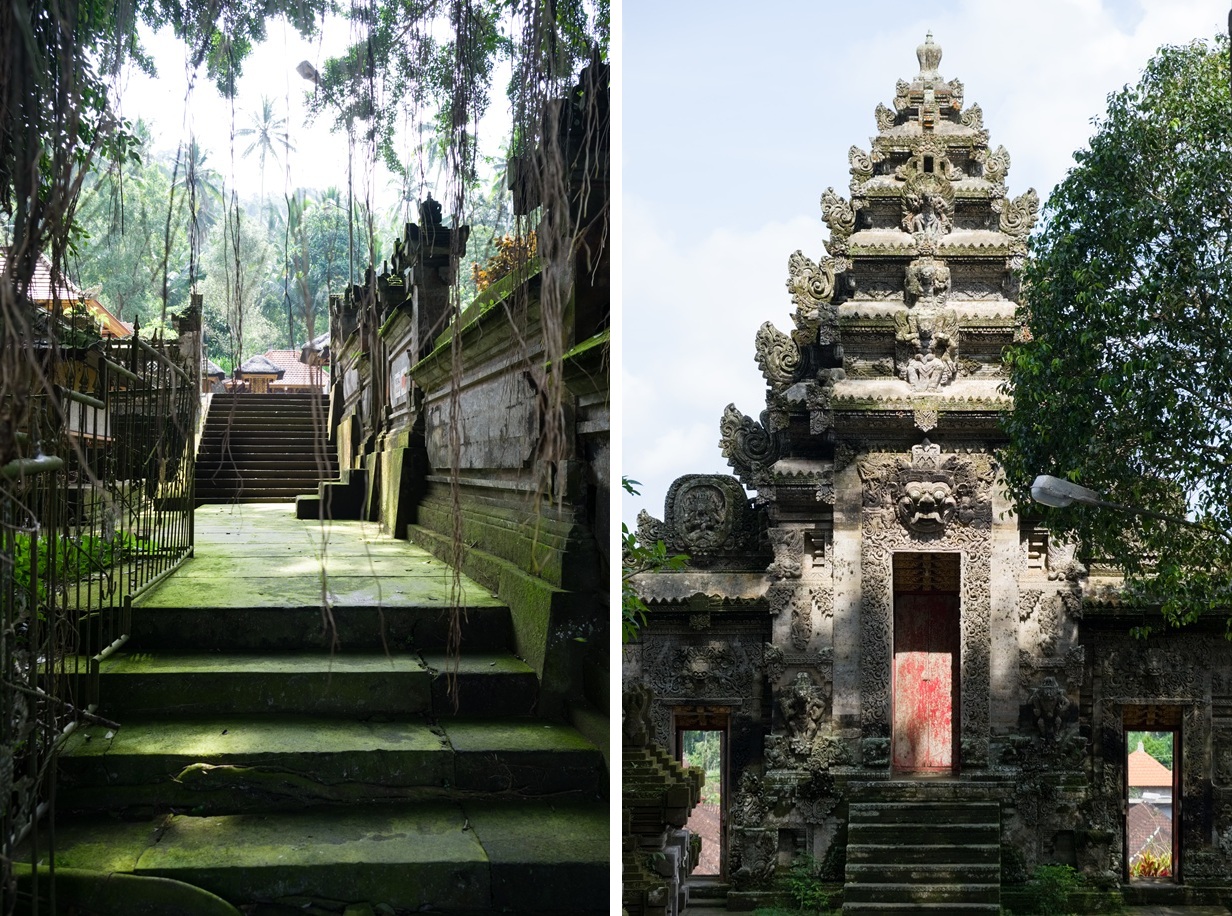
Scenes from Pura Kehen, Bangli’s most prominent temple
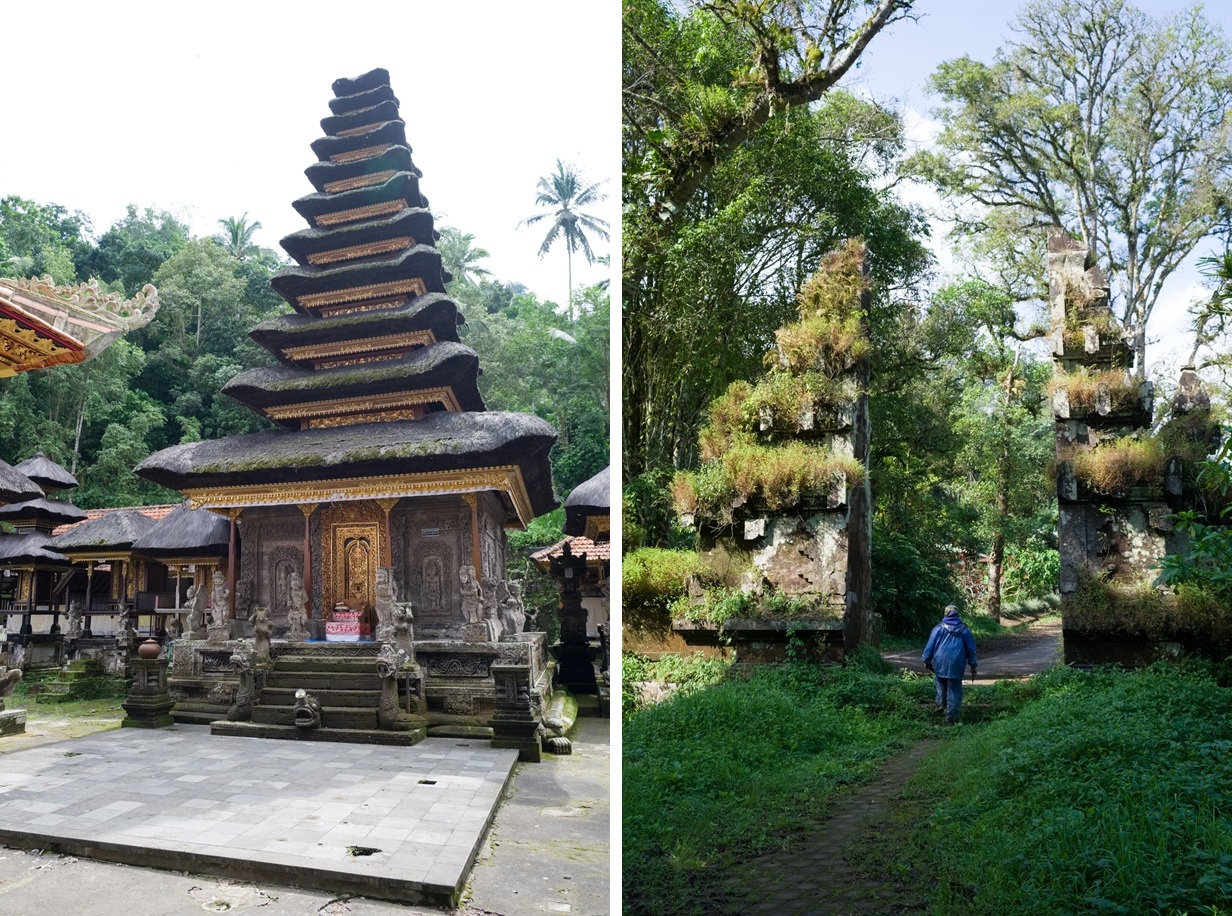
The 11-tiered meru at Pura Kehen; a split gate on the way to Lake Tamblingan
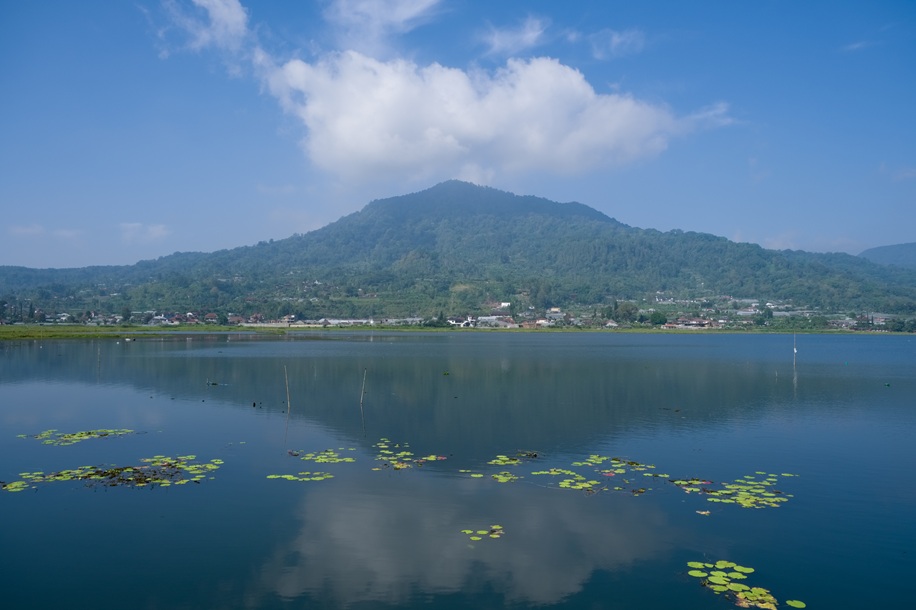
A quiet morning at Lake Buyan
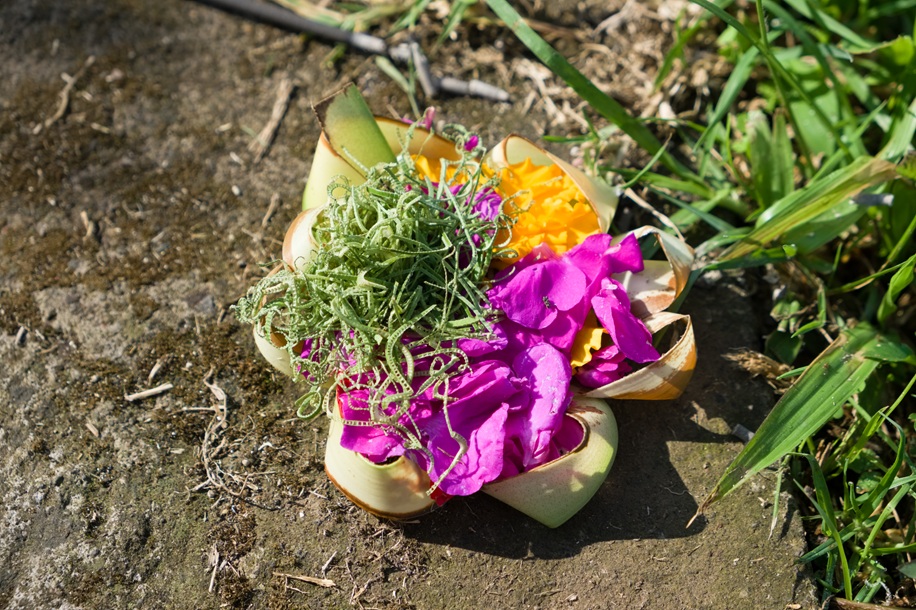
“Canang sari”, a traditional Balinese daily offering
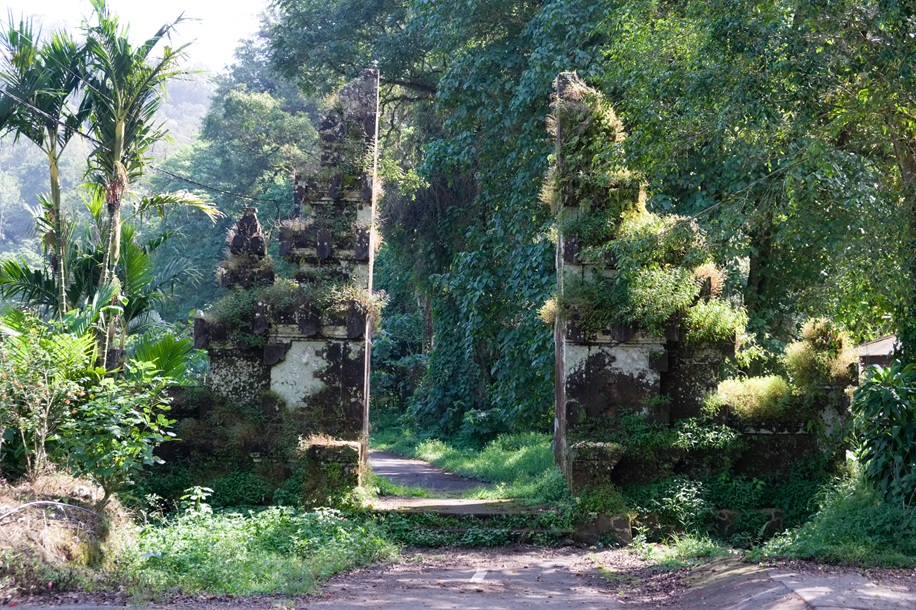
These traditional Balinese split gateways are known as “candi bentar”
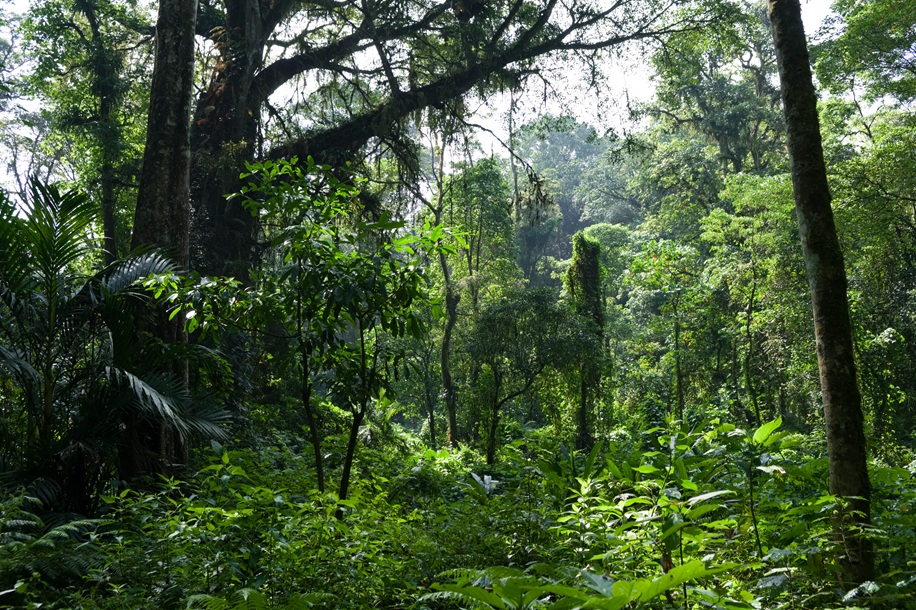
Peering into the rainforest
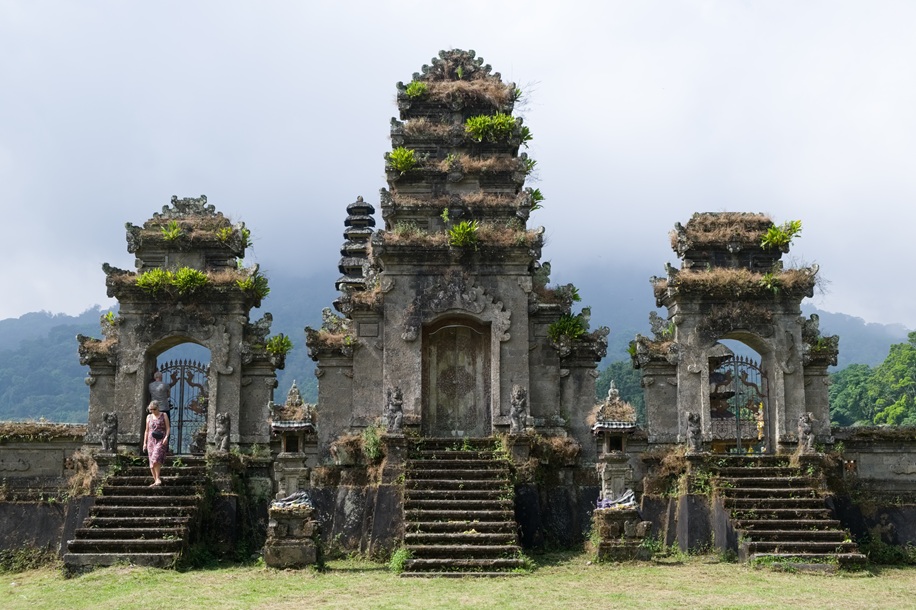
The overgrown gateways at Pura Ulun Danu Tamblingan
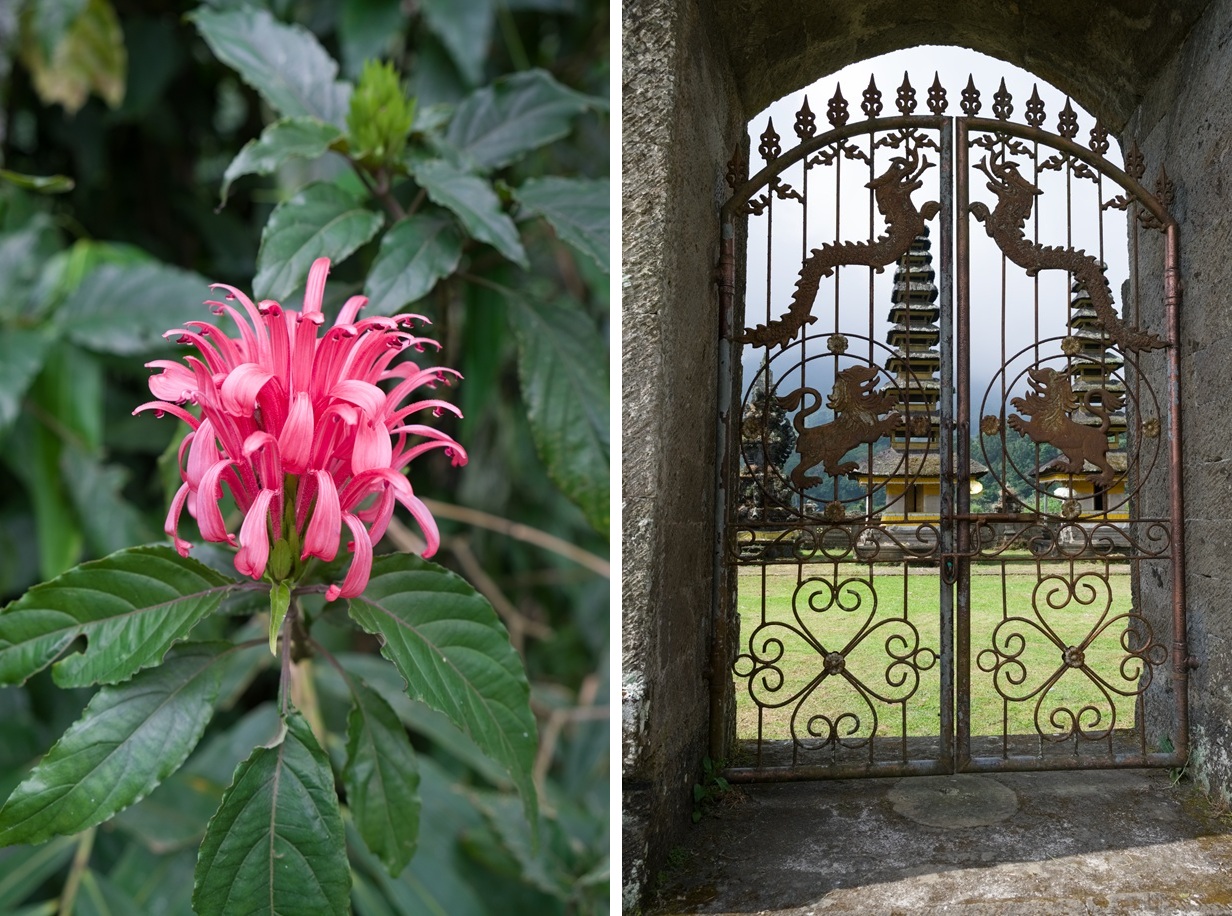
Justicia carnea flowers at the Tamblingan campsite; “meru” towers through a portal
Early the next morning, while digging into a breakfast of mie goreng at The Green Ponci’s rustic open-air dining area, Bama and I glimpse a farmer in the adjacent plot harvesting large heads of lettuce. He and his family also cultivate Chinese celery, whose pungent aroma scents the air. Just up the road, another smallholder has planted a field of cheery marigolds. Our goal for the day is to venture deeper into the countryside, beyond the iconic temple at Lake Beratan.
Three of Bali’s four highland lakes are enclosed within the ancient (and no longer volcanically active) Bratan caldera. Viewed from a satellite, the area is shaped vaguely like an oyster shell. If you imagine a clockface with the caldera’s midpoint at the center of the dial, Lake Beratan is at the 3 o’clock position, Lake Buyan — the largest of the three — straddles 10 to 12 o’clock, while Lake Tamblingan rests at 9 to 10 o’clock. Beratan is by far the most visited one, but tourist numbers thin out at Buyan, and even fewer make the drive to Tamblingan via a narrow road skirting the high caldera rim.
At one of several viewpoints overlooking Buyan and Tamblingan, an enterprising local man has set up an open-air stall where passing tourists can take photos with his exotic pets for a small fee. The one that catches my attention is a flying fox, content to hang upside down from the branch of a dead tree trunk. With its bright, big eyes and pointy ears, the large fruit bat resembles a friendly dog with folded black wings that remind me of a polyester umbrella. As we look on, it suddenly swings downward to relieve itself while upright. That answers a question about bats I never thought I had.
Eventually, Yana descends from the caldera rim through farmland to reach a parking area beside a painted hut with outdoor seating. Unsure of whether we can drive any further, Bama and I decide to walk the rest of the way. “It’s far!” Another driver warns us. “You still have a few hundred meters to go.” We both want to laugh. A great many Indonesians are not habituated to walking regularly as part of their daily lives. I can’t really blame them. Pavements — where they exist — are often hazardous and of poor quality, with uneven surfaces, broken tiles, and sometimes gaping holes over drainage channels. Combine that with the tropical heat, and it’s no wonder most Indonesians prefer to go everywhere on a scooter.
Partly covered with small paving stones, the road we’re on cuts through what appears to be undisturbed jungle. Here, there’s an overriding sense of peacefulness, of being firmly in nature’s embrace. We stop every now and again to admire the towering trees and luxuriant tropical foliage. At the other end lies a grassy campsite overlooked by Pura Ulun Danu Tamblingan, a somewhat neglected temple. Dragonflies circle around its tall stone gateways overgrown with budding wild orchids. When the lake expands during rainy season, the raised enclosure of the temple can sometimes be marooned in shallow floodwaters.
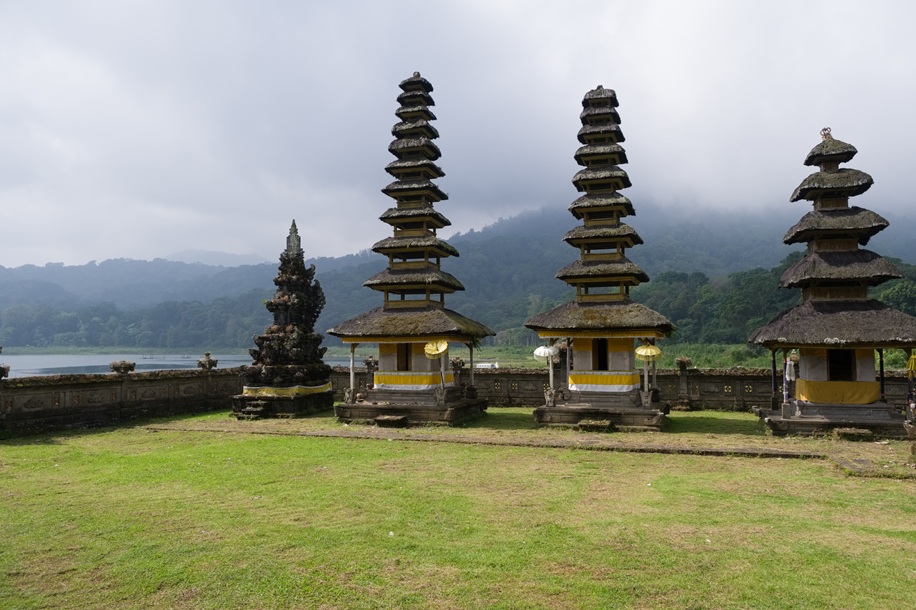
Looking into the main enclosure at Pura Ulun Danu Tamblingan
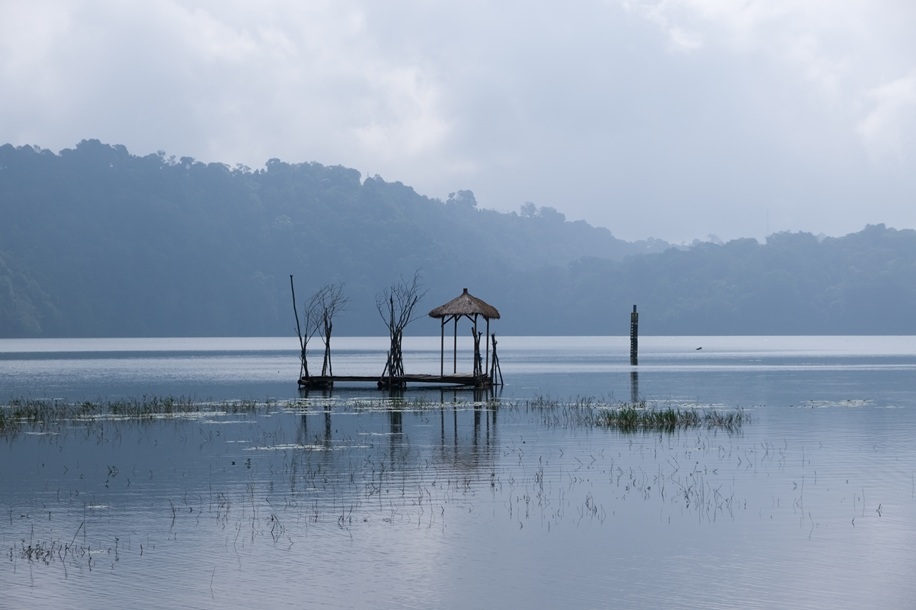
A lonely fishing platform in the lake

Camping out in a Volkswagen Kombi
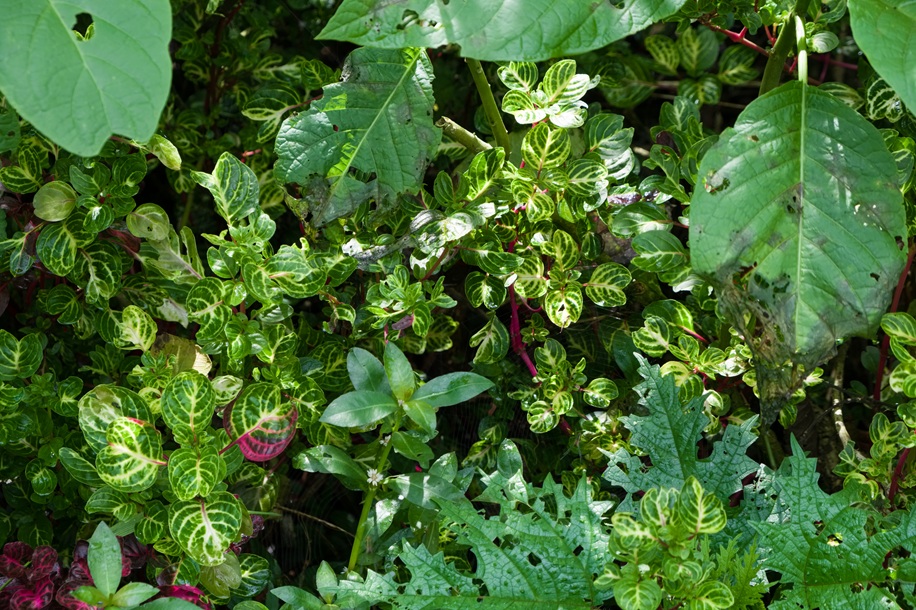
Iresine herbstii aureoreticulata, a plant native to Brazil
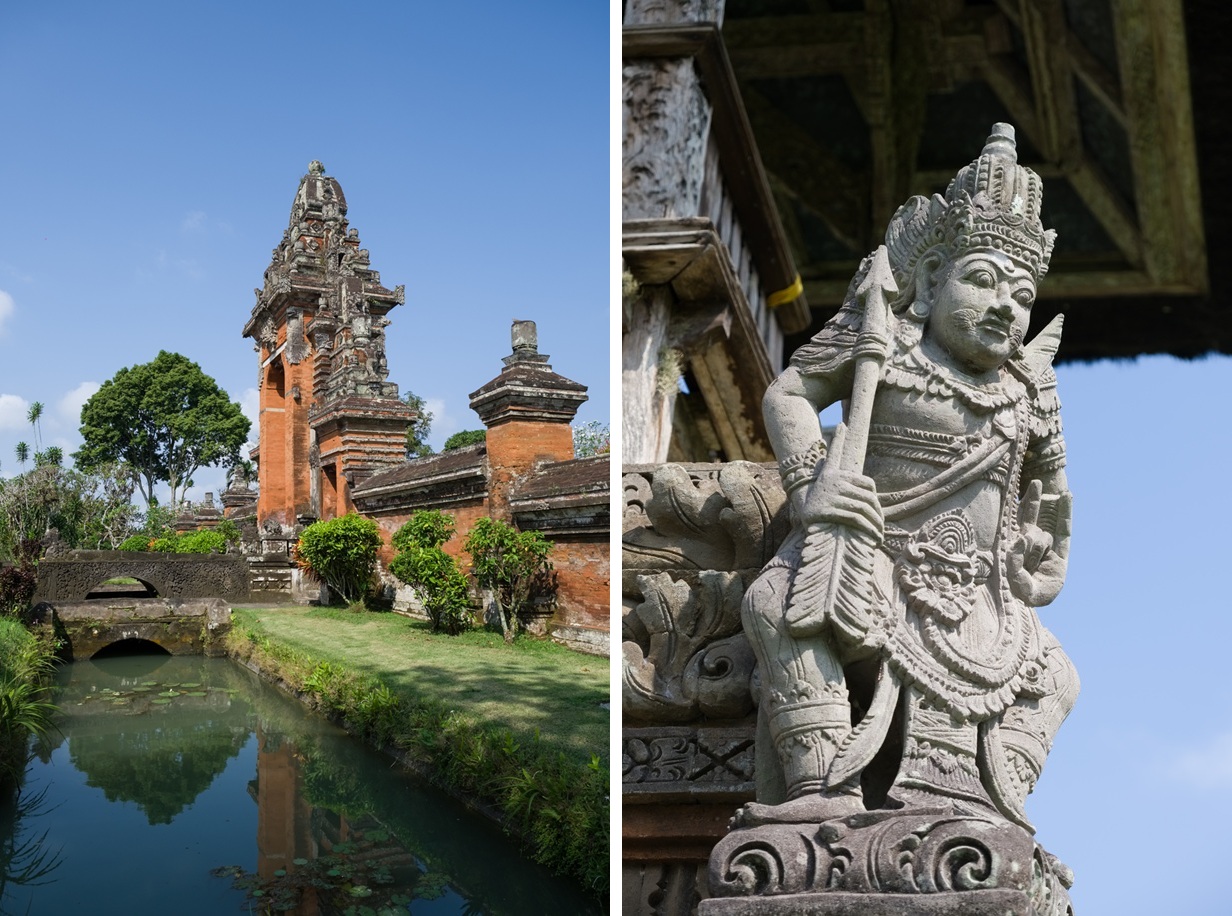
A monumental gateway at Pura Taman Ayun; a sculpture on the grounds
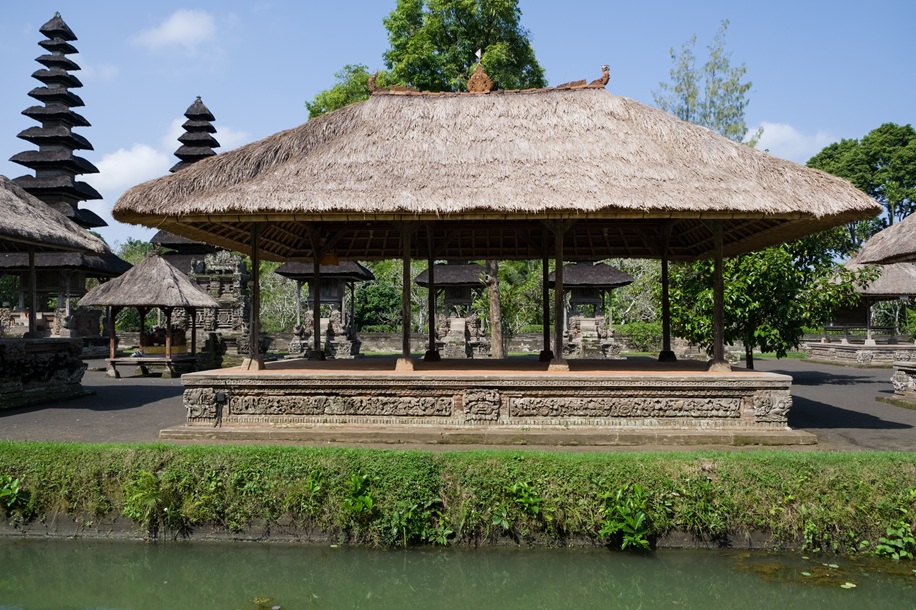
Looking into the inner sanctuary at Pura Taman Ayun
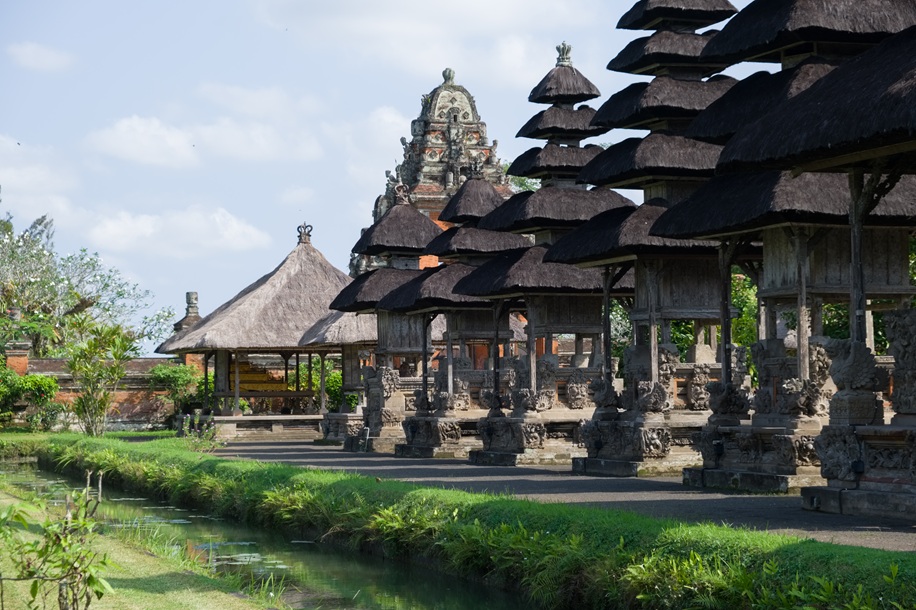
Temple roofs thatched in “ijuk” or arenga palm fiber
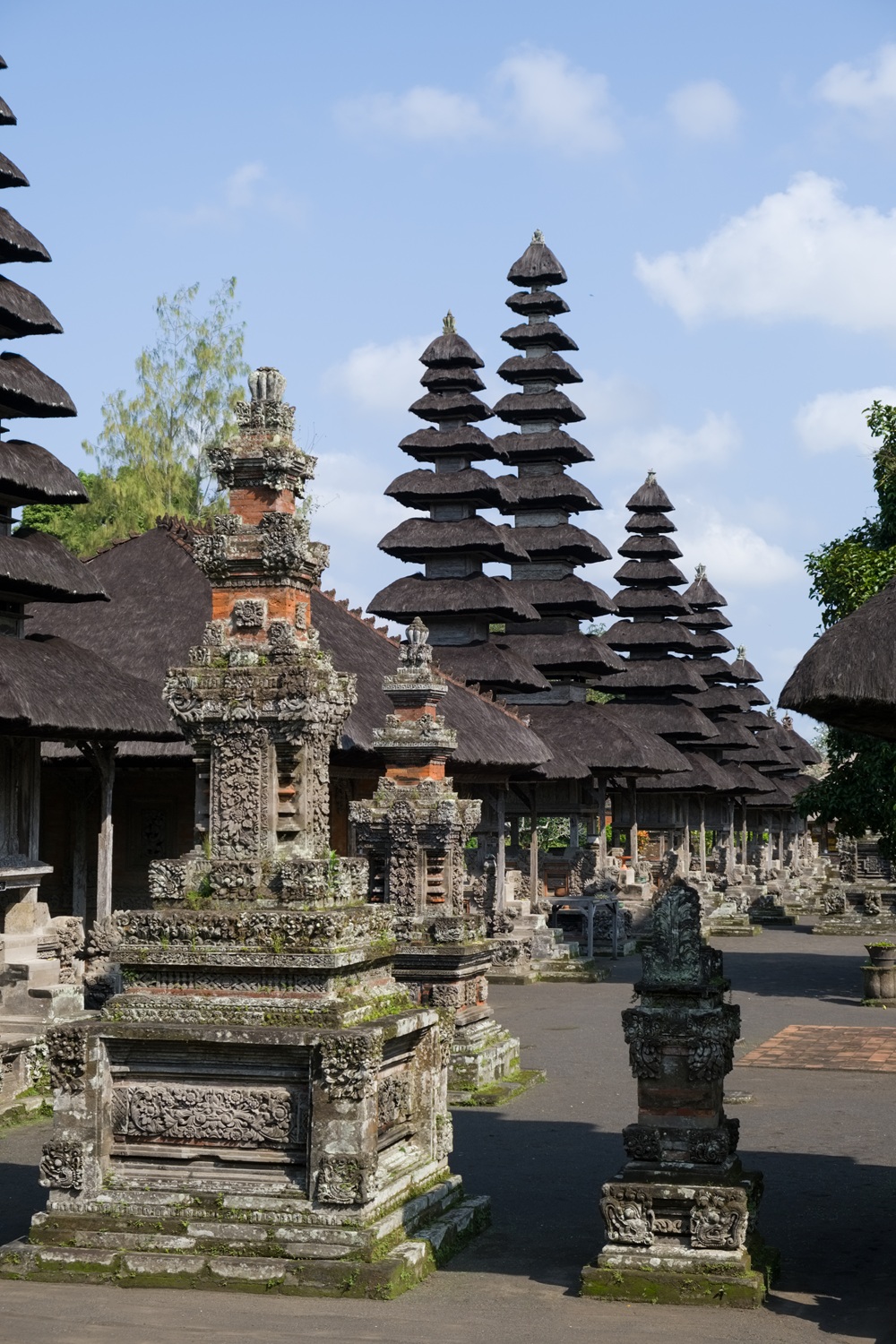
A parade of “meru” towers at Pura Taman Ayun
On these journeys through inland Bali, we learn more about our mild-mannered driver. Yana, who has a degree in business management, tells us he was raised in Ubud but his family come from a village more than an hour’s drive to the northwest. He uses the word “merantau”, which describes the action of leaving one’s hometown and moving to other provinces or islands within Indonesia or even abroad. But the Balinese are so tied to their ancestral villages that relocating to another part of the island is akin to being uprooted. Yana feels he missed out on certain traditions while growing up in Ubud, like being taught to play more complicated local instruments back in his home village.
He also tells us about lawar plek — a “salad” of mixed raw pork and uncooked pig’s blood tossed with garlic, chilies, and green peppercorns. Some local places on the fringes of Ubud still serve the specialty. “It’s extreme eating,” he says. Neither of us are keen. Bama and I may be adventurous eaters, but this is where we draw the line.
Much more palatable is Bali’s famous babi guling, or spit-roasted suckling pig, which I always look forward to eating whenever I’m on the island. From the crater lakes, we head south to the lowlands around the town of Mengwi and swing by a humble roadside eatery called Warung Babi Guling Ninik Nindya. By lunchtime, the urutan (pork meat sausage) and oret (blood sausage) have been sold out, but all the other proteins and side dishes are present. Complementing the tender meat and squares of crackly skin are the ultra-crispy pig’s ear, a small bowl of savory broth, and lawar made with starfruit leaves.
The real reason we’re here in Mengwi is to revisit the UNESCO-listed royal water temple Pura Taman Ayun. According to a lontar palm leaf manuscript known as the Babad Mengwi — the chronicles of the Mengwi kingdom — 17th-century ruler I Gusti Agung Putu commissioned lakeside Pura Ulun Danu Beratan in the highlands before establishing Pura Taman Ayun, whose construction began in 1634. The family temple honors both Hindu gods and the ancestors of the Mengwi dynasty, and is connected to the age-old subak irrigation system still used across much of the Balinese countryside. Ringed on three sides by a wide moat, the 6.9-hectare (17-acre) sanctuary is dotted with fountains, pools, and open-air pavilions, making it a prime example of Balinese landscape architecture.
The tranquility of its park-like setting is only amplified by the absence of market stalls and souvenir sellers. During our time at Pura Taman Ayun, we count just a few other visitors, including two Koreans with their local guide, a Brazilian couple speaking in animated Portuguese, and a French husband and wife. I now consider Pura Taman Ayun one of my favorite Balinese temples; it’s a sentiment shared by Bama.
Our last full day on the island begins with a spectacular sunrise. From the balcony of our cottage, the conical silhouette of Mount Agung rises above the treetops under blazing orange skies. Yana has a surprise for us, too — he has brought along some homemade urutan prepared just that morning by his aunt. It’s unctuous and full of flavor. But a heartier breakfast awaits us down a small road on the outskirts of Ubud. Part of a family compound with an unbelievably elaborate gateway, no-frills Warung Mek Juwel serves the best Balinese nasi campur ayam (rice with chicken and other sides) I’ve ever had. Yana seems to agree. “It tastes just as good as when I last ate here in 2017. The sambal matah is really delicious and the vegetables are special.”
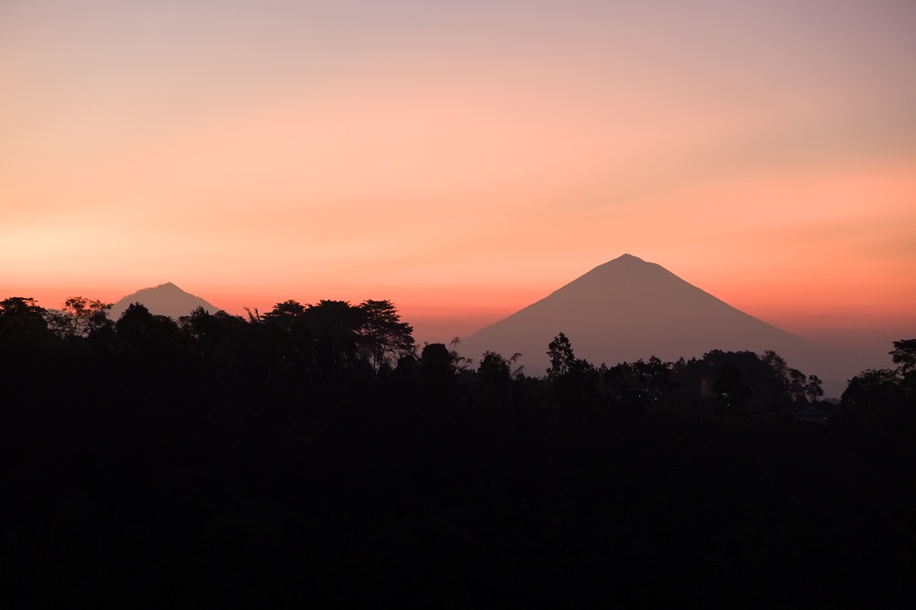
Mount Agung, Bali’s highest and most sacred peak, at sunrise
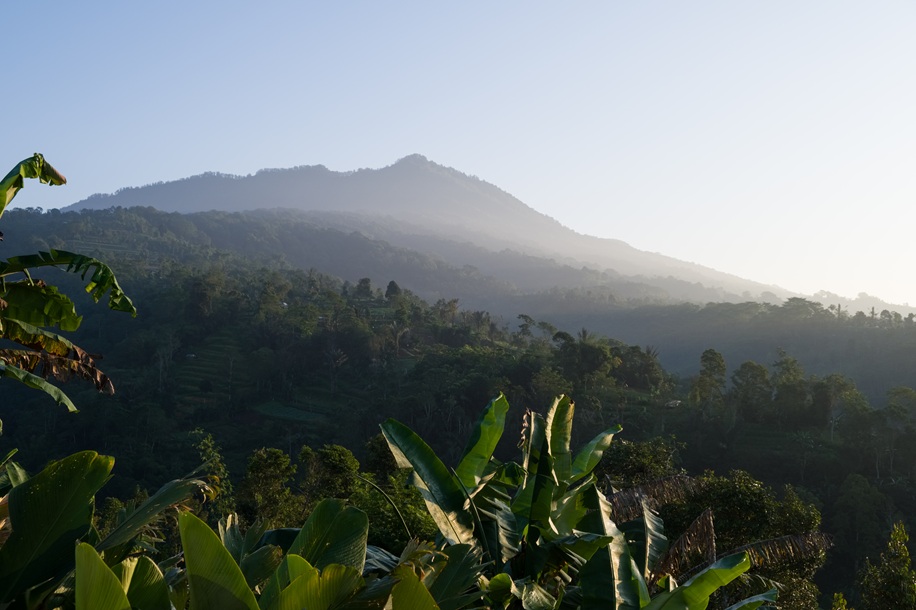
The view from our balcony at The Green Ponci Bedugul
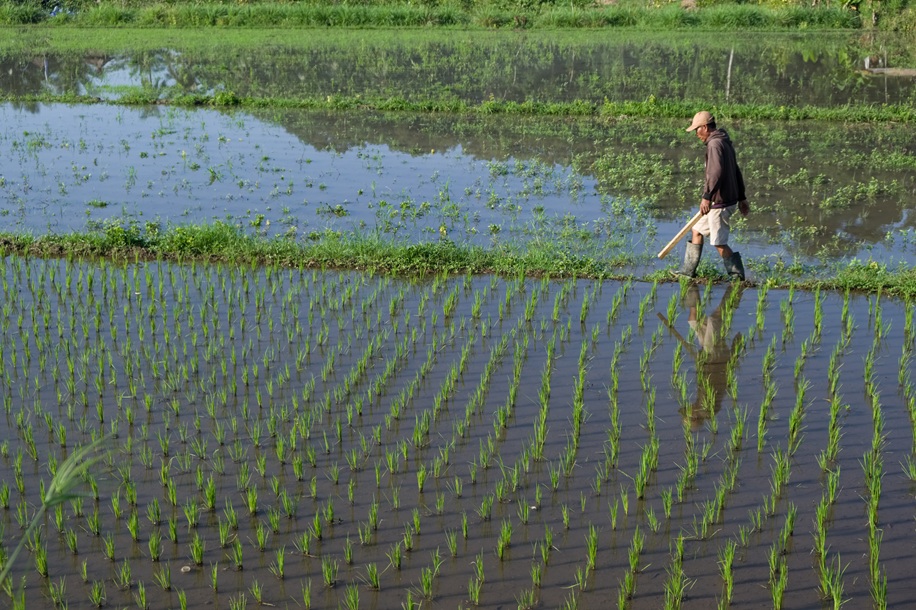
Reflections in the paddy fields
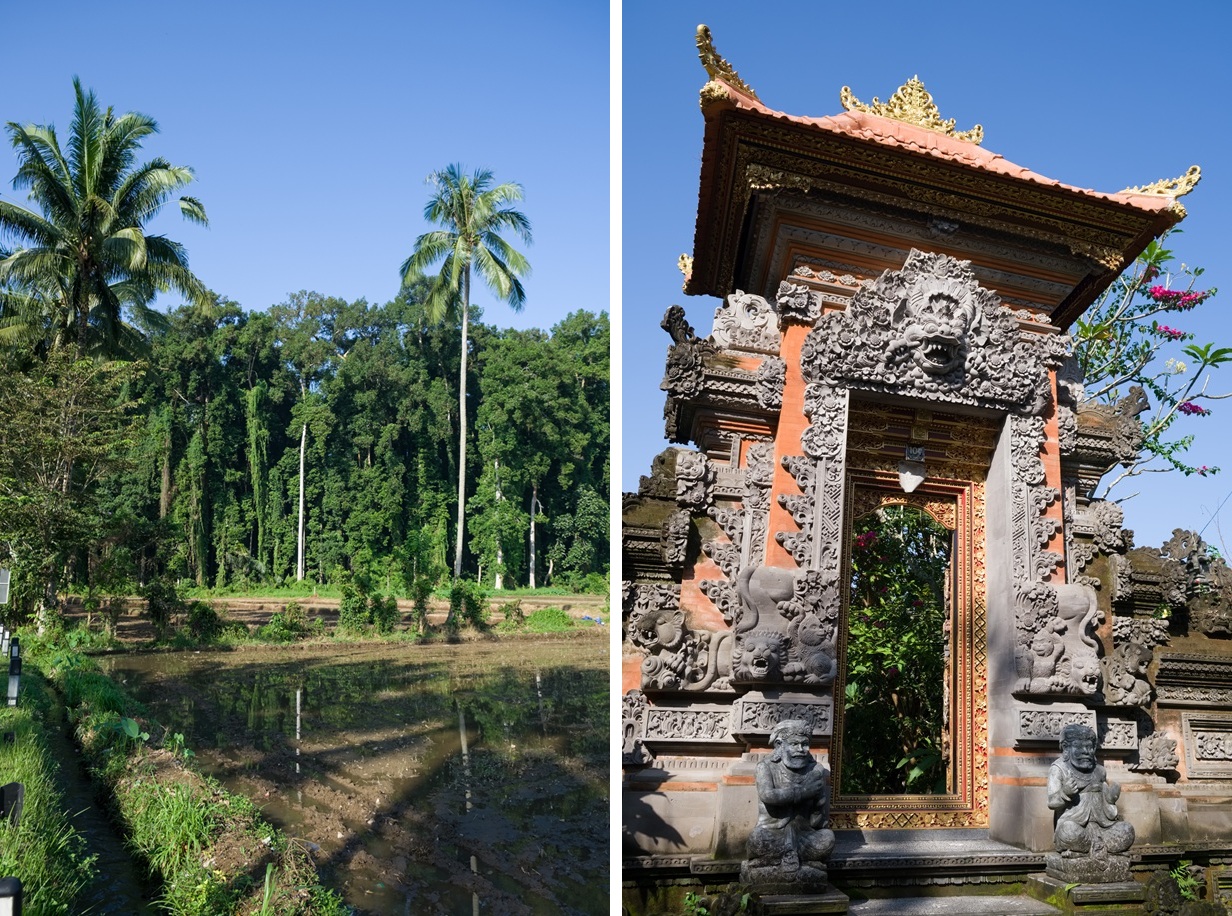
A view of the Sangeh Monkey Forest; the gateway beside Warung Mek Juwel

A breakfast of “nasi campur ayam” (mixed rice with chicken) at Warung Mek Juwel
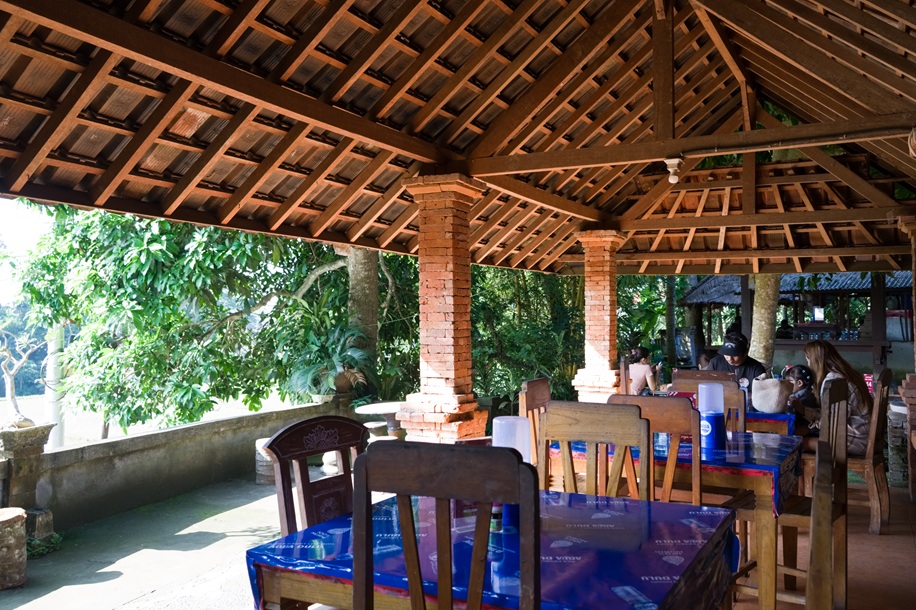
Warung Mek Juwel’s small dining room is on the outskirts of Ubud
For all its timeless beauty and charm, Bali faces plenty of environmental issues. This island, like the rest of Indonesia, has a major garbage problem. Local and provincial governments have not been able to keep pace with an adequate recycling and waste disposal system, nor change thoughtless habits and a pervasive littering culture. One evening, the telltale stench of burning plastic (likely from a nearby plot) permeates our cottage. Bama and I glimpse a shocking amount of trash along the sides of the main north-south road going through Bedugul. Large bags of garbage have been casually thrown over the guardrail, creating a stinking pile on the ravine’s steep green slopes. I can’t help imagining all that toxic detritus being washed down by wet season rains into the sea.
There’s another place that reveals the ugly side of tourism in Bali. Perched on the rim of the Batur Caldera in the Kintamani district, Pura Ulun Danu Batur is the second-biggest temple on the island after Besakih and another component of its scattered UNESCO World Heritage site. Though architecturally impressive and a spiritually important place for Balinese Hindus, it feels more like a marketplace with pushy, aggressive vendors — the complete opposite of the serenity we found at Pura Taman Ayun.
Incense perfumes the air, but I can’t shake the feeling that we are seen as nothing more than walking dollar signs. Though the sarong and sash rental are included in the admission fee, local women charge us 50,000 Rupiah (US$3) per person to rent them inside a darkened room past the ticket counter. A silent minder who doesn’t offer any explanations about the temple chaperones us but promptly disappears after showing us a viewpoint out back, where another man sidles up for a chat. Bama and I are asked to go through his stack of miniature paintings made with ground volcanic stone mined from the slopes of Batur. Then, in an alleyway to the exit, we’re swarmed by a gang of children who appear out of nowhere, loudly and relentlessly chanting to give them money for postcards. When we return to the safety of Yana’s car, the minder waits expectantly while staring into the window. Eventually he scowls and leaves in a huff after coming away empty-handed — it is never made clear that payment is required. We leave the temple with a sense of indignation at how local folks see no problem in swindling visitors at such a sacred site.
Luckily, the rest of our time in Kintamani is far more enjoyable. Before the off-putting experiences at Pura Ulun Danu Batur, we sip on mango avocado banana smoothies and while away an hour or two at Rockaway Kintamani, a newish multi-story café perched right on the caldera rim, with awe-inspiring views from the terrace. Yana navigates the wicked switchbacks on a steep two-lane road leading down to the shores of Lake Batur, whose waters constitute another part of Bali’s UNESCO World Heritage site. Our destination is the small lakeside temple of Pura Segara Ulun Danu Batur. Inside the grounds, we exchange warm hellos with passing Balinese pilgrims dressed in their ritual best; a noisy flock of geese begs for scraps as the peak of Mount Agung plays hide and seek in the drifting clouds.
An hour after leaving Kintamani, Yana pulls into the parking lot of an Ubud restaurant we first visited in December 2013. More than a decade on, Bebek Joni did not only survive the pandemic; it has grown much bigger, expanding its breezy dining area into the paddy fields. Bama and I each order the signature bebek betutu — half a duck coated in a rich Balinese spice paste, with a side of coconutty lawar featuring blanched beansprouts and yardlong beans. The duck itself is even larger, more tender, and tastier than we remember.
Bama still laughs at how hard it was for him to convince me to visit Bali at all. For a long time, I was under the impression that the island was merely a beach destination full of drunken and perpetually underdressed Australians. (That is really only true of certain parts in the south, especially Kuta.) Sadly, overtourism has placed Bali at the top of Fodor’s No List 2025, which rounds up 15 destinations to avoid or at least reconsider. Indonesia’s most fabled island has beaches and rivers choked in plastic pollution, traffic jams that only seem to worsen by the year, aggressive vendors at some of the major tourist sites, and crowds of Instagrammers who line up for hours to get their perfect shot at places like the hillside temple of Pura Lempuyang. Then there are the unscrupulous Russian developers who pressure local residents to sell their land so they can build villas and reap the profits off incoming digital nomads.
But the good far outweighs the bad. Homegrown Indonesian lifestyle brands like Potato Head are pushing new boundaries in eco-conscious hospitality, cutting their waste to landfill from 50% to an incredible 0.5% while supporting creative pursuits. Local NGOs have taken it upon themselves to clean up the beaches, restore coral reefs, and stop plastic garbage from entering the sea in the first place. The island is also home to pioneering restaurants whose chefs are doing wonderful things with locally grown and sometimes forgotten ingredients, championing Balinese producers and artisans along the way. North of Ubud, a farming family operates Indonesia’s only firefly conservation lab and breeding center, which I had the pleasure of visiting as part of a work trip this past March. Despite the runaway development and the environmental woes afflicting the southern half of the island, the magic of Bali is alive and well. ◊
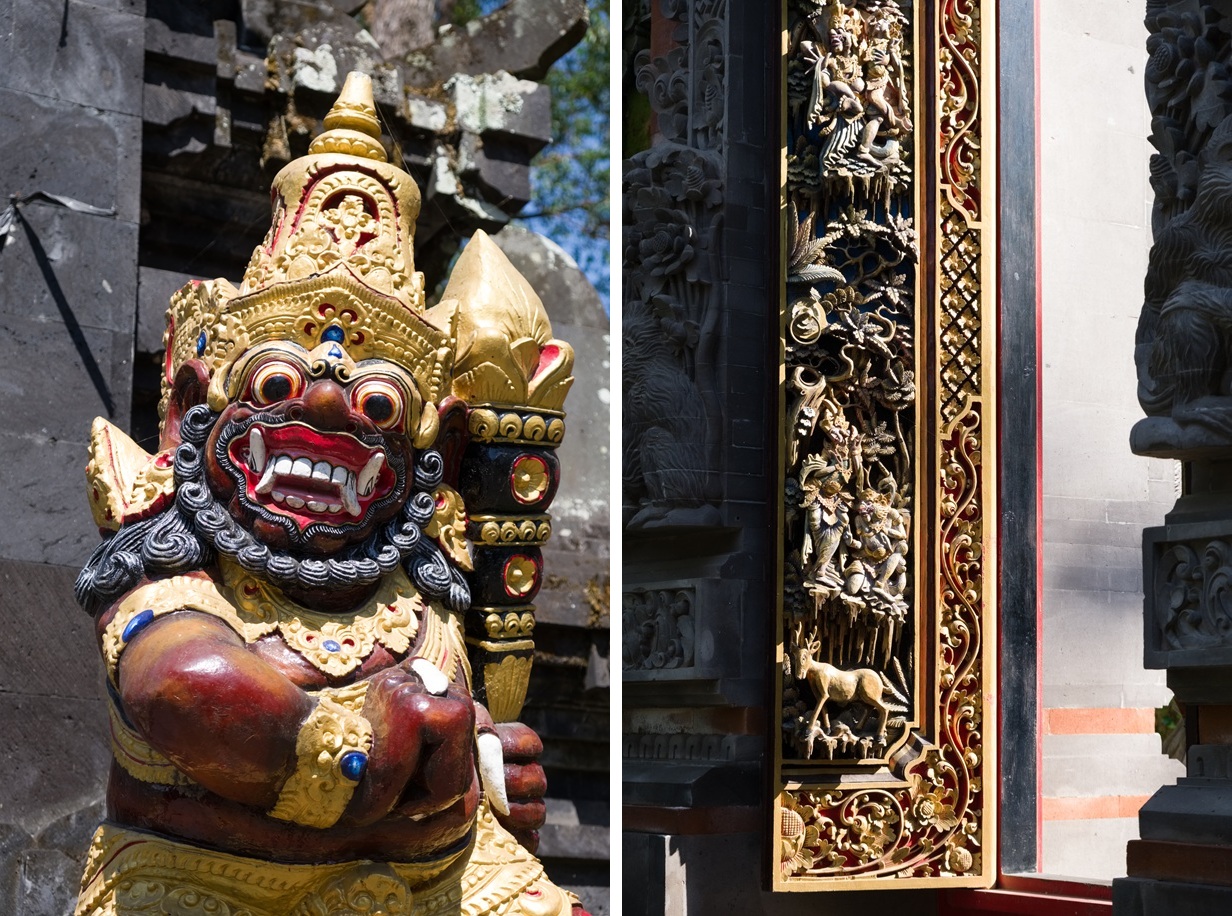
A guardian statue outside a temple; intricate carvings on a door in Ubud
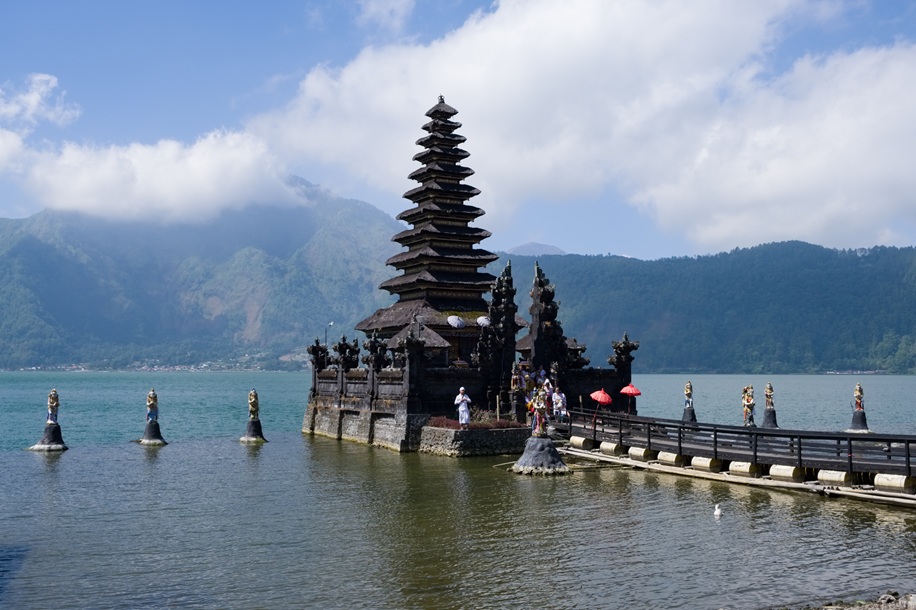
The “meru” at Pura Segara Ulun Danu Batur is built on an islet in the lake
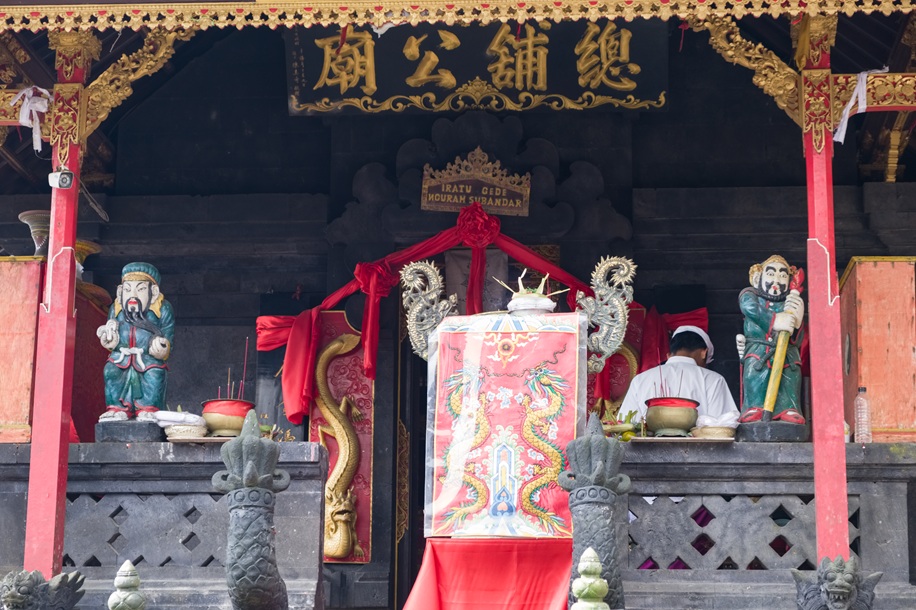
Klenteng Cong Po Kong, a small Chinese temple at Pura Ulun Danu Batur
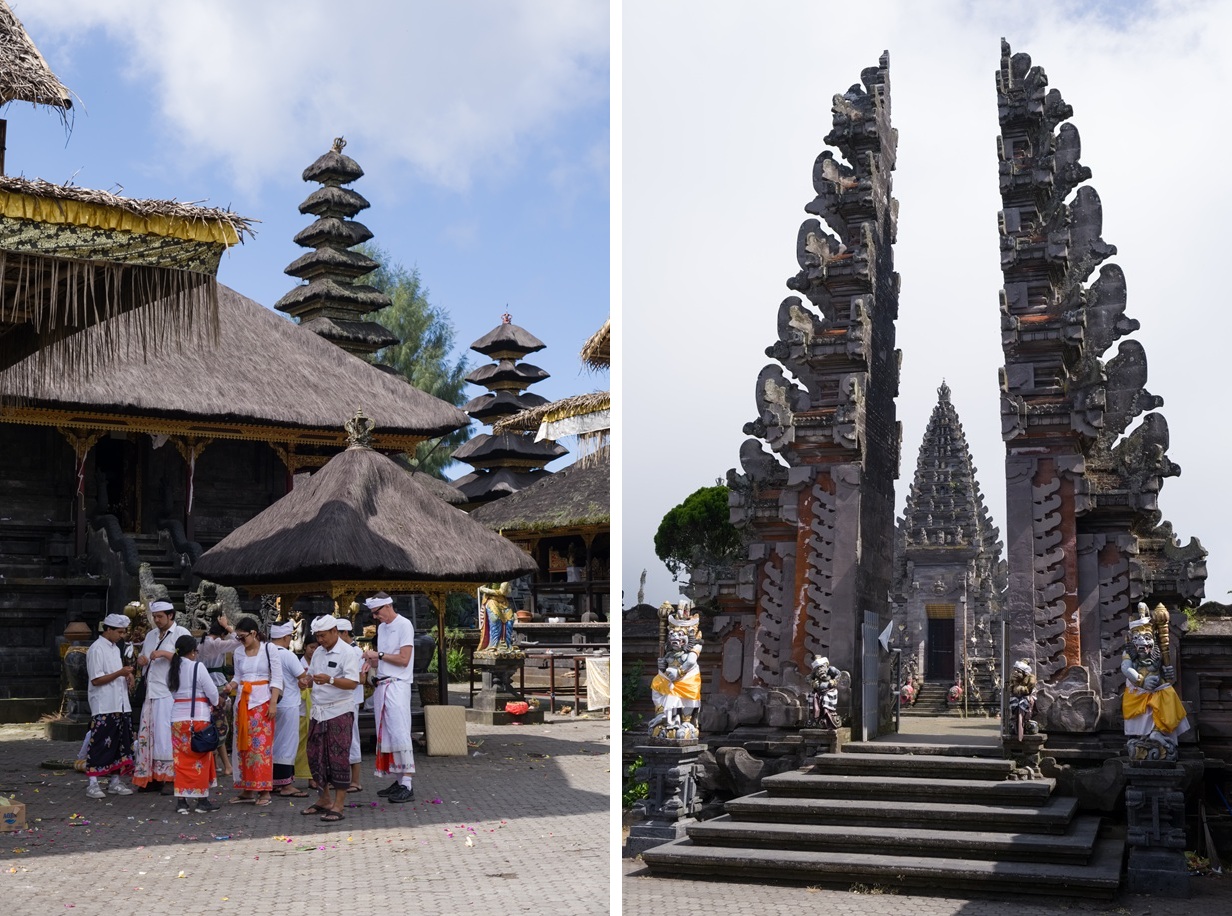
The temple structures at Kintamani’s Pura Ulun Danu Batur date to 1926
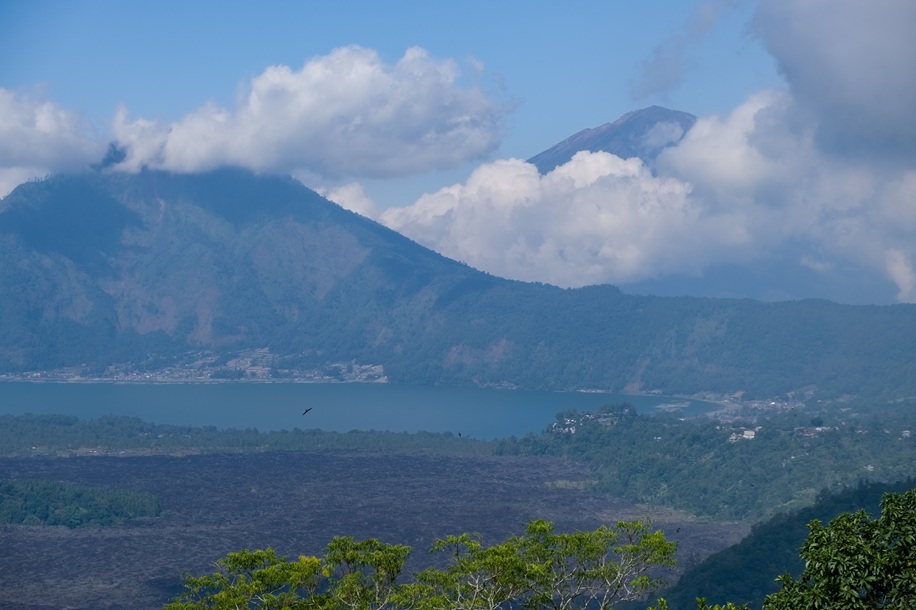
Mount Agung peeking through the clouds above Lake Batur
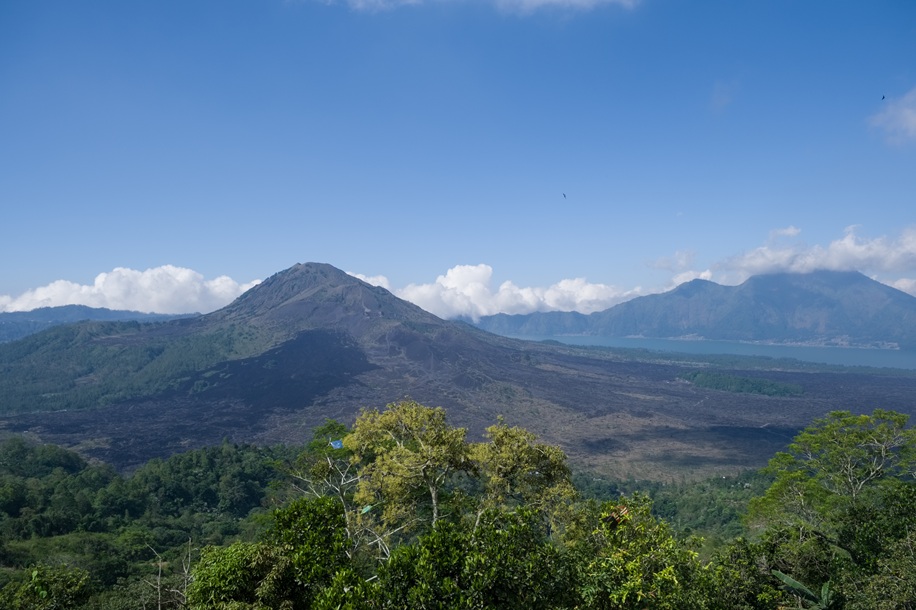
Overlooking the Batur Caldera and its namesake volcano
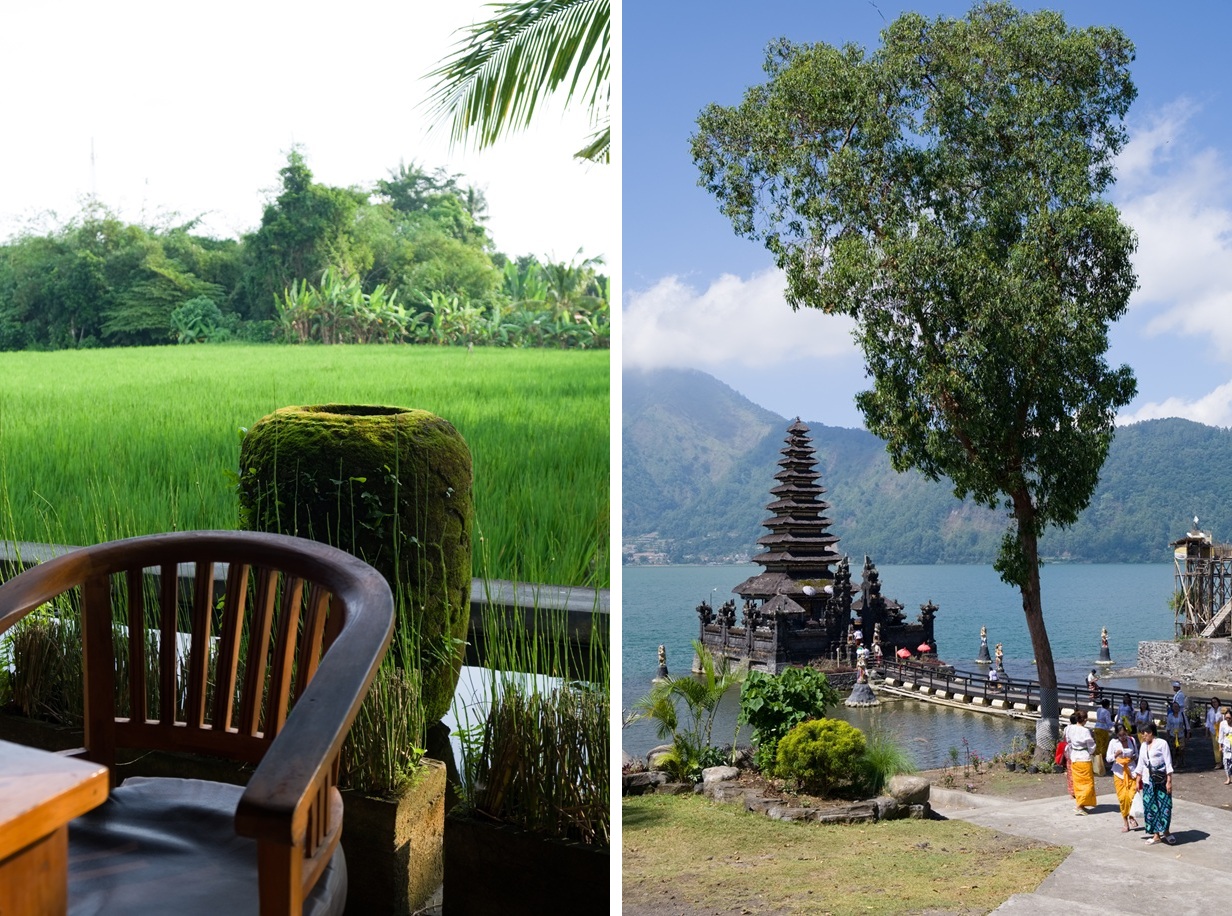
A table with a view at Bebek Joni restaurant; local pilgrims at Lake Batur
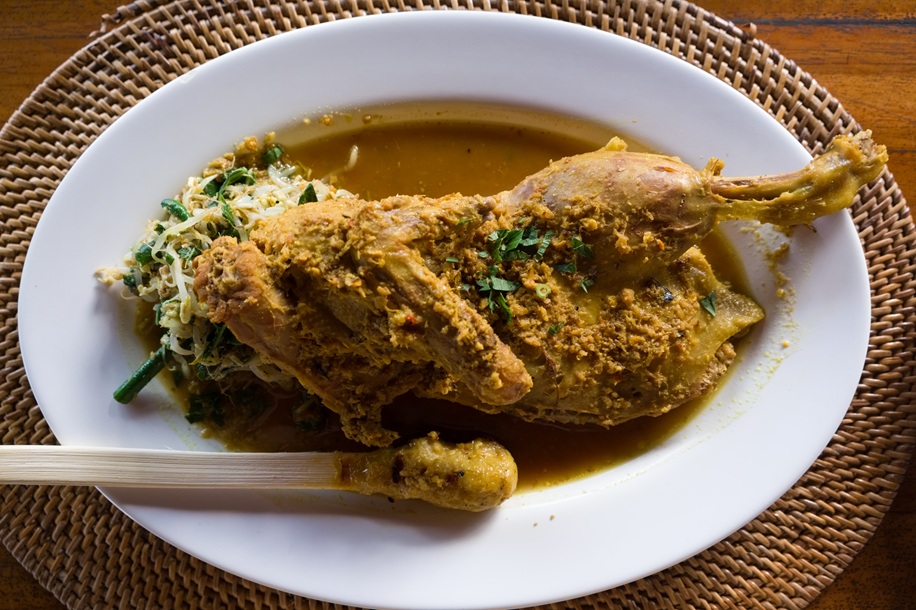
The signature spiced duck (“bebek betutu”) served at Bebek Joni




 Plus Ultra
Thanks for this amazing tour of inland Bali James. I’ll keep it in mind for a future trip. Maggie
It’s my pleasure, Maggie – I’m glad I was able to offer a bit of travel inspiration the same way you’ve done for our recent travels to Mexico and Uzbekistan!
Great photos, even the one of Pura Ulun Danu Beratan in the rain.
Thank you! We were very lucky with the weather during our time in Bali — the rain only fell on day one.
I feel you on Bali and the state of overtourism: I see Bali everywhere on social media, and while it looks absolutely gorgeous, I hesitate to go because of the crowds. However, other parts of Bali look less-busy and more-serene, which you and Bama got to check out! Perhaps I’ll head over there some day and explore for myself! Thanks for sharing 🙂
You’re welcome, Rebecca. 🙂 I have strong feelings about how social media has changed the way we travel — it seems everyone these days is looking for “that shot” and getting FOMO when they see their friends’ travel snaps. Some of the crowds can be hard to avoid especially in the beach areas and downtown Ubud, but there is a workaround if you’re an early bird!
I was quite sure I don’t want to visit Bali, but your blog and Bama’s convince me that it is beautiful, and it is possible to avoid crowds by careful planning.
One of our blogging friends, Madhu, visited Bali for the first time a few months after we went, and said how she wished she had gone 10 years ago before the current boom! But she did still enjoy it and told us the island was one of the most photogenic places she’d ever seen. If you do decide to go someday, my advice would be to steer clear of the busy resort areas in the south!
That’s for sure.
James, this is such a comprehensive write-up of the timeless charm of Bali as well as the island’s uglier side. The problems are real, and a lot of Balinese have been voicing out their concerns about the negative effects mass tourism has brought to their land. But as we learned from this trip a year ago, there are still enough reasons to go back to this fascinating place despite the problems it is facing. Pura Taman Ayun is one of the best examples of how some things on the island actually get better over the years.
Thanks so much, Bama. I agree about Pura Taman Ayun — that was one of the highlights of the trip, and I’m so glad we made the time to revisit it. I am curious about going back to explore more of the east around Candidasa and also the north coast on a future visit. Let’s hope they never start building that proposed second airport near Singaraja. It’s the last thing Bali needs!
Well Bama knows how anti Bali I am because of all the Australian tourism, but if you and he show me such places away from the crowds I might just change my mind! 🤣 A great write up James, your photos and words are wonderful!
Cheers, Anna! You’ll be thrilled to know the worst-behaved foreigners in Bali these days are not the Aussies but the Russians. Locals are getting very fed up with them and are increasingly wary of their home island being turned into a New Moscow. Plus the kind of Aussies you want to avoid generally hang out in the south and only go as far as Canggu, so if you travel farther inland you might not see them at all. 😉
Hahaha thank god the Aussies aren’t the worst anymore!!! And yes I have heard Aussies only hang around one area mostly. Definitely inland travel for me then, although I have to survive the plane ride with them all first! 🤣🤣🤣
I’m just happy that Americans did not make the top-2 worst-behaved! 🙂
What an incredible journey, James! I loved reading about your deep dive into Bali’s quieter, inland wonders. Your vivid descriptions of the temple’s meru towers, the fresh mountain air, and that unforgettable village drink had me transported there myself. It’s inspiring to see how you veered away from the usual beaches and dug into local life — makes me want to plan my own inland adventure in Bali soon!
Thank you for the kind words! Bali does have some lovely beaches but the ones on Lombok, the next island over, are even nicer and not nearly as crowded. It’s the traditional culture and the idyllic countryside that pulls me back again and again.
PS sorry about the slow response — your comment was flagged as spam for some reason so I didn’t see it until the other day!
No worries at all, James! Sometimes these spam filters get a bit overzealous. Lombok sounds amazing — I’ve heard the beaches there are stunning and much quieter. Your love for Bali’s culture and countryside really shines through, and it’s inspiring. Definitely adding Lombok to my travel list now! Thanks for sharing.
Thanks for this virtual tour of the hidden face of Bali. We normally only see the beach resorts so I didn’t realized that there were so much more to the island than the beaches. Certainly a place to add to our itinerary if we ever make it to Indonesia…one day! (Suzanne)
To me, Bali’s traditional culture, arts, architecture, and mountain scenery are infinitely more interesting than the beaches. Fingers crossed you and Pierre will make it there sometime soon!
Thanks for the wonderful tour and photos that capture how special Bali is. I understand concerns about “over tourism” and how locals look at tourists as $ signs, but to let that stop you from visiting would be a shame.
Stay safe,
Steve
Hi Steve, thanks in turn for reading this long post and commenting — I do appreciate you sharing your thoughts. My experiences of Bali over the years have been overwhelmingly positive, but there are times I wonder whether the island is close to its carrying capacity, especially during peak season. When overwhelming visitor numbers are negatively affecting the quality of life of local residents, straining the infrastructure, and putting pressure on finite resources like fresh water, there is a strong case for regulating and managing tourism in a more sustainable way.
I enjoyed the photos and the story. I don’t know why but I had forgotten how big Jakarta is! I think Toronto has just over 3 million people.
Hi Matt! Jakarta just keeps on absorbing more and more new arrivals even though it’s already bursting at the seams — I think the population has grown by a couple hundred thousand since I moved here in 2016.
So much to read and absorb here (in a good way)! Your cottage and its setting look relaxing indeed, and the photo with the main street of Penglipuran was fascinating to me for some reason. Just so different from the places I see every day, and the kind of image that makes me want to buy a plane ticket! Just as I was falling deeply into the beauty of Bali, you reminded us of the environmental problems that I guess we can’t escape no matter how much things look like paradise. 😦
Lex, I was tempted to focus only on the good, but ultimately decided this had to be an honest account of the things we saw and experienced in Bali last June. The last thing I wanted to do was create unrealistic expectations and set other bloggers up for disappointment!