
Sweet Escape: A Taste of Negros Occidental

I hear the procession before I see it weaving through the morning crowds. The fast, rhythmic drumbeats paired with the high-pitched blast of a whistle are sounds you might expect at a Latin American carnival. Only I haven’t left Southeast Asia at all: I’m in the Philippines, a sun-kissed island nation known for its love of song and dance, with a tapestry of cultures deeply influenced by three centuries of Spanish colonial rule. Behind a row of drummers, their instruments tied at the waist or slung from the shoulder, dancers emerge in vibrantly hued dresses with prints of hibiscus flowers and tropical birds. Long flowing sleeves amplify their graceful movements. The spirit of joyous celebration is infectious. Stirred by the warm embrace of the Filipino welcome and an unexpected sense of belonging, I find myself on the verge of being moved to tears.
It is November 2025, and I’m on assignment in Negros, an island about the size of Montenegro or a little larger than Connecticut. Previous work trips have taken me to the Philippines’ economic engines of Manila and Cebu, but this one is different: I’ve come to attend a new international food festival in Bacolod, a city of just over 600,000 people and the seat of Negros Occidental province, covering the island’s western half.
The dancers and drummers herald the opening of the first regional Asian spin-off of Terra Madre Salone del Gusto in Turin. Bringing together small, sustainable producers united in their vision to pass on culinary traditions, champion local ingredients, and safeguard food biodiversity, that biennial gathering is a marquee event of the global Slow Food movement, which emerged from protests against the 1986 opening of Italy’s first McDonald’s near the Spanish Steps in Rome. Alongside an impressive main stage, tents large and small have sprouted up in the manicured park outside Bacolod’s Beaux-Arts Provincial Capitol. The four-lane roads on either side have been closed to traffic and shaded with long canopies: one sheltering street food stalls and booths, the other a produce market for an organic farmer’s festival held in parallel with Terra Madre Asia & Pacific.
As for Negros, the island is now being billed as Asia’s first Slow Food travel destination, with a range of year-round experiences geared toward culinary-minded visitors. People here call themselves Negrenses, and my foray into Negrense food culture begins as soon as I arrive on an early evening flight from Manila. Local guide Jason Tan, who runs a boutique travel agency with his wife Virna, meets me at the airport and offers a quick history lesson on the ride into town. I learn that Negros Occidental has long been the heart of the Philippines’ sugar industry — it still accounts for 60% of national production — thanks to the widespread cultivation of a plant that thrives in the fertile volcanic soil, is harvested just once a year, and requires much less care compared to other staples like rice. “Sugarcane is the lazy man’s crop,” Jason tells me. “You just plant it and it grows.”
Negros Occidental’s rise as a sugarcane-growing region was driven by waves of mass migration from the neighboring island of Panay starting in the 1850s, representing everyone from laborers and subsistence farmers to landed gentry who amassed great fortunes from their haciendas. The settlers brought over their language, Hiligaynon, and built upon their traditional cuisine with the addition of Negros-grown ingredients. Locally processed sugar doesn’t just crop up in desserts: you can taste a discernible sweetness in savory snacks and dishes, including Bacolod’s famed chicken inasal, grilled over charcoal and basted repeatedly in nutty annatto oil. Brown sugar is mixed into the complex marinade, which often contains salt, garlic, ginger, lemongrass, turmeric, fresh calamansi for a fruity tang, and cane or coconut vinegar.
After picking Virna up outside a nearby hotel, Jason takes us to dinner at Aida’s, widely considered one of the best places in Bacolod for chicken inasal. The no-frills eatery is practically full on a Monday night. I’m hungry from an entire day of travel and am keen to have skewered chicken leg, while Virna recommends pakpak, the fatty chicken butt. “It’s the best part!” she enthuses. So, we order both. Smoky, juicy, and well-seasoned, with a crisp skin and beautifully charred edges, Aida’s chicken inasal is a knockout. I put on plastic gloves and tear into the meat with my hands, letting the fragrant annatto oil drip all over the rice on my plate. I also try it with three different dips: soy sauce, chicken oil (“Free cholesterol!” Jason quips), and aromatic sinamak — cane or coconut vinegar infused with ginger, garlic, turmeric, and potent siling labuyo chilies.
The next morning, I join Virna and a small group of journalists on a day trip into the countryside. We spend the first few hours touring Silay (pronounced “See-LIE”), a smaller city up the road from Bacolod known for its heritage architecture, harking back to a boomtime when local sugar barons built opulent family mansions and hosted lavish parties. These elites were exposed to the outside world and many even traveled abroad, making the long journey by steamship to Europe. The concentration of wealth in Silay encouraged art, music, and dance to flourish, so much so the city was eventually dubbed the “Paris of Negros”.
It’s clear this is a place that wears its history with pride. There are street names like Calle Cinco de Noviembre, which commemorates the starting date of a successful island-wide revolt in 1898 during the Philippine Revolution. Virna relates how Negrense fighters from both north and south soon marched on Bacolod and convinced the Spanish governor to surrender without much of a fight. The revolutionaries had a clever ruse to trick the colonial authorities: in the light of the setting sun, decoy wooden rifles and cannons made of bamboo and rolled mats, with coconuts in place of cannonballs, gave the impression they were armed to the teeth. By late November, the Spaniards had evacuated their remaining priests and citizens from the eastern coastline, and the island briefly became the independent Negros Republic until an invading American force landed just three months later.
The sugar boom continued throughout the decades the Philippines was ruled as a U.S. colony. A landmark built during that time was Silay’s San Diego Pro-Cathedral, completed in 1927 to the design of Italian architect Lucio Bernasconi and financed largely by local benefactors. To this day it remains the only domed church in Negros Occidental. Inside, Virna draws our attention to a side-altar with a painting of the Virgin Mary and Child in Filipino dress, and takes us out back to the stone ruins of the building’s mid-19th century predecessor. On her country’s Spanish and American colonial history, she shares a quote attributed to the late Filipino writer Carmen Guerrero Nakpil: “We spent 300 years in a convent and then 50 years in Hollywood!”

The interior and dome of Silay’s San Diego Pro-Cathedral

This Italianate landmark will turn 100 next year

Stained glass inside the church; the soaring dome from below

The Balay Negrense museum in Silay; Sinda Belleza and a plate of fresh lumpia
At our next stop, octogenarian Sinda Belleza welcomes our group into the kitchen where she makes a thousand Silay-style fresh lumpia (spring rolls) per day, equating to 50 kilos or 110 pounds of the snack. We watch intently as she brushes a thick, garlicky secret sauce onto paper-thin crepe-like wrappers before assembling the various fillings on top: soft yet slightly crunchy julienned ubod (coconut palm heart), pork, crispy chicharrón, and lettuce or Napa cabbage leaves. Then our smiling host rolls them all up into tight cylinders. Virna tells us there’s a reason why the sauce is folded inside the lumpia rather than served in a dipping bowl — the doñas of Silay’s elite families did not want to touch the sauce while playing mahjong.
Down another street, we follow Virna through an unmarked gate into the backyard of a faded ancestral house, where an outdoor staircase leads to the top-floor kitchen. Emma Lacson’s Delicacies has been around since 1925 — it specializes in pastries and desserts following heirloom recipes passed down from the owner’s great-grandmother, Soledad Montelibano Lacson. We’re here for its famous empanadas, freshly made and deep-fried in a bubbling wok of hot oil.
Each empanada is individually wrapped in paper. Breaking apart the flaky lard crust reveals a mouthwatering assortment of minced pork, raisins, diced potatoes, onions, garlic, and hard-boiled egg. One bite and I’m hooked: the empanadas have a nostalgic flavor combination reminiscent of torta, the Spanish-influenced Filipino pork-and-potato omelet I grew up eating at home in Hong Kong. Given the dark, sweet-savory glaze coating some of the contents, brown sugar may also be part of the recipe.
From Silay, we head north toward the town of Enrique B. Magalona. Google Maps doesn’t seem to know where we’re going: our driver makes a few circles in the town center until we find another route back into the countryside. At a turnoff up ahead, the paved road suddenly peters out into a rutted dirt trail. Sugarcane fields gradually give way to rice paddies, then mangroves and fishponds on either side of a bumpy track just wide enough for one car to pass through. Looking out from the passenger seat, I’m relieved when our minivan makes it over a rickety wooden bridge spanning a narrow channel.

Making empanadas at Emma Lacson’s Delicacies

These freshly deep-fried empanadas were absolutely delicious

One last look at the lard-crust pastries; fishponds near 7 Hectares

The rustic kitchen at 7 Hectares; a starter of horn snail and vegetables in broth
This detour is entirely necessary for a long, lazy lunch at 7 Hectares, the passion project of Manila-based entrepreneur Kiko Torno and his Negrense wife. Inspired by a farm-dining experience on a trip to Tuscany 14 years ago, the pair turned a series of abandoned fishponds into a model for regenerative aquaculture with zero artificial feeding, just as nature intended. The Tornos’ team of marine biologists have engineered a closed-loop system for raising healthy barramundi, red snapper, mangrove crabs, and other species; milkfish act as natural aerators in the ponds, while oysters and clams filter the water flowing out to sea. Kiko tells us it’s a carbon-negative operation, but I’m struck by an even bolder claim: the food is so clean and so untainted by toxins that diners usually allergic to fish, seafood, or mollusks can enjoy a meal here without fear of an adverse reaction.
“When I started 7 Hectares, it wasn’t for the Philippines alone,” Kiko explains. “75% of the world’s seafood is supplied by Asia, and I wanted to help restore fish stocks in a sustainable way.” To drive that point home among visiting Manileños, the advertising consultant began running pond-to-plate dining experiences in a shaded bamboo-built shelter between the fishponds. Our lunch, a 12-course degustation overseen by traveling chef Gus Sibayan, takes up most of the afternoon. The meal is so delicious no one is in any hurry to leave.
It begins with a starter of horn snail inspired by local vegetable soup laswa, featuring pieces of taro, okra, and thinly sliced daikon, and given an umami kick via dried krill known as kalkag. Red snapper ceviche gets a sprinkling of sea salt before being dressed in calamansi juice and coconut vinegar at the table. Some ceviches can be aggressively sour, but this one is fresh, light, and well-balanced. “Fish should not sit in acid for more than five minutes,” Kiko says. “Any flavor we add has to accentuate the taste of the main ingredient, not overpower it.”
Among Southeast Asian cuisines, Filipino food stands out for its abundant use of souring agents. Kiko introduces us to two specific to Negros: batwan, a small green seasonal fruit that’s highly astringent and hardly edible when fresh, so its tanginess is extracted by boiling and passing the pulp through a strainer. The other ingredient — a rare wild-growing bulb foraged from the island’s upland forests — is yutokorn. Peeling back layers of its fibrous brown husk reveals juicy pods containing tiny black seeds, with an almost citrusy taste akin to juniper.
Seafood sourced from beyond 7 Hectares shows up in the next few dishes. One course involves sardines, seaweed, cured duck egg, and asin tultul from the nearby island of Guimaras — the only salt in the world made with coconut milk. Sustainably picked blue swimmer crab and flower crab are gently steamed and served atop strands of fine gulaman seaweed and crispy linguine-like efuven noodles, supposedly introduced to the Philippines by French nuns. Grilled in an inasal style, thick chunks of locally fished blue marlin (pictured at the top of this post) are brushed with annatto-and-chicken oil and placed on the edible core of a banana tree felled by a recent typhoon.
We also enjoy squid stuffed with risotto and Negrense chorizo, then lightly blanched tiger prawns with a creamy sauce of their own head fat and water buffalo milk. But the undisputed star is 7 Hectares’ whole barramundi, wrapped in banana leaf and grilled over an open fire fueled by coconut husks. I’m amazed at the fish’s simplicity and sublime flavor, with a delicate sweetness brought out by the smoky fragrance of the burnt banana leaf. It might just be the tastiest barramundi I’ve ever had.

Tiger shrimp for lunch; 7 Hectares’ whole barramundi grilled in banana leaf

The dining pavilion at 7 Hectares sits between two tidal fishponds
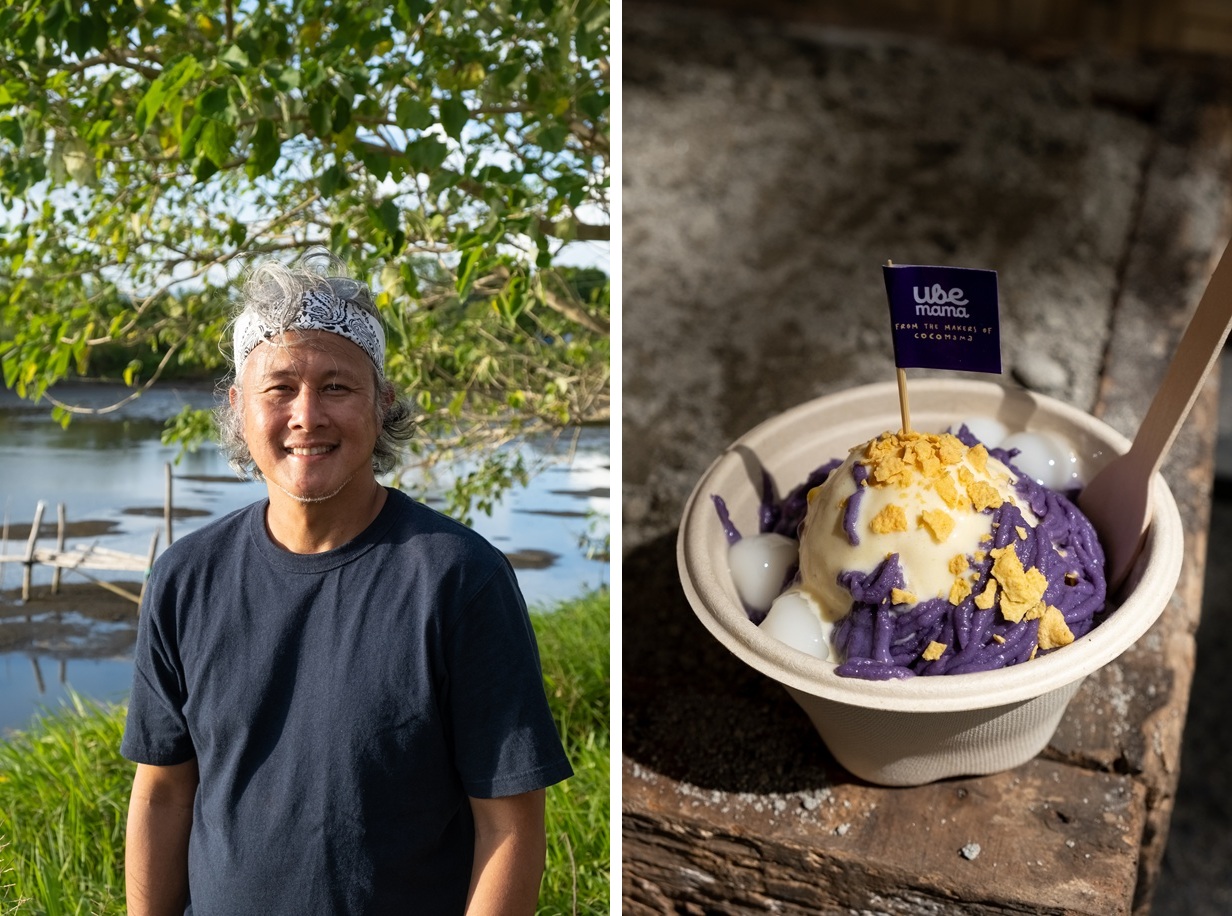
7 Hectares’ owner Kiko Torno; an ube-laced treat at the Terra Madre food festival

Torch ginger for sale at the organic farmers’ market; dancers on the festival grounds
Back in Bacolod that night, I’m thrilled to find more barramundi from 7 Hectares on the menu at organic restaurant Lanai by Fresh Start. The fellow journalist sitting next to me isn’t so enthusiastic. But something we can agree on is the restaurant’s coziness, with tall shuttered windows and a dining room that feels polished yet homey at the same time. We’re told by the owner that this project was a “Covid baby”. If the name sounds familiar to American readers, that’s because it refers to the Hawaiian word for an open-sided porch or veranda of a house. And the place has spades of island charm — Lanai’s main hall opens out to a manicured lawn framed by tropical foliage, insulated from the noise of a busy six-lane artery down a narrow driveway between two larger buildings.
Each time I visit the Philippines, I look for desserts or pastries made with ube (pronounced “oo-beh”), a native purple yam with an earthy, slightly nutty, and mildly sweet flavor. Ube’s natural violet hue and distinct taste make it a popular ingredient for countless baked goods across the archipelago. The tuber is often boiled, mashed, and then stirred in a hot pan with coconut cream, condensed milk, and butter to create velvety ube halaya jam.
At Lanai, ube stars in the dessert cocktail Sadya sang MassKara, a tribute to the city’s famous MassKara festival held every October, when local troupes in resplendent, over-the-top masks and costumes face off in boisterous street dancing competitions. The tasty concoction mixes ube cream liqueur and house rum with vanilla, cinnamon, pandan syrup, and palm tree flour syrup; chewy nata de coco and grass jelly in coconut cream fill a small bowl (made from a dried cacao pod) attached to the glass by a wooden clothespin.
Another day, while roaming the Terra Madre festival grounds, I enjoy thick, melt-in-the-mouth strands of minced ube girding an ice cream inspired by maja blanca, a Filipino coconut-milk pudding that often has kernels of sweetcorn. Topping it off are garnishes of salted coconut cream, sticky-rice balls known as palitaw, and cornflakes.
I then browse the various stalls to pick up edible souvenirs like a bottle of coconut vinegar produced on the island of Palawan and artisanal chocolate bars made of Negros-grown criollo cacao — the fruit of a successful quest to track down the world’s rarest cacao variety, brought over from Mexico by Spanish friars in the mid-17th century. I also take home a jar of dry palapa, a quintessential condiment from the Muslim-majority Moro people of the Philippines’ far south. This one blends toasted grated coconut and pieces of scallion-like sakurab with spices, salt, and sugar.
In between cooking demos and talks given by culinary experts, the sight and smell of all the street food at Terra Madre makes me ravenously hungry. And so, I find myself with Virna and some visiting chefs at a long communal table with a tantalizing smorgasbord of Filipino dishes. From a stall run by the Slow Food community in Boracay — a small island I visited on assignment in 2018 — there are crispy fried shrimps and inubarang manok: native chicken and banana pith (ubad) in a coconut-milk stew. Other vendors ply us with Negrense-style lechon (spit-roasted pig) and dinuguan, a rich stew of pork blood cooked with various herbs and aromatics; grilled pieces of river eel on skewers; and prized (and highly seasonal) angel wing clams known as diwal. Meaty and sweet-tasting, the clams are chargrilled and sprinkled with fried garlic. Most unusual of all is kamantaha, pale-shelled, alien-like ghost shrimp from the depths that only appear in significant numbers after typhoons.

Grilling cuttlefish at Terra Madre; making piaya (muscovado-stuffed flatbread)

Pork belly in guava sauce at Lanai by Fresh Start; the restaurant’s main dining room

A corner of Lanai; the Agimat ni Dios Buhawi cocktail uses local black plum wine
Sadly, I miss out on these curious ghost shrimp, as I must rush off to a lecture about the surprising relationship between lambanog — a Filipino palm liquor most commonly distilled from fermented coconut sap — and the Mexican spirits mezcal and tequila. Much of the session is led by medical anthropologist Gideon Lasco, a name I’d heard of more than a decade ago while working at the now-defunct adventure travel magazine Action Asia. (He has long been a prominent figure in the Philippines’ mountaineering community.)
Gideon tells us Filipino sailors who crossed the Pacific on Spanish galleons between Manila and Acapulco introduced their pre-colonial distillation techniques and portable stills to the Americas. Scholars agree that Filipino migrants also brought the coconut to Mexico, sharing their knowhow in cultivating coconut palms, harvesting the sap, and distilling it into vino de coco. Homegrown coconut brandy became so popular in Mexico and production so widespread on the Pacific coast it threatened the sales of Spanish wine; colonial authorities eventually banned all production of the spirit in the 17th century. Mexicans adapted by applying the same techniques to the agave, thereby giving birth to mezcal and tequila. So, two alcoholic spirits considered to be quintessentially Mexican actually have forgotten Filipino roots, while their Southeast Asian prototype, lambanog, remains virtually unknown outside its country of origin.
This may be a food-oriented trip, but one morning, we’re driven for 90 minutes out of town to Negros’ north shore for an excursion that doesn’t involve any eating. At Old Sagay Port, our group hops aboard a motorized bangka (double outrigger boat) for the short crossing to Suyac Island, a speck of dry land measuring just 1.8 hectares (or 4.4 acres) in size, fringed by 15 hectares (37 acres) of mangroves. Community-led conservation efforts have led to the creation of an eco-park on the island, with 90 percent of earnings from admission fees and other charges going to Suyac’s 700 village residents. At the top of the ramp leading from the jetty, we’re welcomed with garlands of pototan (Bruguiera gymnorrhiza) mangrove flowers and then a song and dance routine before a brief explainer on the mangroves’ importance in capturing carbon, their benefits for local fisheries and food security, and usefulness as a protective “bio-shield” against typhoons and coastal erosion. Village guides escort us along an elevated boardwalk through the mangroves, stopping beside a gnarled 300-year-old pagatpat (Sonneratia alba) tree. I learn that the name Suyac means “thorn”, alluding to the mangroves’ pointed aerial roots protruding above the shallows.
We savor the fresh, briny sea air on the scenic bangka ride to our next destination. Fishermen in their single-man boats wave as we glide by: our helmsman steers a course toward the lonely sandbank at Carbin Reef, whose only permanent structure is a concrete watchtower for rangers looking after the surrounding marine reserve. The ruined supports of its predecessor, destroyed in 2013 by Typhoon Yolanda (a.k.a. Haiyan), still rise above the waves. None of us, sadly, have brought our swimwear.
By the time we return to Bacolod in the mid-afternoon, I’m regretting the fact that I woke up late and skipped breakfast. Virna directs our driver to the no-nonsense eatery Sharyn’s Cansi House for a very late lunch involving the Bacolod specialty cansi. It may not be the prettiest dish, but this hearty beef-shank soup is hugely satisfying. Flavored with batwan and black pepper, the broth is savory, salty, and somewhat sour. We enjoy it with rice, extra soup served in mugs, and a dry version of the dish called crispy cansi, which resembles shredded beef jerky.

A welcome dance at Suyac Island Mangrove Eco-Park; on the boardwalk

Exploring the island’s sole village, home to 700 people

An early-20th century ancestral house turned restaurant in Silay
On my final day in Negros, I manage to fit in one last excursion to Silay before the early afternoon flight to Manila. Virna has arranged for some of us to meet Solomon Lopez Locsin, a 39-year-old historian, tour guide, and heritage advocate from a local sugar-growing family. During his recent six-year tenure as a city councilor, he drafted and helped pass a municipal bill for the creation of Silay’s protected heritage district.
Solomon is waiting for us at El Ideal, an old-school bakery café that has operated since the 1920s in a Spanish-colonial house on the city’s main strip. While quizzing him on the history of his hometown, we all tuck into slices of El Ideal’s signature guapple pie — made from a guava variety cultivated for its large size and crunchy texture — with a sweet crumble topping. Solomon tells us this pie was born out of the economic hardship that came with the 1980s sugar crash, when Silay’s housewives sought out an alternative livelihood by selling snacks and desserts based on closely guarded home recipes.
Virna and Solomon then take us down a narrow lane to the house where Marit’s Special Piaya prepares a classic Negrense treat of muscovado-filled unleavened flatbread. Its fourth-generation owner has stuck to a tried-and-tested recipe passed down from her grandmother, and her piaya have attracted the attention of the highest levels of government. When we drop in to the workshop, staff members are busy making 500 of them to be sent to Malacañang — the Presidential Palace in Manila.
I’ve eaten chunky piaya at Lanai and fresh from the griddle at the Terra Madre festival grounds, but this is something else entirely. Carefully made by hand and still warm to touch, the flaky, thin crust sprinkled with sesame seeds gives way to a gooey, rich muscovado sugar filling that isn’t overly sweet. Marit’s piaya come in three more flavors: ube, cacao, and matcha. I end up buying six packs, some to share with Bama, others to distribute among my coworkers.
Back on Silay’s main street, Solomon is keen to show us the Bernadino Jalandoni Museum, locally known as the Pink House for its cheerily painted exterior. The 1908-built ancestral mansion is something of a time capsule, complete with period furniture and capiz-shell windows above the open ventanillas that allow cool breezes to circulate through the building. In the upstairs living room, our guide points out the ceiling of intricately patterned steel trays imported from Hamburg. “These wealthy families would travel to Europe and bring things back,” Solomon explains.
We have just enough time for a quick look inside the restored German Unson Heritage House a few blocks away. Built in 1938, the graceful Mission-style home wouldn’t look out of place in Southern California. It now operates as a family-run bed-and-breakfast, though the place is devoid of guests when Solomon carefully opens the front door. Soon, I bid farewell to Virna as she chaperones a fellow journalist to an interview, before doing the same with Solomon outside the terminal of Bacolod’s airport — a 15-minute drive from Silay.
Looking back, my most recent jaunt in the Philippines was the best kind of work trip I could have asked for. Not only did it reveal an underappreciated part of a country I love, but it also showed me the sweet spot where local history and food culture intersect. I can’t wait to introduce Bama to the sights and the delicious flavors of Negros someday. ◊

A bangka boat at Suyac Island; Marits Valladarez, owner of Marit’s Special Piaya

Inside the workshop at Marit’s Special Piaya

Graceful arcaded buildings on the main street of Silay

Scenes from the German Unson Heritage House, now a family-run B&B

Living quarters at the Bernadino Jalandoni Museum

An antique bed in the museum; a slice of guapple pie at El Ideal bakery

Bacolod cansi (sour beef shank soup); the Bernadino Jalandoni Museum’s study





I love reading about 7 Hectares – very impressive.
I’m not as adventurous as you with food but I want to try the guapple pie and the barramundi. The ube ice cream looks good but I can’t handle lactose.
It’s nice that your business trip meshed so nicely with your own interests and agenda.
That long lunch at 7 Hectares was a real highlight of the trip. I could barely believe it when Kiko told me people with fish or seafood allergies could eat there with no issues. Some of the more traditional ube-based desserts in the Philippines use coconut milk, so you will definitely be fine with those.
I remember the first time I tired ube ice cream as a kid and I really liked it. (I was born in the Philippines) But somehow my body became lactose sensitive in my 20s.
It’s strange how our food tolerances can change as time goes by. Bama has gone through a similar experience, so we generally buy lactose-free milk these days. But luckily he can still enjoy ice cream and other dairy products, especially if they’ve been cooked or processed.
Looks like a foodie paradise! I’ve not heard of Negros, but it looks like a unique island with so much going for it. All the dishes look so fresh and flavorful, and now I have to find the opportunity to head to the Philippines some day, especially to visit Negros! Thanks for sharing, James!
Rebecca, it was an eye-opening trip for sure! And I can say that Negros had some of the best food I’ve eaten over four different work assignments in the Philippines. The chicken inasal I had that first night was superb, and I loved the street food in Silay as well. Thanks too for commenting and getting through such a long post!
This is such a heartfelt and mouth-watering post, James. I love the idea of a global slow food movement. I always appreciate independent brands that champion locally-sourced and sustainably-grown produce, and highlight long-forgotten ingredients. If anything, this post further convinced me to visit the Visayas when I go back to the Philippines, hopefully sooner than later. I would consider myself lucky if I’m able to try half of what you had on this trip!
Thank you so much, Bama. I’m crossing my fingers that we get the chance to plan a trip to the Visayas within the next few years. I know you will love Negros and I’m intrigued to see how the food in Iloilo compares to what I ate last November!
An excellent story! I loved reading about all the food and its origins and heritage. I would love to visit this part of the world someday.
Much appreciated, Nicole! The Philippines is such a beautiful and fascinating country – I hope you make it there in the not-too-distant future.
What a lovely write up about your time in Negros Occidental, James. How interesting to read of it as a the heart of the Philippines’ sugar industry and sugarcane. Fascinating how you can taste locally processed sugar in the meals, sounds like the kind of sugar with very distinct taste. The lumpia and empanada sound delicious, and you captured some great photos of them empanadas being served 😊
Cheers, Mabel! Everything I ate in Negros was delicious — I don’t recall having a bad meal or any disappointing snack on that trip. 🙂 The locally grown muscovado sugar definitely tasted richer and more flavorful than the highly refined white sugar we’re all used to.