
Retracing the Past in Montréal
So much can change in the span of 17 years. That’s how long it takes for a newborn to reach the cusp of young adulthood, and for Switzerland, a nation of master engineers, to drill the world’s longest and deepest railway tunnel through the Alps. (That would be the remarkable 57-kilometer or 35-mile Gotthard Base Tunnel.) Until two months ago, the last time I visited Montréal was in the spring of 2009, when the city was just emerging from another long Canadian winter and the maple trees blanketing the slopes of Mount Royal were still naked, their branches bereft of leaves.
My brother was attending college in Montréal at the time, and we hiked up the Grand Escalier du Mont Royal — the same staircase I referenced in my previous post — during the pre-dawn chill to witness the sun rising over the city on Easter Sunday. I also recall digging into a plate of poutine dressed with bacon and mushroom and meeting his close friends, among them Montrealers who were trilingual or even quadrilingual. Funniest of all was Anne, who entertained the whole group with her hilarious real-life anecdotes. I was deeply impressed that she could switch between French, English, Vietnamese, and Cantonese at will.
But my very first memories of Montréal date from one particular summer in the early 2000s, when, together with our parents, my brother and I accompanied our elder sister to help her settle into her new life as a college student. I’ll always remember what happened when we arrived at Toronto Pearson after an uneventful 16-hour flight from Hong Kong. “I’m here to send my daughter to university,” my father told the immigration officer matter-of-factly. The middle-aged woman at the counter glanced at our family of five. “Which one?” My mother immediately burst into a fit of laughter, flattered that someone had assumed she was at least 30 years younger.
Montréal struck me as being remarkably different from Toronto. It felt distinctly European; all the signs and so many of the conversations around us were in French. I recall the family going to Schwartz’s Deli for its legendary smoked meat sandwiches, but not St. Viateur, which strikes me as being especially strange given how much my bread-loving mother appreciates a good bagel. Québec’s biggest and most multicultural metropolis also gave us a delicious introduction to Lebanese cuisine, which was incredibly rare in Hong Kong at the time. My semi-vegetarian mother was elated every time we got to eat tabbouleh salad and fattoush, hummus and baba ghanoush. My fussier father went along but was less enthusiastic. At one point he got so tired of eating Lebanese he asked us aloud, “Can we not have Middle Eastern food?”
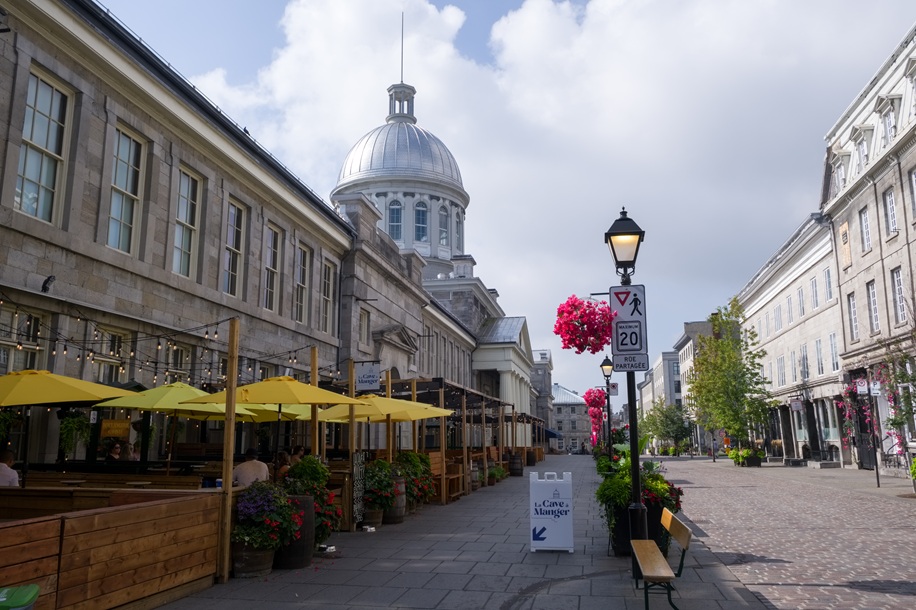
“Terrasse” seating outside the domed Bonsecours Market in Old Montréal
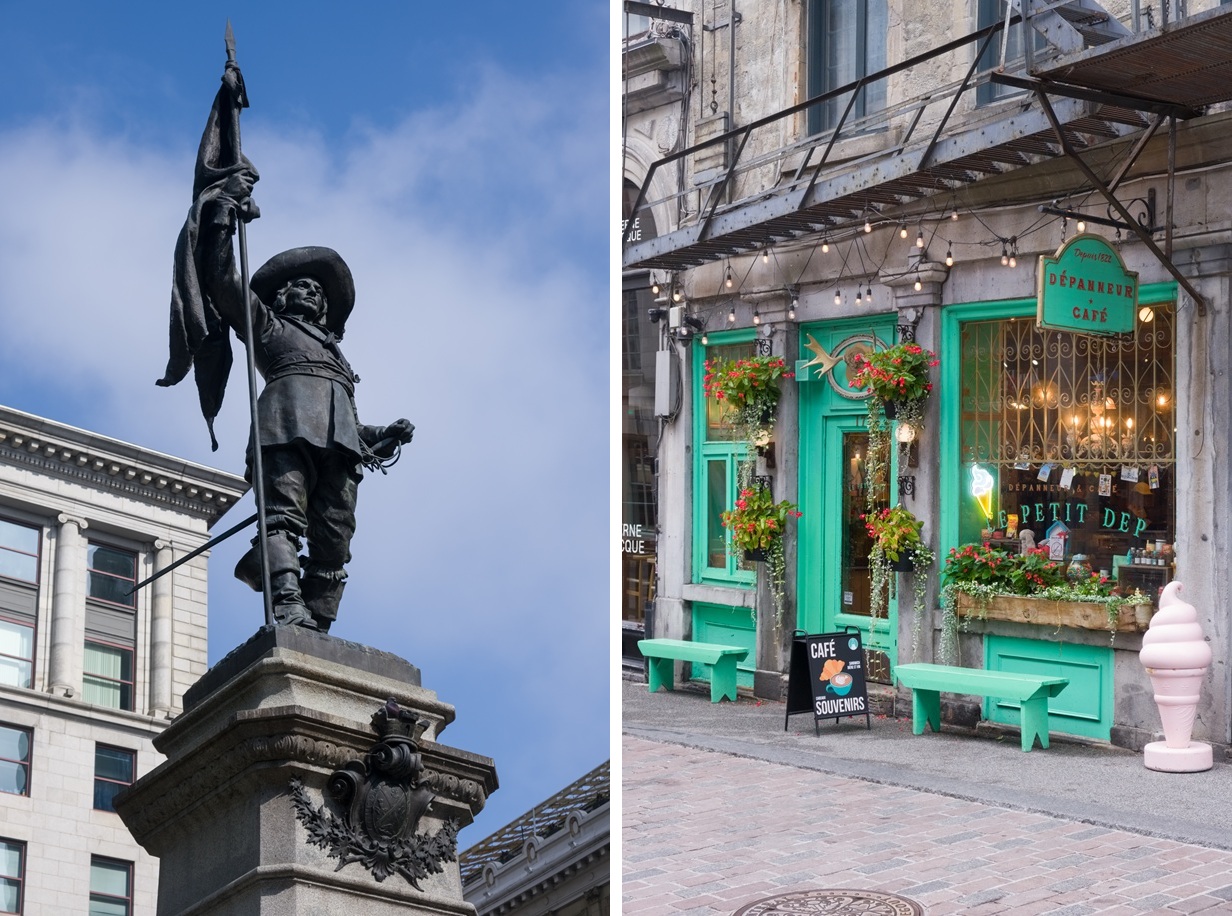
The Maisonneuve Monument on Place d’Armes; a Québécois café and grocery store
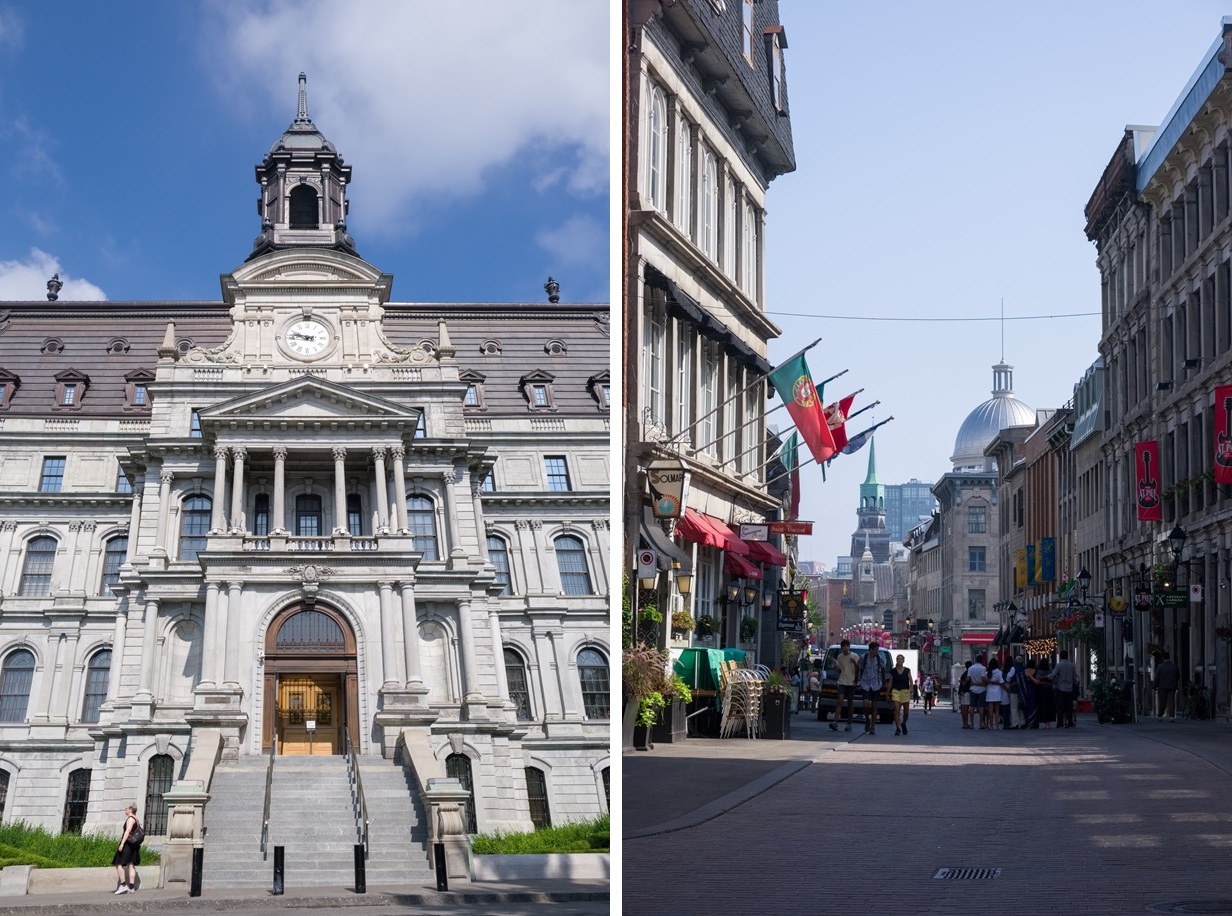
Montréal’s stately Beaux-Arts City Hall; looking down Rue Saint-Paul
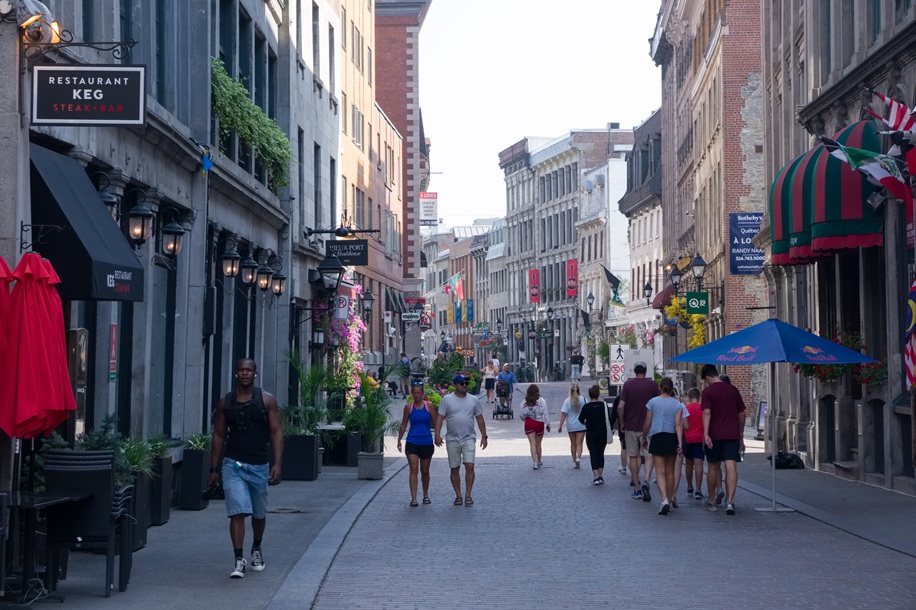
A pedestrianized stretch of Rue Saint-Paul, the oldest street in the city
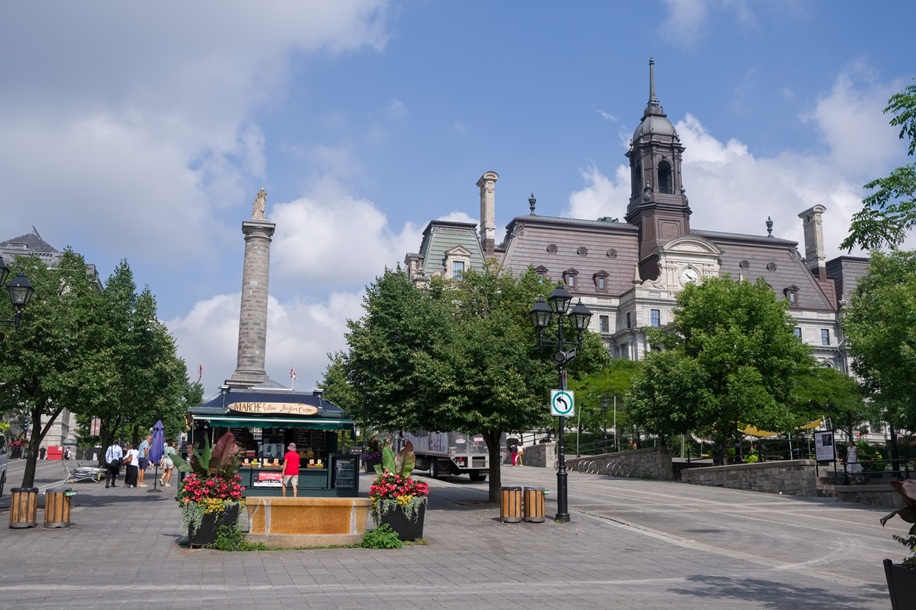
Nelson’s Column and Montréal City Hall, seen from Place Jacques-Cartier
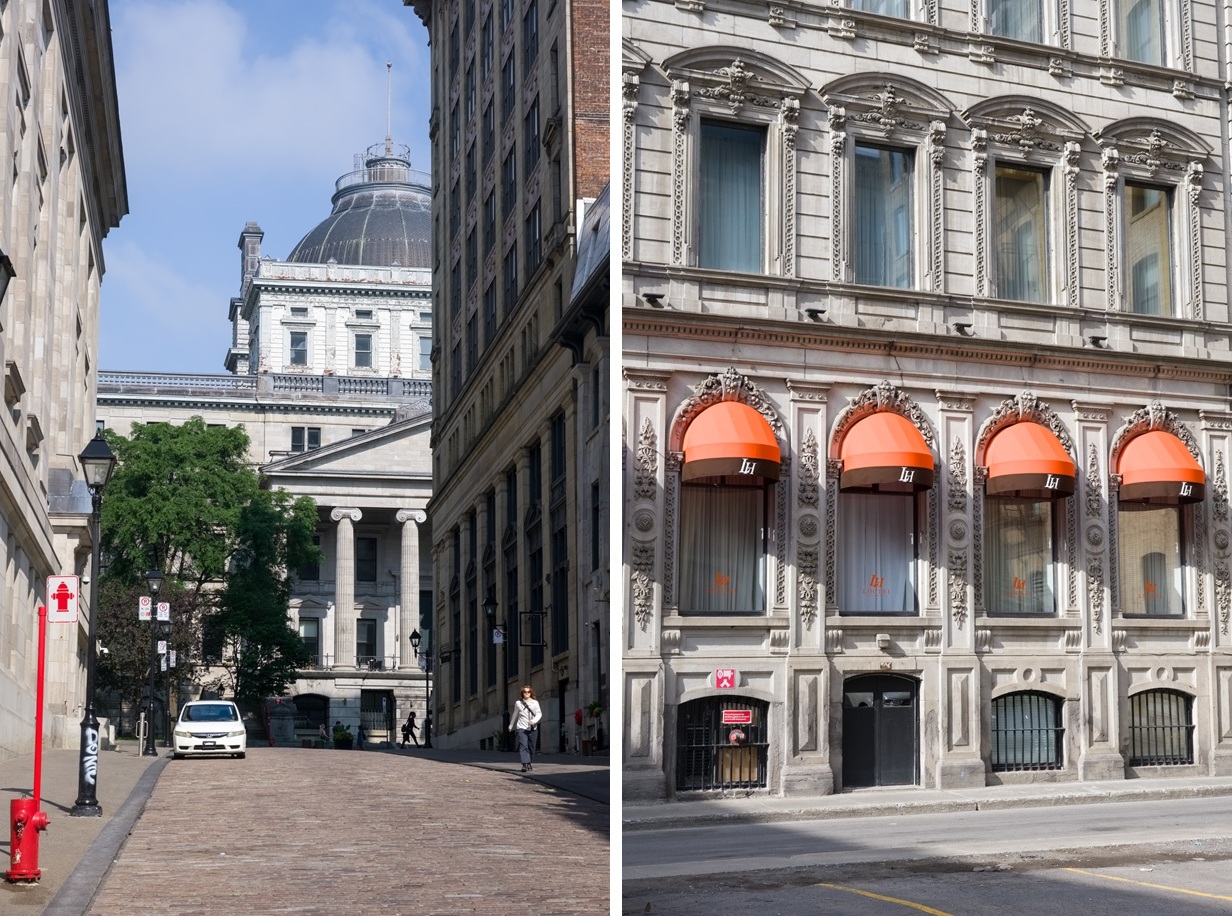
A view of the Lucien-Saulnier Building, a former courthouse; outside a heritage hotel
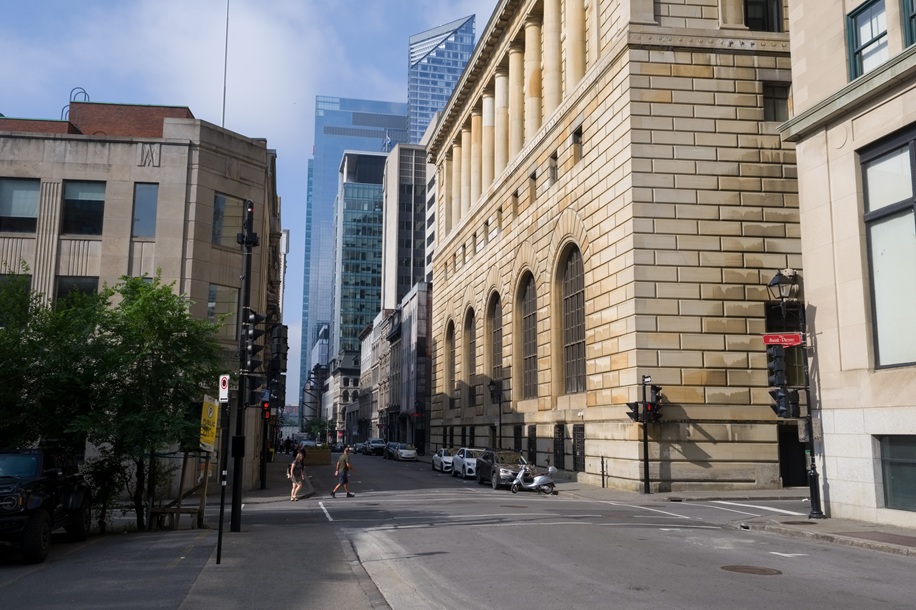
Old Montréal sits beside the city’s modern central business district
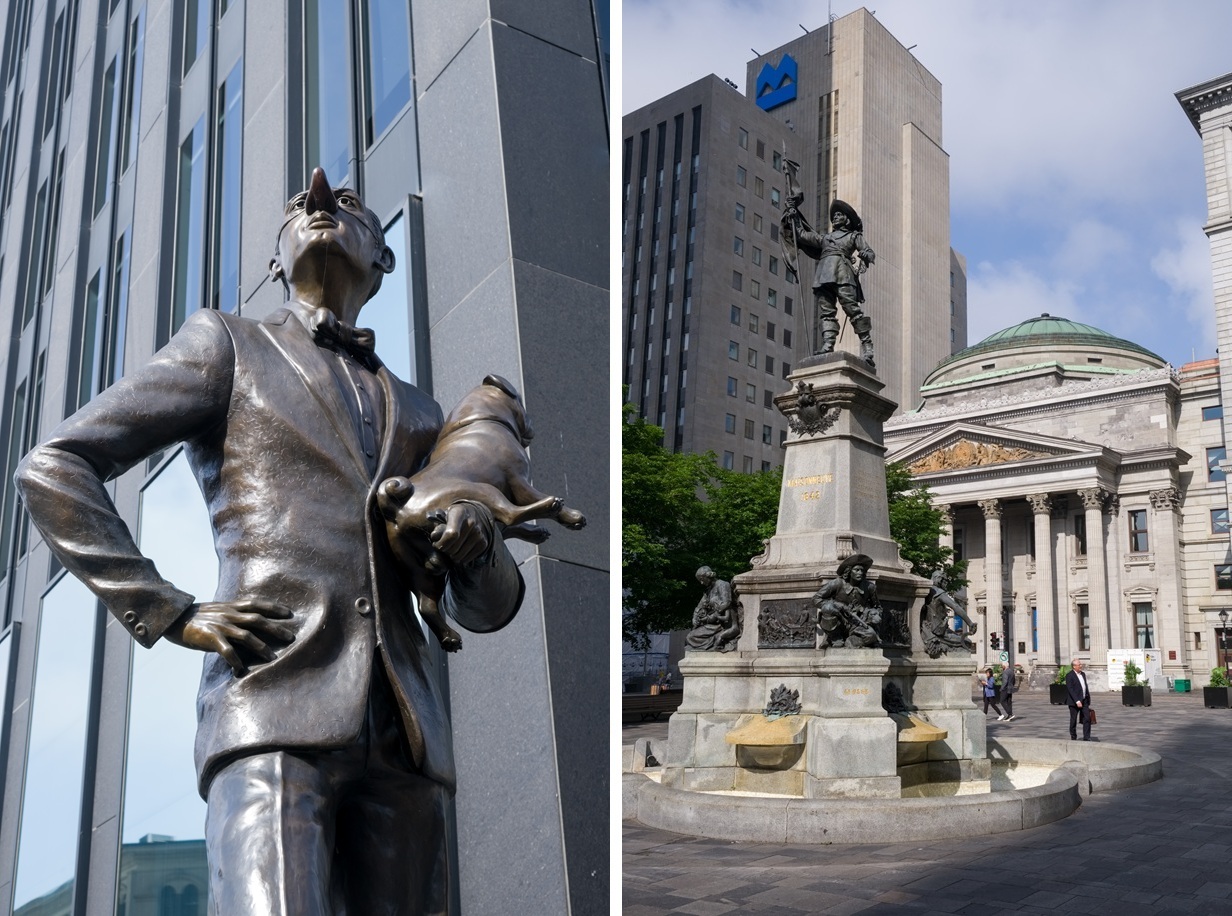
A sculpture symbolizing Montréal’s Anglophones on Place d’Armes; the same square
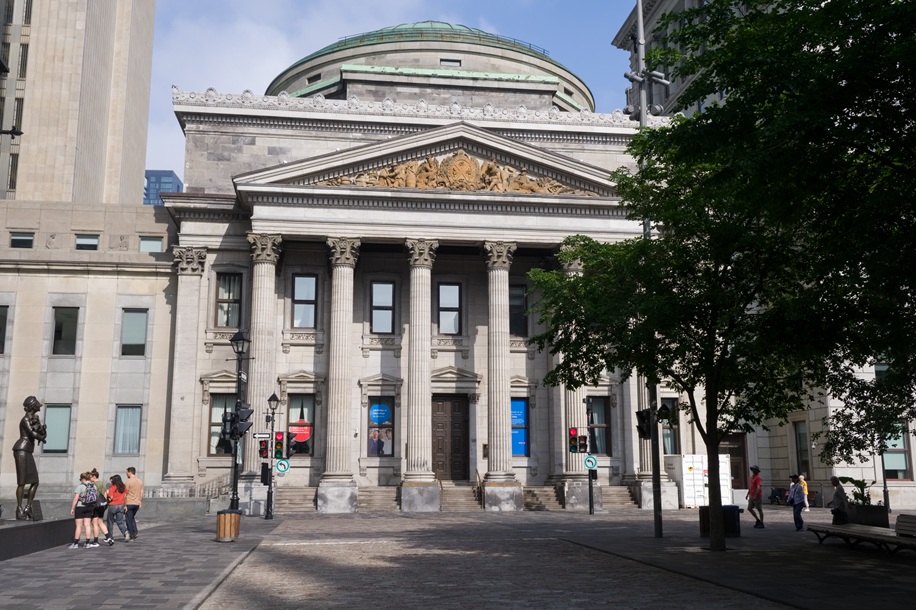
The Bank of Montreal Head Office on Place d’Armes was built in the 1840s
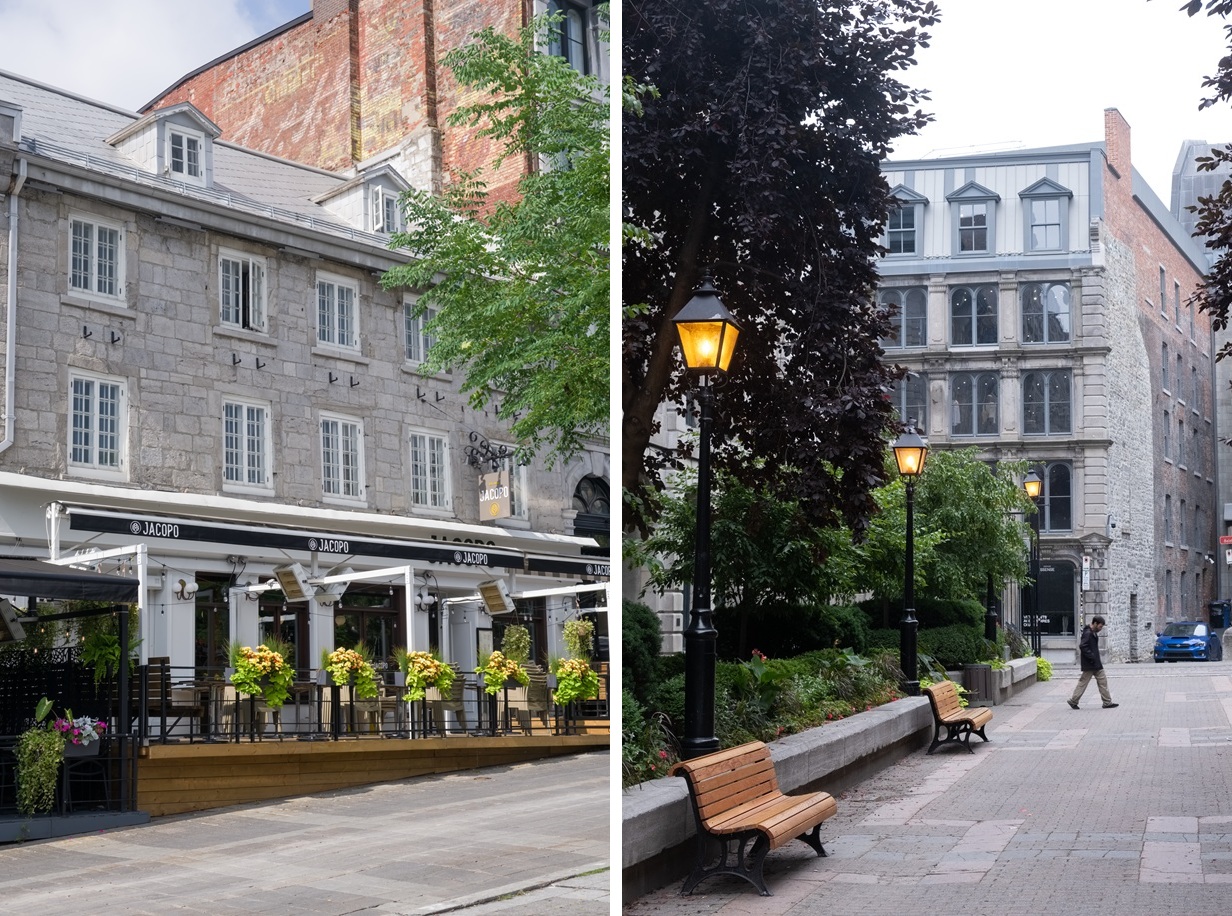
Restored heritage architecture in Old Montréal
I returned to the city several years later when it was my brother’s turn to study in Montréal. He was lucky. Instead of moving into a college dorm, he simply took over the rented apartment my sister was vacating. We repainted the walls of his new bedroom from jade green to a more agreeable white. Patrick, his Lebanese flatmate, also joined in, and shared snacks like a large bag of roasted pistachios he had brought over from Beirut.
On our mother’s encouragement, my brother and I rented bikes in the Old Port, the historic docklands outside Old Montréal that’s now a recreational zone along the St. Lawrence River. They say you never forget how to ride a bicycle, but I actually did. Despite happily wheeling around the two-story carpark of a large Hong Kong housing estate one childhood summer, whatever muscle memory I still had from that time did not kick in. It was traumatic: I endured the laughter of more than a few passersby who saw me struggling and losing my balance over and over again. I have not ridden a bicycle since.
The Old Port may have been the scene of shame and personal humiliation all those years ago, but on this most recent trip, I took Bama there for a stroll on our first morning in town. The waterfront had changed somewhat: I spotted several large structures that weren’t there before. We passed La Grande Roue de Montréal — a Ferris wheel added in 2017 — the Grand Quay cruise terminal inaugurated the following year, and a boxy glass-clad observation tower, which only opened in 2023.
Stepping away from the river, it might be easy to forget that Montréal sprawls across an eponymous croissant-shaped island in the St. Lawrence. More than two million people live on this landform spanning just over 472 square kilometers (182 square miles), an area comparable to Andorra or slightly smaller than Guam, making it the world’s most populous freshwater island.
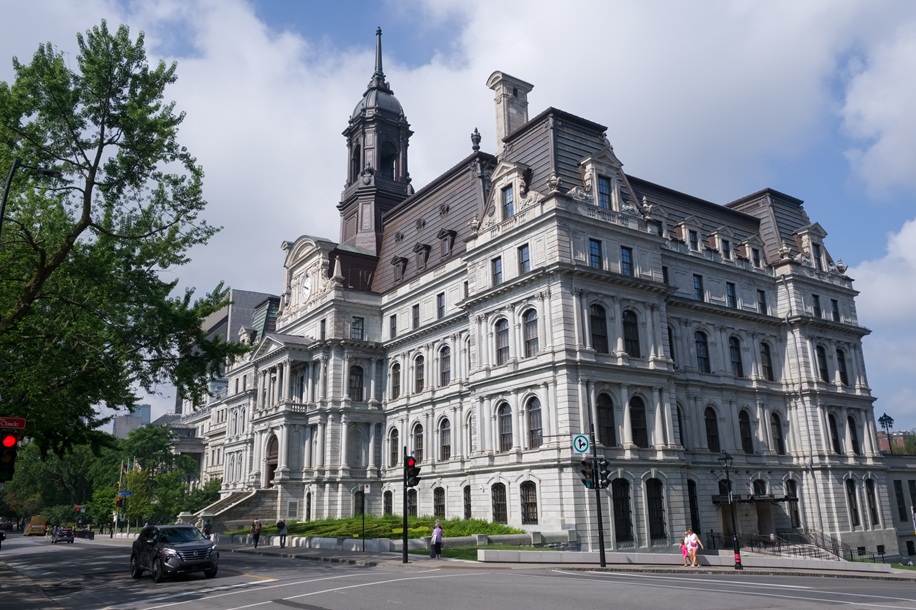
The five-story City Hall from another angle
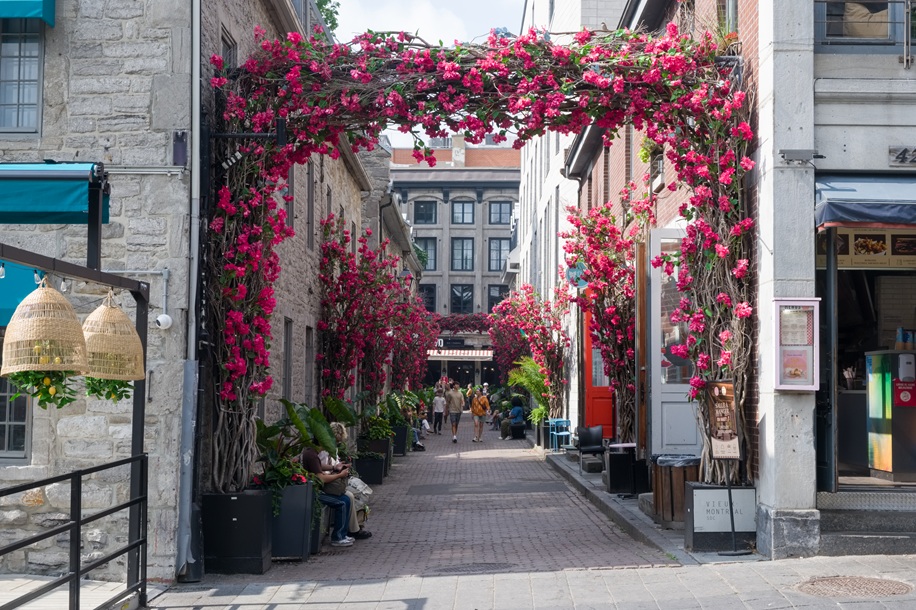
A laneway decorated with artificial bougainvillea
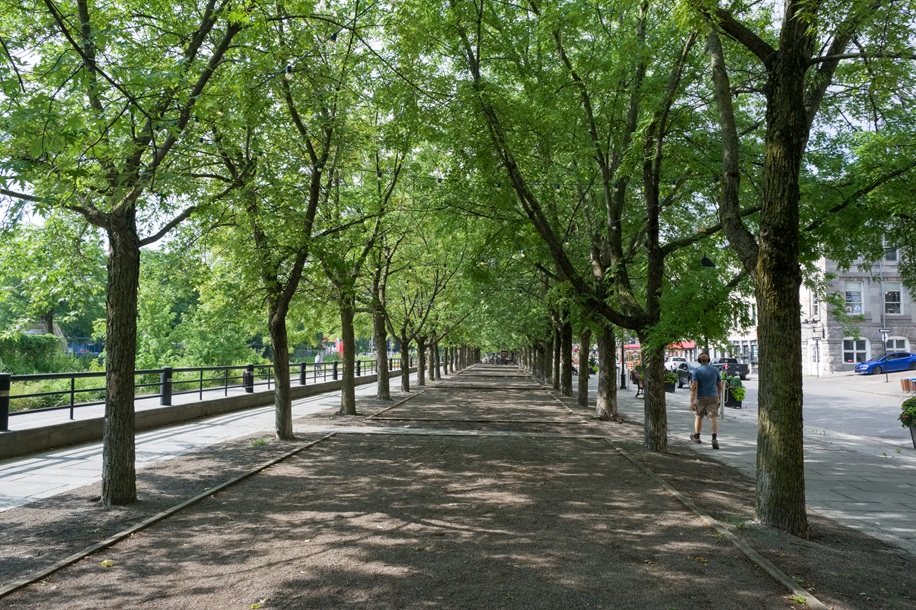
Looking down a shaded promenade between Old Montréal and the Old Port
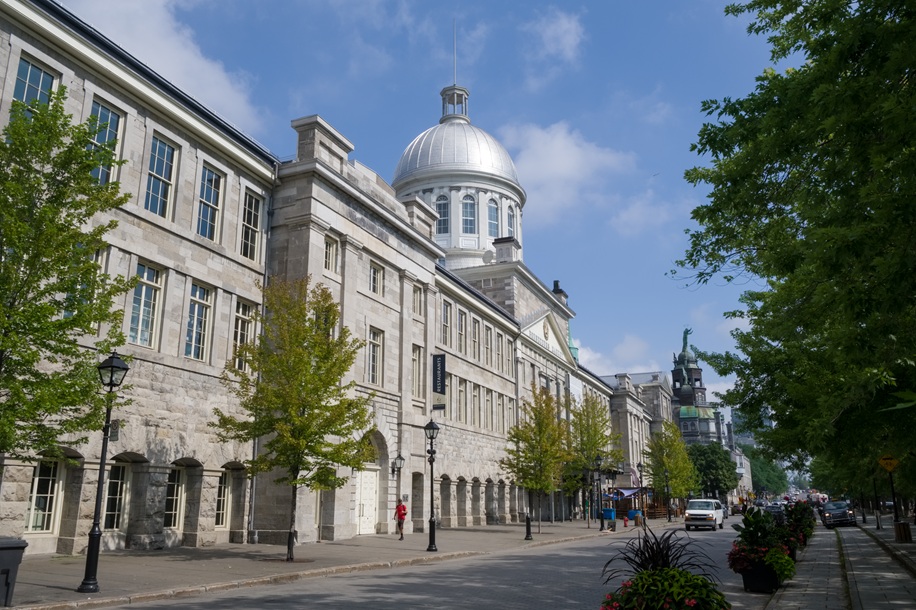
The design of Bonsecours Market was heavily influenced by Dublin’s Custom House
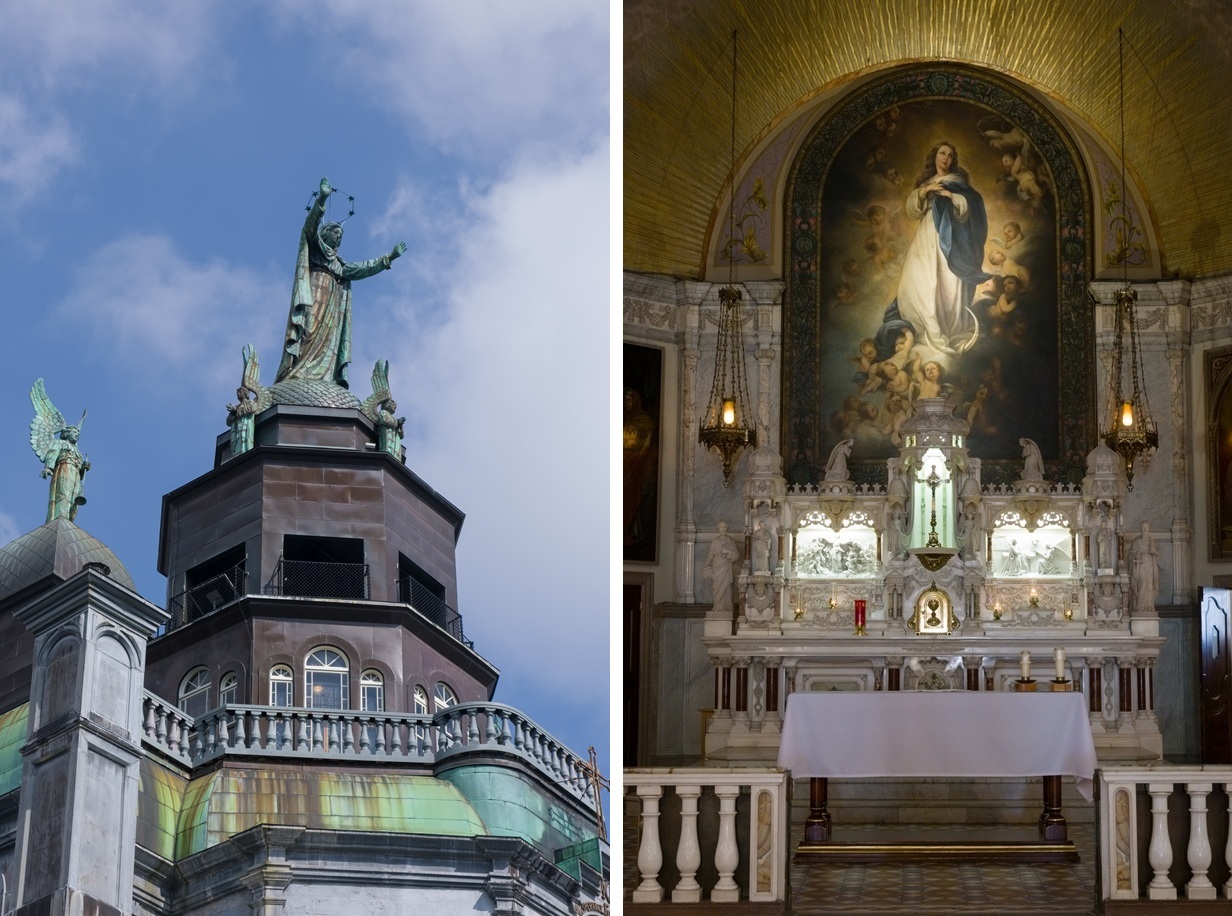
Two depictions of the Virgin Mary at Notre-Dame-de-Bon-Secours Chapel
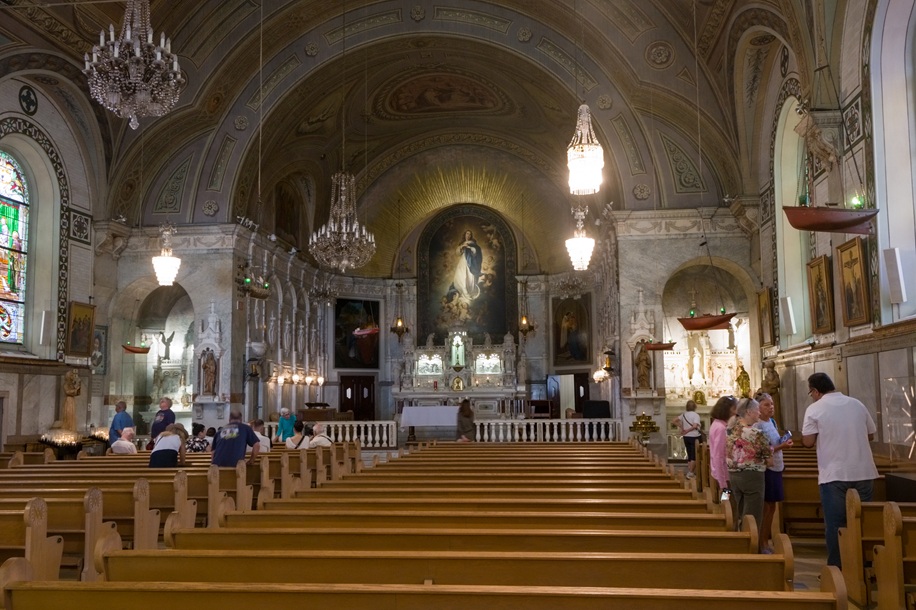
Inside the same 18th-century chapel, nicknamed the “Sailors’ Church”
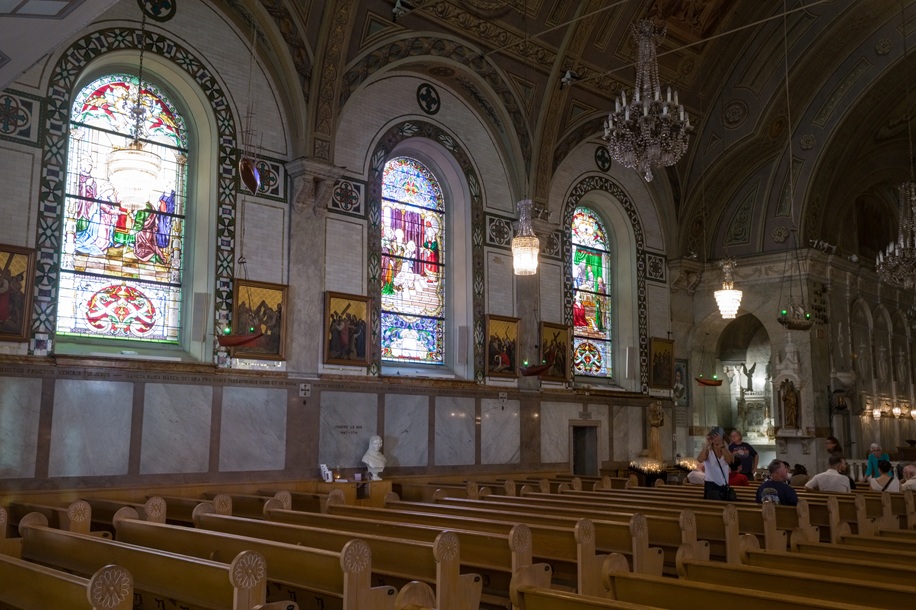
Montréal artist Delphis-Adolphe Beaulieu created the stained glass windows in the 1900s
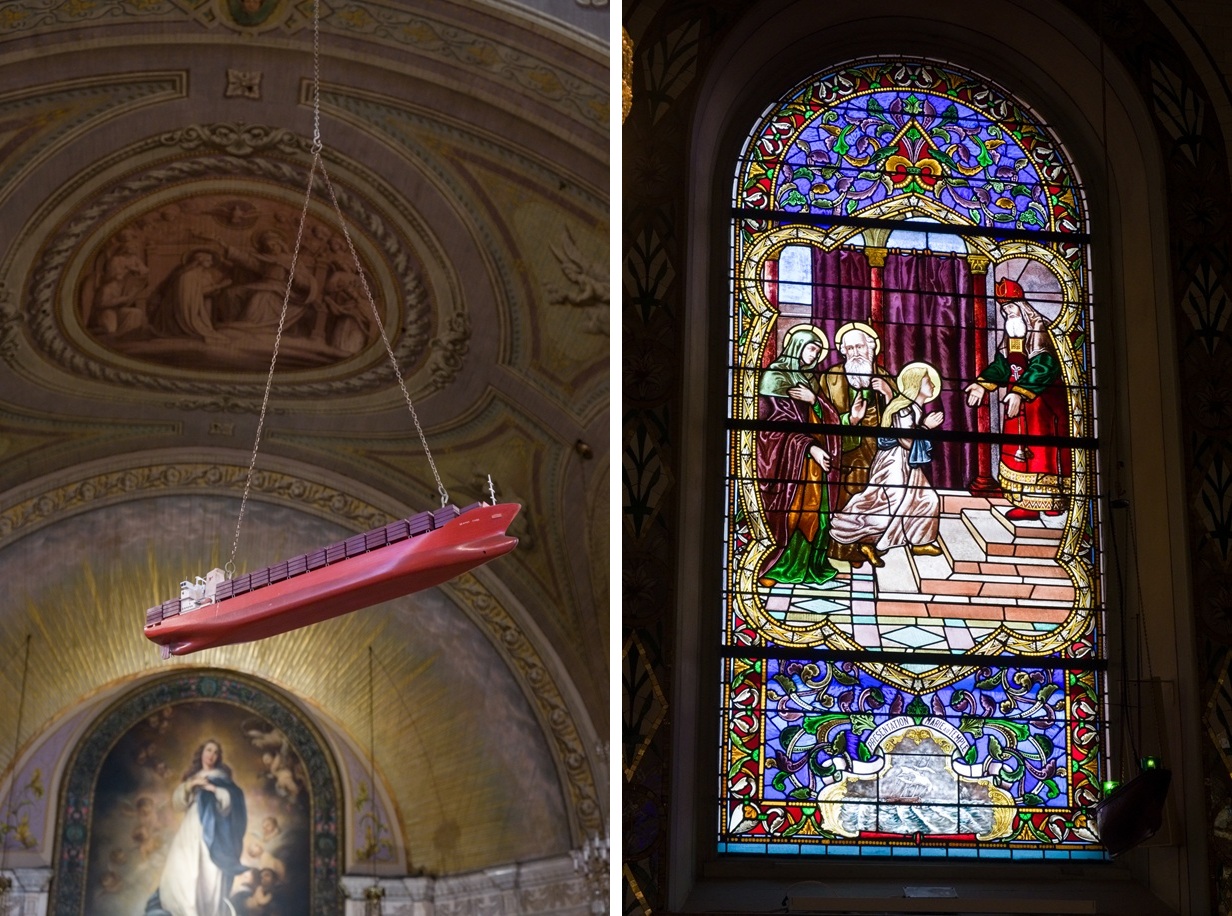
A votive offering of a miniature container ship; one of the stained glass windows
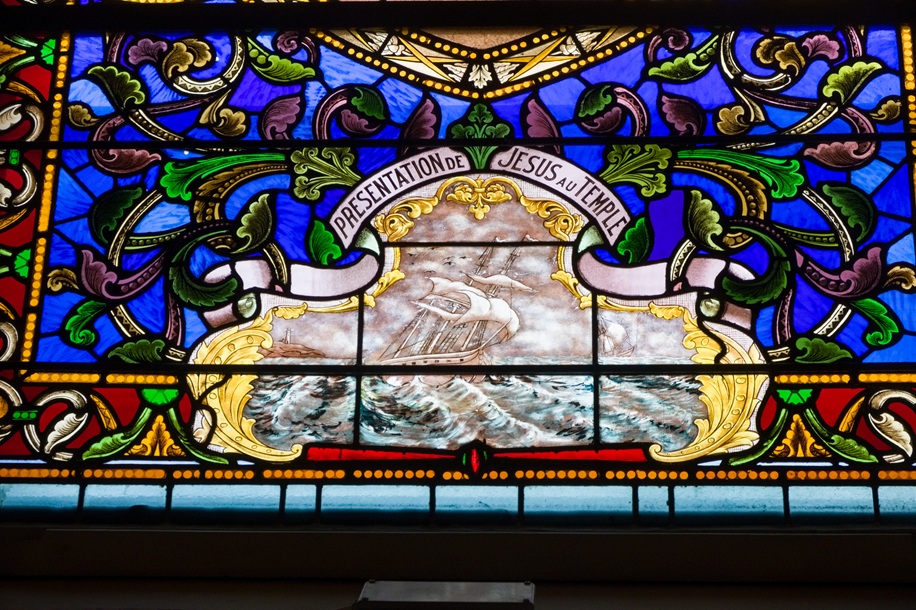
Navigating a wind-whipped sea with a lighthouse in view
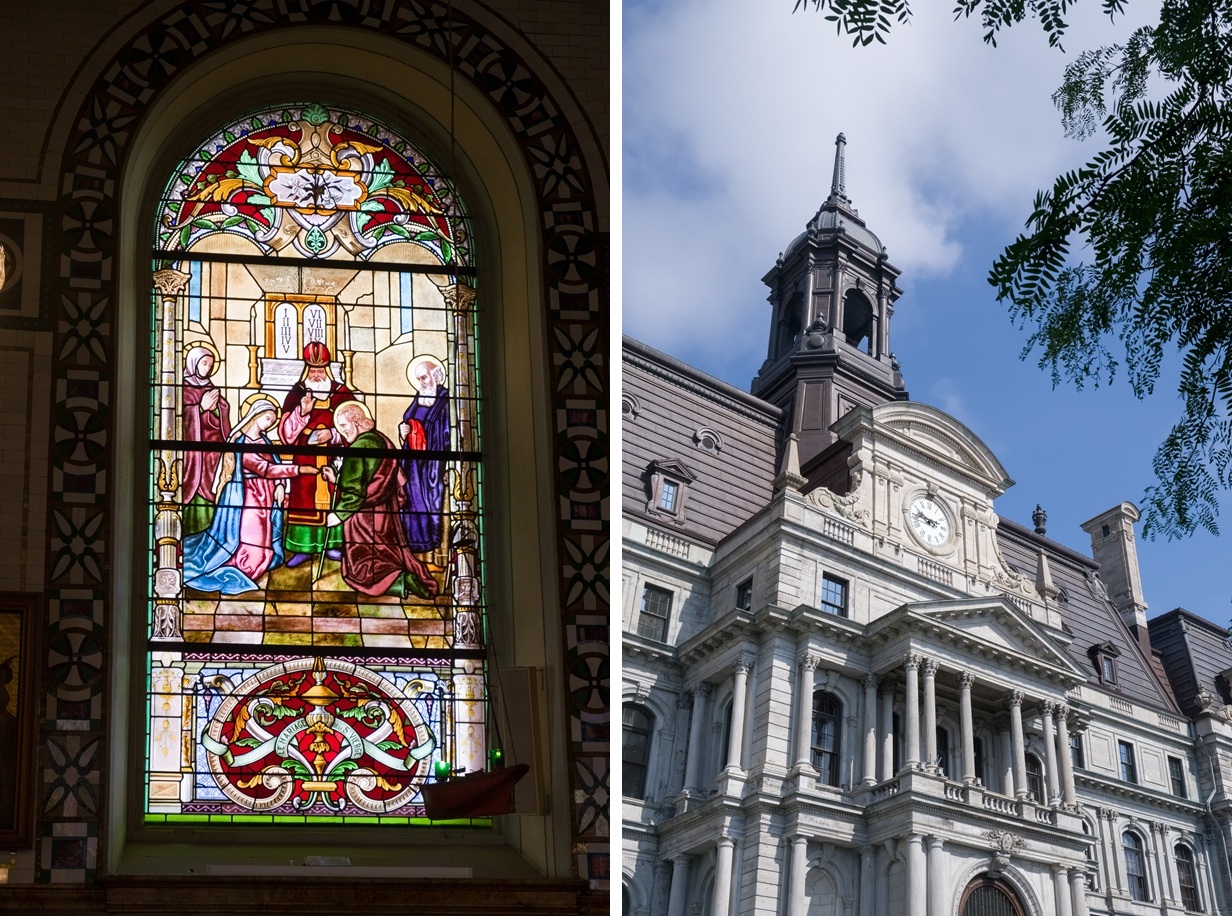
The marriage of Mary and Joseph; the copper-clad cupola of the nearby City Hall
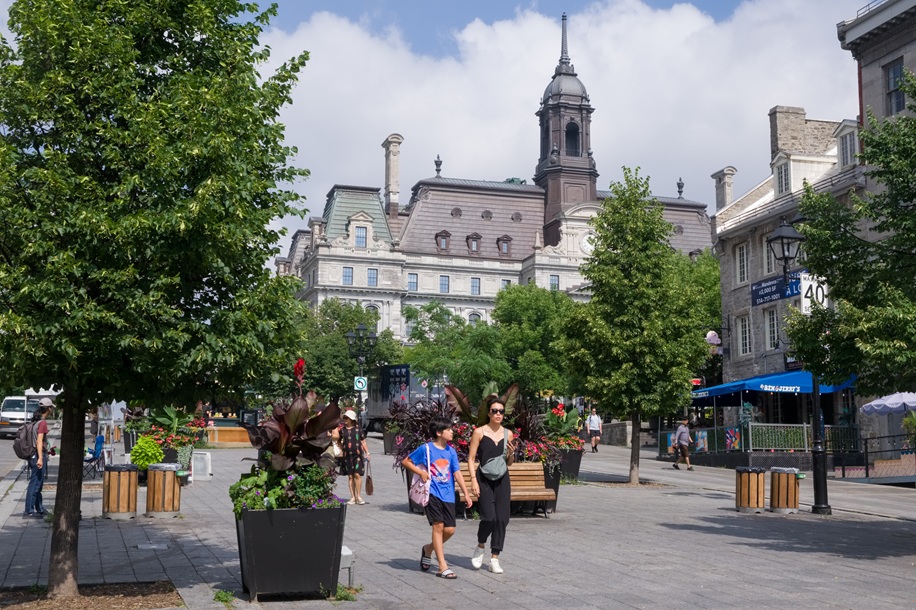
Morning visitors taking a stroll at Place Jacques-Cartier
Bama and I wandered Old Montréal’s cobblestone streets before most of the tourist shops opened, admiring the restored heritage buildings along a pedestrianized stretch of Rue Saint-Paul, the oldest street in town. We stopped to photograph the five-story City Hall, originally built during the 1870s in the Second Empire style (this Montreal Gazette article shows us how it once looked) but largely destroyed in a 1922 fire. The surviving outer walls were incorporated into a new Beaux-Arts building by architect Louis Parant, who modeled his copper-roofed creation after the more ornate Hôtel de Ville in the French city of Tours.
Across the street, the limestone Nelson’s Column marks the the top of Place Jacques-Cartier, a sloping square that hosted a bustling open-air market until the 1950s. We strolled downhill to reach the domed Bonsecours Market, now a multipurpose building hosting events and a number of boutiques and run-of-the-mill souvenir shops. The Notre-Dame-de-Bon-Secours Chapel right next door turned out to be far more interesting. For reasons I cannot remember, I had never set foot inside this centuries-old sanctuary dedicated to Mary, Our Lady of Good Help. Bama and I stopped to admire the beautiful stained-glass windows and barrel-vaulted ceiling, adorned with trompe l’oeil frescoes depicting eight scenes from the life of the Virgin Mary. These had been painted by artist François-Édouard Meloche in 1886 and covered up by painted canvas during early 20th-century renovations; workers rediscovered them by chance after the roof sprung a leak in 1994. Suspended from the ceiling were handcrafted models of various ships, from twin-masted sailboats to a miniature container vessel, votive offerings left by sailors who had survived dangerous ocean voyages.
I learned that the chapel was consecrated in 1771 over an earlier stone structure that burned down almost 20 years before. That first, more humble iteration had been envisioned by French religious sister Marguerite Bourgeoys, who established Montreal’s first public school in 1658 to provide free education and vocational training to French and Indigenous children alike. The very next year, she founded the Congregation of Notre-Dame, a community of non-cloistered women dedicated to education. Bourgeoys was eventually canonized in 1982 as Canada’s first female saint.
Another morning, we returned to Old Montréal to visit the neo-Gothic Notre-Dame Basilica, where Céline Dion and her manager René Angélil married in a lavish winter wedding in 1994 (the French-Canadian superstar grew up in a town just outside the island of Montréal). This 1820s landmark is one of Canada’s most-visited historic attractions for good reason: its striking fairytale interior was directly inspired by the royal chapel of Sainte-Chapelle in Paris. Unmistakably French in character, its soaring vaulted ceilings are painted cerulean blue and patterned with gold fleur-de-lys; intricately detailed polychrome columns alternate in shafts of crimson red, deep blue, and chocolate brown, all featuring luminous golden motifs.
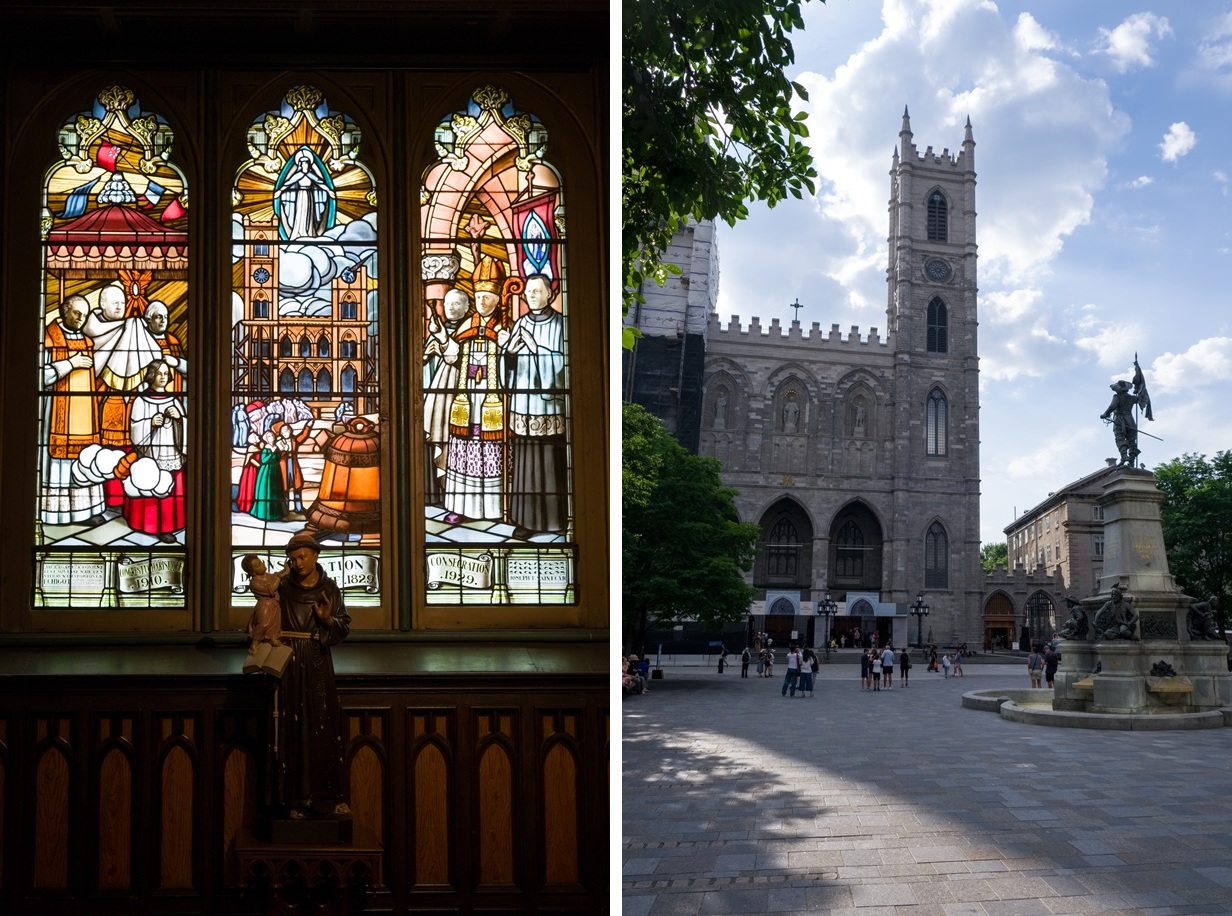
Stained glass windows at the Notre-Dame Basilica; the church stands on Place d’Armes
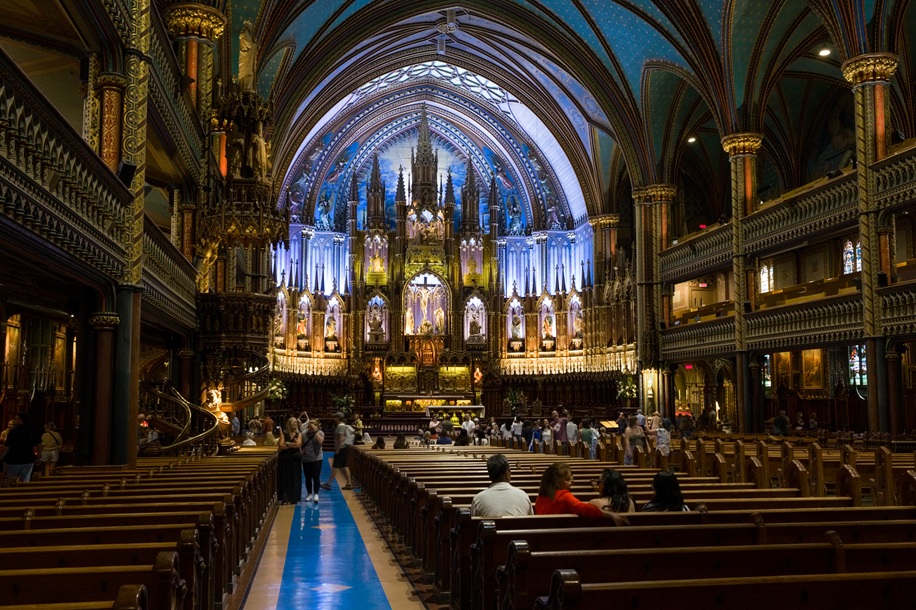
The neo-Gothic interior was directly inspired by Sainte-Chapelle in Paris
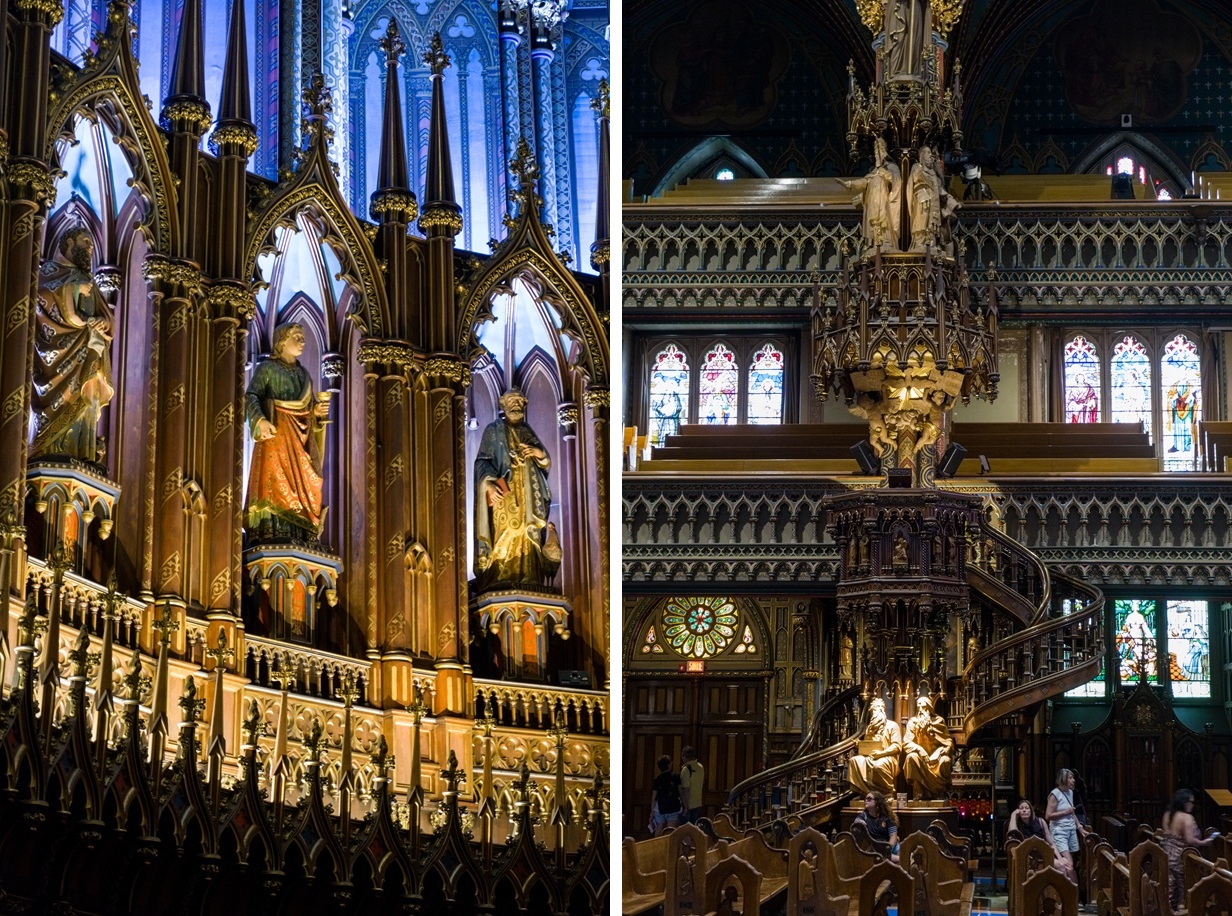
Apostles and the Evangelists above the main altar; the church’s ornately carved pulpit
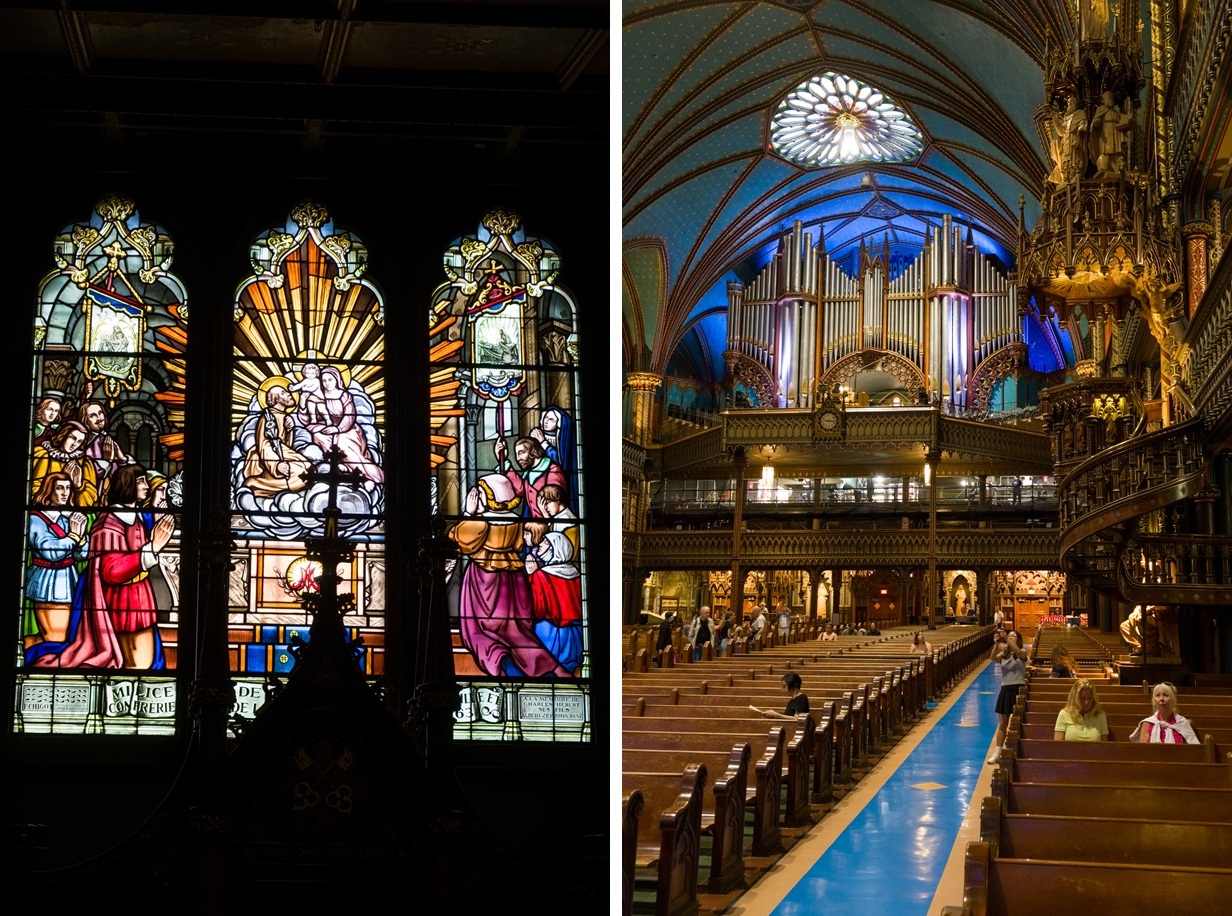
The Holy Family in stained glass; looking back at the monumental pipe organ
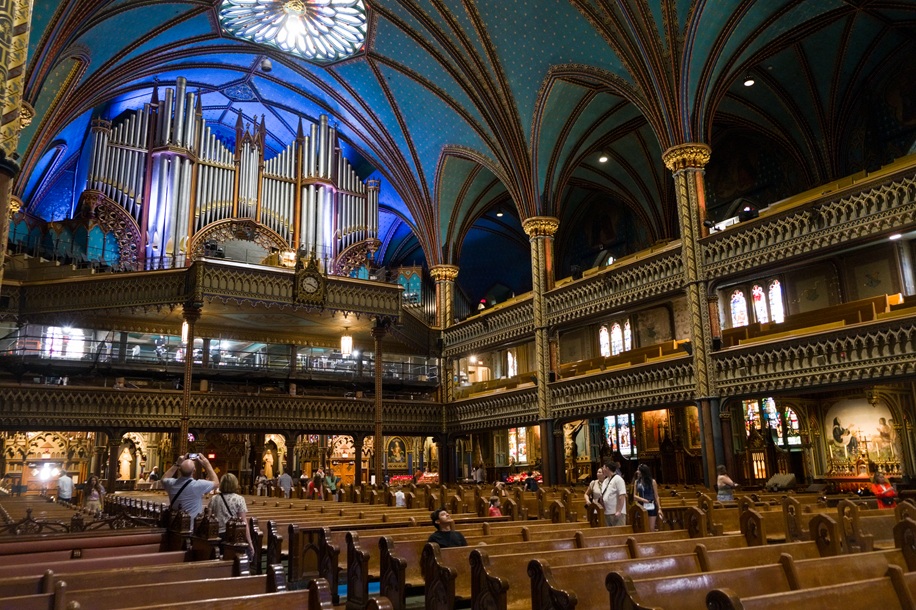
A female organist played soul-stirring music when we visited the church
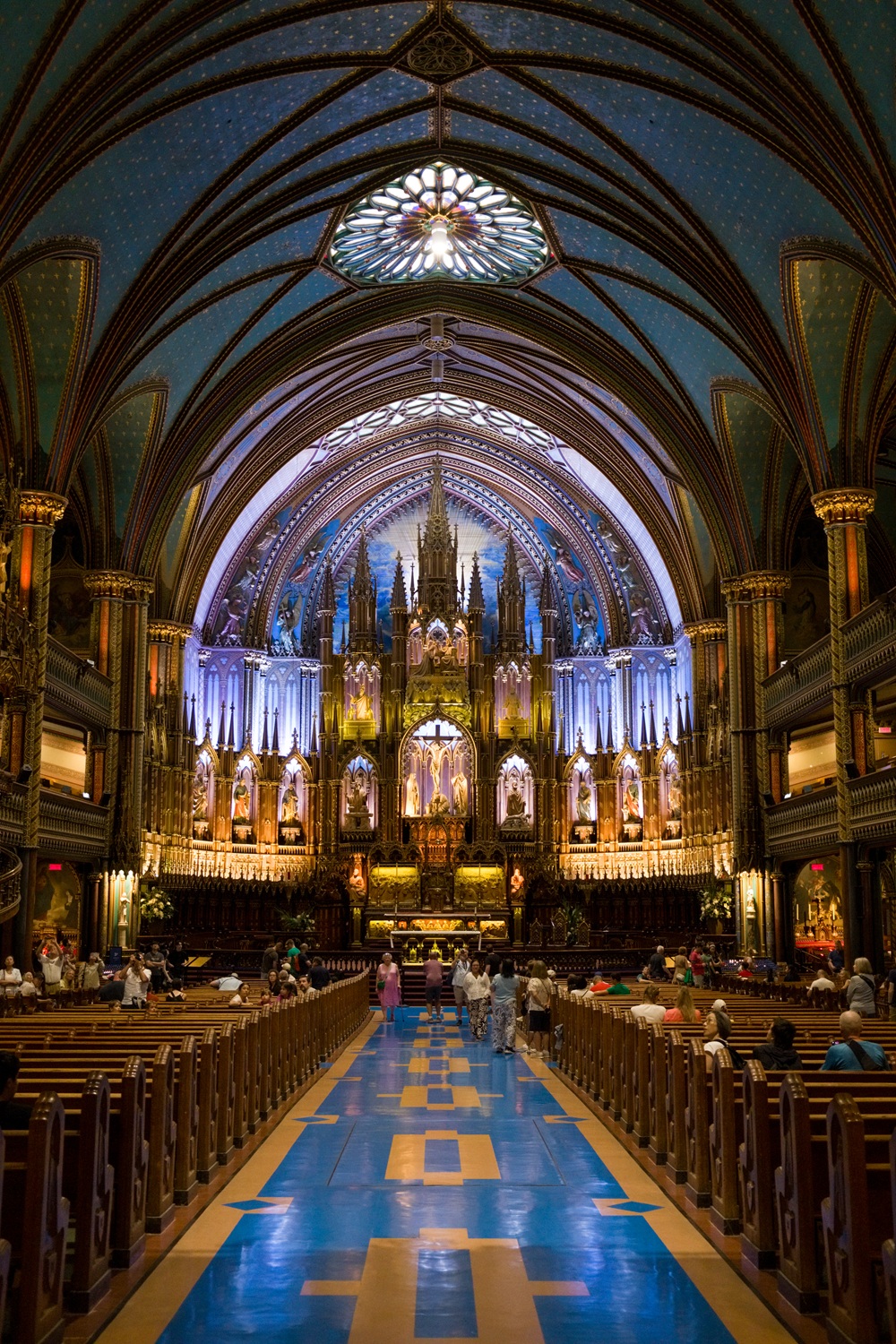
One final look down the nave to Notre-Dame Basilica’s dazzling main altar
Bama and I joined the steady flow of visitors who, like us, were awestruck at the immense beauty all around. A skilled female organist at the keyboards of the impressive pipe organ, built by local specialists Casavant Frères in the late 19th century, added to the reverential atmosphere. For a while, we sat silently in the pews, listening to the rich, powerful tones filling the nave. It was magic. I thought of my own mother, who plays a simple electronic organ for her church choir in Hong Kong, and couldn’t helping imagining the delight on her face at hearing such majestic and beautifully layered music. Then we emerged into daylight on the paving stones of Place d’Armes and circled the monument to French military officer Paul Chomedey de Maisonneuve, the founder of the city.
Given Bama’s deep love for the past, I knew I had to bring him to Pointe-à-Callière, Montréal Museum of Archaeology and History. The modern institution was built over a former point of land where a creek named the Rivière St. Pierre once flowed into the St. Lawrence — the birthplace of the city. For this was the very spot where a group of around 50 French men, women, and children led by Maisonneuve landed on May 17, 1642 to establish the Catholic mission of Ville-Marie. Later dubbed the Montréalistes, the colonists included nurse Jeanne Mance, who founded the Hôtel-Dieu de Montréal — the city’s first hospital — three years later on Rue Saint-Paul. Emblazoned across the wall of one underground gallery at the museum are words attributed to Jesuit priest Barthelemy Vimont at the Mass celebrating Ville-Marie’s founding on the day of the settlers’ arrival. “What you see here is but a grain of mustard seed, but I have no doubt that this seed will grow into a great tree and spread in all directions.” Vimont could never have predicted that their little religious mission would eventually blossom into the second-largest majority French-speaking city in the Western world.
While the Island of Montréal has been documented as Kawenote Teiontiakon in the local Kanien’kéha (Mohawk) language, it received its modern name in October 1535 during French explorer Jacques Cartier’s second voyage to North America. After being greeted by a welcome party of more than a thousand people on the riverbank, Cartier and some of his men were escorted to the Indigenous village of Hochelaga, which he described in his journals as being “near and adjacent to a mountain, the slopes of which are fertile and are cultivated, and from the top of which one can see for a long distance. We named this mountain ‘Mount Royal.’”
The Frenchman also recorded seeing fields of corn and counted about 50 longhouses in the village, protected by a three-tiered wooden palisade. But Hochelaga’s exact location remains a mystery. By the time Cartier returned to the island on his third voyage in 1541, his journals no longer mention the settlement, which had likely been abandoned or destroyed at that point. A century later, Maisonneuve and the early colonists would disembark from their boats onto the same fertile, forested island at the crossroads of several trade routes. It was no longer inhabited, though still used as hunting grounds and a stopping point by Indigenous nations, among them the semi-nomadic Anishinabeg (Algonquins) living in communities along the Ottawa River valley, and the Kanien’kéha, who were among the founding nations of the Haudenosaunee (Iroquois Confederacy) south of the St. Lawrence and Lake Ontario. Alongside the Wendat (Huron), the Anishinabeg were fur-trading partners and allies of the French, but the hostile Haudenosaunee launched repeated attacks that threatened the very existence of the fledgling European outpost.
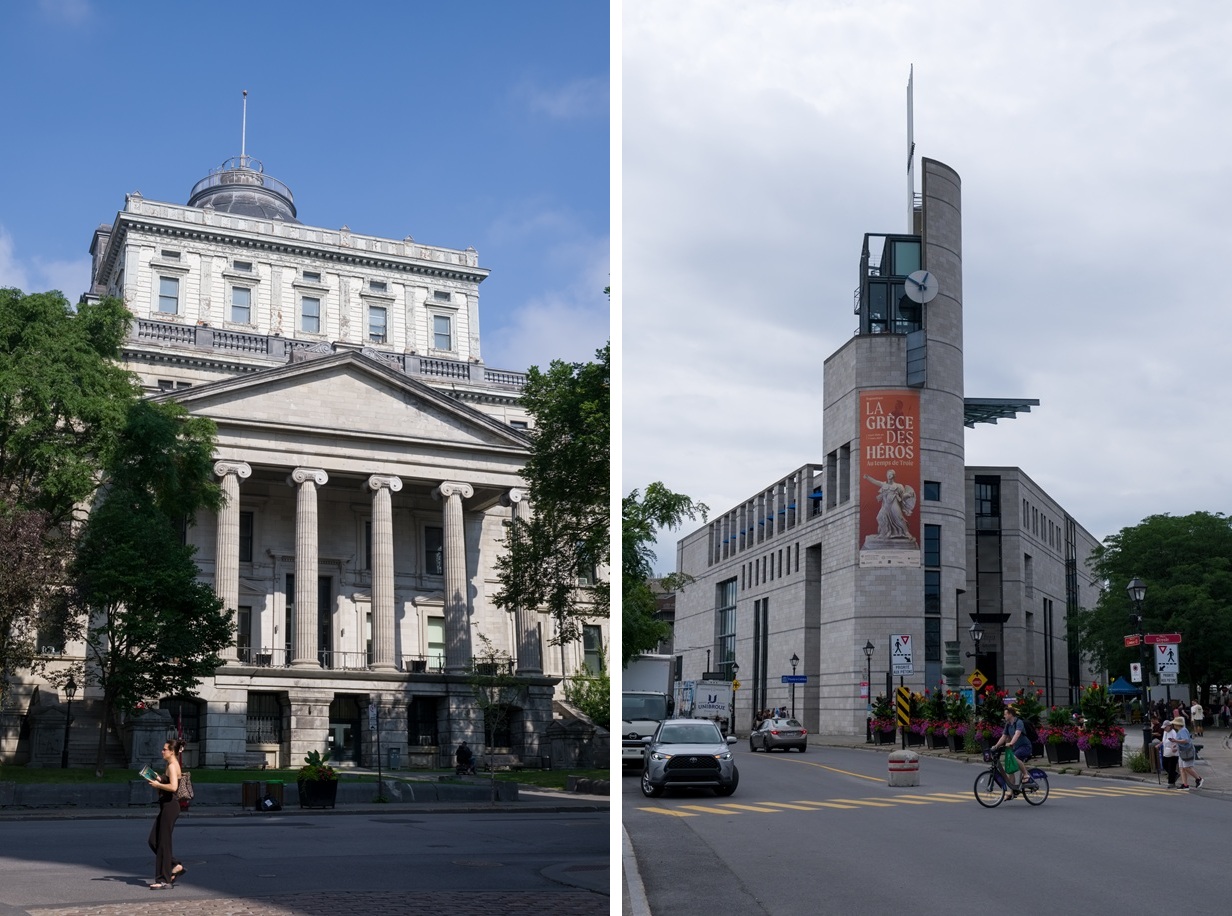
The Lucien-Saulnier Building; the Éperon Building of the Pointe-à-Callière Museum
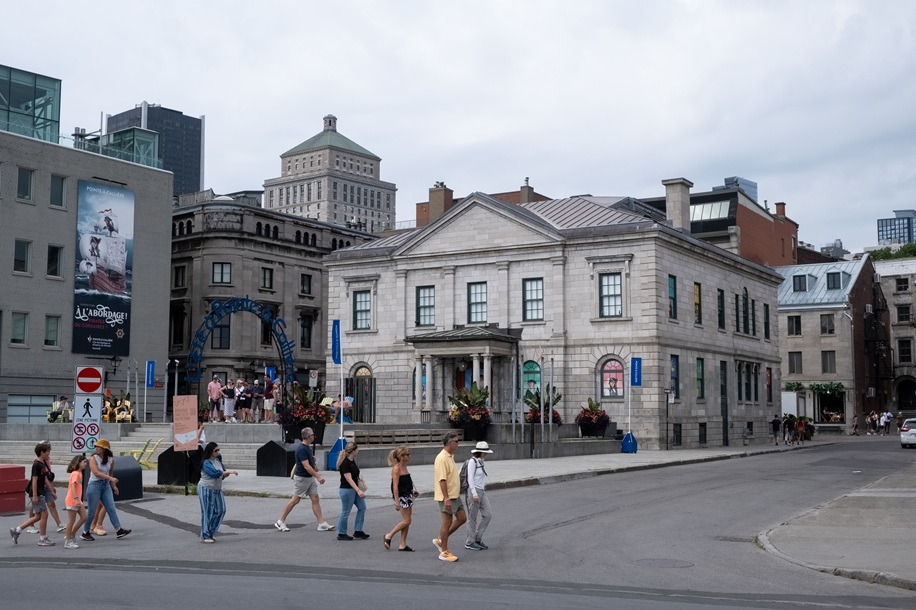
The Old Custom House on Place Royale is another component of the same museum
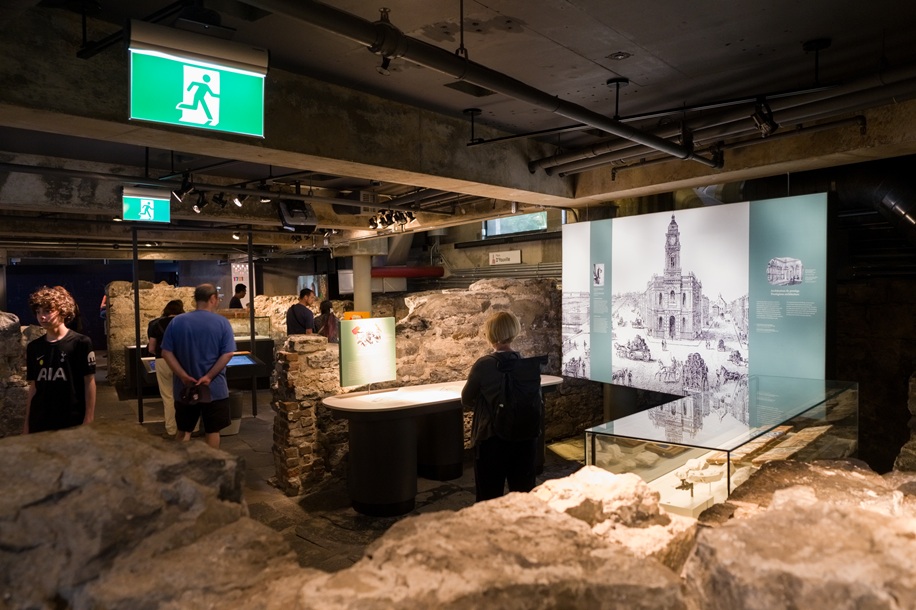
Artifacts on display amid the ruins preserved beneath the Éperon Building
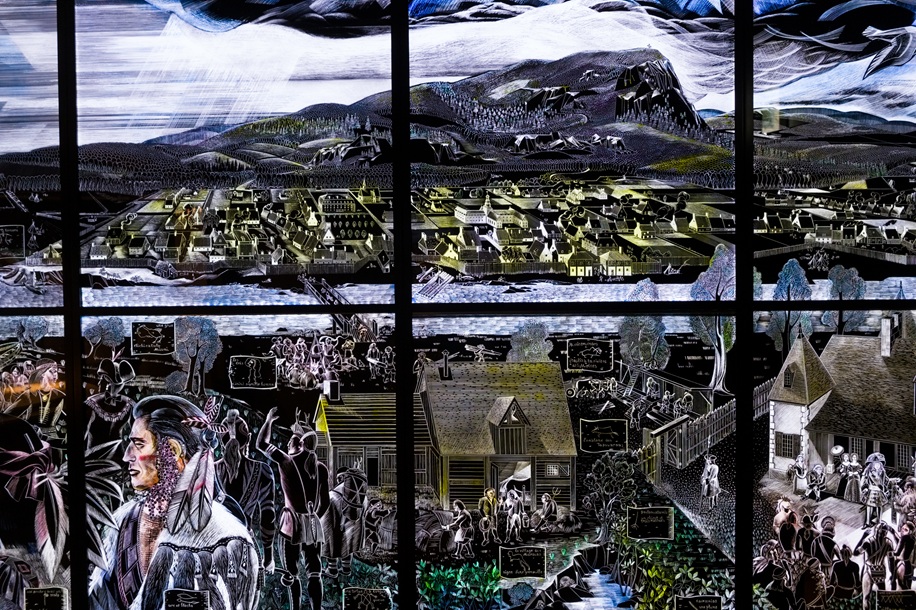
A depiction of Montréal in 1701 on plexiglass by French-born artist Nicolas Sollogoub
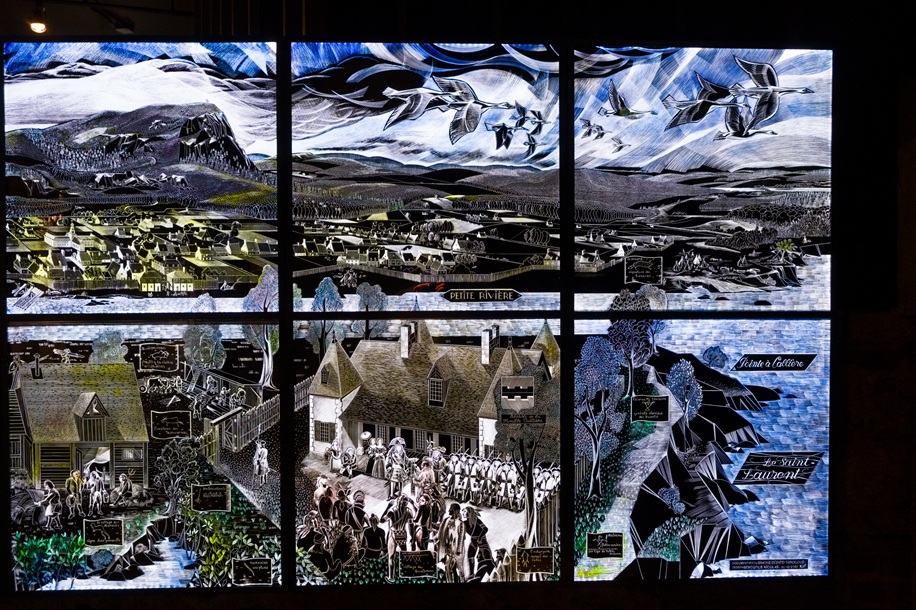
The governor’s residence at Pointe-a-Callière, site of the modern museum
I remembered being hugely impressed by Pointe-à-Callière on my first visit in the early 2000s, and multiple expansions since then have added galleries both above and below ground in disparate buildings linked together via subterranean passages. At the remodeled 1950s pavilion called the Mariners’ House, Bama and I walked through a two-story temporary exhibition titled “Heroes of Greece. The Age of Troy”, with ancient Greek artifacts on loan from institutions like Athens’ National Archaeological Museum, which we’d explored just a few months before.
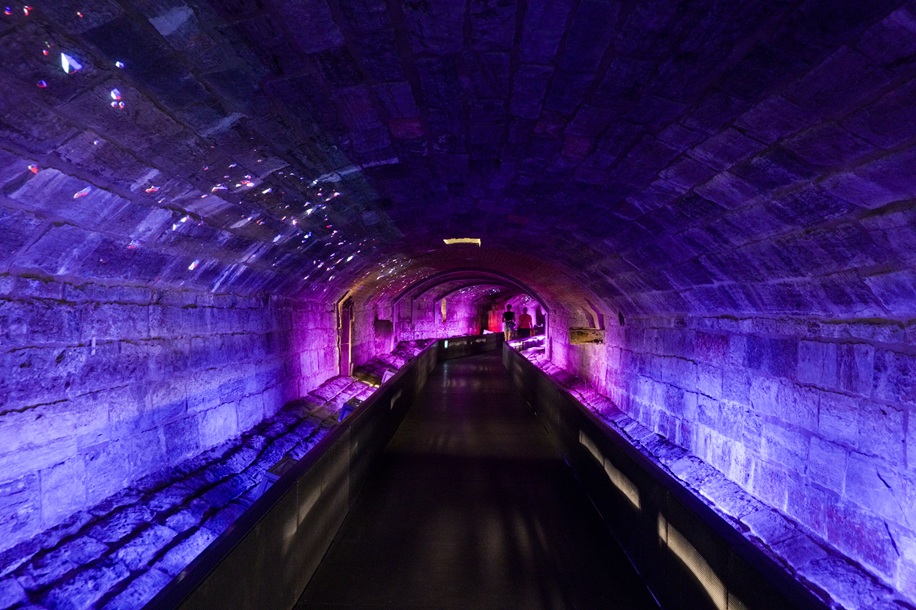
But an unexpected highlight was the 110-meter (360-foot) Memory Collector gallery, which repurposes a section of the city’s first stone masonry sewer — the oldest of its kind in Canada. Built in the 1830s and decommissioned only in 1989, the William Collector Sewer diverted part of the Rivière St. Pierre, buried underground after it became too polluted. Today the refurbished portion is something of a time tunnel, with changing light effects and a multimedia display at one end where it leads to the glassy Fort de Ville-Marie – Québecor pavilion, inaugurated nine years ago.
We both found the layered archaeological ruins utterly fascinating: one gallery retained the large rounded cobblestones laid down in 1786 for the city’s first paved road; another the remnants of 17th-century Fort Ville-Marie and the foundations of the Callière estate, a chateau-like residence built in 1688 for Louis-Hector de Callière, the Governor of Montréal. He would later be appointed as viceroy overseeing all of New France, the vast, expanding North American colonial territory claimed by the French.
Some exhibits also revealed the site’s First Nations heritage. Archaeological digs at the museum have unearthed several peace pipes (passed around as a symbol of consensus) found buried in the soil, as well as a number of shell beads from wampum, which had a special ceremonial and spiritual significance for the Indigenous nations of northeastern North America. These were sacred belts or necklaces exchanged between parties to seal an agreement, and often served as certificates of authority as well as physical records of major events.
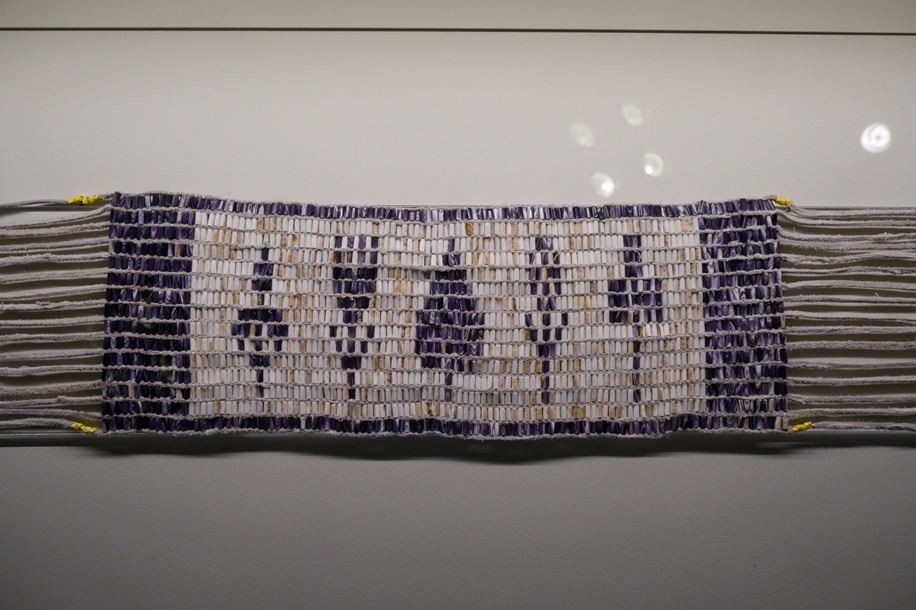
“Tiohtià:ke”, a contemporary “wampum” belt inspired by the city’s flag
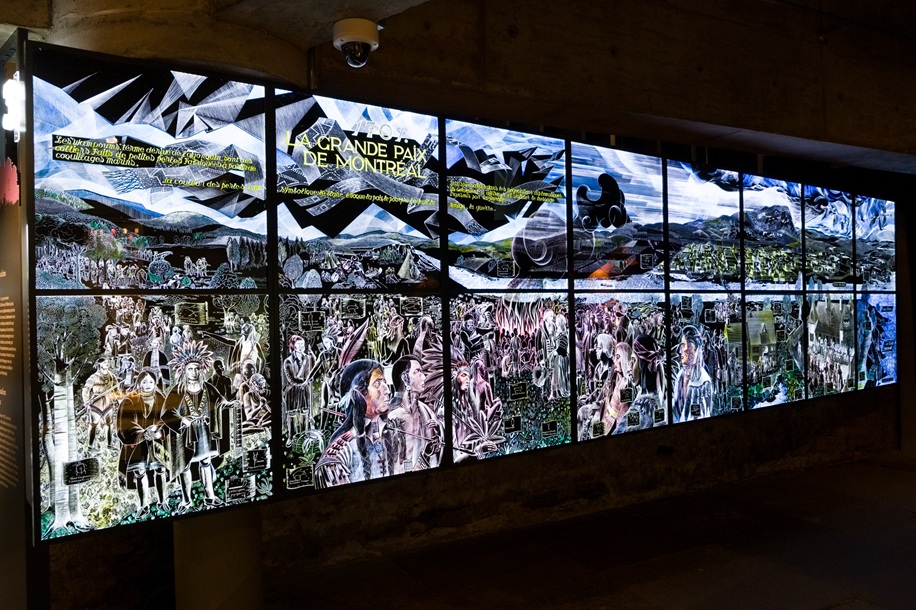
Sollogoub created his installation “1701. The Great Peace of Montréal” from 1997–2000
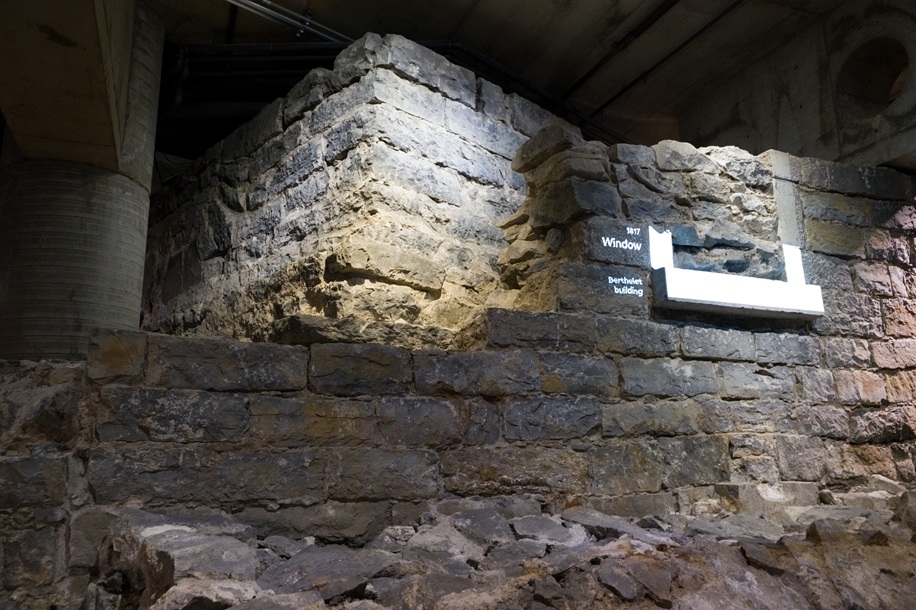
Layers of archaeological history in the museum’s crypt
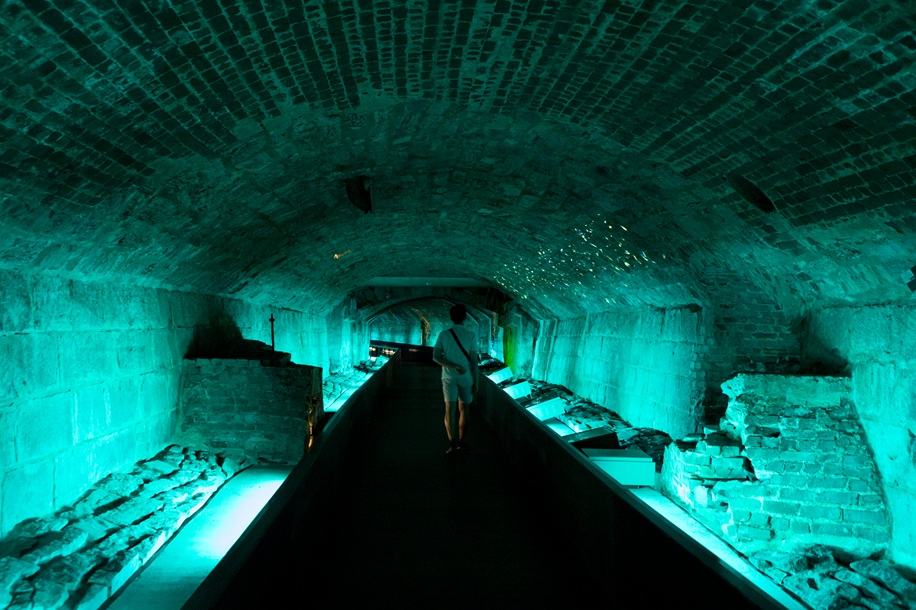
Bama walks through the Memory Collector gallery inside a former sewer
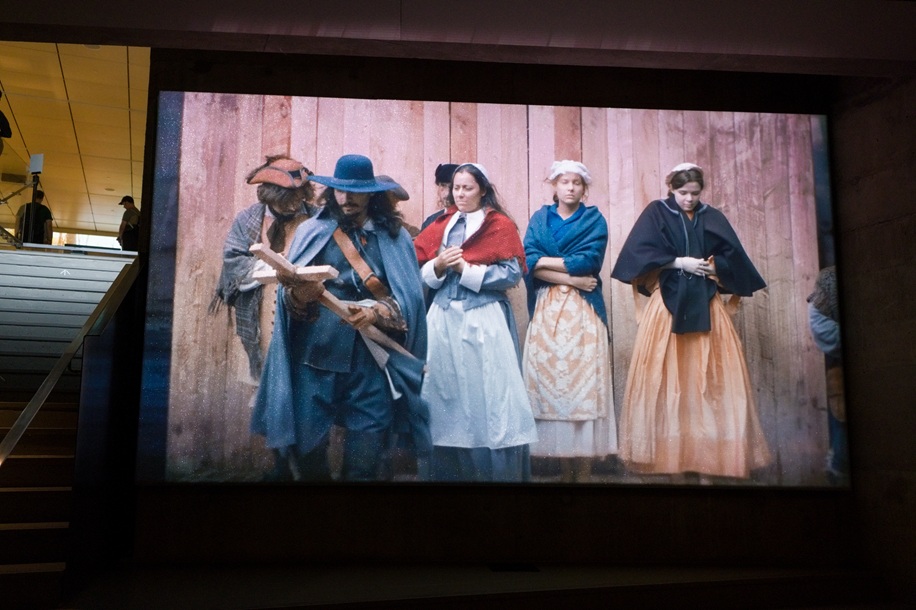
A reenactment of Maisonneuve and Montréal’s founding colonists in 1642
By a sheer stroke of luck, the timing of our visit coincided with a special three-month showcase commemorating the 325th anniversary of the Great Peace of Montréal of 1701, an international agreement far ahead of its time that was signed on the exact site where Pointe-à-Callière now stands. That summer, around 1,300 ambassadors from 38 Indigenous nations and representatives of New France descended on what was then a small settlement of about 1,200 residents for one of the most important diplomatic gatherings in the history of North America. They were hosted by Louis-Hector de Callière, by then the Governor of New France, alongside the great Wendat chief and master strategist Kondiaronk, known for his political influence and brilliance as an orator.
Kondiaronk played his part as a chief architect of the treaty and key broker during the talks, convincing skeptical envoys to commit to the cause. Montréal was being ravaged by an influenza epidemic at the time, and he delivered a powerful two-hour speech defending the peace treaty even while seriously ill with a high fever. Tragically, the statesman did not live to see the agreement ratified or sign it with his own hand — he died just hours later at the age of 52. Kondiaronk was so widely respected he was given traditional condolence rites by the Haudenosaunee, longtime enemies of the Wendat, in a multifaith and cross-cultural union of Indigenous and Catholic tradition conducted as a symbol of unity, in line with his final wish. French subjects and First Nations alike attended his grand funeral procession on August 3, 1701, when he was buried with military honors at the old Notre-Dame Church, predecessor of the current basilica at Place d’Armes.
All parties formally signed the landmark agreement the very next day, ending more than seven decades of intermittent but brutal conflict, known as the Beaver Wars, in northeastern North America. Not only did it usher in a nearly 60-year period of peaceful coexistence between 38 Indigenous nations and the French; the Great Peace of Montréal allowed unrestricted trade and travel across a vast region stretching east from Acadia (now the Canadian Maritimes and parts of Maine) up the St. Lawrence to the Great Lakes west of Detroit, and extending as far south as the Mississippi Valley. North America’s first multilateral treaty of continental scale did not happen overnight: it took 20 years of negotiations and concerted efforts by both the French and the First Nations to achieve such a major diplomatic breakthrough.
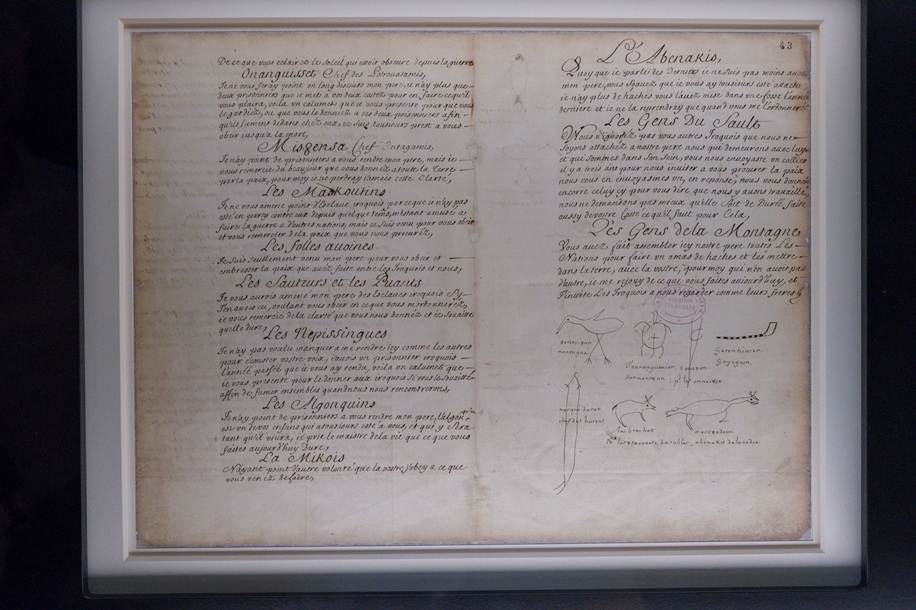
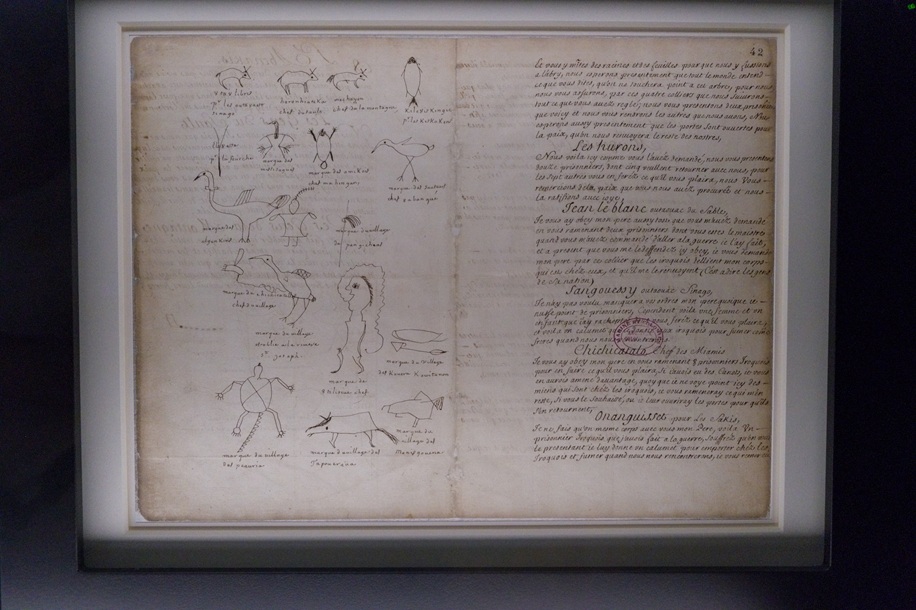
Bama and I found the pièce de résistance of the 1701-themed interpretative trail at one dimly lit corner of the Fort de Ville-Marie – Québecor pavilion: the original and only known copy of the seven-page treaty on loan from the Archives nationales d’outre-mer (Overseas National Archives) in Aix-en-Provence, France. This priceless document was handwritten on parchment, and First Nations delegates signed the treaty with pictograms representing their chiefs or clans. On one right-hand page, a long, stylized muskrat that stood for Kondiaronk had been drawn by a Wendat envoy.
More than three centuries on, the Great Peace of Montréal offers plenty of lessons for our broken world. It shows us the importance of listening to one another, sharing ideas, and overcoming doubts to reach a consensus. The treaty stands as an example of thinking long-term and making a joint decision grounded in cooperation, fairness, and the pursuit of common interests. It demonstrates what can happen when people build bridges and not walls, and reminds us of the enduring value of being a good neighbor. Given the escalating trade war initiated by Washington between two longtime North American allies, these are all things that too many folks south of the Canadian border have evidently forgotten. ◊
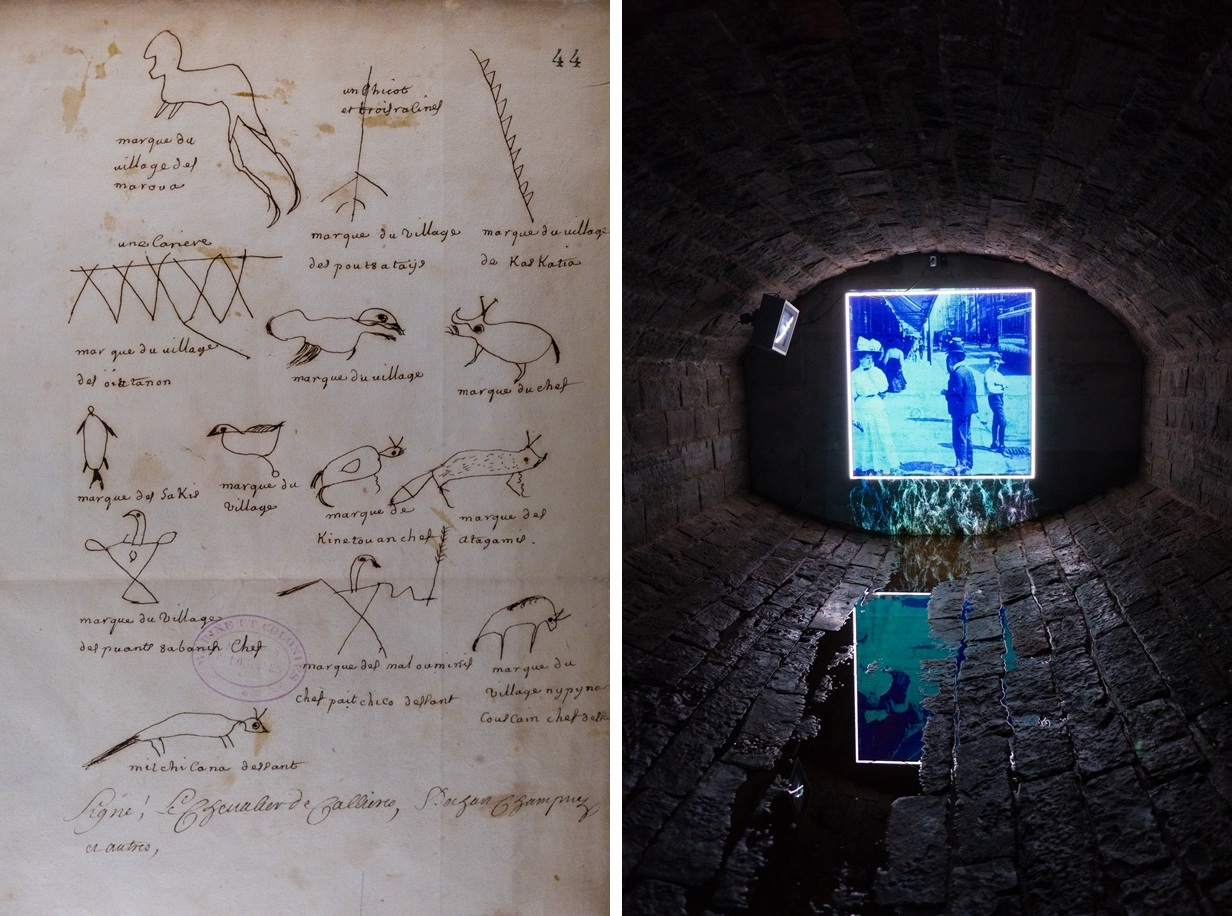
Pictograms from the Great Peace of Montréal treaty; inside the Memory Collector
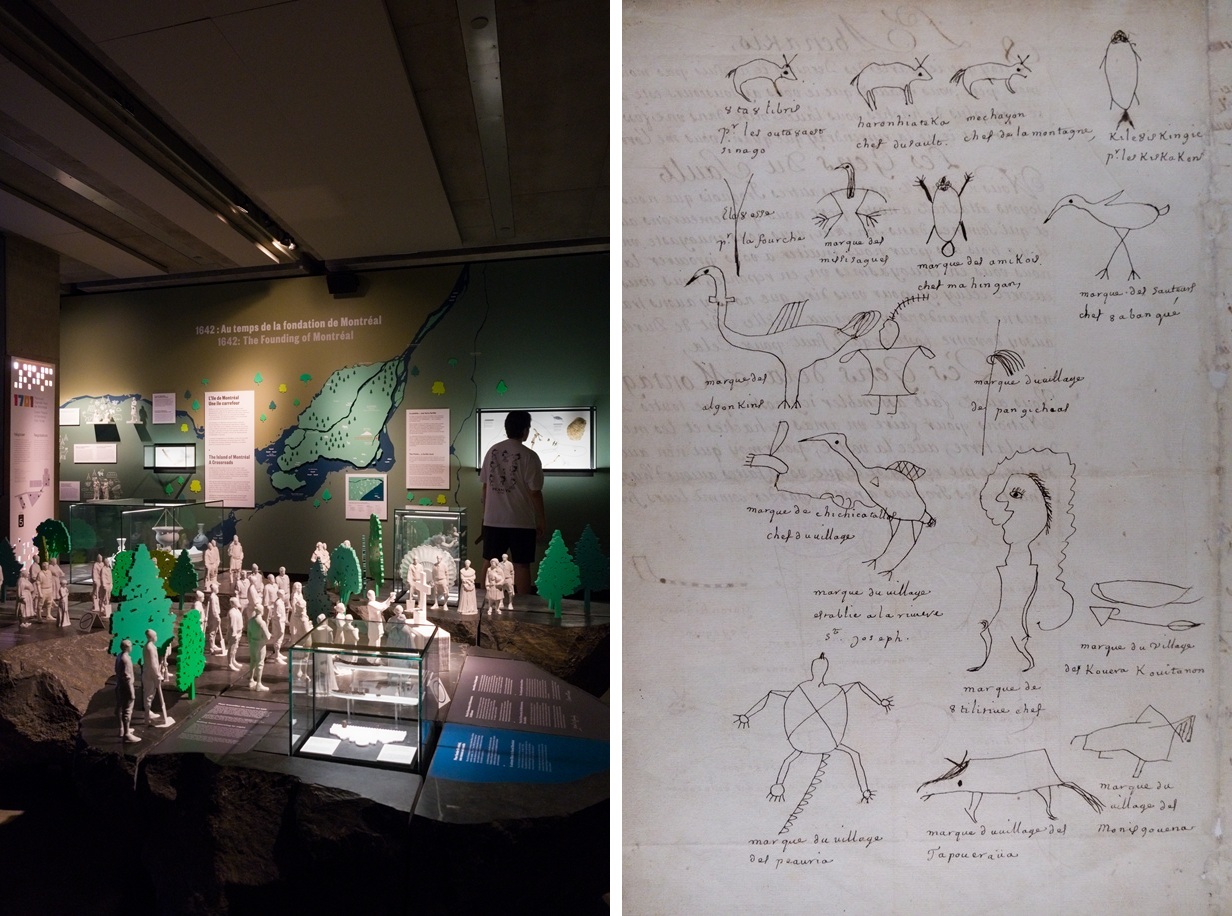
An underground gallery at the museum; the marks of French-allied Indigenous nations
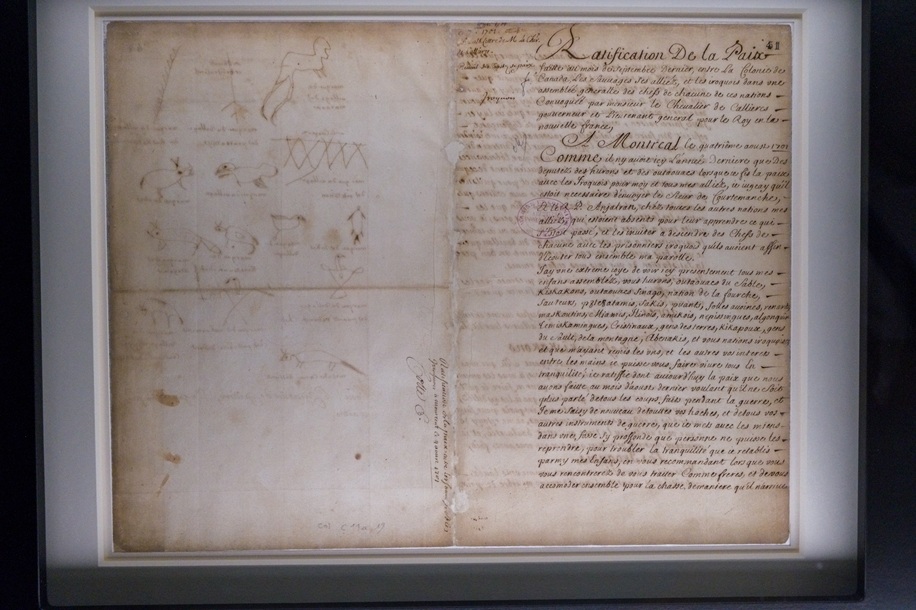
The opening page of the original seven-page treaty document, on loan from France
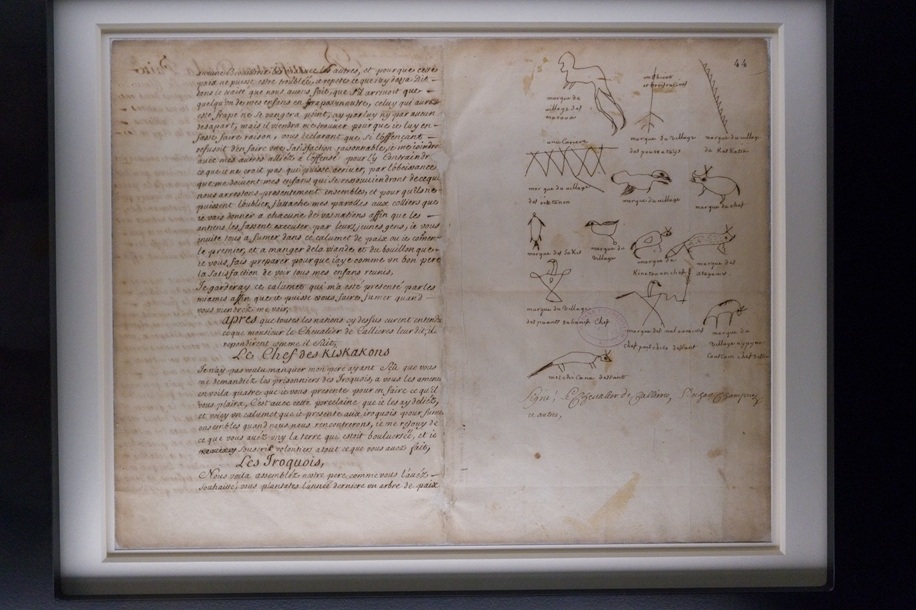
We were incredibly fortunate to see the actual treaty while visiting Montréal
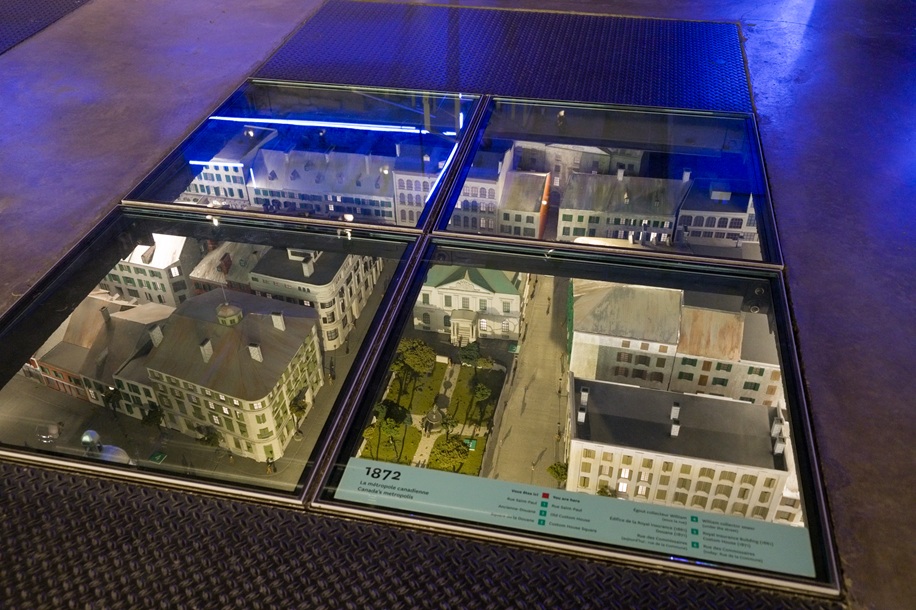
A model of Place Royale as it looked in 1872, when Montréal was Canada’s leading city
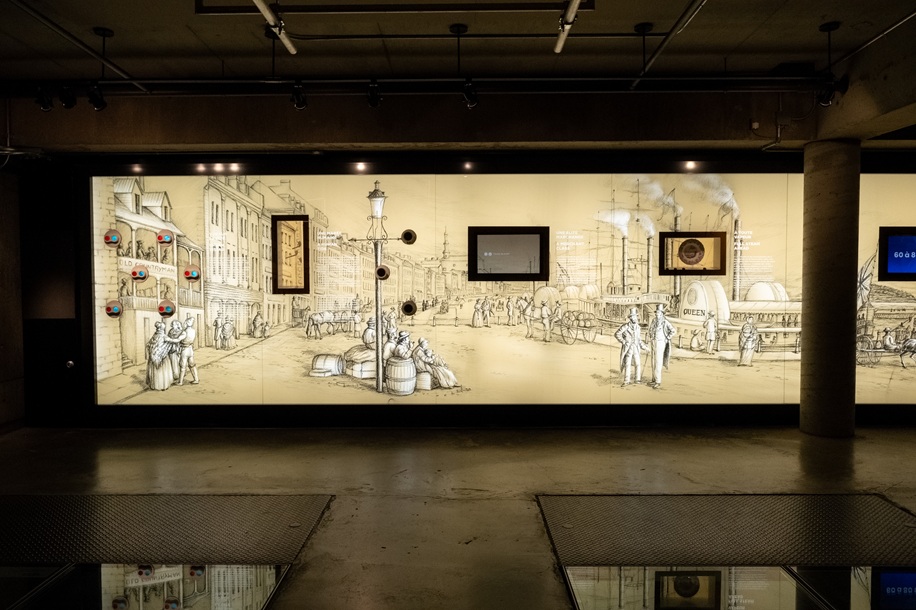
A large-scale illustration of the bustling riverside wharves of Old Montréal
The long stylized muskrat on the right stands for Kondiaronk and the Wendat nation
The Great Peace of Montréal treaty document is usually kept in in Aix-en-Provence
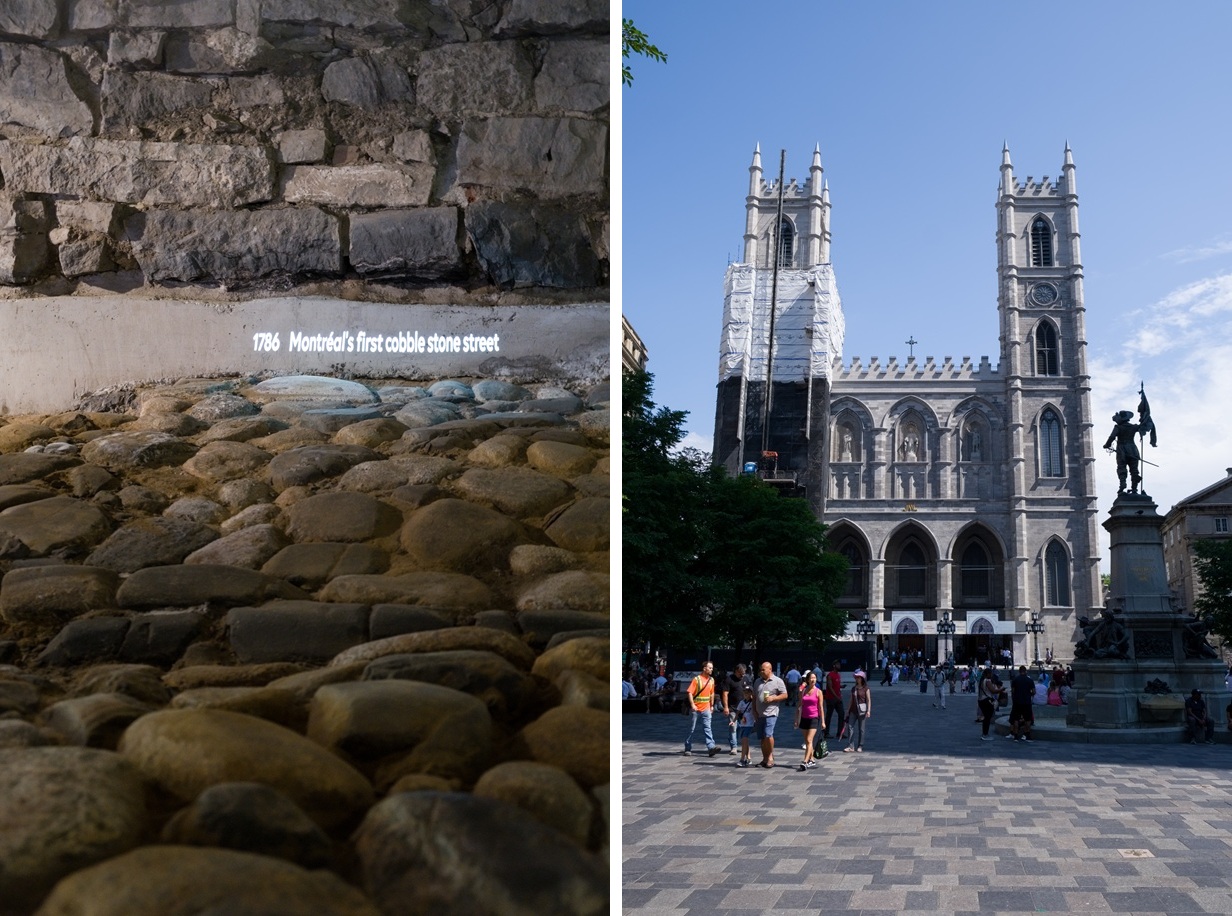
Centuries-old cobblestones at the museum and modern paving on Place d’Armes
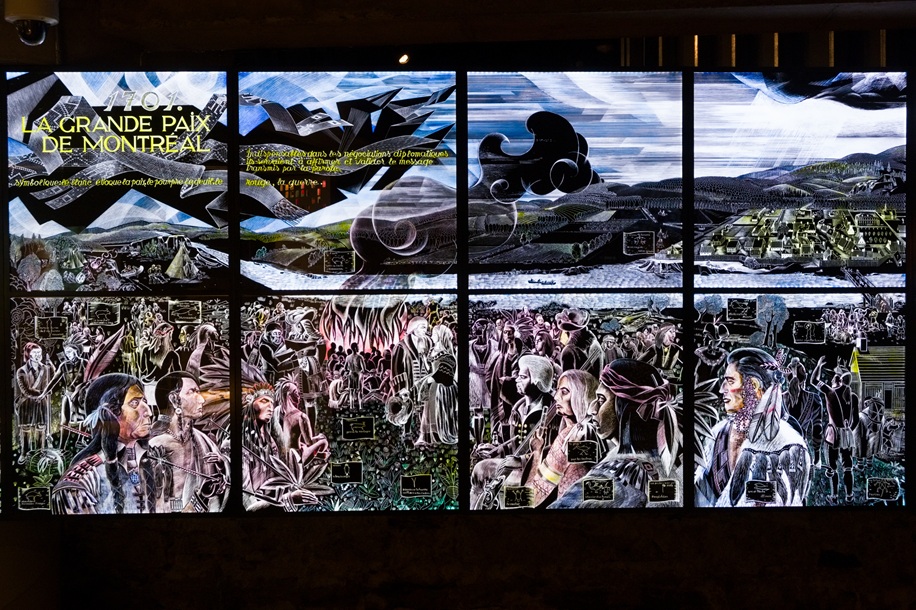
A tribute to a part of North American history that deserves to be better known





I think it takes a long time for muscle memory to become indelible. The differences in my ability to swim and bicycle, both of which I did as a child, convinced me of this.
What’s strange is that I had a completely different experience skiing again more than 15 years after I first learned to do it as a teenager… it was surprisingly easy to pick up where I left off, but of course having a patient and encouraging ski instructor went a long way!
I enjoyed walking through Montreal with you today. It is such a great city. But you’re right, it’s too bad our neighbours to the south have forgotten how to make peace. Maggie
Thank you, Maggie — after so many years since my last visit, I’d forgotten just how beautiful Montréal can be in the summertime. And I especially loved the newer galleries at the Pointe-à-Callière Museum. In the future I will write another post on the neighborhoods and sights (like the markets) that Bama and I explored outside Old Montréal. Stay tuned!
Thanks for refreshing my memory of Montreal. Although I didn’t visit the museum, we rented bikes and even though I hadn’t ridden in years, I was luckier than you and hadn’t forgotten how.
If it wasn’t so far away from Indonesia, I would go back in a heartbeat. I might have lots of extended family in Toronto, but Montréal is hands down my favorite city in Canada. And that’s something this most recent visit has only confirmed.
I loved it too!
Montréal seems like a city that keeps you coming back to it, over 17 years! It’s funny to hear that the officer mistakened your mom for being younger than she was: as the saying goes, “Asian don’t raisin!” 😆 Sorry you were traumatized by riding (or rather, falling off) the bike while there, and like you, I’m a bit shaky when it comes to biking again! All the same, Montréal is a gorgeous city, a place I haven’t returned to since I was a teenager. I hope to return sooner than later! Thanks for sharing, James 😊
I’m open to learning to bike again so long as there’s no one else (or few people) around to laugh at just how bad I am. Montréal was so vibrant and full of life when we went this summer — fingers crossed you’ll get the chance to revisit pretty soon!
You reminded me to make a another visit to Montreal. J and I have visited there a few times and I’ve travelled there on business a few times too. While my home is in Toronto, I think Montreal has a flair for life. But I think Toronto has better Chinese food although I haven’t compared it in a while now. Thanks for sharing your experience and the lovely pictures.
I think the consensus is that Toronto has a more diverse Asian food scene, though we actually came across a Cambodian restaurant in Montréal (something Jakarta does not yet have) while looking for places to eat on Google Maps. I would have considered dining there had we stayed another night or two!
I’m also particularly fond of Montreal, especially in the summer when the whole city is buzzing with a wide range of outdoor activities to enjoy.
We covered a lot of ground but our stay felt too short (and quite rushed sometimes when it came to sightseeing). Given the chance, we would happily have spent another three or four days in Montréal, visiting more markets and museums and eating our way through the Plateau!
Montreal’s relatively long history, reflected in its numerous historical buildings, is another reason why I loved this city so much. I tried to hold my tears at the Notre-Dame Basilica when the organist was playing the keyboards of the pipe organ. The beautiful tones reverberating across the spectacular setting really moved me. But another highlight from our trip was definitely seeing the original document of the Great Peace Treaty of Montreal. We were really lucky with the timing of our visit! I really can’t wait to go back to this marvelous city.
I wholeheartedly agree — it would be so nice to revisit Montréal during the autumn and see the changing colors of the foliage. And I wouldn’t mind hitting the markets to look for more Québec cheeses! If only Canada weren’t so far away from Indonesia…
Such a beautiful city, and your photos more than do it justice. I also really enjoyed reading about your history with Montreal.
I got a good chuckle out of the story of your family’s first visit and the question at immigration. There were four of us siblings in my family, three girls and a boy, and we will never let my brother forget that a work colleague of our dad told him he had four beautiful daughters! That’s where I thought you were going with the officer’s confusion, but the better interpretation is certainly that your mom looked so young!
Actually I had a similar thing happen to me on another trip to Toronto. My cousin (less than 2 years younger than me) was working part-time as a barista in a neighborhood strip mall when I walked in with her mom to pick something up. Her coworker told her, “Wow! You have a really young dad!!”
Such a delight to read your very thorough reviews of Old Montreal and its various institutions. You do such justice to the area with your words and photos. Just a quick fun fact about the Nelson’s Column – it is interesting to note that the statue of Nelson is turning its back to the river; you would think that as a seaman he would be looking at the water. It is also a bit intriguing that we have a statue to Nelson who has no link to Canada…(Suzanne)
Thank you, Suzanne! Those intriguing facts about Nelson’s Column are things I never considered before. Now that you mention it, it is quite odd that his statue does not face the river and Place Jacques-Cartier, which would feel more natural from an urban planning perspective. Madagascar must have been an eye-opening experience — I will be reading your post on Antananarivo right after this.