
Samarkand: Stories from an Ancient Crossroads
There are a handful of places in the world whose names are tinged with magic — faraway cities that conjure up a lost age of historic splendor. So it is with Samarkand. The mere mention of this fabled Silk Road trading hub in modern-day Uzbekistan brings to mind grand monuments, bustling markets, and caravans loaded with riches from both East and West. Samarkand has inspired its share of art and literature through the ages: it’s mentioned as the home city of Shah Zaman, one of the two fictional brother-kings who set the scene for One Thousand and One Nights. Some creatives — like realist Russian painter Vasily Vereshchagin — had the great fortune of traveling to Central Asia long before commercial aviation made long-distance trips a breeze, but there were many more who never did set foot in that part of the world. Take the British poet, novelist, and playwright James Elroy Flecker, who penned these lyrical verses while working in Constantinople and Beirut as part of the consular service before World War I:
We travel not for trafficking alone;
By hotter winds our fiery hearts are fanned:
For lust of knowing what should not be known
We take the golden road to Samarkand.
—From The Golden Journey to Samarkand, James Elroy Flecker (1913)
A far cry from the long-distance camel rides undertaken by Silk Road traders of centuries past, our own journey from Indonesia seemed incredibly easy by comparison. When Bama and I went two years ago, Uzbekistan Airways had started running eight-hour nonstop flights between Jakarta and Tashkent (a route the airline has sadly now dropped), and the Spanish-built high-speed Afrosiyob train whisked us from Tashkent to Samarkand in a little over two hours. “It smells like Europe,” Bama mused as we settled into our seats.
Uzbekistan’s tourism boom was immediately clear from the myriad nationalities represented in a single train carriage. Directly across the aisle, a Malaysian mother and her adult daughters were busy stowing their bags in the overhead racks. A middle-aged Russian couple occupied the seats in front of us, and we also spotted a rambunctious tour group of Spanish retirees, along with two young Chinese vacationers spending their Golden Week holiday abroad.
Perhaps the most famous Chinese traveler to ever visit this region was Xuanzang, a Tang dynasty Buddhist monk who embarked on an epic 17-year pilgrimage to India in the 7th century. He passed through Samarkand when it was the capital of the Sogdians: multilingual master traders who played a key role in the exchange of goods and ideas along the Silk Road. Descriptions of Xuanzang’s travels were compiled into the book Record of the Western Regions, commissioned by Tang Emperor Taizhong upon his return. The monk reported that Samarkand was “very populous” and that “the precious merchandise of many foreign countries is stored up here… The inhabitants are skillful in the arts and trades beyond those of other countries. The climate is agreeable and temperate. The people are brave and energetic.”
Samarkand was known to the ancient Chinese as the State of Kang, and Tang-era cities were home to a long-established population of Sogdians who ran the caravan trade, opened wine taverns, and did brisk business in the markets. Some even enjoyed a privileged status as high-ranking military officers and appointed regional leaders. The Tang fascination with all things foreign also had an effect on local fashion, with Chinese women adopting aspects of Sogdian dress. Records state that on two occasions, Sogdian merchants brought diplomatic gifts to the Tang royal court: the golden and silver peaches of Samarkand. Chinese chronicles say the exotic fruit was as large as goose eggs, and an edict was issued for them to be planted in the imperial gardens.
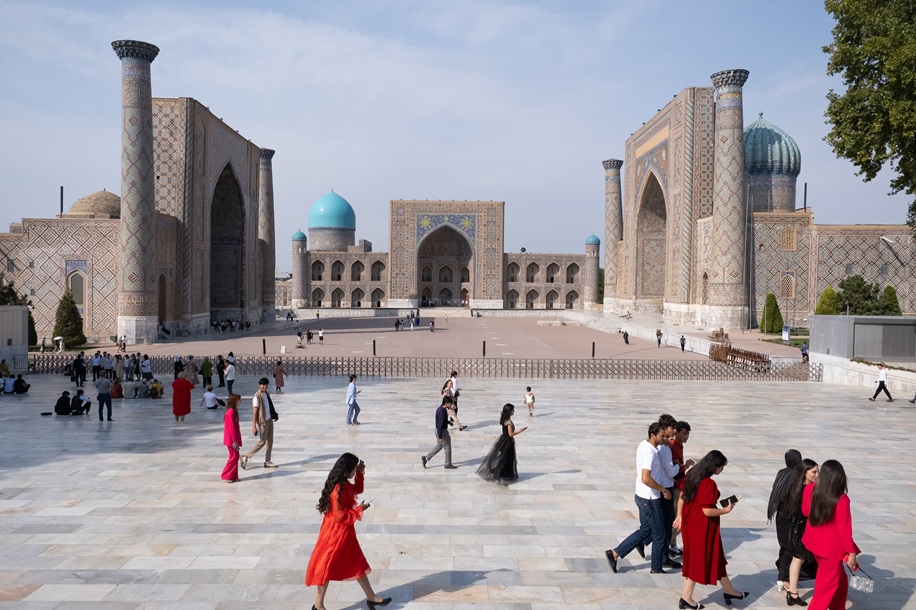
Three historic madrasas frame Samarkand’s iconic Registan Square
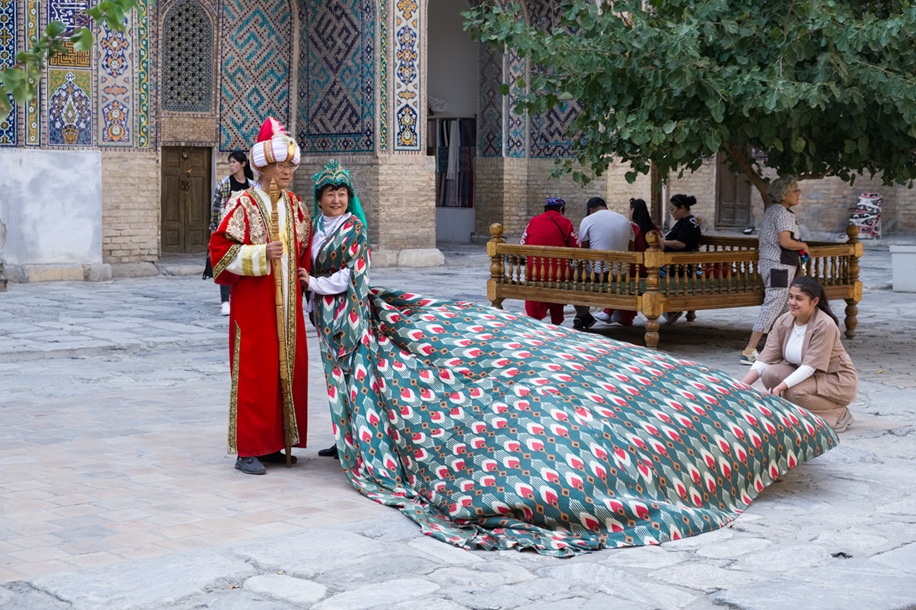
Chinese tourists dressing up as a royal couple of centuries past
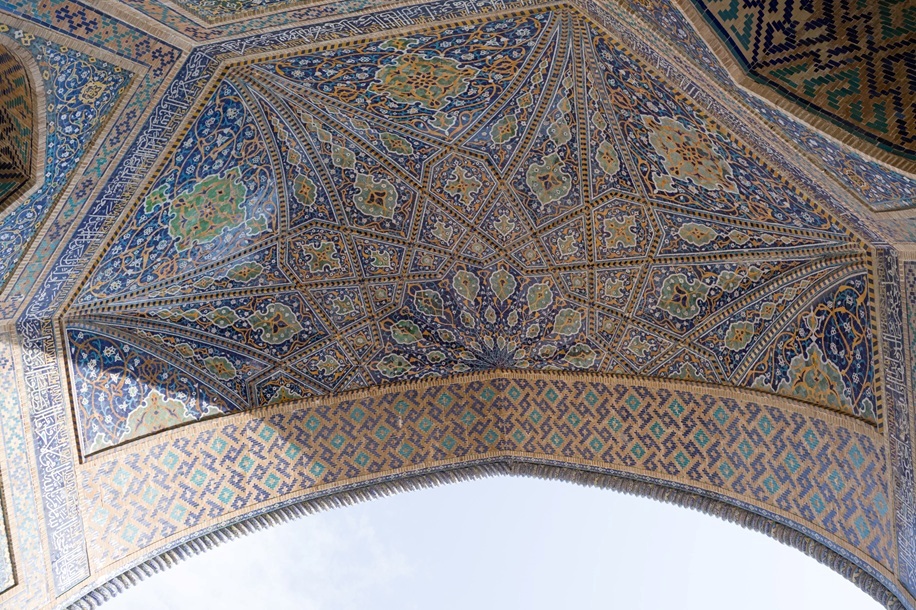
Looking up from the iwan (vauled porch) at the entrance of Ulugh Beg Madrasa
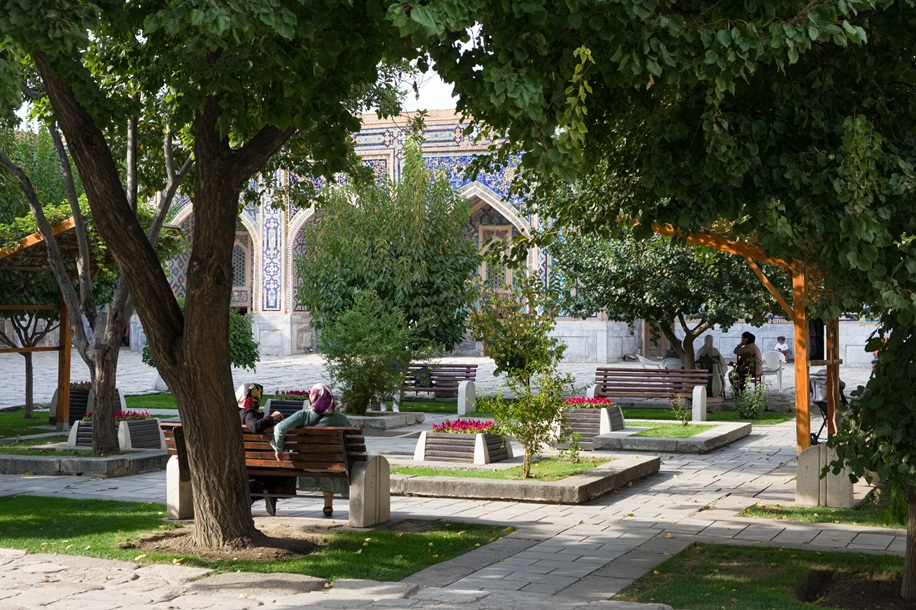
The leafy courtyard inside the same 15th-century building
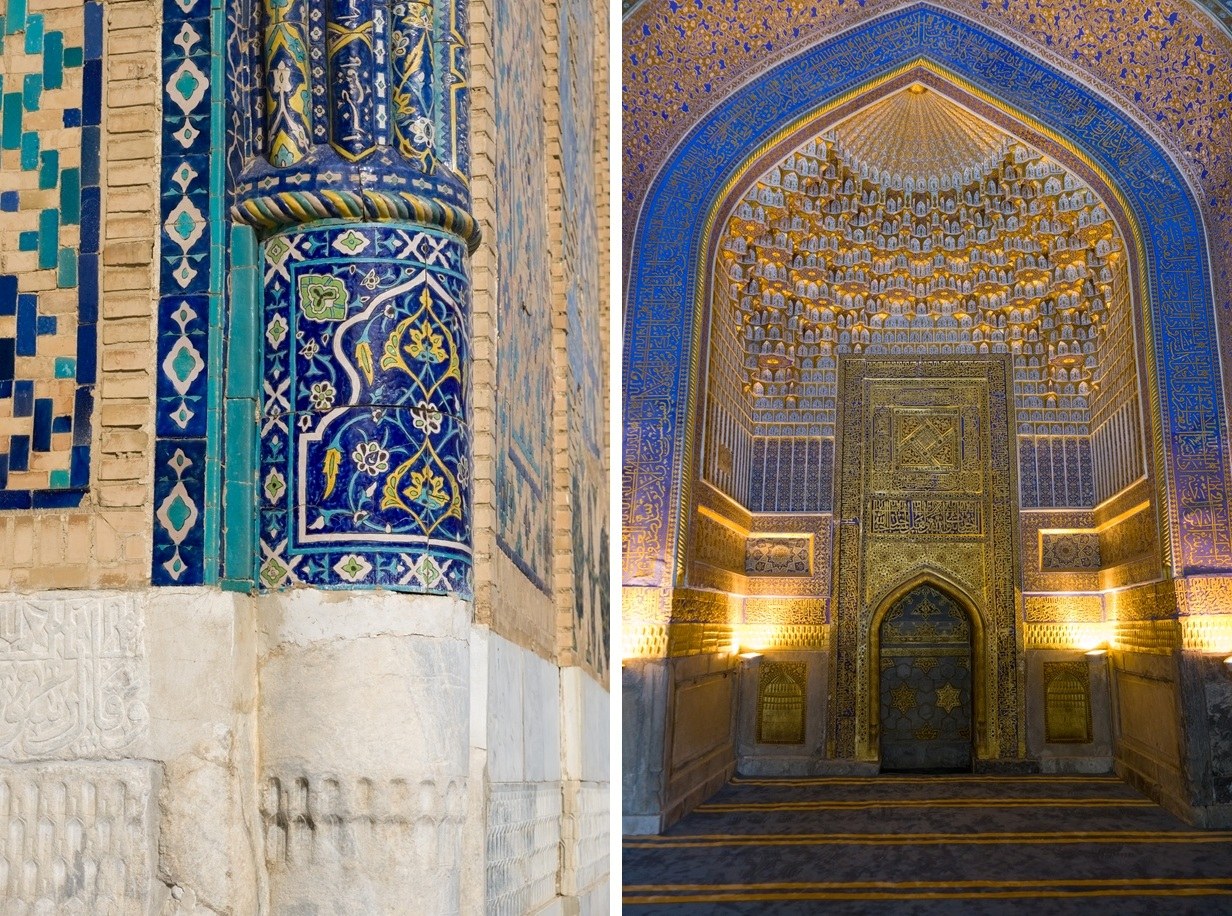
Majolica tiles on Tilya-Kora Madrasa; the madrasa’s mihrab, which points to Mecca
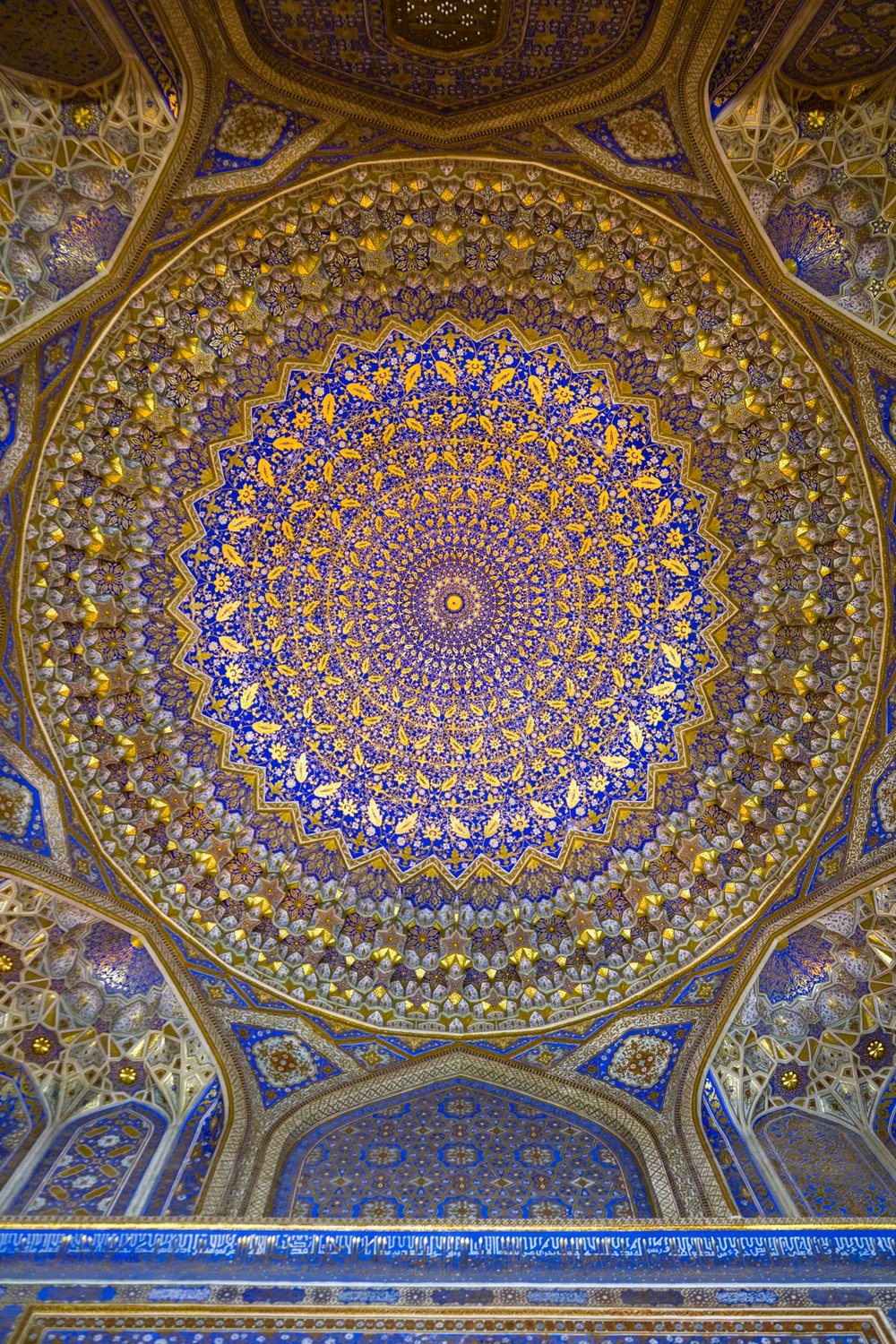
The prayer hall at Tilya-Kori Madrasa is known for its remarkable trompe-l’œil ceiling
The steppes of Central Asia weren’t just a superhighway for trade: they also served as a natural conduit for military campaigns from both West and East, with Samarkand falling to a handful of legendary conquerors — including Alexander the Great — over the centuries. The most notorious was Genghis Khan, whose Mongol horde invaded in 1220 and devastated what was then the crown jewel of the Khwarazmian Empire. Samarkand had not fully regained its luster by the 1330s: a visiting Ibn Battuta observed broken palaces and substantial areas still in ruins. Even so, the Moroccan traveler described it as “one of the largest and most perfectly beautiful cities in the world.”
The rise of Timur (a.k.a. Tamerlane) would mark a major shift in Samarkand’s fortunes. He made it the capital of his growing empire in 1370, which, at its apogee, stretched from eastern Anatolia to the plains of north India and from the Aral to the Arabian Sea.
History remembers Timur as a brilliant military leader who was incredibly brutal to the cities that resisted his empire’s seemingly unstoppable expansion. Proud, wealthy centers of commerce like Herat, Baghdad, Damascus, and Delhi were sacked and their populations massacred or enslaved. And yet Timur was also an intellectual with a taste for beauty and culture, sparing the artisans and architects of the lands his armies devastated so they could be sent to Samarkand. The golden age of art and learning ushered in by Timur continued with the reign of his grandson Ulugh Beg, who founded the most advanced observatory of its time and the oldest of the three monumental madrasas on the Registan, the city’s social heart.
The Registan attained its current form in the 17th century with the construction of the Sher-Dor Madrasa and Tilya-Kori Madrasa. The former is distinguished by the tilework of lion-tiger hybrids and deer above its main archway — unusual since traditional Islamic art shies away from the depiction of living beings — while Tilya-Kori Madrasa has a lavish blue-gold interior of spellbinding beauty. All three madrasas feature high rectangular entrance portals called pishtaq (or peshtak) and rows of iwan: vaulted spaces with one side open to the elements. Their turquoise domes and walls clad in glazed majolica tiles glint at midday and glow in the soft light of the morning and late afternoon. It’s easy to see why the British statesman (and future Viceroy of India) George Curzon dubbed the Registan “the noblest public square in the world” after his 1888 visit.
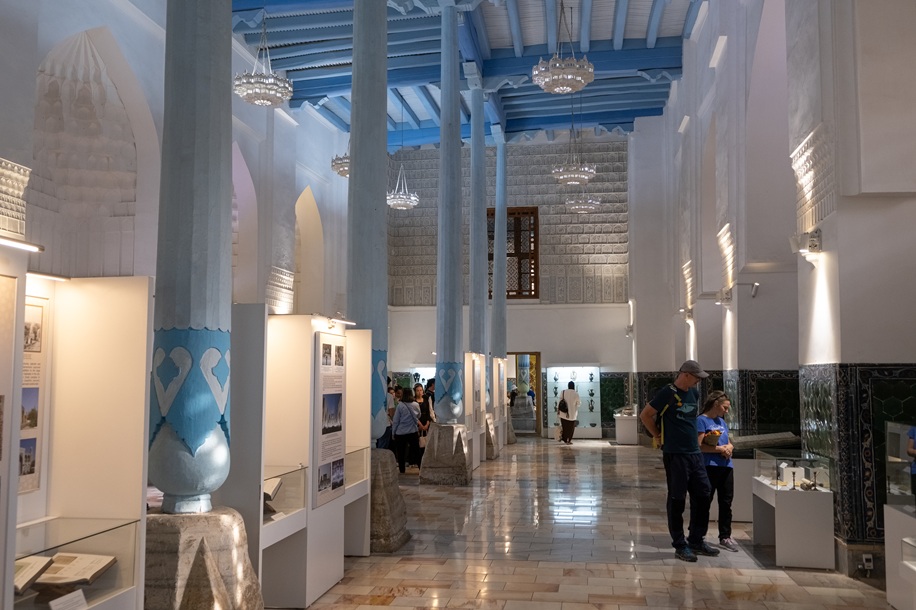
Touring the museum inside Ulugh Beg Madrasa
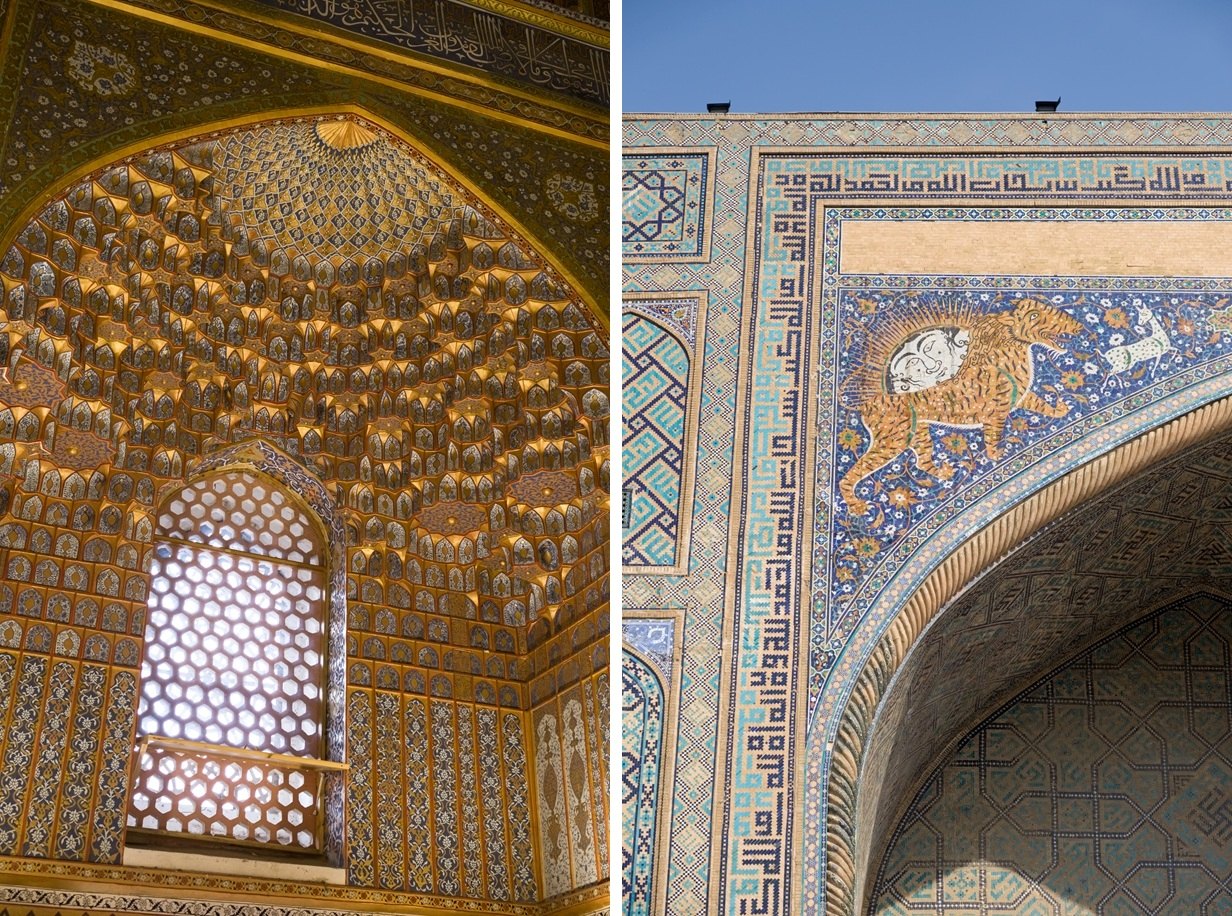
Elaborate muqarnas (honeycomb vaulting) and unusual animal mosaics on Sher-Dor Madrasa
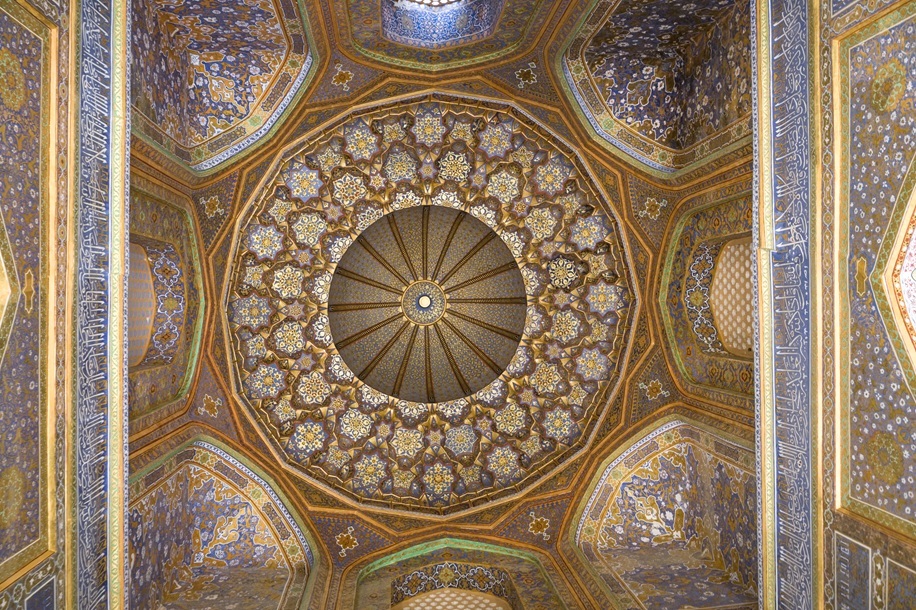
Beneath one of the smaller domes at Sher-Dor Madrasa
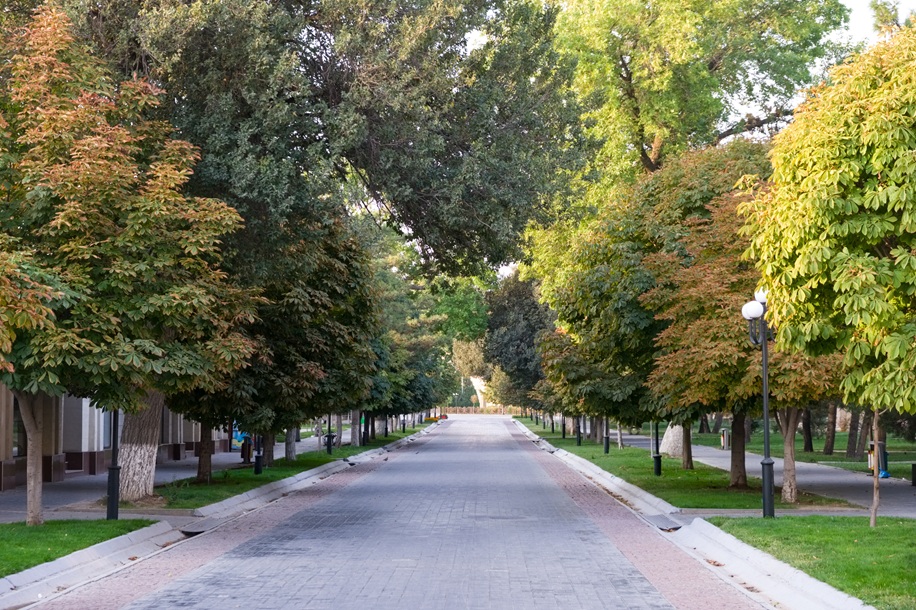
Early fall foliage along a pedestrianized avenue
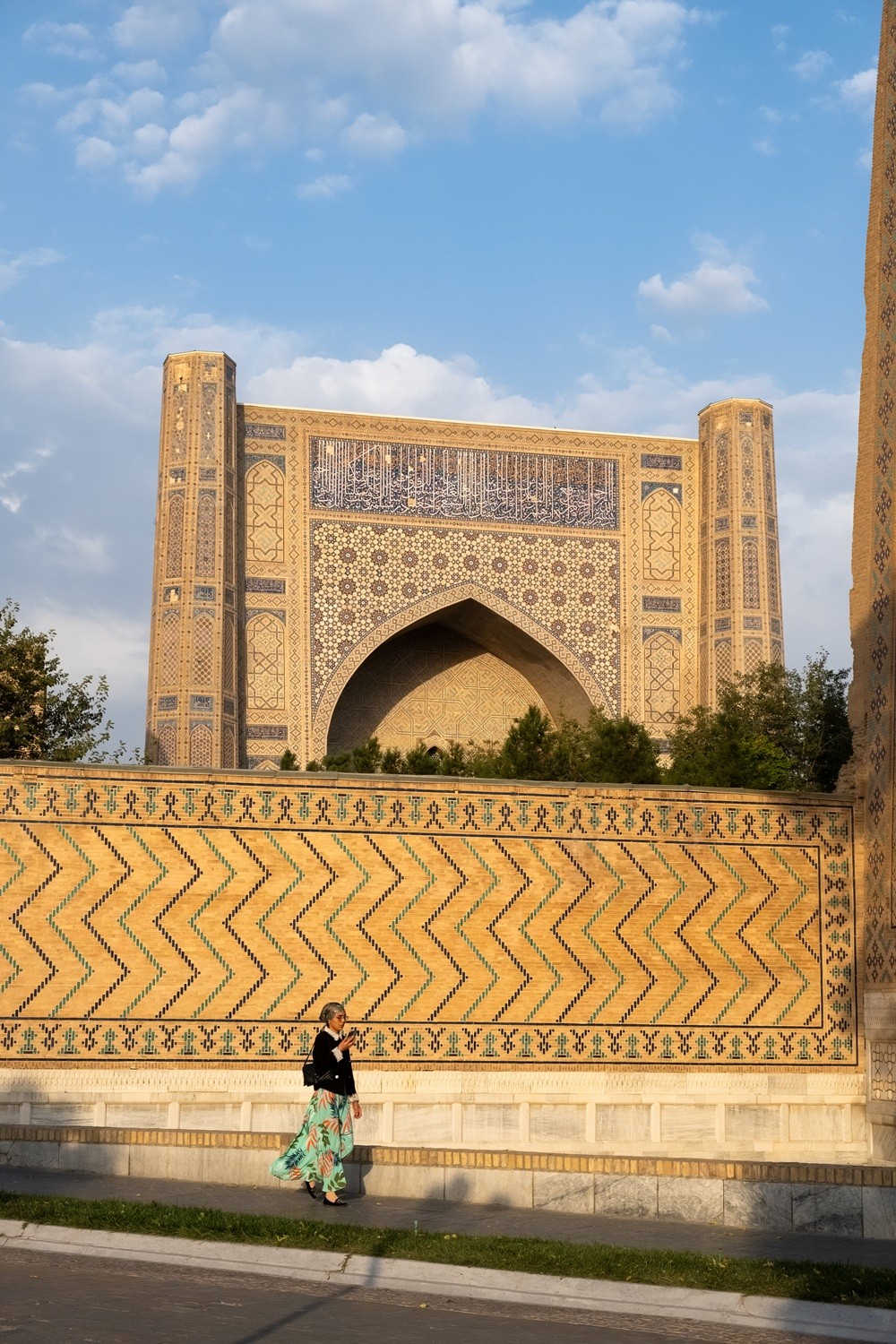
Outside the monumental Bibi-Khanym Mosque
More than a decade ago, an adventurous aunt and uncle in Hong Kong joined a small group tour that took in Uzbekistan’s Silk Road cities. The Central Asian nation was not yet on the global travel radar, and my aunt recalls having the lights at the Registan switched on just for them after handing the caretaker a small fee.
How things have changed. Several times a week, workers set up speakers and rows of seats for sound and light shows that see the madrasas bathed in a kaleidoscope of shifting colors. As birds chattered loudly in the trees of the gardens above the square one afternoon, we passed Indian travelers ordering coffee and gelato at a gazebo-like food stand. I overheard a local attempting to strike up a conversation with a young Chinese couple on the viewing deck overlooking the Registan: “Kitay? Kitay?” he asked. “No,” the man replied confidently. “We are from China.” (Something had been lost in translation: “Kitay” is in fact the Russian name for the country.) The Chinese boom in outbound travel was already reshaping Uzbekistan in small ways. Down Registan Street, the busy six-lane avenue that serves as Samarkand’s main tourist drag, a sign outside a boba tea shop in Russian and simplified Chinese advertised a drink inspired by the Hong Kong dessert mango pomelo sago.
For us, the influx of Golden Week visitors from mainland China was most acutely felt at the Shah-i-Zinda necropolis. Bama and I had erroneously believed that getting there before 8:30 a.m. would ensure a crowd-free experience. Instead, we encountered throngs of Mandarin-speaking early risers; some were clearly interested in the architecture and history of the place, but most were of the stick– and phone tripod–wielding variety. They perched themselves against the tombs’ majolica-tiled facades and posed vainly in straw hats and summery dresses before moving on to the next photogenic entryway. These beautiful centuries-old tombs seemed to be regarded as little more than a backdrop for their social media snaps on Xiaohongshu (a.k.a. RedNote). With no security guard present, two Chinese tourists swung their legs over a rope barrier into the carpeted, shoes-off prayer hall at the Qusam Ibn Abbas Complex, built around the grave of its namesake preacher: a first cousin of the Prophet Muhammad, and the man credited with bringing Islam to Central Asia. Ibn Battuta wrote down the rituals he observed at the site when he stopped by in the 1330s:
“The inhabitants go out to visit it every Sunday and Thursday night and the Tatars also visit it, bringing large votive offerings of cattle, sheep, and money, which are used for the maintenance of travelers and of the guardians of the hospice.”
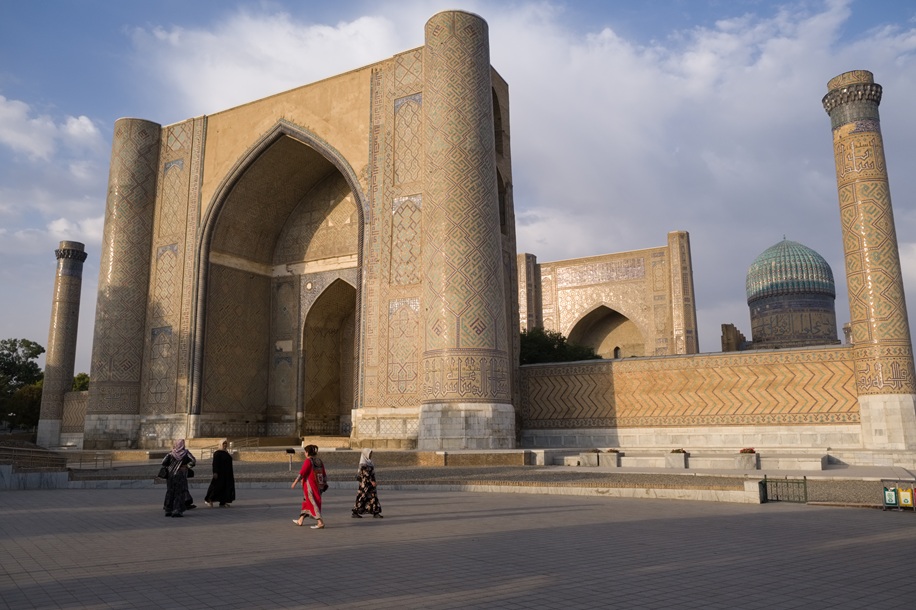
Bibi-Khanym Mosque has been restored and reconstructed over the past five decades
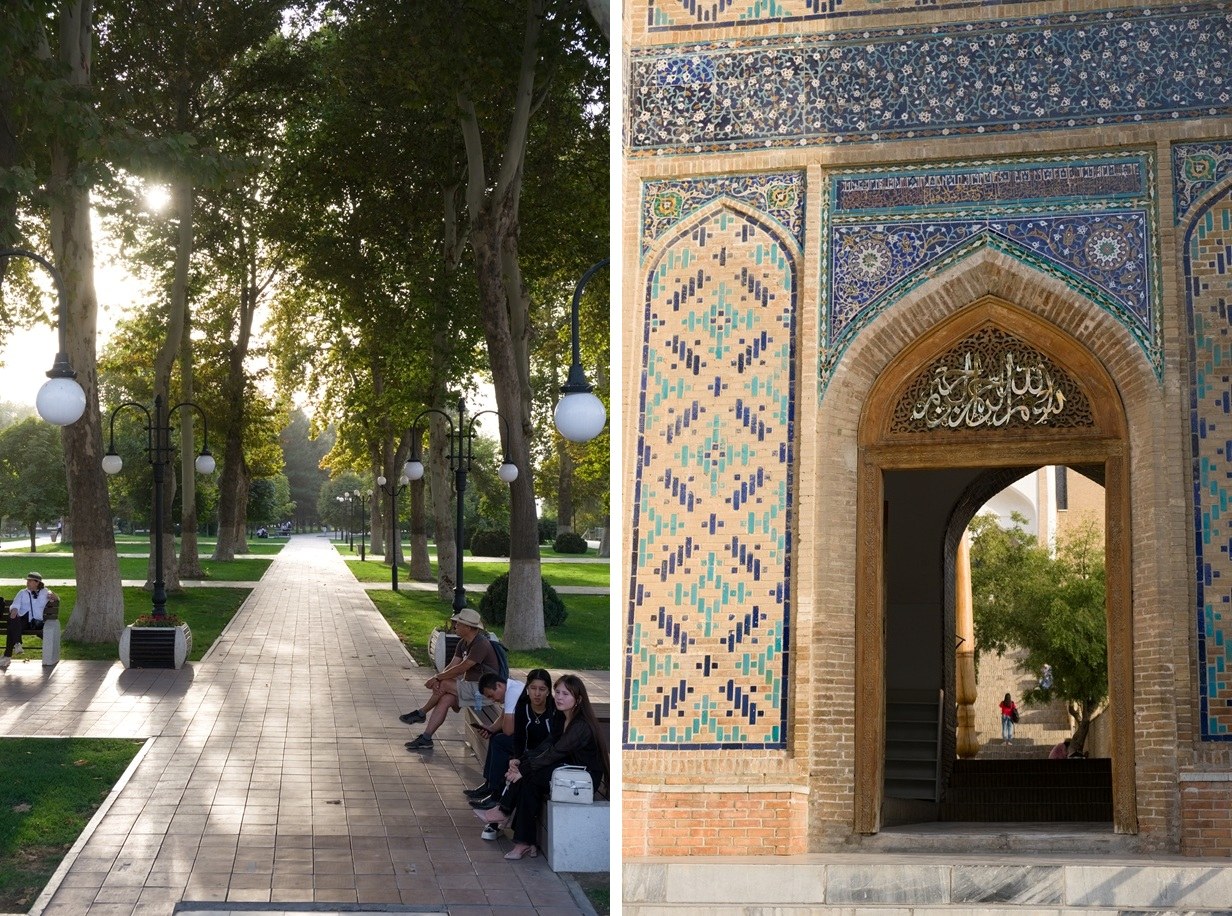
The gardens above Registan Square; entering the Shah-i-Zinda necropolis
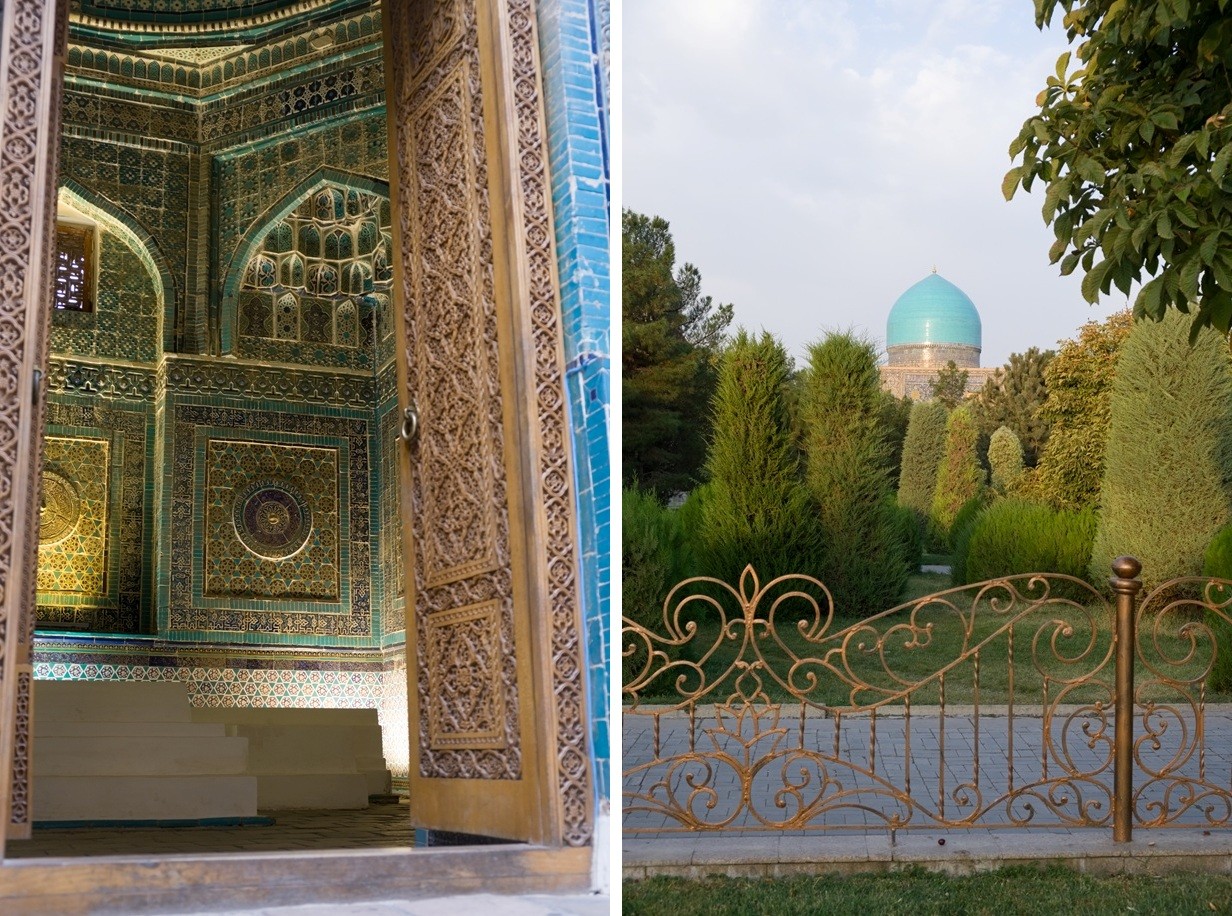
One of many elaborate tombs at Shah-i-Zinda; the dome of the Registan’s Tilya-Kori Madrasa
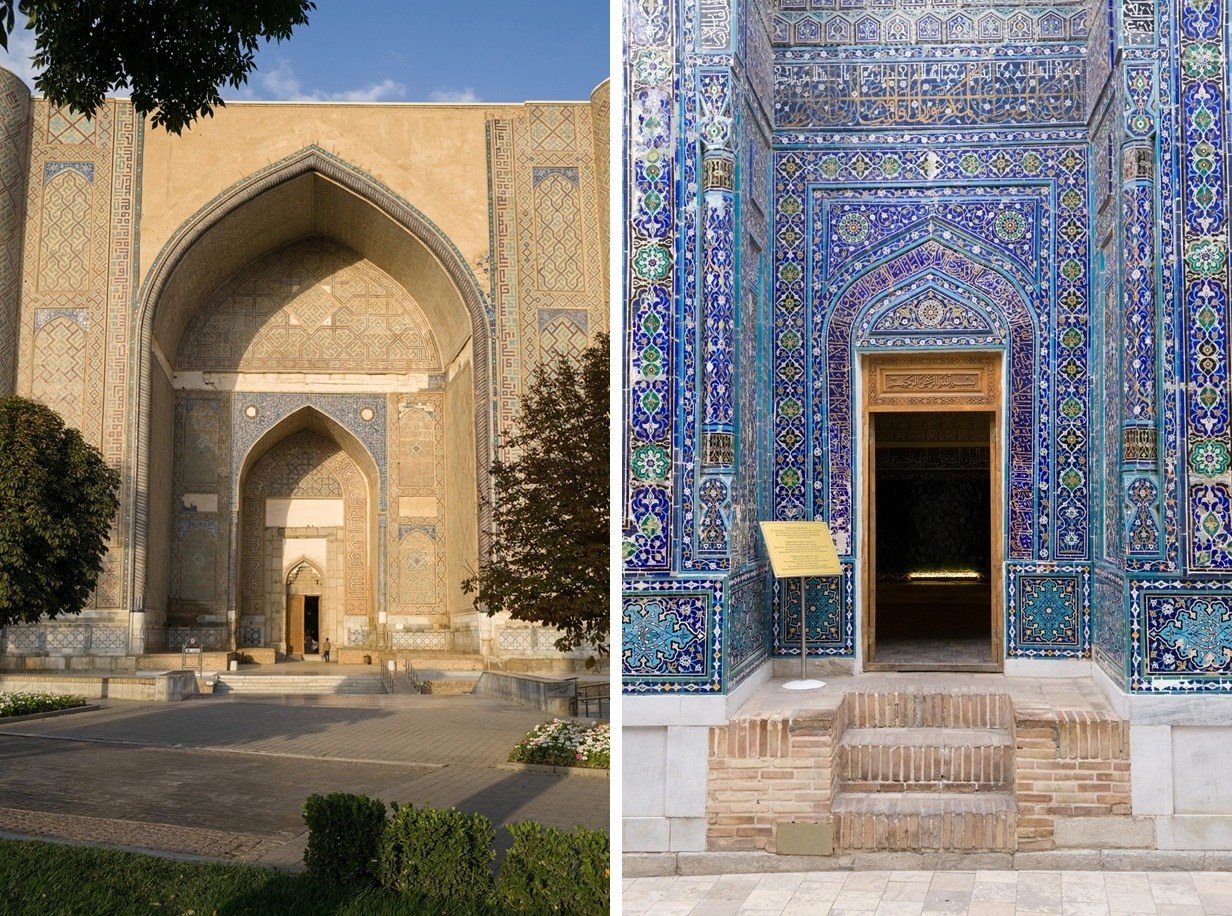
A person is dwarfed by the main portal of Bibi-Khanym Mosque; majolica tiles at Shah-i-Zinda
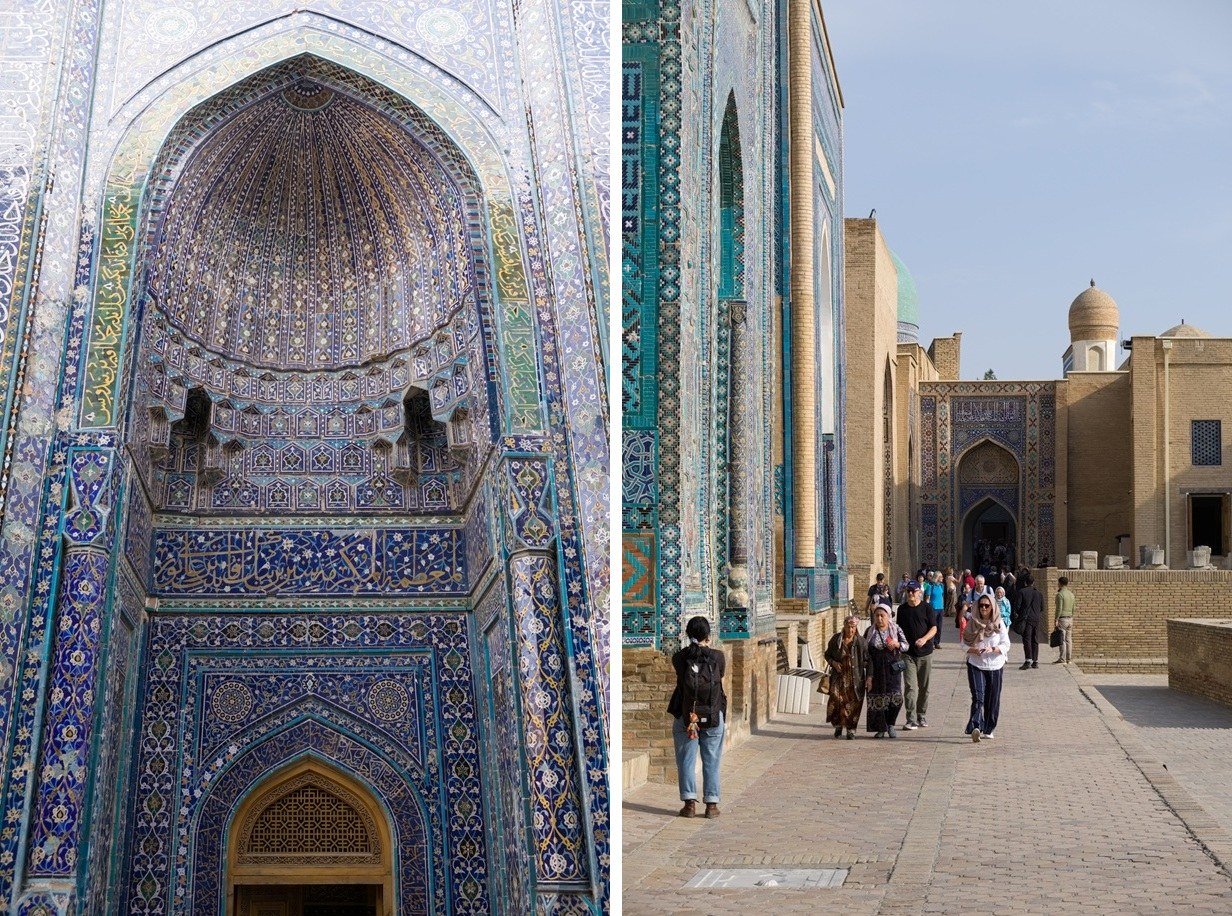
Details fit for Timurid royalty; a busy morning at Shah-i-Zinda
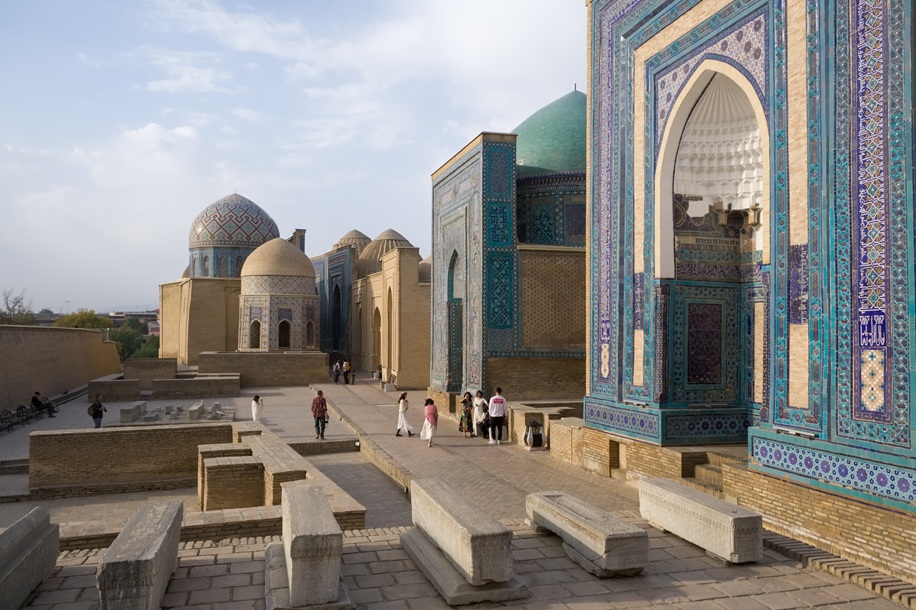
A confection of domes and pishtaqs (monumental portals)
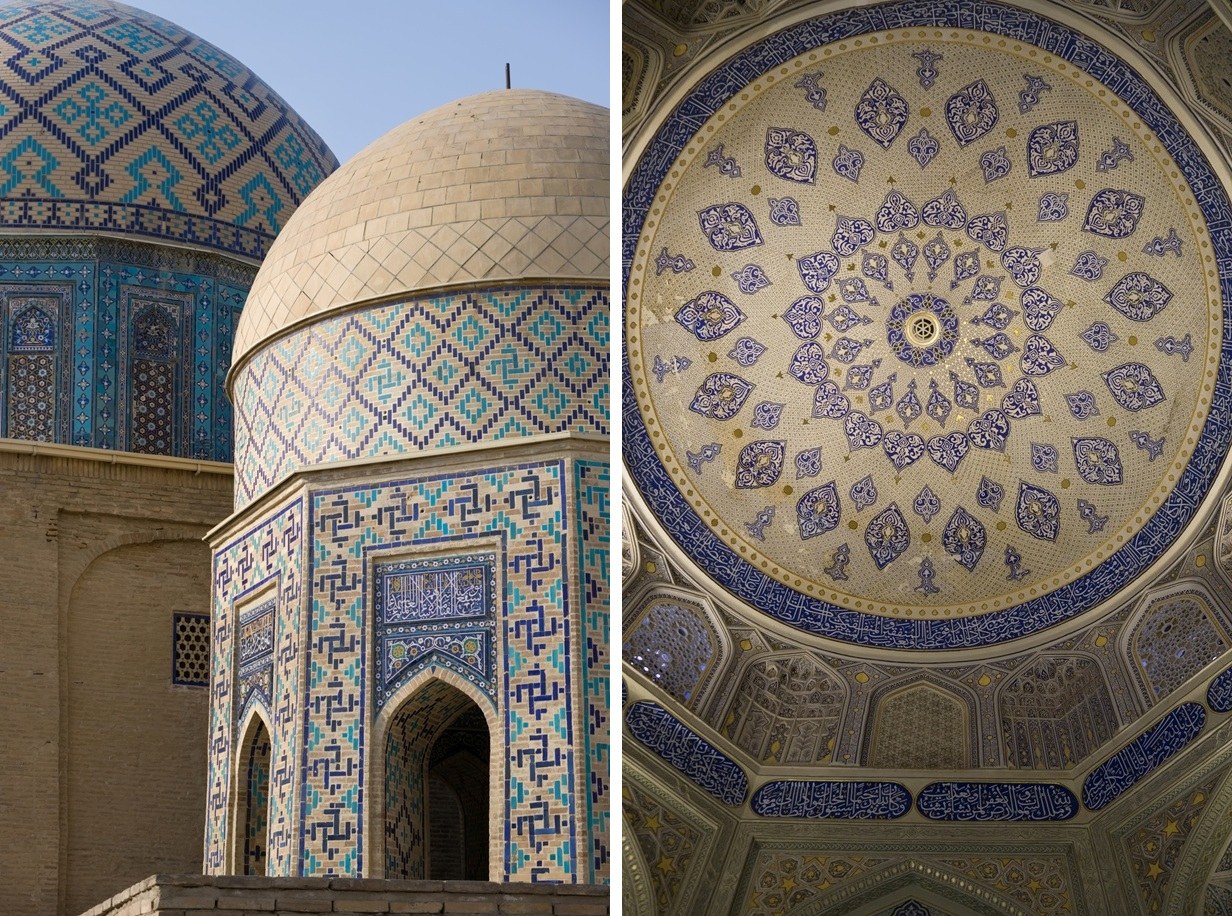
Patterns in blue, turquoise, and gold at Shah-i-Zinda
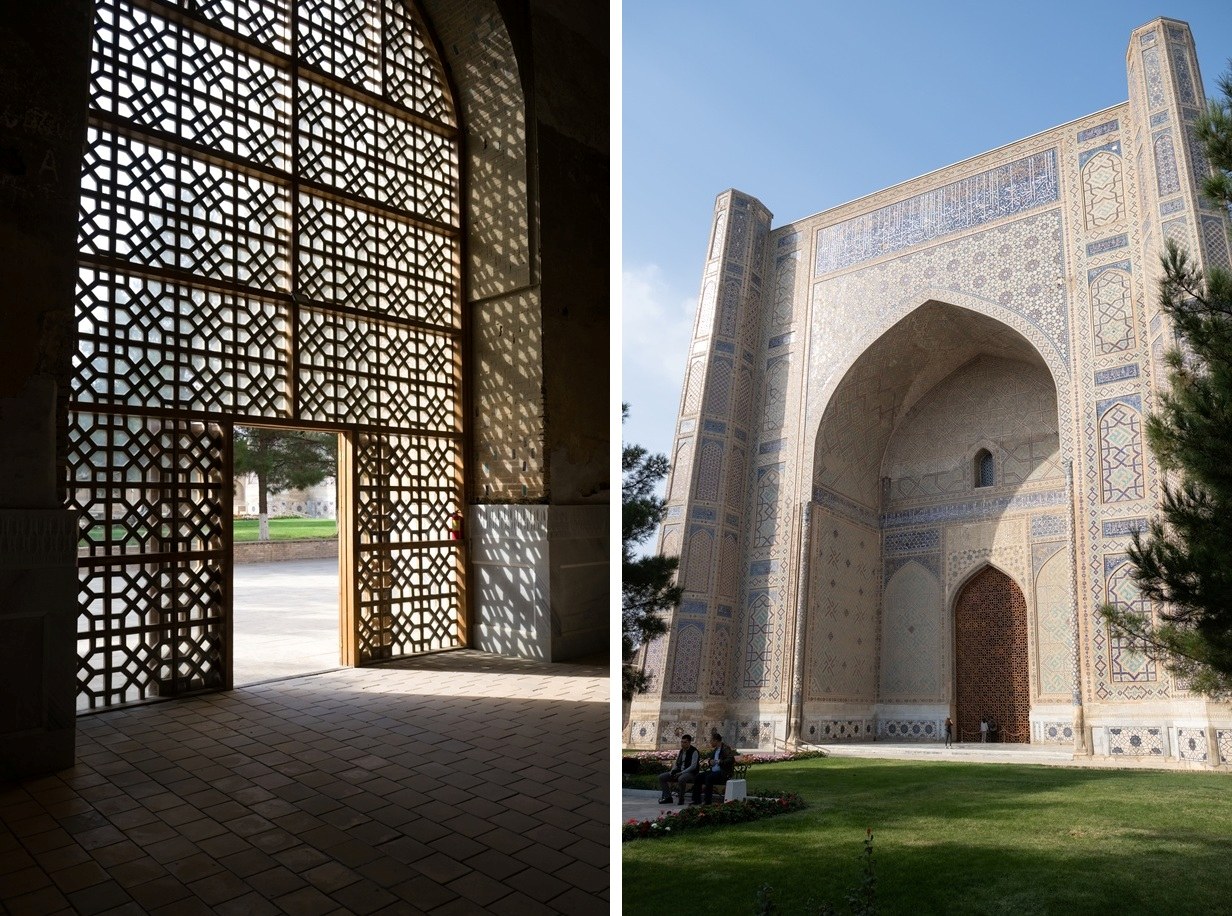
Looking out from a side hall at Bibi-Khanym Mosque; the pishtaq of the mosque’s prayer hall
We’d come to Uzbekistan in October — Bama’s first experience of fall — and the crisp weather was cool enough to warrant a sweater. Foliage in shades of yellow and orange framed the pedestrian avenue running past Bibi-Khanym Mosque, a landmark even more monumental than the madrasas of the Registan. Commissioned by Timur’s favorite wife and chief consort, empress Saray Mulk Khanum, it dates to the early 15th century; construction began in 1399 and was fast-tracked so the mosque was largely complete in 1404. But the imposing masterpiece gradually fell apart over the subsequent centuries; much of it succumbed to wind erosion and strong earthquakes. Only from the 1970s did a series of large-scale restorations and reconstructions bring back much of the building’s past splendor.
Behind the 35-meter-high (115-foot) main portal lies an expansive, leafy courtyard once used for Friday prayers. At its center stands a massive Qur’an stand made of carved marble blocks. With space for nearly 10,000 worshippers, the complex was so enormous and ambitious in scale it was never truly finished — not by Timur himself nor the rulers who succeeded him. Engineering technology hadn’t quite caught up with his grand vision to build the biggest mosque in Central Asia: the structure was so heavy it soon began to crumble under its own weight. We gained a newfound appreciation of its sheer bulk up close; fellow visitors at the base of the prayer hall’s pishtaq were reduced to tiny ant-like beings in comparison.
Right next door to Bibi-Khanym Mosque is Siyob Bazaar, whose stalls overflow with foodstuffs and beautifully hand-painted ceramics. Bama and I soon encountered a friendly seller of dried fruit and spices while looking for edible souvenirs. Though we did not speak each other’s languages, his hospitality was clear. After buying a small plastic jar filled with his all-natural spice mix for plov, Uzbekistan’s national dish, the vendor gave us each a farewell gift. It resembled a prune, being oval, dark, and fleshy, but was stuffed with walnut. “Apricot,” he said. The snack proved so delicious that no sooner than gobbling it up a short distance away, we immediately turned around to buy half a kilo to take home.
But the real reason we visited the bazaar was Samarkand’s legendary non flatbread, shaped like a thick-rimmed disc with a thin, indented center. Inside the standalone wooden structure dedicated to the local specialty, an eagle-eyed vendor signaled for us to come closer. With a flourish she pulled away a white cotton sheet to reveal round, prodigious loaves of non stacked atop one another. She quickly handed us one, saying a few unfamiliar words in Uzbek. “It’s still warm!” Bama exclaimed. We bought the whole loaf without a second thought, and found a shaded bench nearby to enjoy our very first taste of Samarkand non, washed down with bottled peach and pomegranate juice. It was a revelation. Fresh from the oven, with crispy edges, and an interior like that of a bagel but a little denser, the non tasted like it had been lovingly handmade and perfected over many generations. And its mouth-watering fragrance was surprisingly long-lasting; two days after taking it back to our hotel room, we could still discern its aroma. The next few mornings would always begin with a light breakfast of non and walnut-stuffed apricots from Siyob Bazaar — a match made in heaven.
Bama and I agree that the food of Samarkand was, broadly speaking, the best we ate in Uzbekistan. Down a dusty road off Registan Street, we feasted on sheep’s tail-fat kebabs, lagman noodles, and shurpa soup at the no-nonsense restaurant Shokhrukh Nur. And the cozy family-run hotel we booked a short distance away was attached to a small eatery popular with locals. Here, Bama and I saw Samarkand-style plov being cooked alfresco in a large gas-fired kazan or wok-like cauldron.
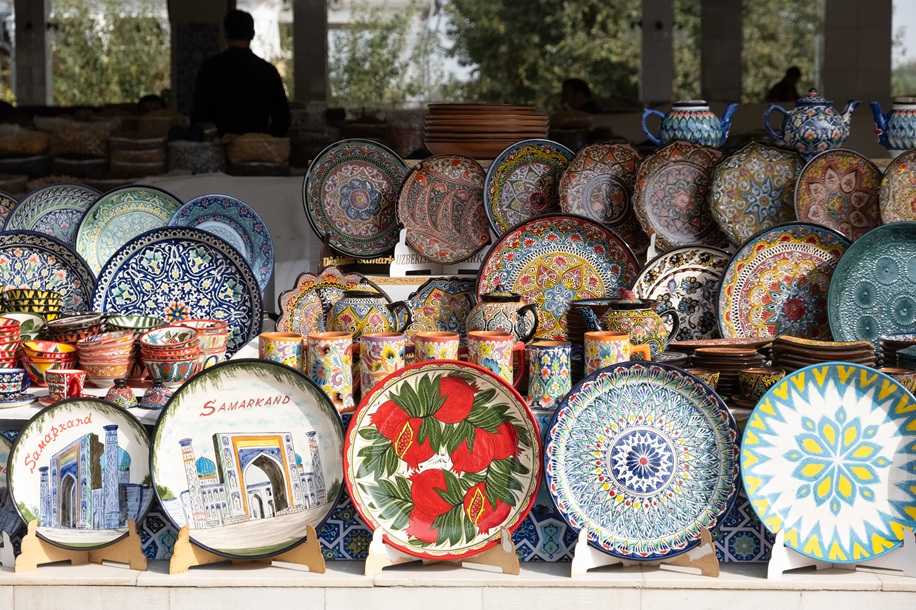
Ceramics hand-painted by local artisans as seen at Siyob Bazaar
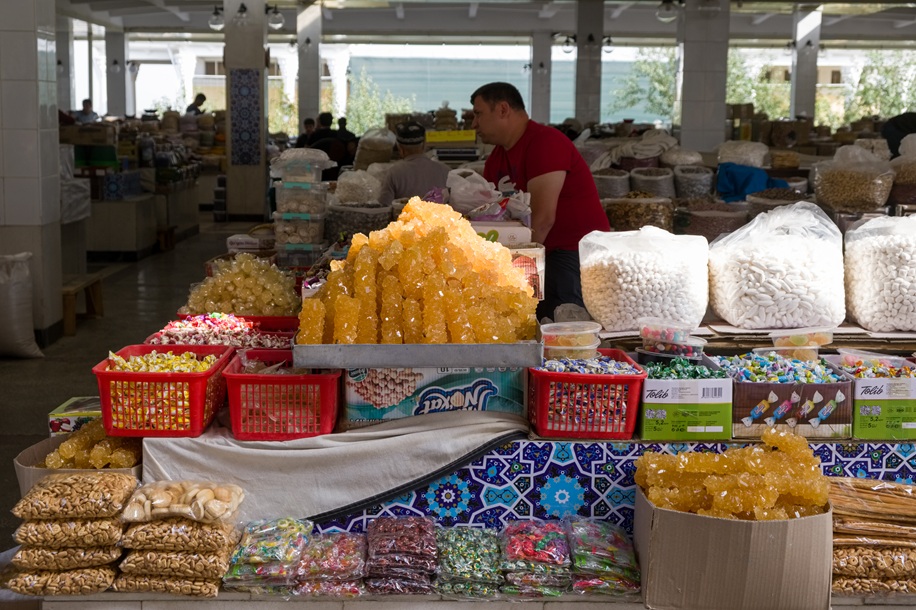
A stall selling dry snacks, candies, and amber-hued nabot (traditional rock sugar)
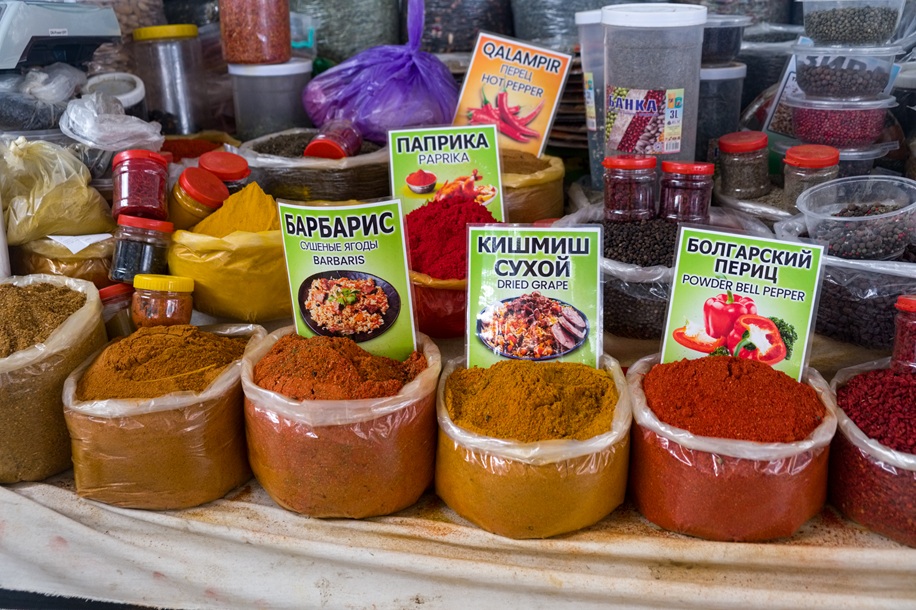
We were most interested in the powdered seasoning and spices
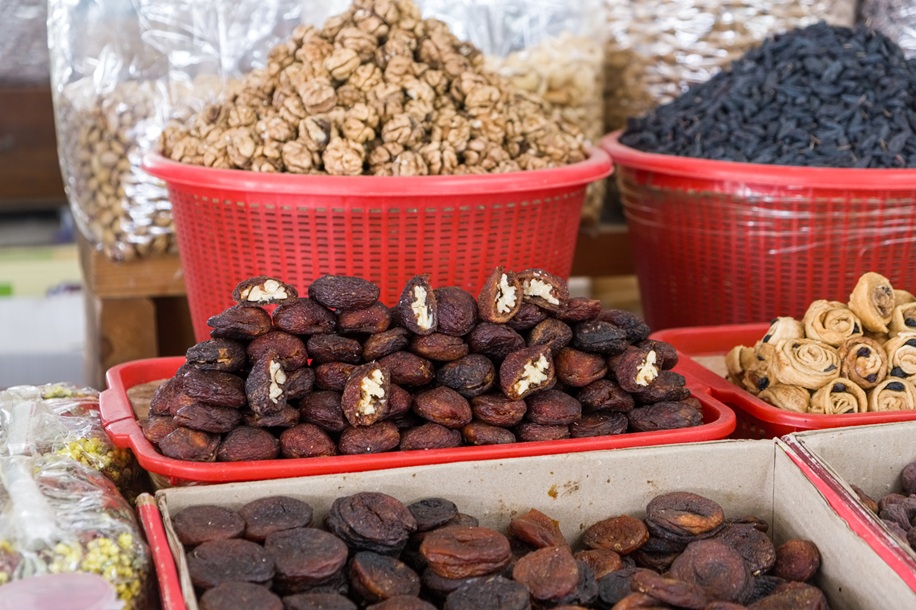
Walnut-stuffed dried apricots made for delicious souvenirs
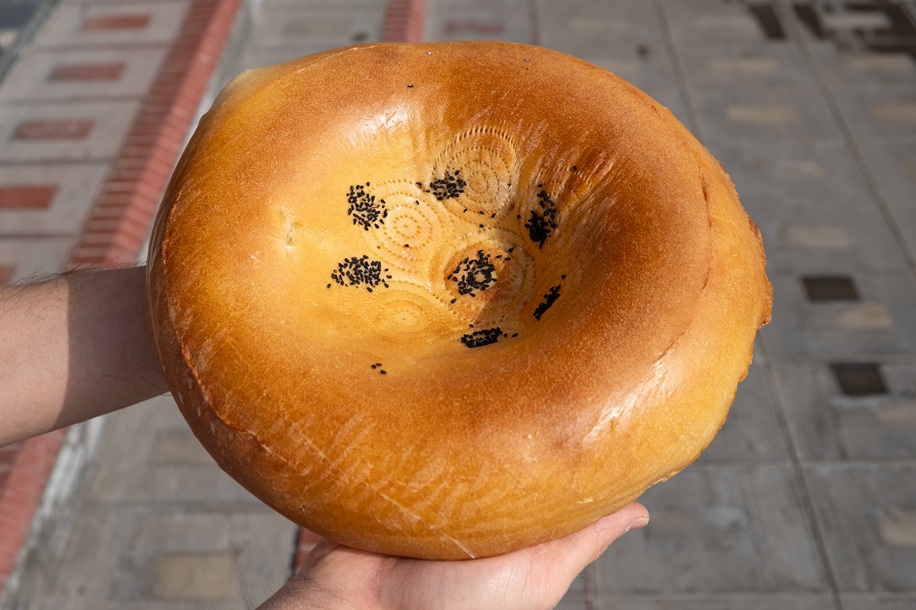
A freshly baked loaf of Samarkand-style non
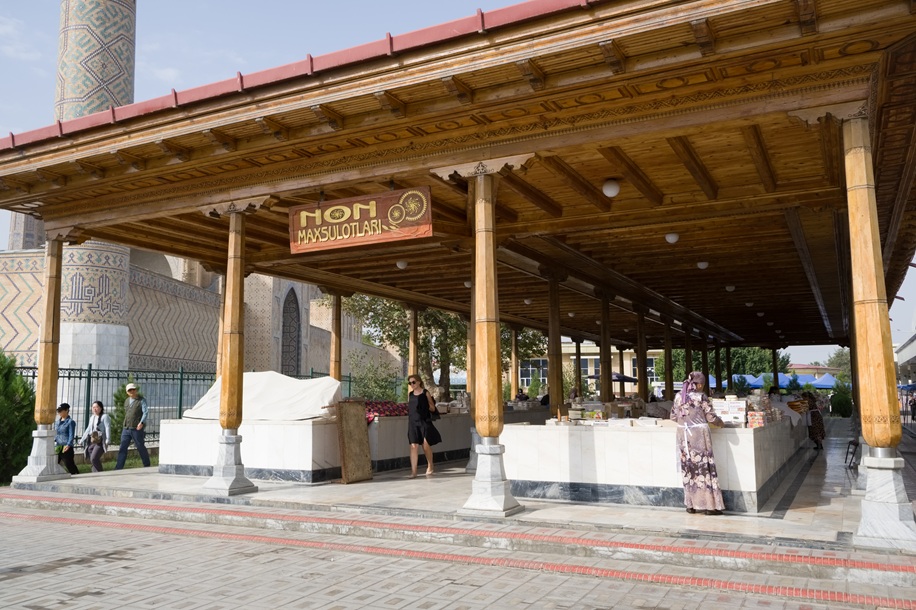
This wooden structure at Siyob Bazaar is dedicated exclusively to non
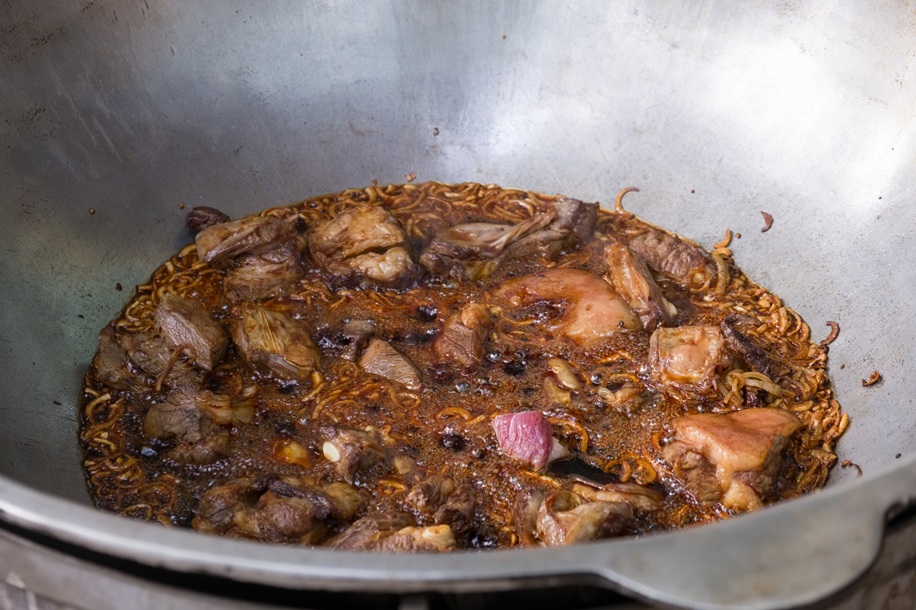
Cooking beef short rib for Samarkand-style plov outside our hotel on Suzangaron Street
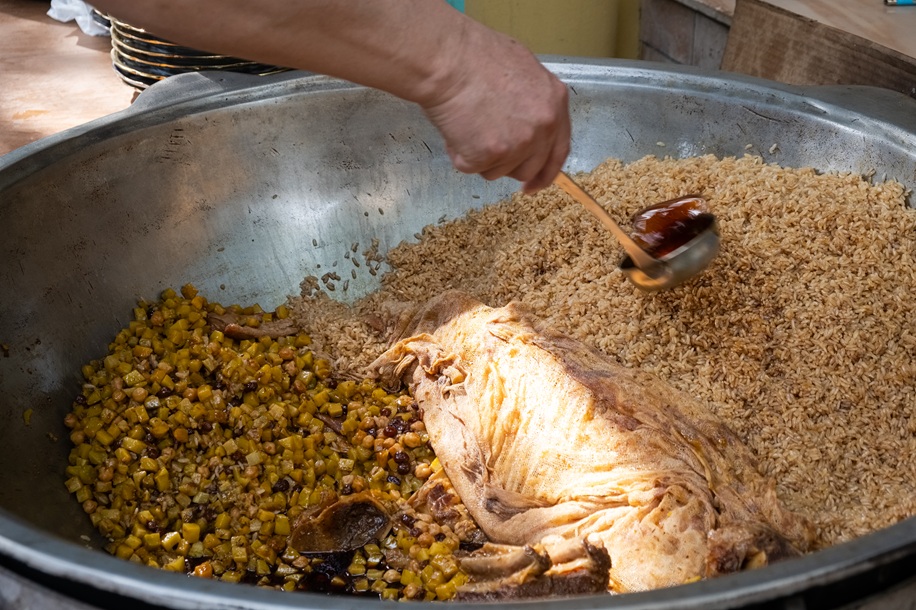
Ladling a spice- and meat-infused nut oil mixture over rice for plov in a large kazan cauldron
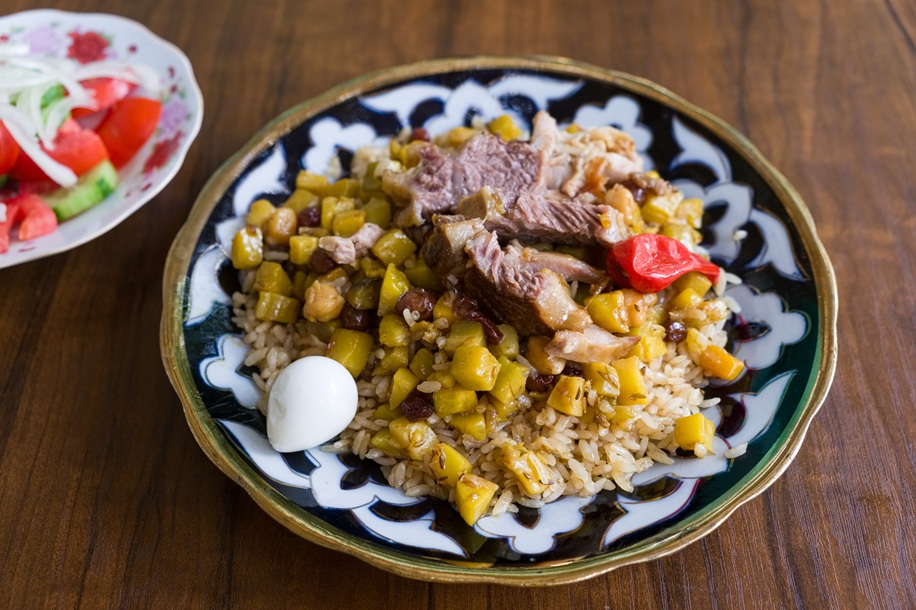
Samarkand-style layered plov, our favorite version of Uzbekistan’s national dish
We couldn’t have picked a better place for our first meal in Samarkand after the high-speed train journey from Tashkent. None of the other plovs we tried in Bukhara, Khiva, or Tashkent over the next two weeks could match this specific preparation of Samarkand-style plov. Every bite was packed with flavor, and we found the perfect pairing in the restaurant’s homemade peach juice, easily better than anything store-bought. As tradition dictates in Samarkand, the various plov ingredients are layered on the plate, with rice at bottom, cooked vegetables (plus caramelized onions; small, fat raisins; and the occasional chickpea) in the middle, and meat on top. I detected flecks of cumin, and we both appreciated the topping of boiled quail egg and a single deep-red chili pepper for added heat.
At first, Bama and I mistook the finely diced yellow carrot as potato, but then we observed the chef chopping up the huge root vegetables while setting out from the hotel one afternoon. “Even guests from Russia say they have never seen it before. It only grows here in Central Asia,” he explained. The chef also divulged a few secrets about his plov: instead of using the more traditional lamb or mutton, he preferred tender beef ribs, and he cooked the dish in an indulgent mixture of three plant-based oils — sesame, walnut, and pistachio.
When we weren’t eating plov or non or local dumplings and soup noodles, we toured more historic sites like Gur-e-Amir, Timur’s elaborate burial place. The grand mausoleum was originally meant for Muhammad Sultan, his heir apparent and beloved grandson. Awe-inspiring as it may be, with acres of glittering gold leaf, a soaring central dome, and intricate honeycomb vaulting known as muqarnas, I found the heavily restored interiors over-the-top and even gaudy. What didn’t help was the fact that we had to jostle with so many other visitors, often in large, noisy tour groups. So much so the atmosphere felt more like a marketplace than a royal tomb, without a trace of reverence for a formidable conqueror who singlehandedly changed the course of history.
While wandering the museum inside the Registan’s Ulugh Beg Madrasa, we came across photos of the richly ornamented ceiling at Ak-Saray Mausoleum, a short stroll from Gur-e-Amir via a series of narrow lanes hidden behind a high, featureless wall. Ak-Saray was built in the 1470s as a family tomb for the Timurid rulers after Gur-e-Amir ran out of space, and its austere facade belies the startling beauty within. The mausoleum’s friendly bearded caretaker offered to record a video on Bama’s phone, and set it on a turntable below the ornately painted dome of the main hall. Compared to Gur-e-Amir, Ak-Saray was blissfully quiet — up until a small but loud Chinese family wandered in after us, their shrill voices echoing off the plastered brick walls adorned in fine mosaics and kundal, a kind of relief painting with layers of gold leaf. Admiring Ak-Saray’s gilded interior shimmering in the late afternoon light, I was glad we’d made the detour.
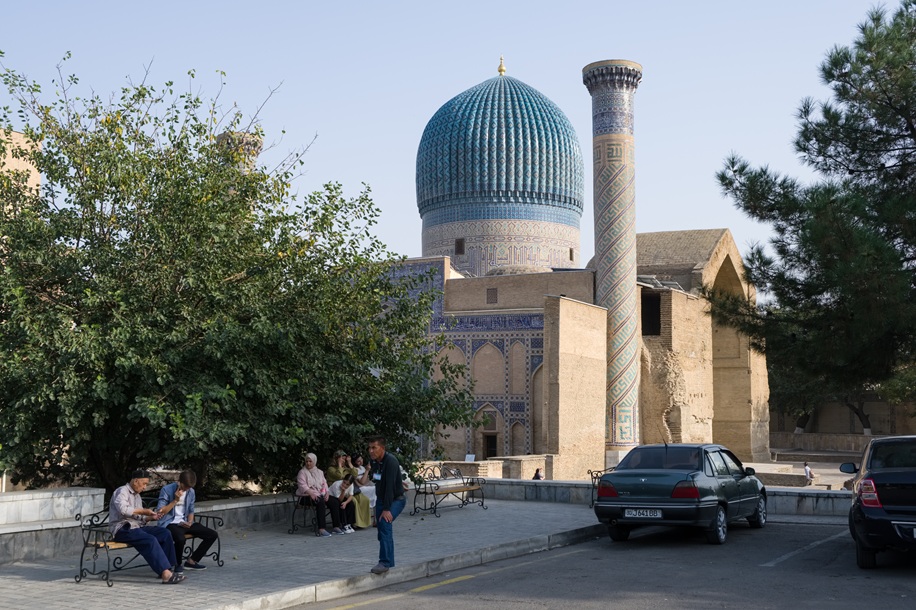
The turquoise dome of Gur-e-Amir, Timur’s mausoleum
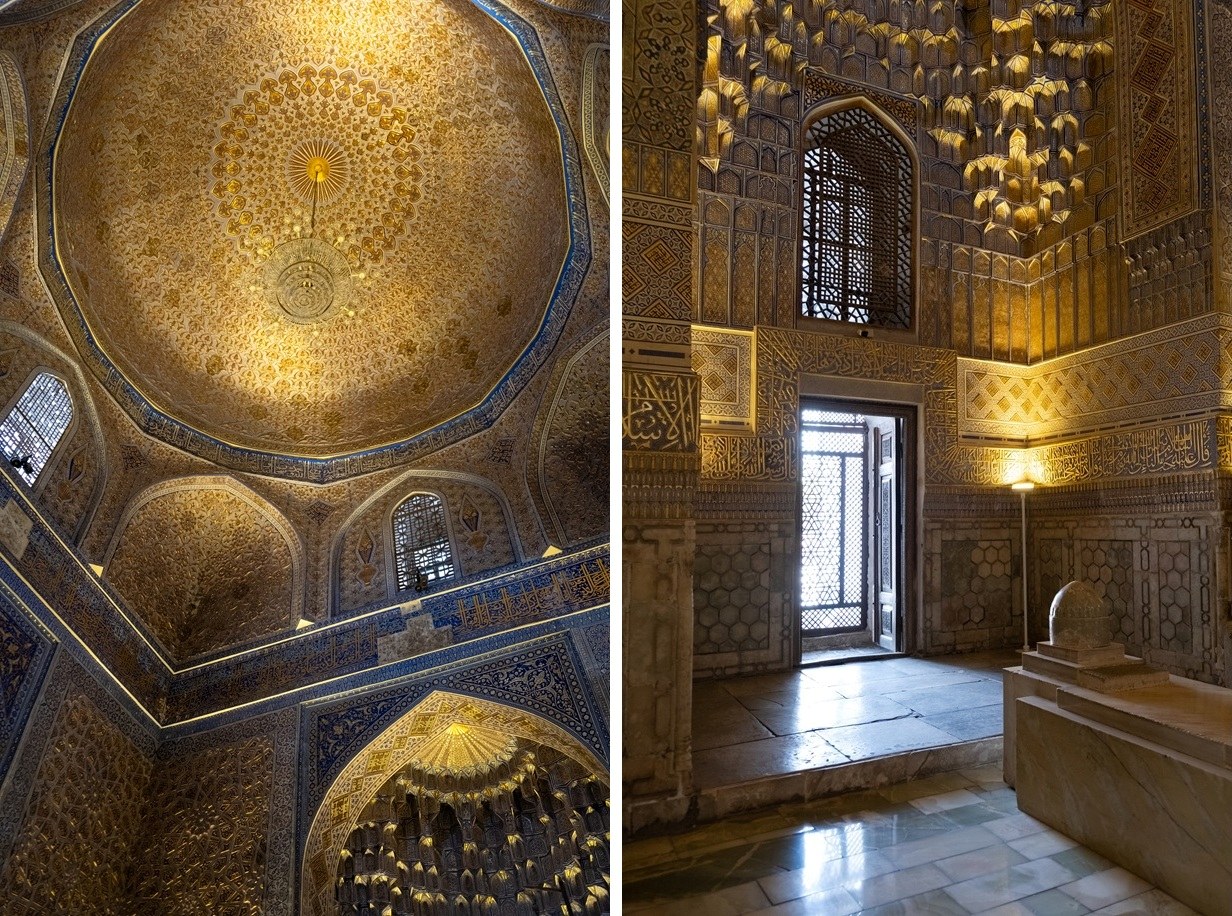
Gold leaf galore inside Gur-e-Amir’s main burial hall
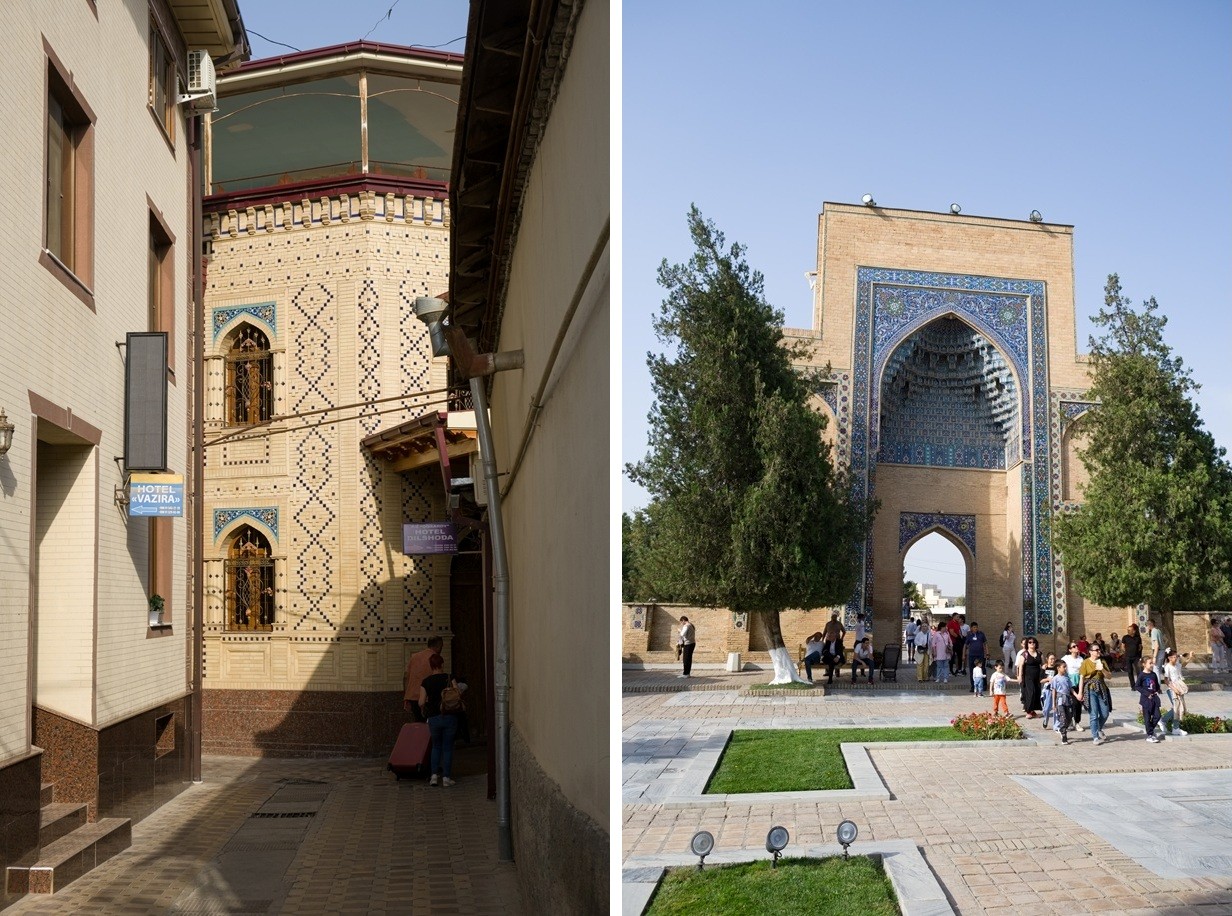
A narrow lane en route to Ak-Saray Mausoleum; the entry courtyard at Gur-e-Amir
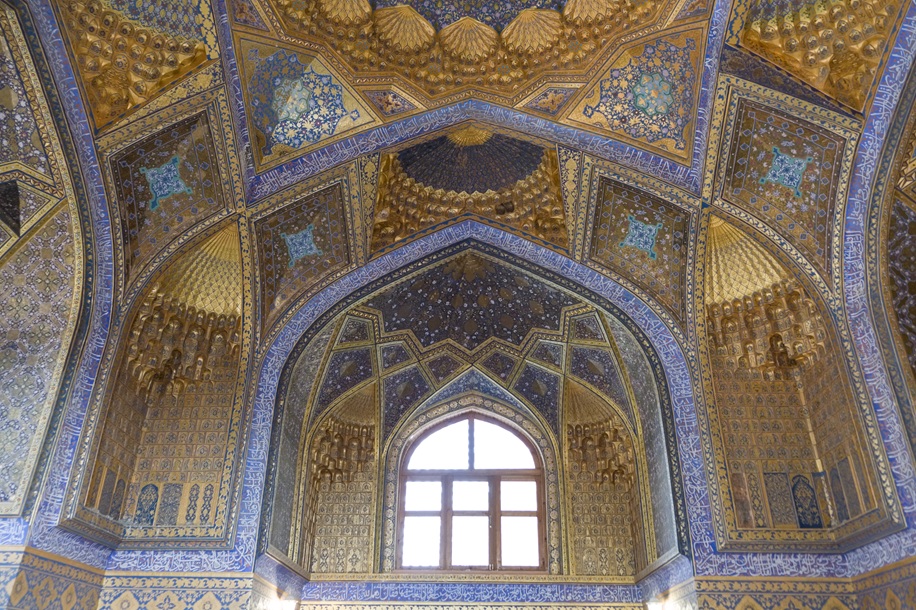
The beautifully restored interior of Ak-Saray draws far fewer visitors
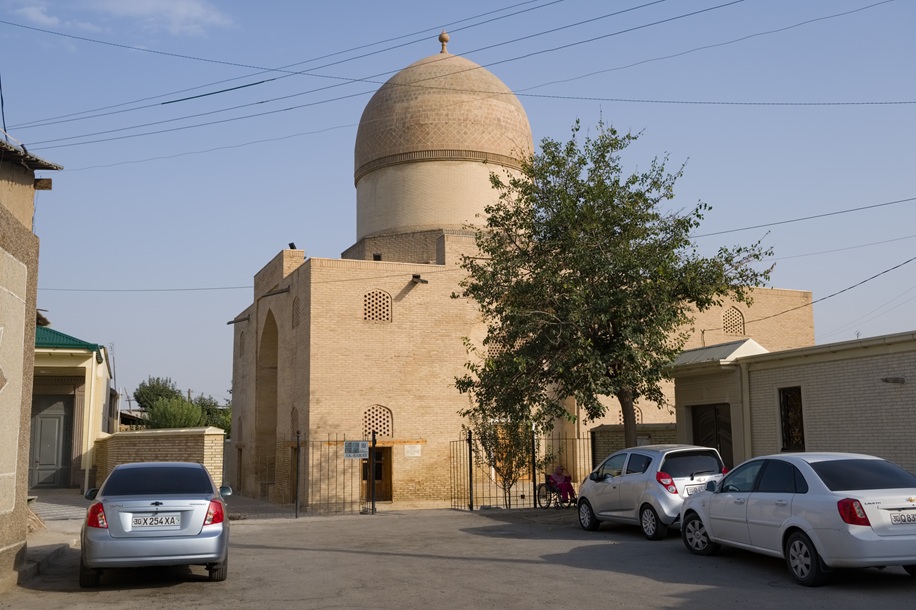
Ak-Saray Mausoleum’s plain brick exterior belies the finery within
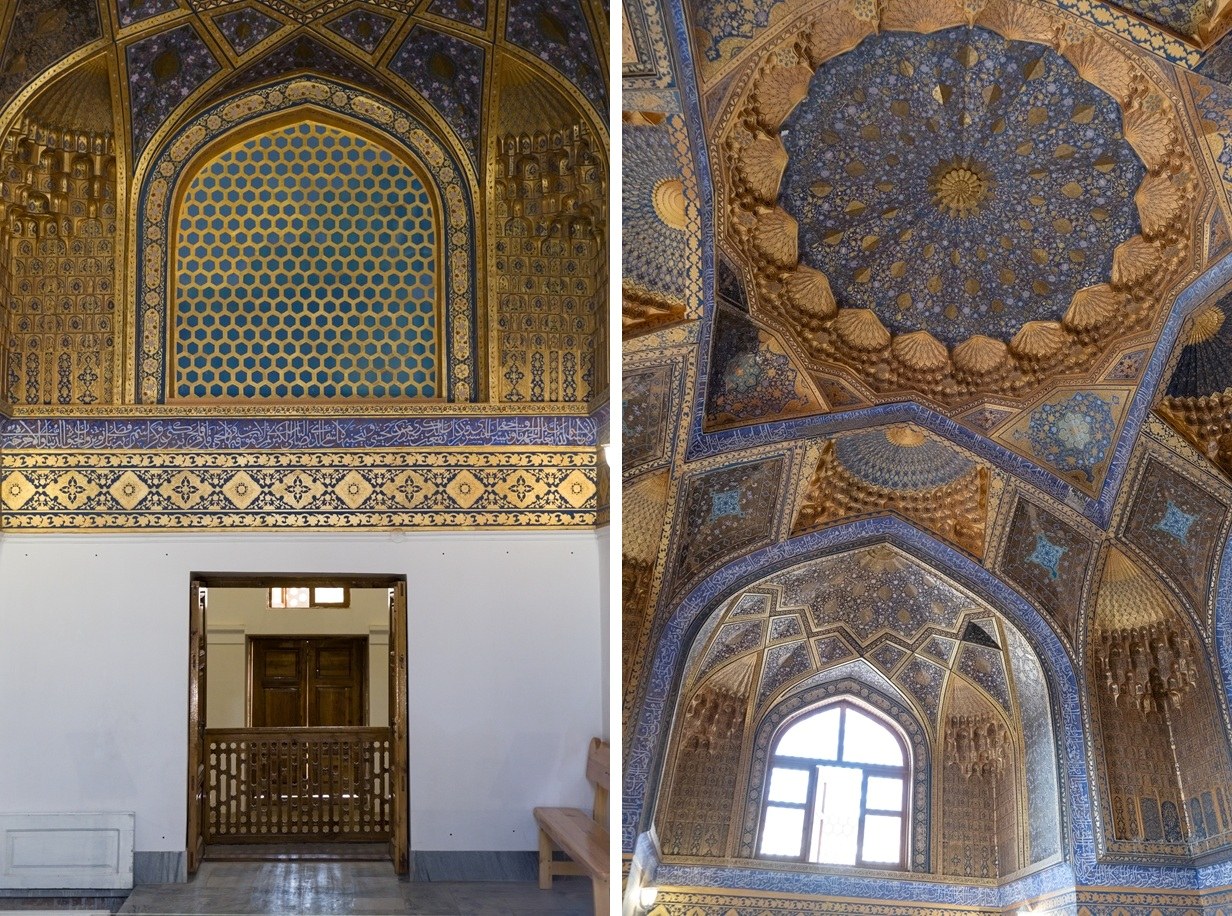
Ak-Saray’s painted gold-leaf walls and vaulted ceilings are a showcase of Uzbek craftsmanship
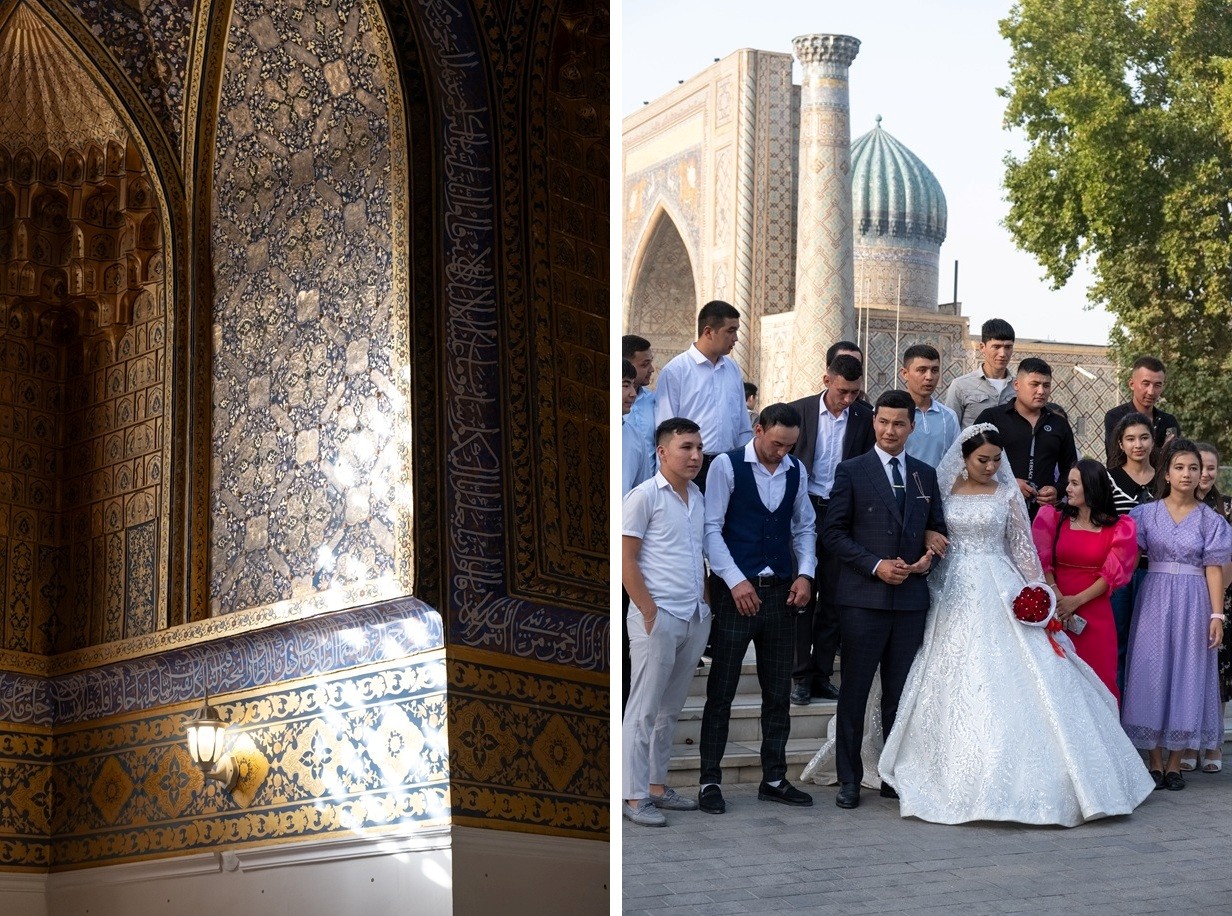
Late afternoon light streaming into Ak-Saray; a wedding party outside the Registan
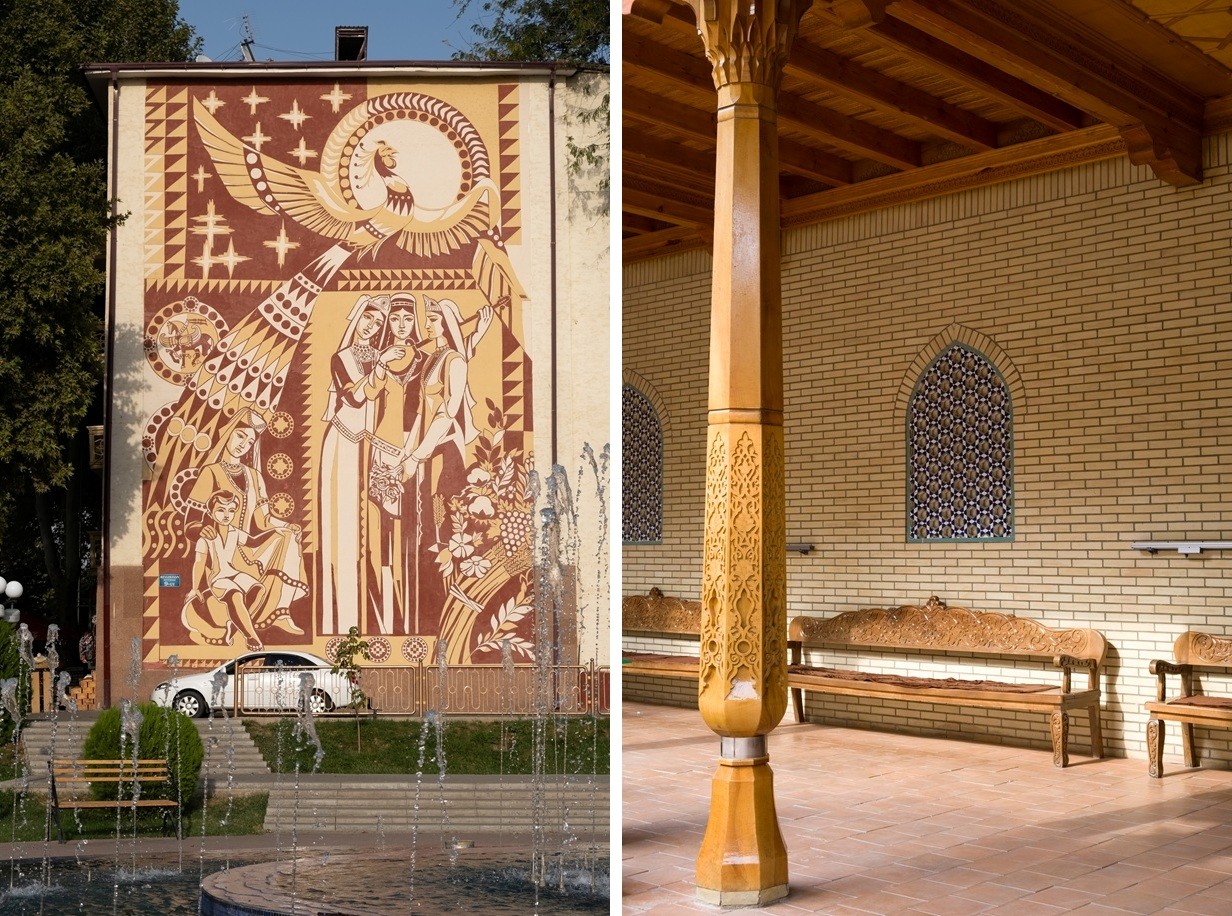
A mural of the mythical Huma bird and figures from Uzbek folklore; at the Mausoleum of Daniel
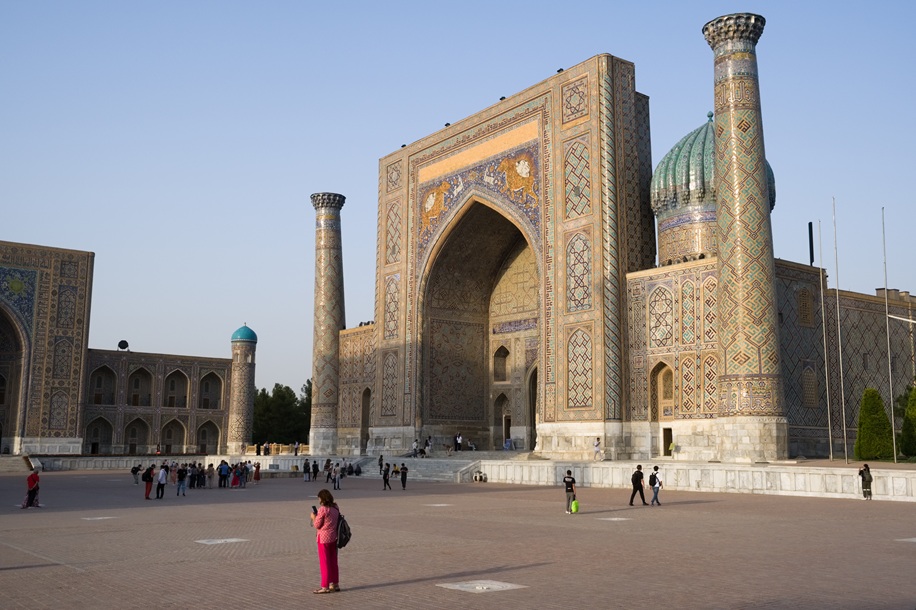
The Registan’s Sher-Dor Madrasa aglow in the late afternoon light
Another day, we hired a taxi to the small museum on the site of Ulugh Beg’s 15th-century observatory, whose foundations were discovered in 1908 by Russian-Uzbek archaeologist Vassily Lavrentyevich Vyatkin. The building was once a circular three-story structure containing a giant stone sextant with a 40-meter (131-foot) radius, partly carved out of an underground trench. Ulugh Beg and his astronomers didn’t just map out the constellations of the night sky; their enormous sextant was so advanced it measured the length of the year to within 25 seconds of its actual value, and determined the Earth’s axial tilt to be an astoundingly accurate 23.5°, two discoveries unmatched in the medieval world.
On the long, leisurely walk back to the center of town, Bama and I stopped for an hour or two at the Soviet-era Afrasiab Museum of Samarkand. It sits on the edge of the Afrasiab Mound, a 220-hectare (543-acre) archaeological site that corresponds to the ancient city destroyed by the Mongols in 1220. The galleries held exhibits like a series of elongated skulls — the clearest evidence of artificial headshaping practiced by Sogdian nobles as a marker of their high social status. Even more striking were the priceless 1,300-year-old Afrasiab murals dating back to the middle of the 7th century, depicting emissaries from different countries seeking an audience with King Varkhuman of Sogdian-era Samarkand. There were Turkic representatives, alongside Tibetan messengers, diplomats from Tang China, and even ambassadors from the Korean kingdom of Goguryeo. It felt strangely apt to stand next to a few Chinese tourists admiring the mural of a Tang empress on a decorative boat and a more faded portrayal of ancient Chinese nobles on a hunting trip.
We also visited the supposed mausoleum of the Old Testament prophet Daniel, who is revered in all three Abrahamic religions. Local residents believe his remains were brought from the ancient Persian capital of Susa following a years-long military campaign by Timur in the 1390s. Legend has it that Susa, despite being weakly fortified, held out against Timur’s powerful army. After repeated attacks failed, religious leaders told him the spirit of Daniel was protecting the city and no assault would be successful. Hearing this, Timur called off the siege and negotiated with the townsfolk to spare their city in exchange for part of the sacred relics to be taken back to his imperial capital.
The stories differ on whether the conqueror transported an arm bone, the prophet’s right hand, or simply a handful of earth from the burial site back to Samarkand. It’s also said that the horse carrying the relics of Daniel stopped outside the city walls and refused to go any further, and a miraculous spring with healing waters gushed forth from the spot where the its hoof struck the ground, just below the slope where the hillside tomb was later built. Bama and I walked past the small domed pavilion containing this holy spring without realizing its significance, and made our way up to the main hall, where the 18-meter-long sarcophagus was covered in a dark cloth embroidered with Islamic calligraphy. To this day, Uzbeks and travelers from far and wide flock here to pray for prosperity, healing, and divine protection.
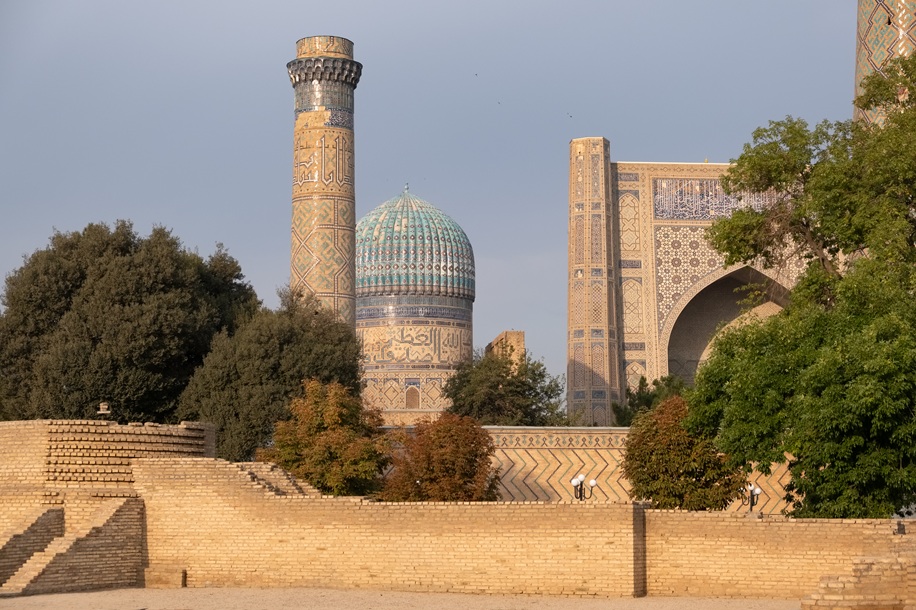
Bibi-Khanym Mosque as seen from the grounds of the Bibi-Khanym Mausoleum
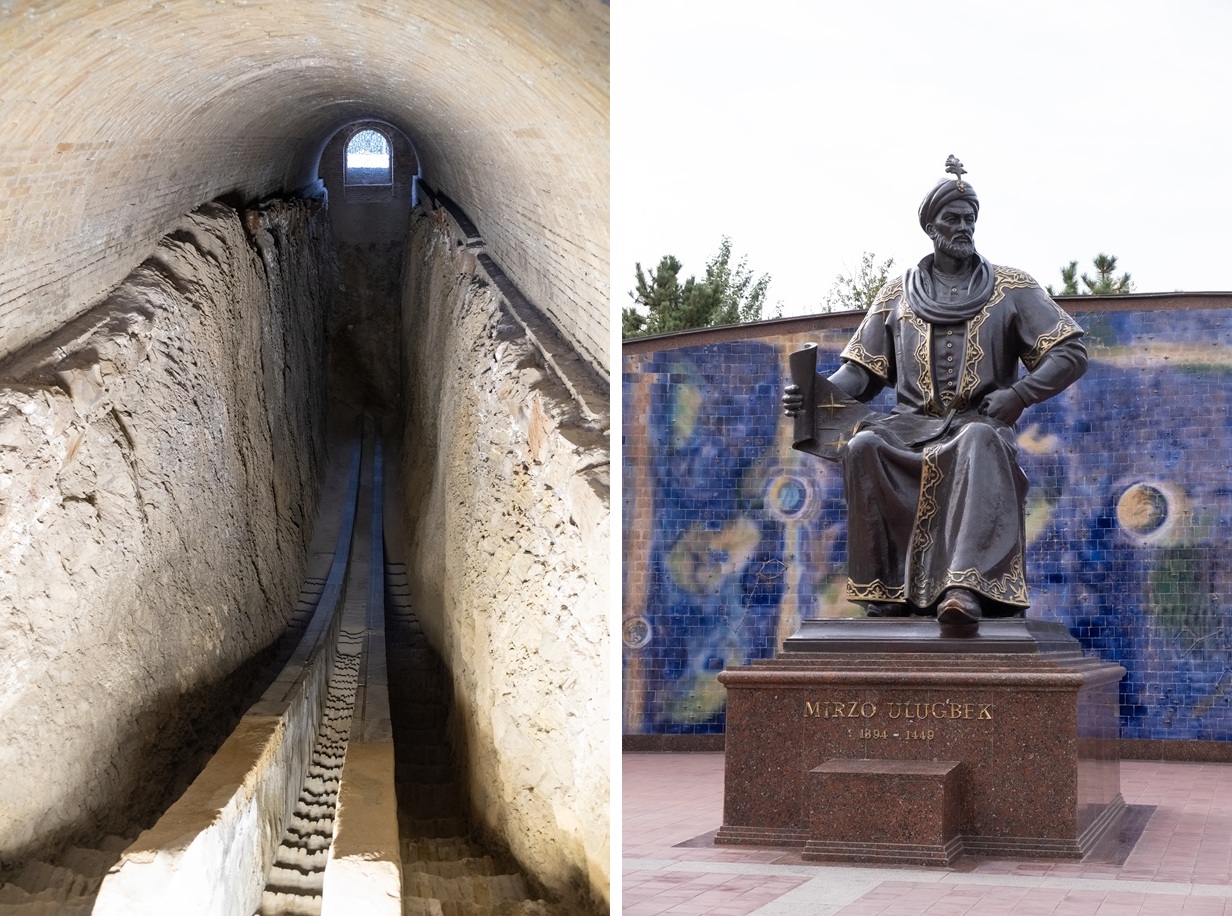
The remains of Ulugh Beg’s observatory, built in the 1420s; a statue of the Timurid ruler
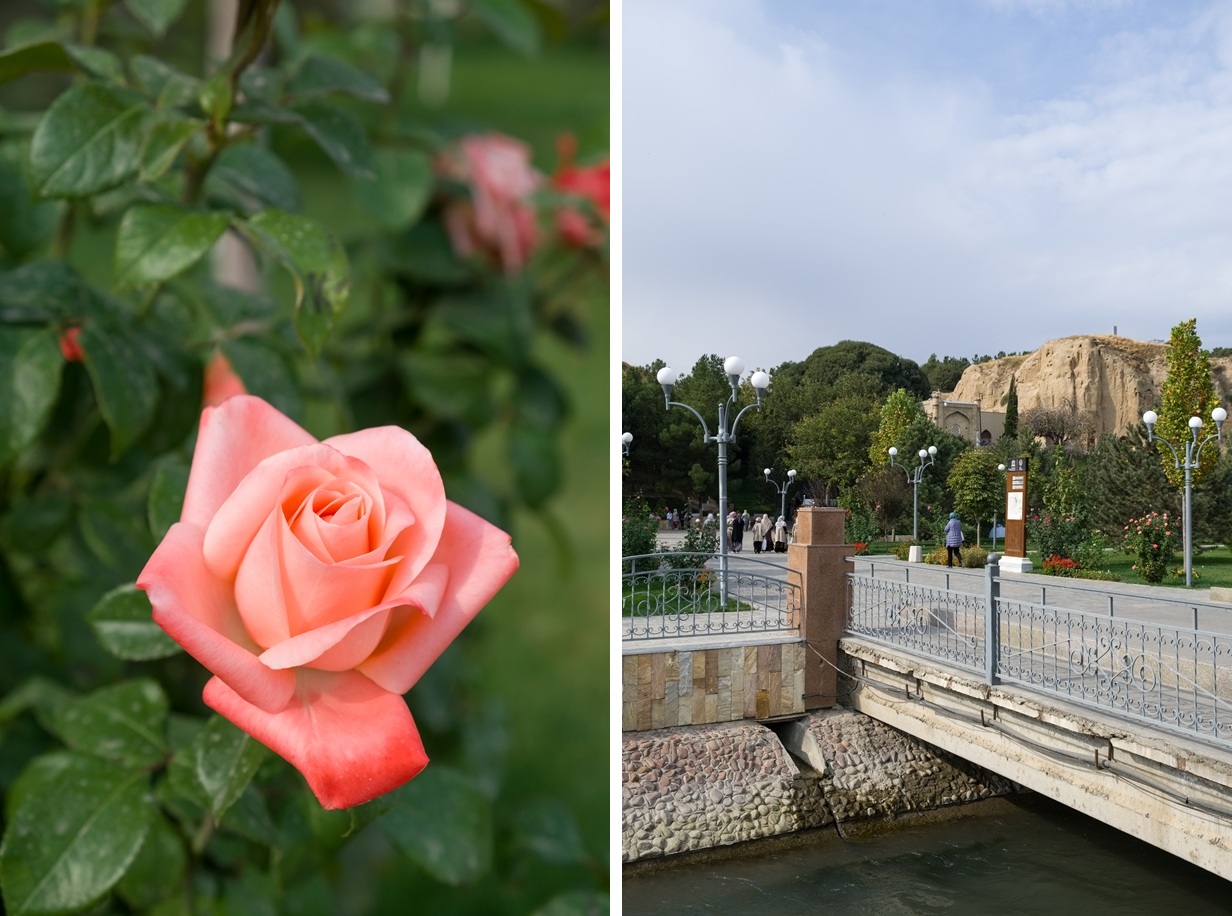
Pretty in pink; approaching the purported Mausoleum of Daniel (the small building above the trees)
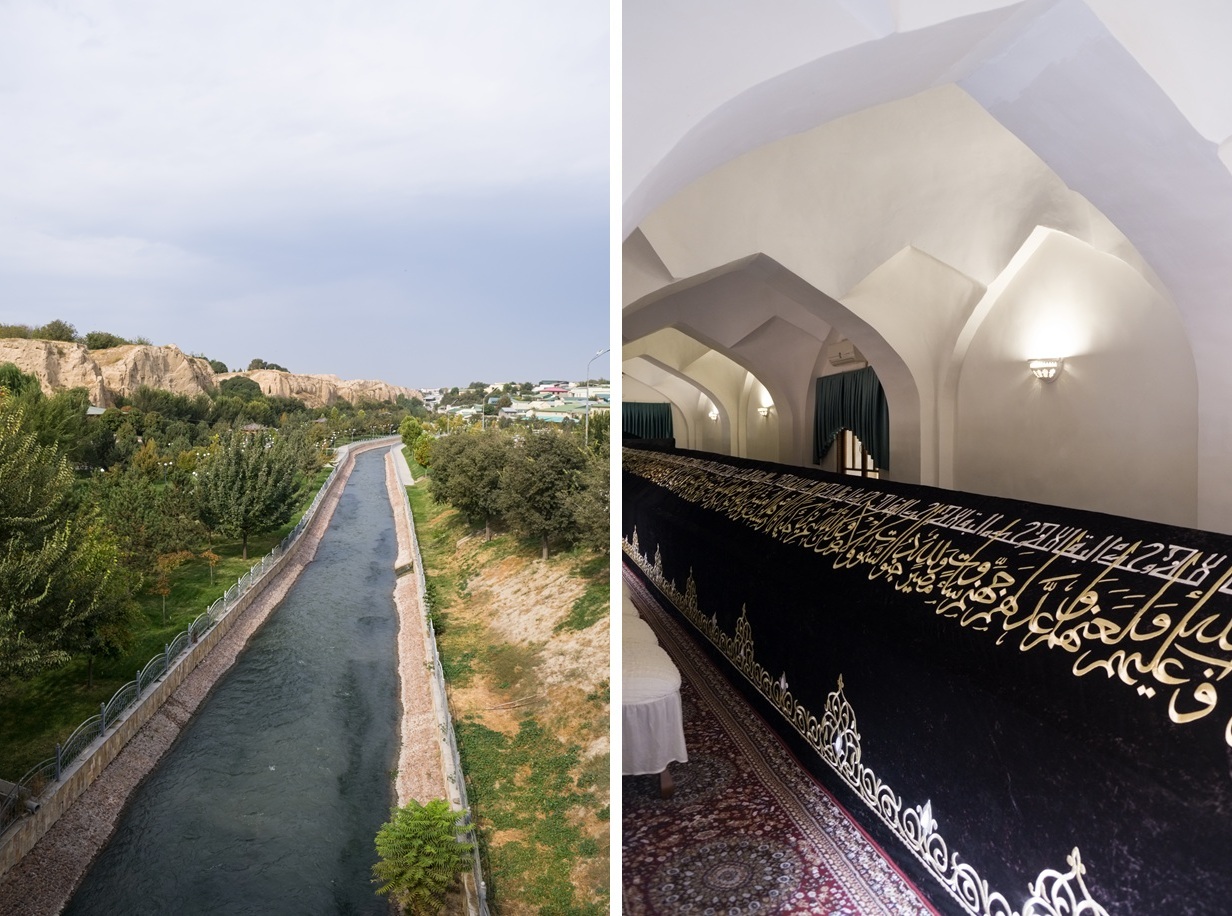
Overlooking the Sieb Aryk river from a high bridge; Daniel’s 18-meter-long sarcophagus
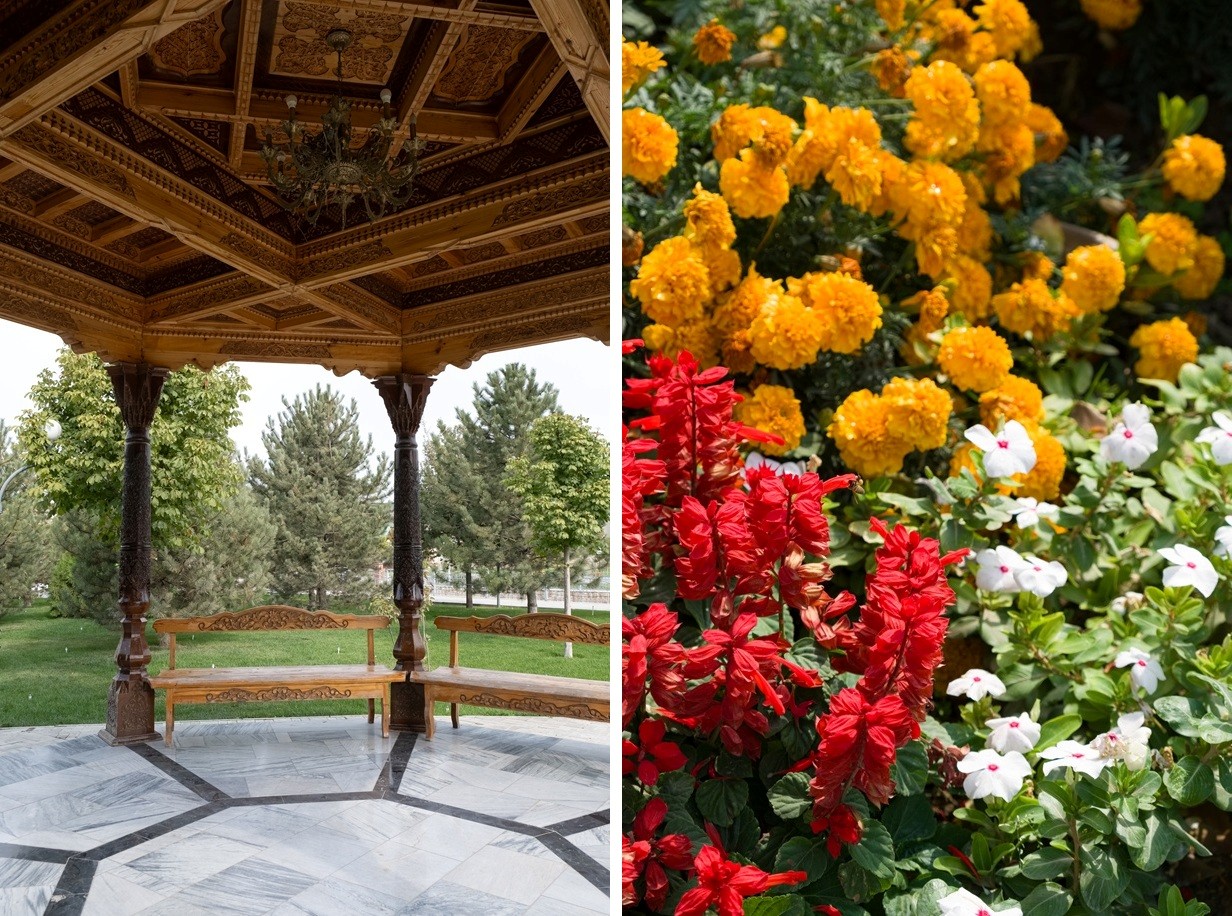
An ornately carved gazebo in a nearby riverside park; autumn flowers
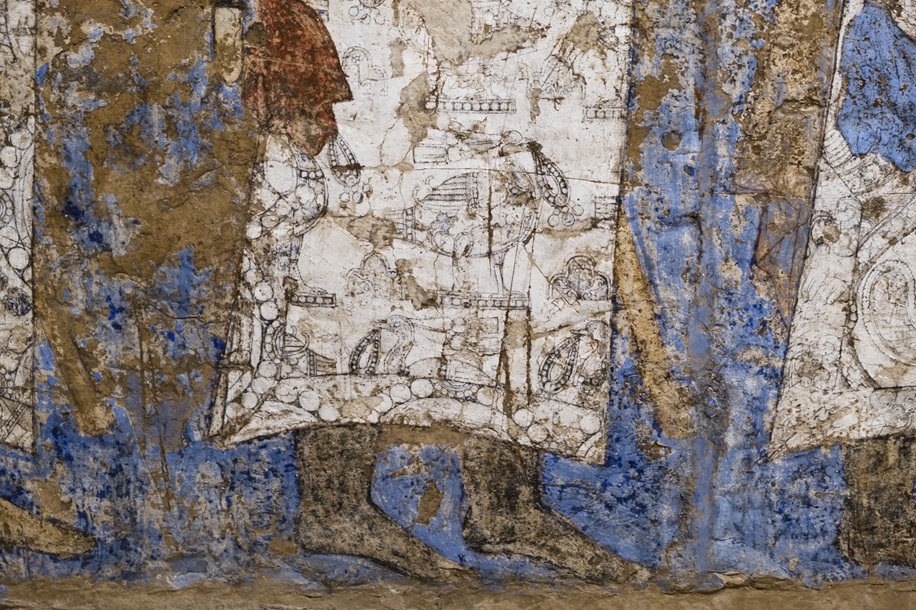
Details of the 7th-century Afrasiab murals at the Afrasiab Museum of Samarkand
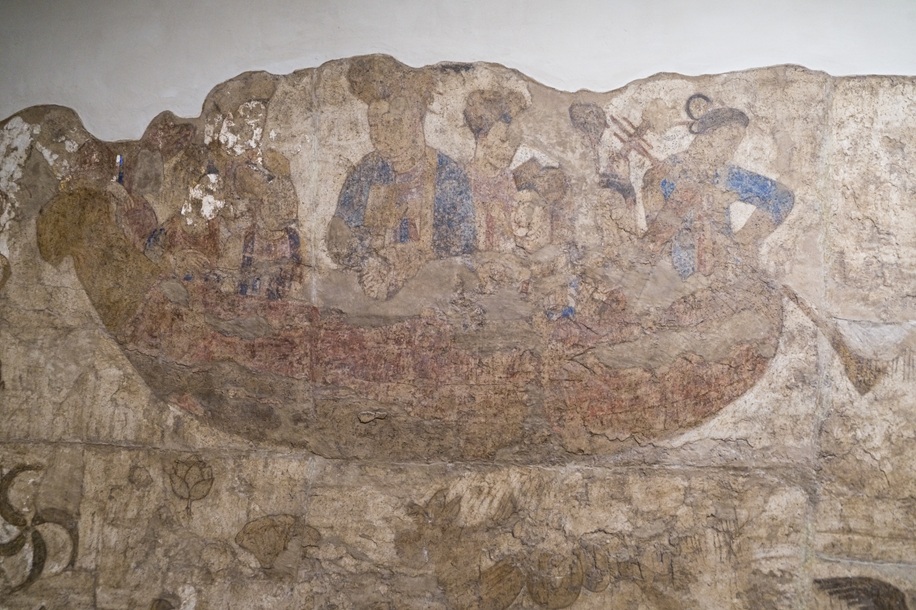
A Tang Chinese empress with her courtiers on a decorative boat
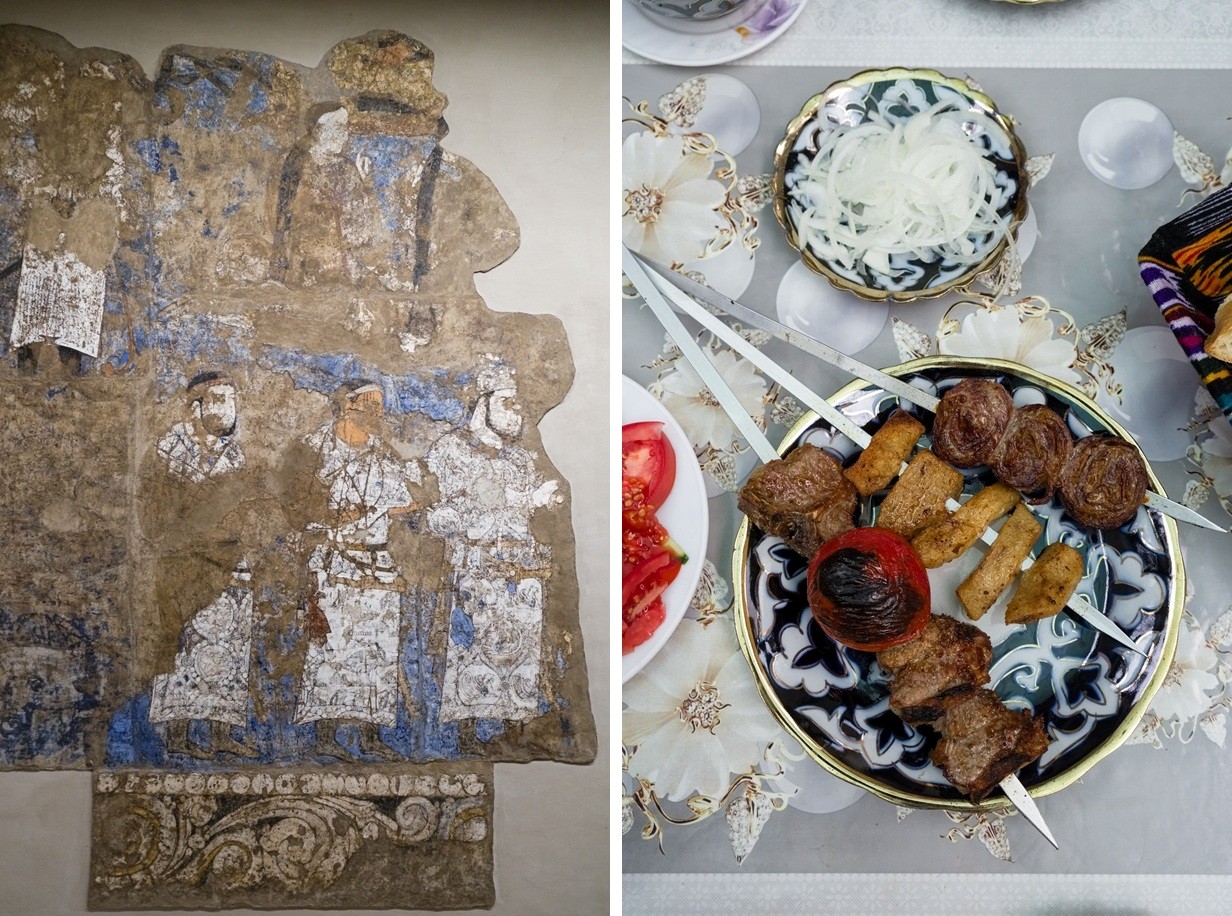
Sogdian-era ambassadors from Central Asia; assorted lamb and beef kebabs at Shokhrukh Nur
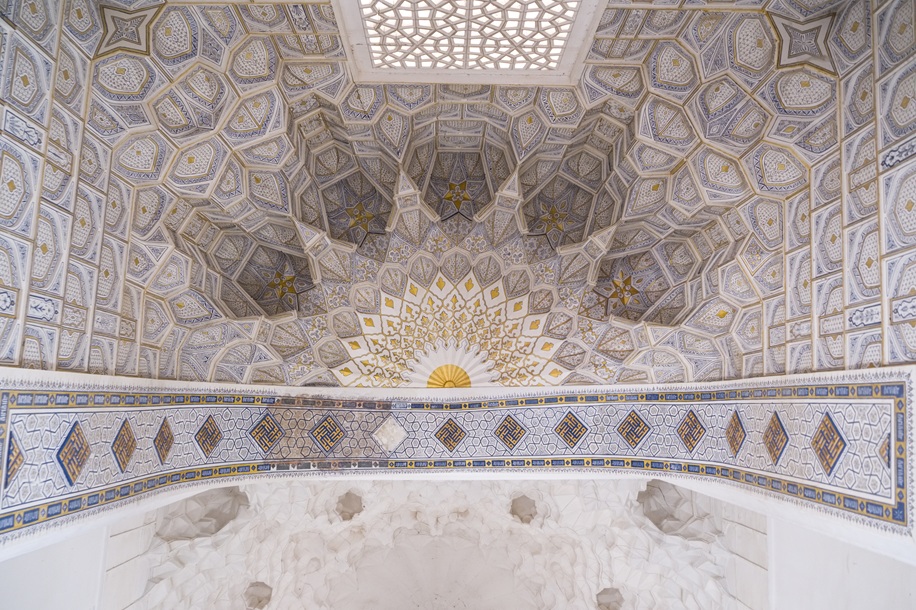
Muqarnas (honeycomb vaulting) at the Bibi-Khanym Mausoleum
There was an unexpected moment that made us chuckle while strolling the promenade along the small Sieb Aryk river not far from the Mausoleum of Daniel. We looked down into the clear water to see a floating, half-eaten non sailing by with the fast-flowing current. Our own loaf from Siyob Bazaar was waiting for us in the hotel room, and despite our best efforts, we only managed to finish three quarters of it in four days. The remainder became too stale for us to consume, but the bread never lost its flavor or enticing aroma.
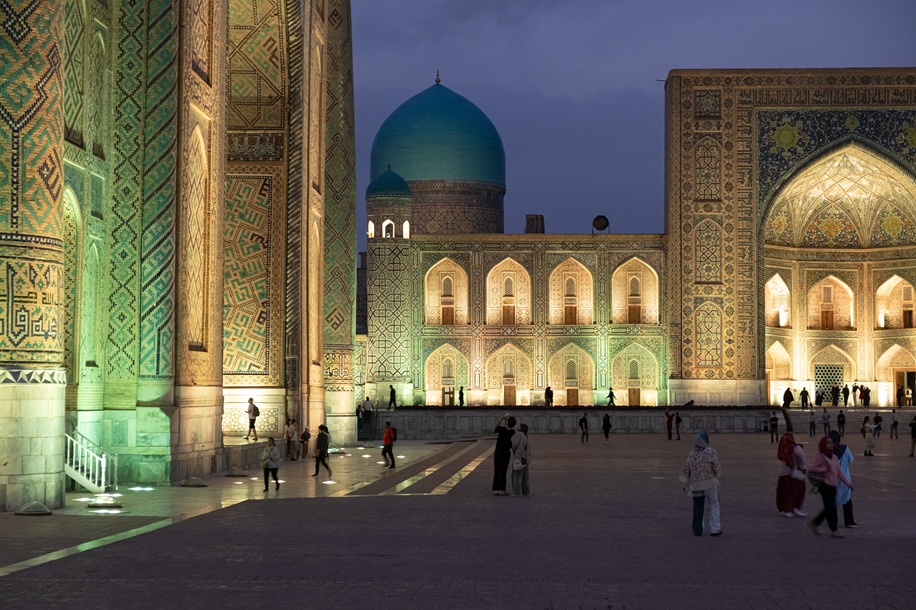
Samarkand proved both a culinary and a visual feast. Between meals, we admired the blue Central Asian sky, the fall foliage, and the shared architectural language of the city’s storied madrasas, mosques, and mausoleums. We strolled past the Registan just after sunrise, when all was quiet and the autumn sun’s first rays cast a soft glow on the Ulugh Beg Madrasa as a caretaker dutifully swept the empty square. Bama and I returned twice before sunset to watch the madrasas’ appearance change with the darkening sky, and see them tastefully floodlit at blue hour while many others sat or reclined on the wide stone steps below the raised viewing platform. We came across several wedding parties and saw moments of tenderness between friends and lovers; the Registan steps and the gardens that flanked them felt like Samarkand’s living room, a gathering place for young and old, locals and tourists alike.
Toward the end of our two weeks in Uzbekistan, Bama and I departed Bukhara before dawn on the nearly seven-hour Sharq train east to Tashkent. We knew we’d stopped at Samarkand more than two hours later when the carriage was suddenly perfumed with the smell of freshly baked non, procured by fellow passengers from two flatbread stalls right on the station platform. Part of me wanted nothing more than to step off the train and spend another few days in this thriving ancient city. ◊
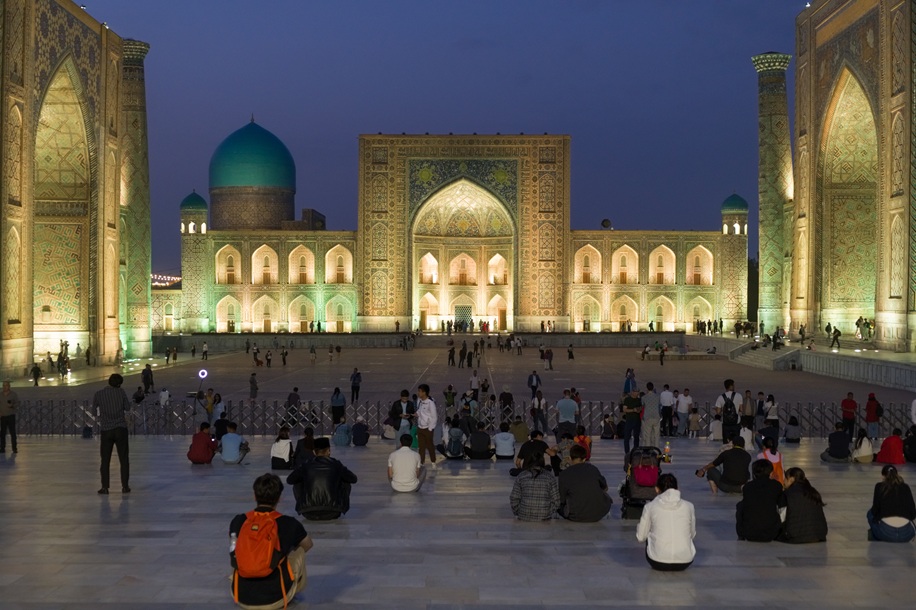
Blue hour one evening at Registan Square
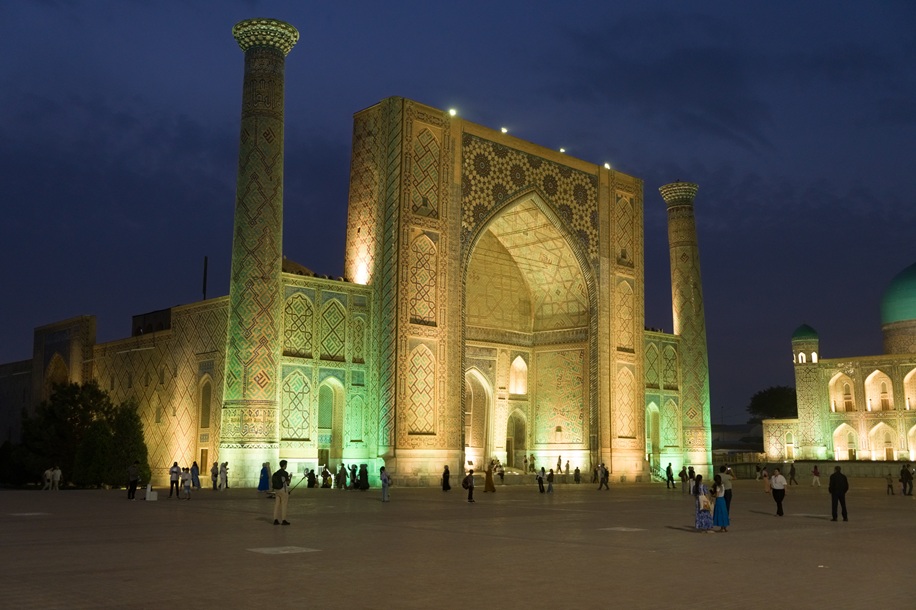
The floodlit Ulugh Beg Madrasa with its leaning pishtaq and curved minaret
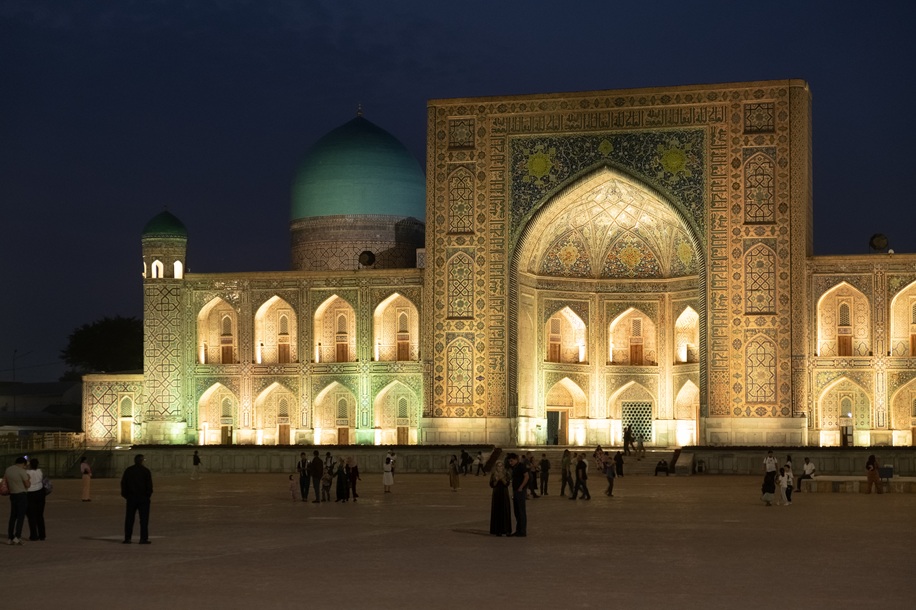
Sightseers below the carefully restored iwans of Tilya-Kori Madrasa
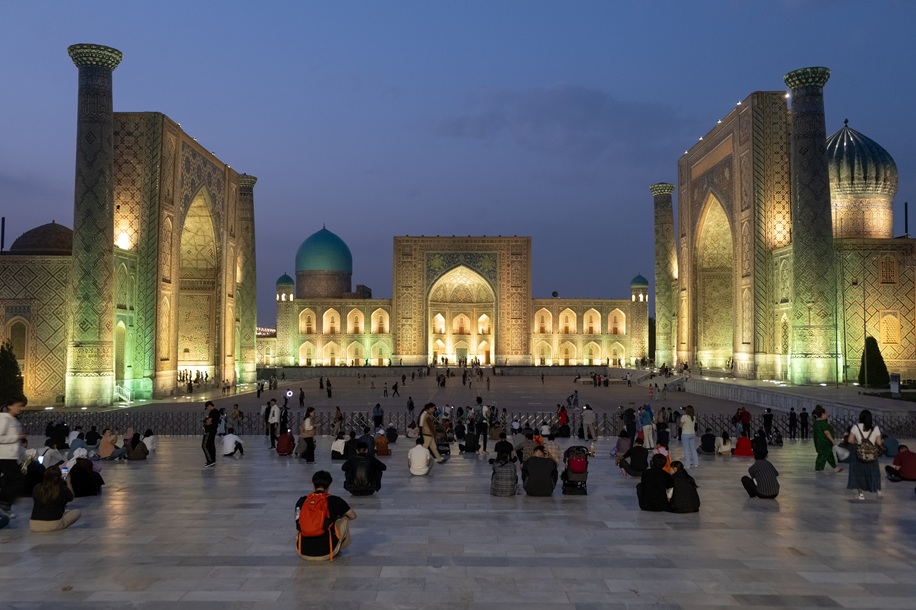
One last look at the Registan
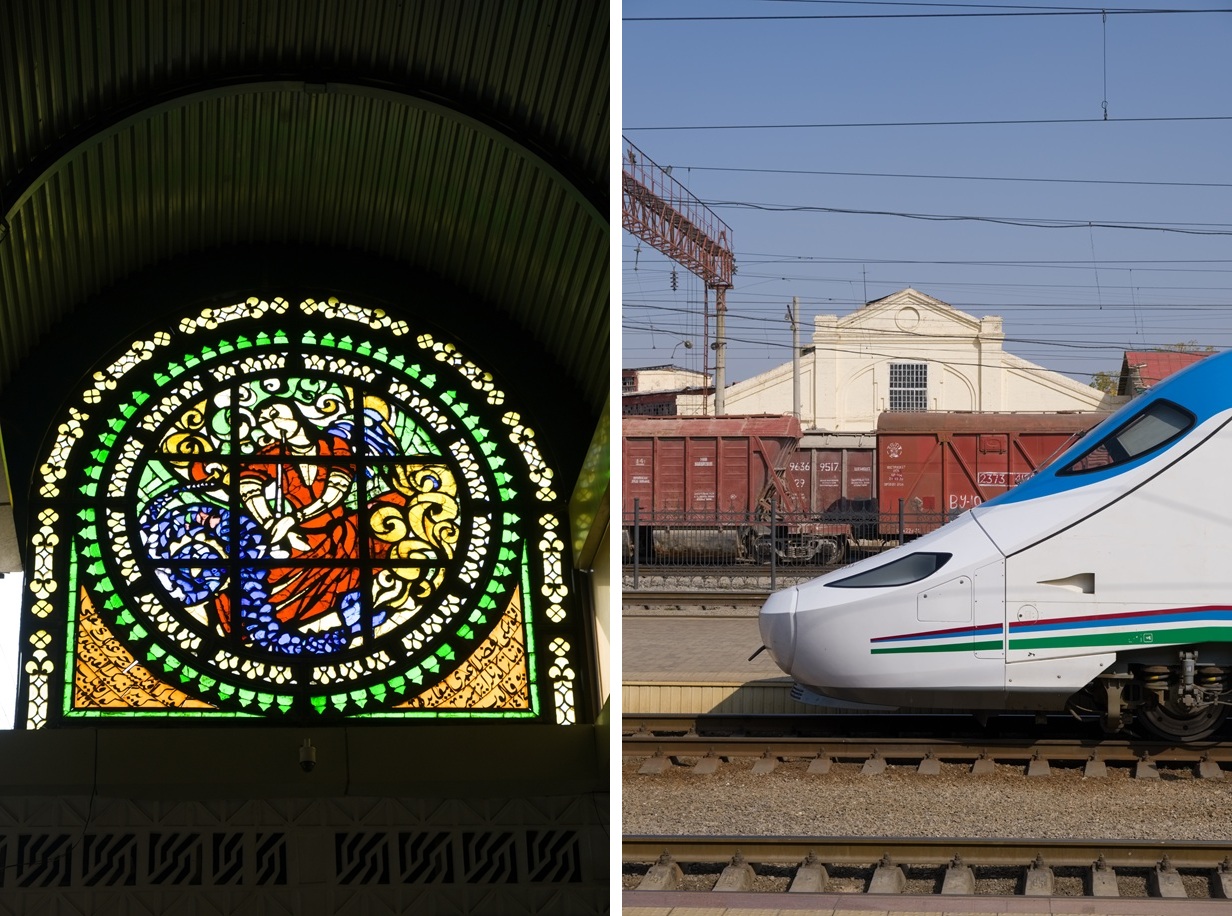
A stained-glass window at Samarkand Railway Station; history and modernity on the tracks
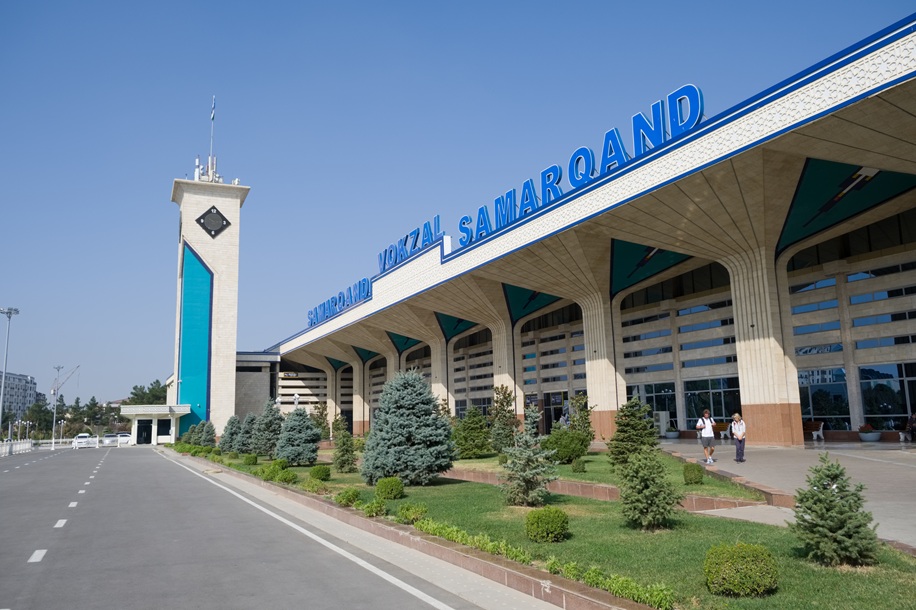
The current Samarkand Railway Station building was constructed in the 1980s
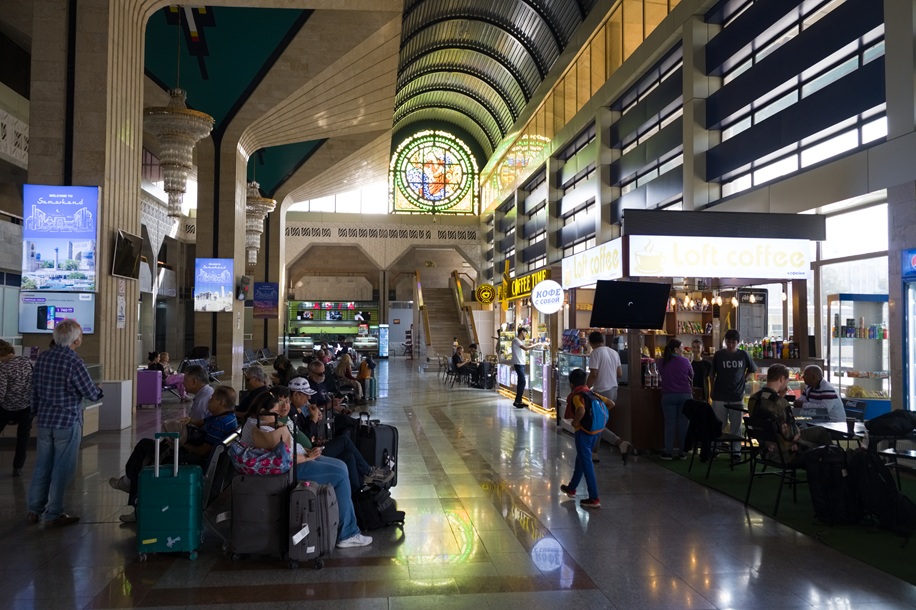
Inside the waiting hall at the station, which has undergone a few renovations
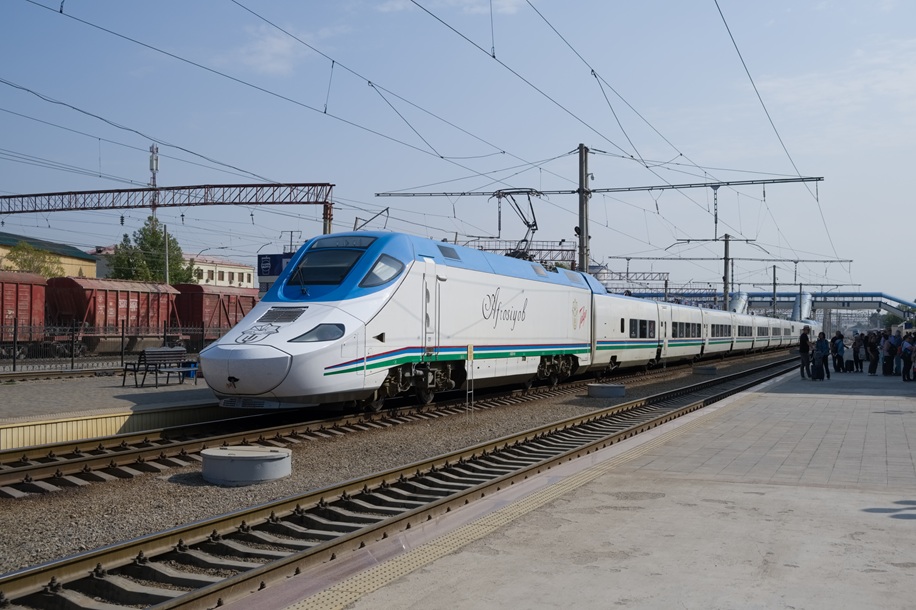
The Spanish-built Afrosiyob high-speed train first launched in 2011
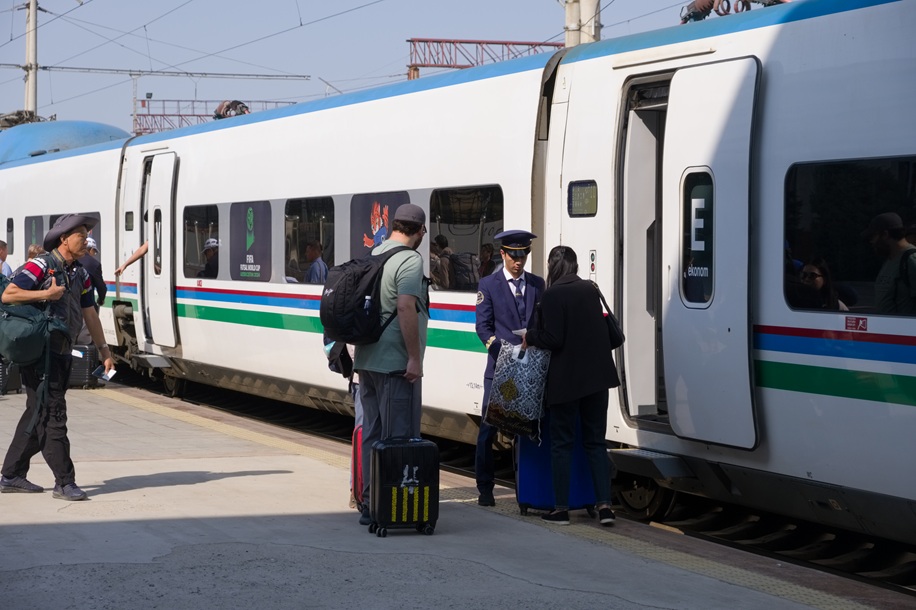
Boarding an Afrosiyob train to Bukhara





A great post, James. It’s fun to read your take on Samarkand and Bama’s, and truly a gorgeous set of photographs. Seriously amazing shots, which makes me want to pack up my bags and see these sights myself!