
An Istanbul Stopover
My first brush with Turkey (now officially Türkiye) happens out of pure necessity. En route to Mexico, Bama and I may be genuinely fatigued after stepping off a long-haul flight, but the idea of holing up in an overpriced airport hotel and doing absolutely nothing is out of the question. Not when we have 20 hours to spare in one of the world’s great historic cities — and the only one to straddle Europe and Asia.
All the while we are on the lookout for the friendly stray felines who are fed and sustained by caring Istanbulites. On the Turkish Airlines flight from Jakarta, we’ve both watched the heartwarming documentary Kedi, which offers a unique cat’s-eye view of Istanbul. Bama is a lifelong cat-lover and he spots one even before we alight from the terminus of the newish M11 metro line. At Göktürk, one of the intermediate stations, my travel companion excitedly points out the nearest window, a big smile spreading across his face. “I just saw a big fluffy cat sitting at the bottom of the escalator!”
Eventually, after traversing a network of underground passageways with stalls selling sesame-encrusted simit and tasty-looking sandwiches, we emerge into the paved expanse of Taksim Square. An empty double-decker tourist bus sits in one corner. The two of us stop in our tracks, amused at the sight of a tuxedo cat pawing at the window from the driver’s seat. Just down a quiet road lies the clean and comfortable two-star hotel where we deposit our backpacks and freshen up before heading out to explore.
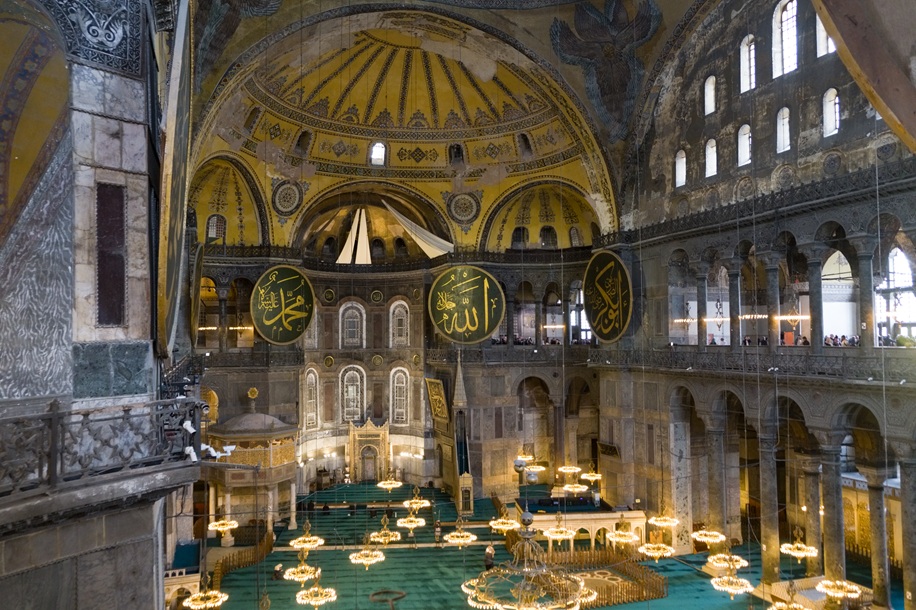
Bama takes me back underground to ride the funicular to the shores of the Bosporus, and then a tram across the Golden Horn to the oldest part of town. We end up petting a few feral cats before circling the German Fountain and the obelisks rising from Sultanahmet Square, built over the site of the city’s Roman and Byzantine-era hippodrome. Our destination is a 55-meter-high wonder I have dreamed of visiting for years. I still remember a tall architecture book gifted by a family friend during my early teens: it had moody black-and-white photos taken inside the Hagia Sophia, shafts of sunlight streaking through the windows below its soaring central dome.
Originally commissioned in the sixth century by Emperor Justinian I — who famously exclaimed that he had outdone the Biblical king Solomon and his temple in Jerusalem — the great cathedral was converted into a mosque following the Ottoman conquest of Constantinople in 1453. Almost 500 years later, the rebirth of Turkey as a secular republic after World War I saw the Hagia Sophia closed to worship to be reconfigured as a museum from the mid-1930s. Restorers uncovered precious Byzantine mosaics for public viewing, creating a unique juxtaposition of Christian and Muslim religious art accessible to everyone. But the landmark was controversially turned back into a mosque in 2020 by Turkey’s longtime conservative president Recep Tayyip Erdoğan, who has drawn plenty of criticism for his increasingly authoritarian tendencies.
We’ve come during a time of student-led street protests prompted by the sudden arrest of Istanbul Mayor Ekrem İmamoğlu, a popular figure widely seen as the main challenger to Erdoğan in Turkey’s 2028 elections. His detainment on corruption charges occurs four days before he is expected to be named presidential candidate for the CHP, the largest opposition party. Coincidence? Nobody in their right mind thinks so — it’s little wonder the more liberal and secular-leaning Turks are angry. Here in Istanbul, we see telltale signs that Erdoğan’s security forces are on alert. High metal barriers erected around the perimeter of Taksim Square limit entry to just a few chokepoints; the occasional armored vehicle and soldiers keep a watchful eye on the comings and goings at Sultanahmet Square. Matching the somber mood are the dreary grey skies and cooler weather (around 16°C/60°F), the virtual opposite of what we will soon experience in Mexico.

A local cat warms to Bama; Firuz Ağa Mosque, just off Sultanahmet Square
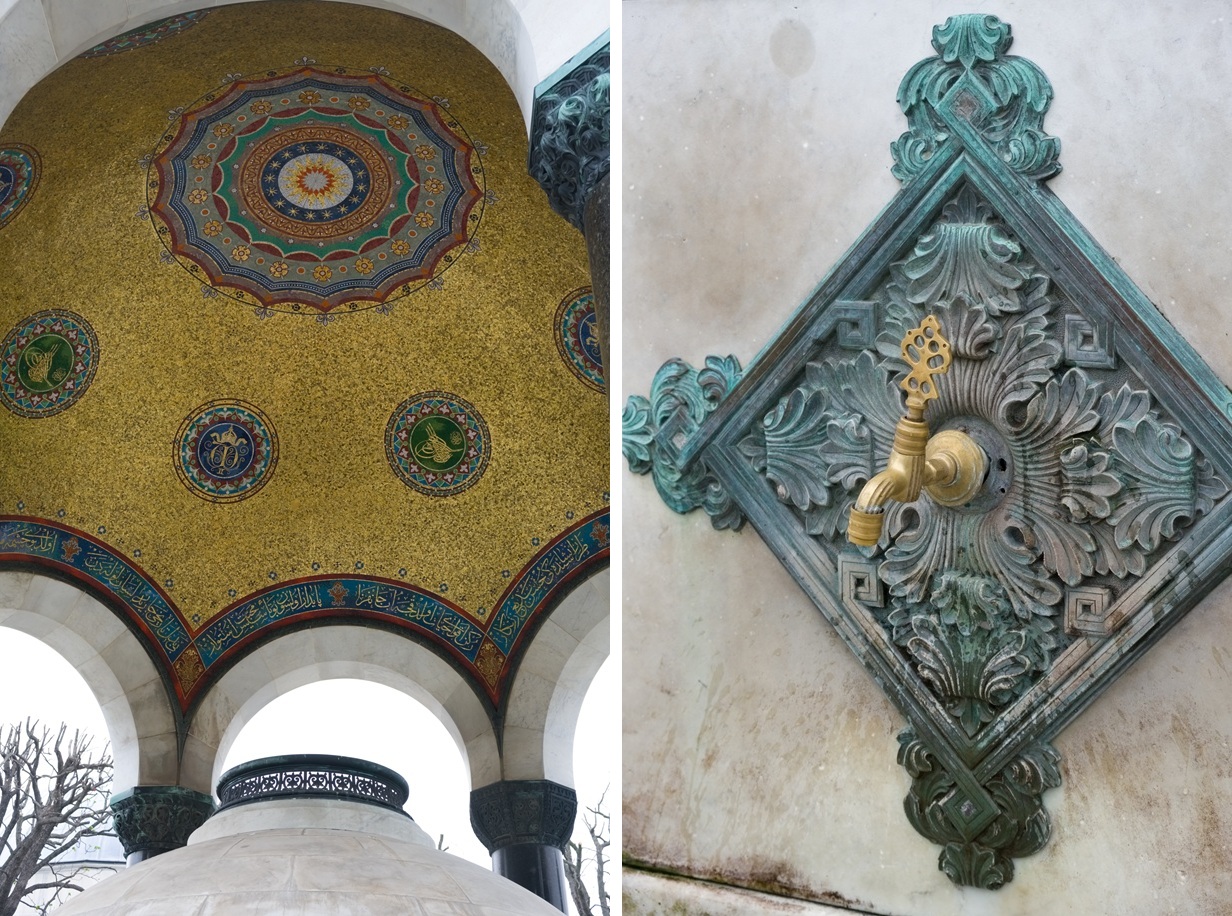
The intricate mosaic ceiling and a faucet at the German Fountain

Built in 1898, the drinking water fountain is on Sultanahmet Square
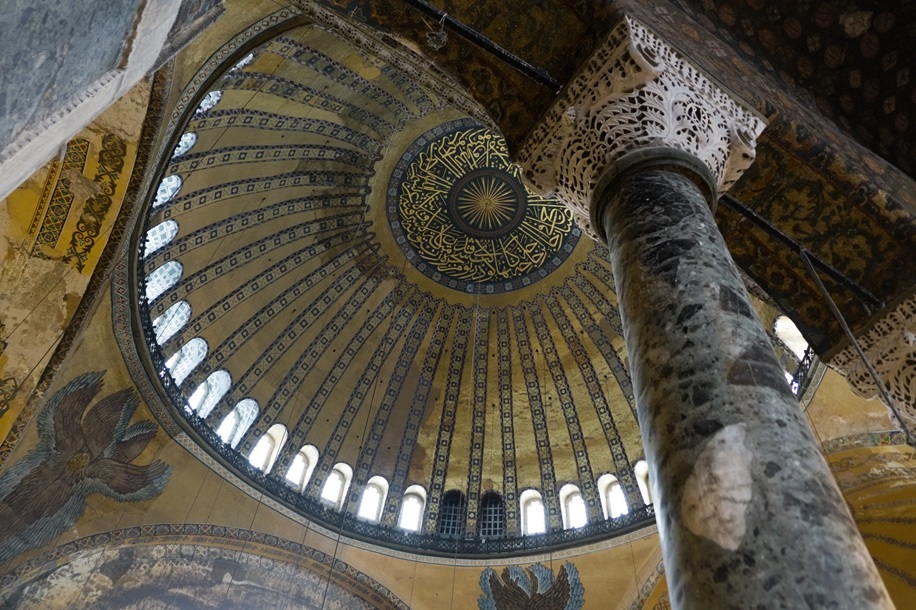
Looking up into the massive dome of Hagia Sophia

A ninth-century mosaic of Christ flanked by Emperor Constantine IX and Empress Zoe
At Hagia Sophia, scaffolding shrouds a part of the facade; one of its four pencil-like minarets has been partly dismantled for seismic strengthening and reconstruction. We join the slow-moving line for walk-in tickets and are entertained by two cats yowling and staging a faceoff over their territory. Bama and I are shocked at how eye-wateringly expensive admission is: we pony up 99 euros (112 U.S. dollars) for two, including entry to the Hagia Sophia History and Experience Museum on nearby Sultanahmet Square.
Perhaps it is the tiredness talking, but I am resigned to the reality of pressing crowds and long lines, of strict checks and door frame metal detectors up ahead. We’re asked to open our camera bags, deposit them in a tray with our phones and wallets, and put everything through an X-ray machine. It feels a whole lot like airport security. I can’t help but start to wonder — what if Hagia Sophia is one of those places that just looks better in books and pictures? Ultimately, my fear of the place being a huge disappointment proves unfounded. I follow Bama up a series of wide, well-lit ramps leading to the upstairs gallery to catch my first glimpse of the building’s magnificent interior. It fills me with awe. This Byzantine masterpiece has stood for nearly 1500 years through wars, earthquakes, and other calamities. It took the rulers of Western Europe almost a millennia to build a bigger church; only in the mid-16th century was Hagia Sophia eclipsed by Spain’s Seville Cathedral.
Anyone who was here before Covid will immediately notice the sweeping changes to the visitor experience. Since the building’s recent reconversion into a mosque, the ground floor has become off-limits to foreign travelers. Dress codes apply to everyone: shoulders, arms, and knees must be covered, and all women are asked to don a headscarf before entering. Non-Muslims can only tour the U-shaped gallery, which is so extensive it accommodates us all without feeling cramped, except in places where people gather to admire the shimmering Byzantine-era mosaics. Bama tells me this is a part of the building he hasn’t been to before. His previous visit in 2013 involved shepherding a group of coworkers who were far more interested in shopping than history and architecture.
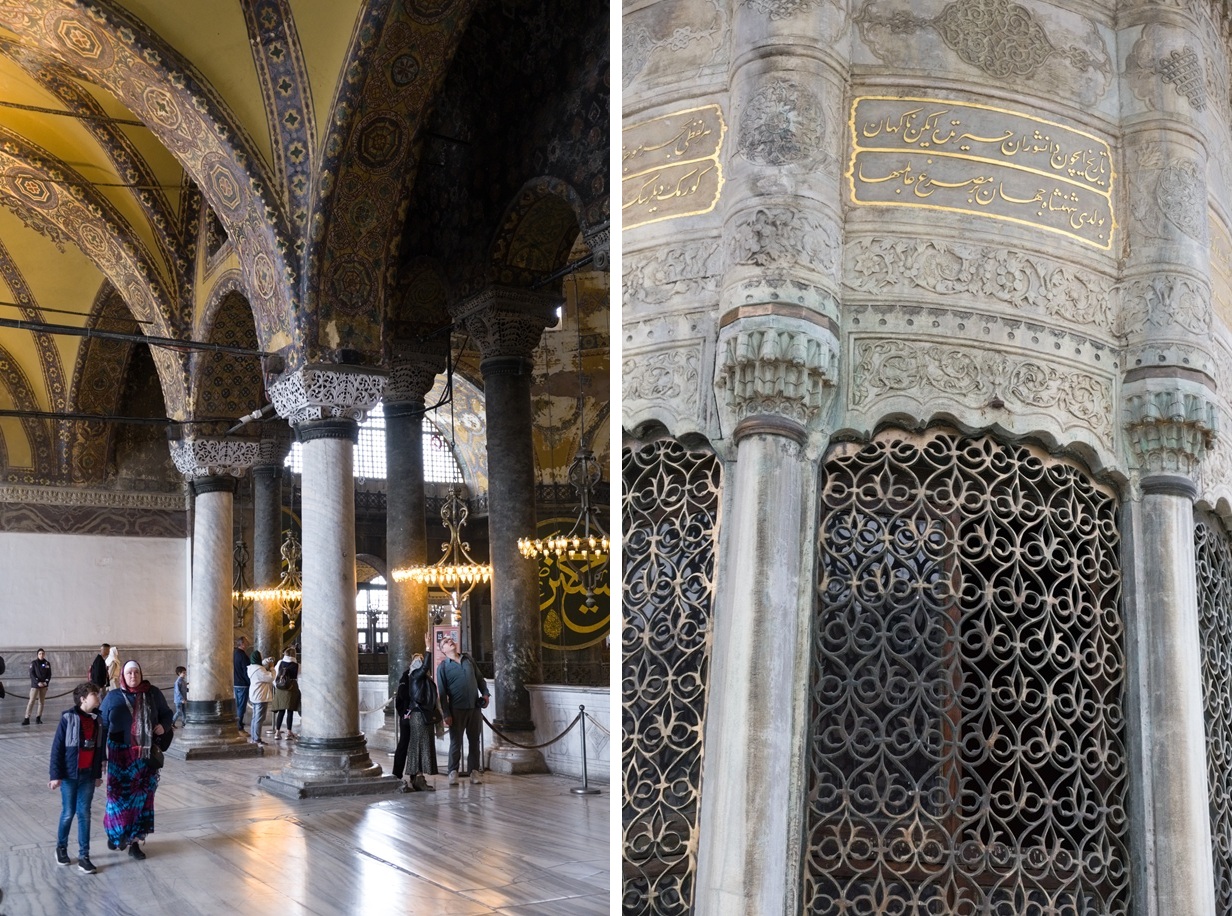
Columns in the upstairs gallery; details on an Ottoman ablution fountain outside

The 12th-century mosaic of the Virgin and Child with Emperor John II and Empress Irene
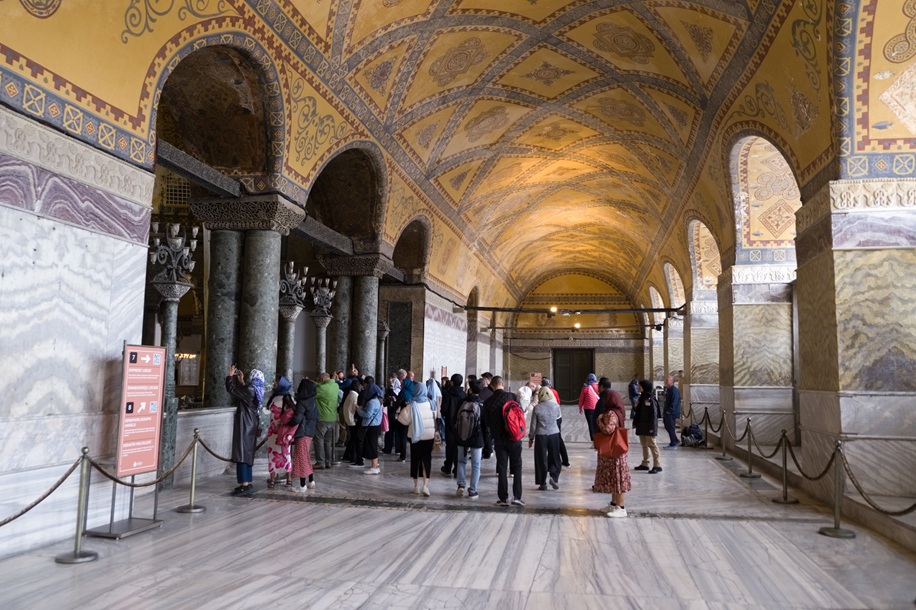
Looking down the vaulted, marble-floored West Gallery

A closeup of the West Gallery’s painted ceiling

The awe-inspiring interior of Hagia Sophia, which was originally completed in 537
Nor does Bama recall seeing the famous 10th-century mosaic in the lunette of the southwest vestibule near the exit, depicting the Virgin Mary and Christ Child flanked by two Roman emperors: Justinian I with a model of the Hagia Sophia, and Constantine holding one of the empire’s new capital, which he called Nova Roma but ended up bearing his name.
Over at the Hagia Sophia History and Experience Museum, immersive multimedia presentations set the scene for an audiovisual journey through time. We learn of pivotal moments like the Nika riots of 532, which razed half the city and destroyed an earlier iteration of the Hagia Sophia, then periods of construction, the dome’s collapse months after a 557 earthquake (its rebuilt form would partially collapse two more times), and the infamous Sack of Constantinople during the Fourth Crusade. Chief Ottoman architect and engineer Mimar Sinan is credited with ensuring the building’s survival to the present day, by reinforcing the dome and shoring up the structure with buttresses in the 16th century. Because this is Istanbul, a rotund cat lies stretched out on the floor in one of the introductory galleries, unperturbed as a floor-to-ceiling LED screen floods the darkened room in color accompanied by booming sound effects.
Bama and I end up skipping the Blue Mosque that afternoon. The lines at the visitor entrance are far too long, and we are feeling the effects of little sleep on our 12-hour flight from Jakarta. Hopping back onto a tram and then the funicular to Taksim Square, the two of us go in search of a late lunch. We wander past a store where the buttery aroma of freshly baked borek wafts out into the street, before finding a cheap and cheerful spot for a döner kebab featuring beef and fries; a boat-shaped pide loaded with provolone-like kashar cheese and sujuk sausage (a combination similar to what we ate in the snowy mountains of Lebanon); shepherd’s salad starring tomato and cucumber; and the mystery vegetable dish sebzeli yemekler, which tastes a lot like collard greens stewed with garlic.
The remainder of our day is spent at the hotel for a much-needed shower and a few hours’ nap before heading back to the airport to catch the 1:45 a.m. flight to Mexico City. I’m grateful for this small taste of Istanbul, but there is simply not enough time to wander the Grand Bazaar, visit Chora Church or Topkapi Palace, or take a scenic ferry ride to the Asian side of the Bosporus. All these places and experiences are things we will save for a proper trip to Turkey in the future. ◊

Hagia Sophia’s Deësis mosaic dates to 1261, when the church was refurbished after the Fourth Crusade

The 2nd-century BC Beautiful Door, made of bronze and wood; a verd antique column for a candelabra

The 10th-century lunette mosaic of Virgin and Child with emperors Justinian I and Constantine

Fellow tourists milling around the imposing bulk of Hagia Sophia

Taking a snooze in Sultanahmet Square

Baklavas and other sweet treats in a shop window

Bagel-like simit for sale at Taksim Square

One of the resident felines on Sultanahmet Square; a street off Istiklal Avenue

A late lunch of pide with kashar cheese and sujuk sausage

The view of a Chinese gateway from our hotel room; a historic tram on Taksim Square




 Plus Ultra
Despite the short time in Istanbul, you saw a solid amount, especially the main sites and landmarks. I actually went to Istanbul just before the pandemic and before it became a mosque, so I able to see the Hagia Sophia on the ground floor. Definitely feels like you’re in an otherworldly place, with the lights seemingly floating above you…I saw many adorable cats (and dogs!) while in town, and I hear the locals take good care of them. Turkish food is one of my favorites, and I’d happily eat kebabs, pide, and baklava all day! Thanks for sharing your brief time there, James; I have a feeling you’ll return sooner than later to see more of Turkey!!
Thanks in turn for the comment, Rebecca! I’m glad this post reminded you of your own experiences in Istanbul and at the Hagia Sophia. About Turkish food, we were hoping to find a place near our hotel that served imam bayildi (stuffed eggplant), but just didn’t have enough time! I’m crossing my fingers for a longer stay in Istanbul (and a chance to go elsewhere in the country) at some point.
Even as a non-religious person, I am glad they haven’t covered all the Byzantine mosaics again. It would be sad to think that they might once more be hidden from view.
It was a shame we could no longer view the Virgin and Child mosaic in the apse — there’s another rather beautiful one above the Imperial Door in the ground-floor narthex (the first picture in this article: https://www.liturgicalartsjournal.com/2024/08/a-brief-survey-of-some-of-extant.html) that is now inaccessible to foreign visitors.
You guys are like me – any amount of small time in a place is still enough to run around and see as much as possible! Who needs sleep? lol. I enjoyed your post James, I have yet to visit Istanbul for myself but it’s high on my list for sure!
Anna, we only managed to go exploring on the first layover in Istanbul! Coming back from Mexico on a 16.5-hour flight that landed after 10 in the morning, Bama and I agreed it was best to just have lunch and then catch up on sleep at the hotel. Standing at midday in a long queue outside a major attraction was the last thing we wanted to do in our exhausted state!
Yes it’s the queues and times waiting around that are so tiring, especially after a long flight already! I don’t blame you resting up on your way home!
I’m with Anna and you two on always cramming in a bit of a city when I get a decent layover. I was lucky to be in Istanbul pre-Covid and pre-Erdogan. Although I guess I now feel fortunate to have been able to walk on the ground floor of Hagia Sophia, I can still remember the slight sense of unease as I walked in my bare feet on the carpet where people were praying. I just felt like I was doing something sacrilegious or offensive even though it was allowed. I also got a chuckle out of your mention of the protests; I swear we and everyone we know have seen protests in Istanbul – one of their national pastimes, I guess. 🙂 I enjoyed your framing of the post around the stray cats!
I think the unease you felt on that previous visit tells us how considerate you are as a person! It’s funny that so many people you know have seen protests when visiting Istanbul. I would say Indonesians also like to air their political grievances in the streets. Every now and again there are demonstrations here in Jakarta, most often outside parliament over unpopular new laws, with the larger ones shutting down parts of major avenues.
That is a steep entrance fee. Regardless I would still like to visit Hagia Sofia. I’ve been watching the Netflix series, The Ottomans, that has made me more determined to one day visit Turkey and I hope I’ll be able to, but I can’t say I’m a cat fan!
I did see a trailer of The Ottomans one time but never made the effort to sit down and watch the series! The entrance fee would have been cheaper had we not bundled in the museum, but it was really well done and the multimedia presentations were a great way to learn about the Hagia Sofia’s backstory.
What an amazing way to spend a stopover! ✨ I love how you captured the heart of Istanbul — from the stunning Hagia Sophia to the sweet street cats and delicious bites. Your vivid storytelling made me feel like I was right there with you! Definitely saving this for when I finally visit Türkiye. Thanks for sharing this beautiful glimpse into your adventure!
You’re welcome, and thanks too for the kind words! I feel like we barely scratched the surface of Istanbul in those 20 hours, but it was time well spent!
That’s the magic of a great stopover — just enough time to fall in love and leave you wanting more! Even in those 20 hours, you managed to capture the spirit of the city so beautifully. Can’t wait to see where your next whirlwind adventure takes you!
Ideally, one should at least spend a few days in Istanbul to cover the major sites. But as you said, spending that many hours at the airport was just not an option, so I’m glad we ended up exploring the city a little bit. Some things felt the same like on my first trip in 2013, but many things had definitely changed. One thing’s for sure: Hagia Sophia was just as impressive as how I remembered it to be. It was really nice that this time around I got to see the mosaics, but the experience would have been even better had we been allowed to explore the ground floor like I did 12 years ago. I hope one day we’ll return to this great city, with more time in hand and better luck with the weather.
Admittedly the weather in Istanbul wasn’t great — I was really surprised at how cold it was, especially on the way back from Mexico. But then again the whole experience was a bonus. I’m glad we could fit in the Hagia Sophia while we still had some energy left!
James, I came here from Bama’s blog post. I don’t know how I have missed all this time that you also write. Both of you have such a skill of bringing us along with you, through your words. Absolutely marvelous posts! I appreciate that you included so much history, James, and it reminded me of the stories I was told when I visited back in 2000. I just can’t get over the hugeness of the space inside the Hagia Sophia. It is so magnificent to see, and I appreciate your photos (and also the personal glimpses of Bama from a distance, like how he loves to see the cats ❤ ). In the photos I am reminded of how awe-inspiring the calligraphy work is there. Because of these two posts I am now going to find my old scrapbook and take a look at the photos again. It was such a long time ago, and my camera was poor, and used only film so I took very few photos in order to save money. But you have kindled my love of Turkey once more. Thank you!
Hi Crystal, thank you so much for your thoughtful comment! Bama has always been much better at posting regularly on his blog — I sometimes go months without publishing anything especially when work gets too busy. I’m glad our recent stories from Hagia Sophia brought back fond memories of your own visit there in 2000… fingers crossed you’ll get the chance to revisit Turkey and see more of Istanbul in the next few years. In the meantime, I hope you’re enjoying a fabulous holiday season with your loved ones! Happy New Year and have a healthy start to 2026.